


 |
FAM601Y-FINANCIAL MANAGEMENT 200-2ND OPP-DEC 2025 |
|
|
1 Page 1 |
▲back to top |
~
nAmlBIA UnlVERSITY
OF SCI En CE Ano TECH no LOGY
FACULTY OF COMMERCE, HUMAN SCIENCES & EDUCATION
DEPARTMENT OF ECONOMICS, ACCOUNTING & FINANCE
QUALIFICATION: BACHELOR OF ACCOUNTING (CHARTERED ACCOUNTANCY)
QUALIFICATION CODE: 07BACC
LEVEL: 6
COURSE CODE: FAM601Y
COURSE NAME: FINANCIAL MANAGEMENT 200
SESSION: DECEMBER 2025
DURATION: 2 HOURS 30 MINUTES
PAPER: PRACTICAL AND THEORY
MARKS: 100
EXAMINERS:
ASSESSMENT 6 - 2No OPPORTUNITY EXAMINATIONS
Mr. Immanuel-King Kenaruzo
MODERATOR: Mr. Simeon Nghiwilepo
INSTRUCTIONS
• This question consists of two questions with five (5) required.
• Answer All the questions in blue or black ink.
• Start each part of the required on a new page.
• Show all your work on the answer sheet.
• The use of a pencil is not allowed.
• Questions relating to this paper may be raised in the initial 30 minutes after the start
of the paper. Thereafter, candidates must use their initiative to deal with any
perceived error or ambiguities and any assumption made by the candidate should be
clearly stated.
PERMISSIBLE MATERIALS
Non-programmable calculator/financial calculator
THIS QUESTION PAPER CONSISTS OF 5 PAGES (Including this front page)
FAM601Y, Assessment 6 (2nd Opportunity)
Page 1 of 5
© NUST2025
|
|
2 Page 2 |
▲back to top |
Question 1
75 Marks
I BUSINESS OVERVIEW
Namdeb Holdings (better know as Debmarine Namibia) is a large household name in Namibia
as a seller of quality diamonds. Debmarine Namibia is not manufacturer per se (they are
mainly producers of rough diamonds), but crucial because they supply the raw material (rough
diamonds) to the manufacturing I cutting sector.
Debmarine Namibia together with Dalumi Diamonds, Yerushalmi Brothers, and Sahar Atid
Diamonds formed a jointed venture establishing DYS Diamond Manufactures (Pty) Ltd (DYS).
DYS is company that polishes and manufactures diamonds located in Katutura, Windhoek.
I INVESTMENT DECISION
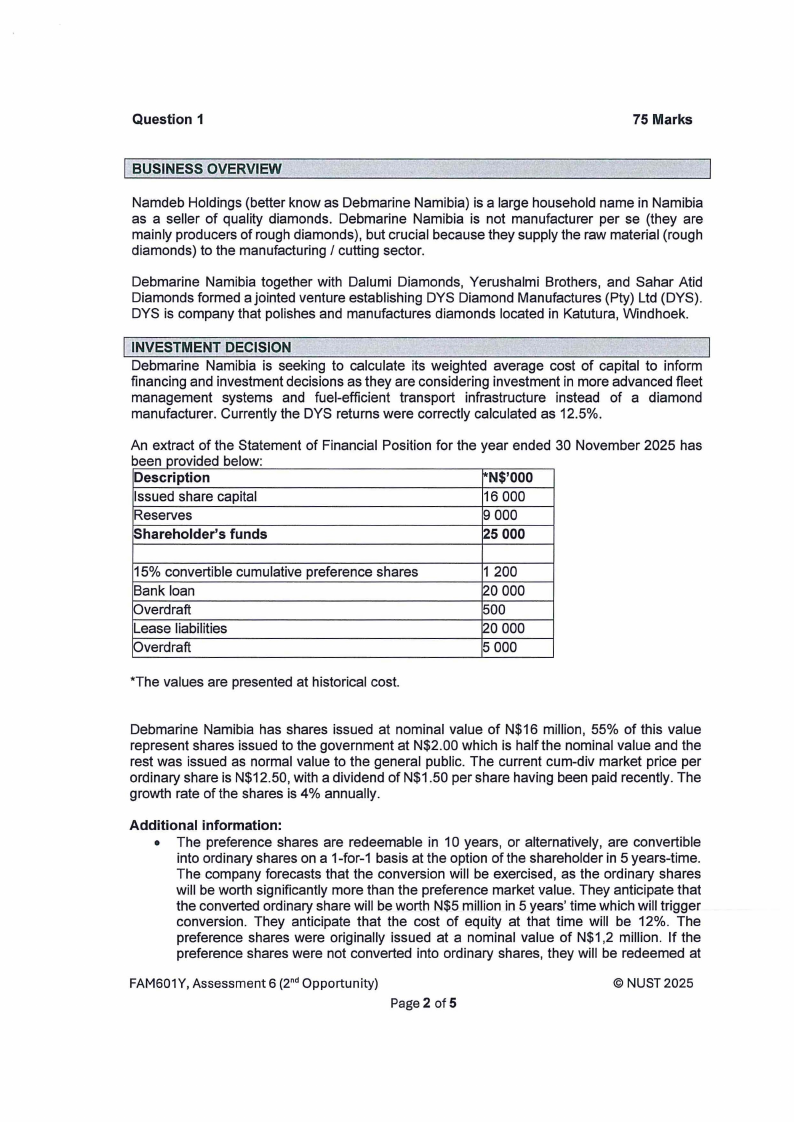
Debmarine Namibia is seeking to calculate its weighted average cost of capital to inform
financing and investment decisions as they are considering investment in more advanced fleet
management systems and fuel-efficient transport infrastructure instead of a diamond
manufacturer. Currently the DYS returns were correctly calculated as 12.5%.
An extract of the Statement of Financial Position for the year ended 30 November 2025 has
been provided below:
Description
*N$'000
Issued share capital
16 000
Reserves
9 000
Shareholder's funds
25 000
15% convertible cumulative preference shares
Bank loan
Overdraft
Lease liabilities
Overdraft
1 200
20 000
500
20 000
5 000
*The values are presented at historical cost.
Debmarine Namibia has shares issued at nominal value of N$16 million, 55% of this value
represent shares issued to the government at N$2.00 which is half the nominal value and the
rest was issued as normal value to the general public. The current cum-div market price per
ordinary share is N$12.50, with a dividend of N$1.50 per share having been paid recently. The
growth rate of the shares is 4% annually.
Additional information:
• The preference shares are redeemable in 10 years, or alternatively, are convertible
into ordinary shares on a 1-for-1 basis at the option of the shareholder in 5 years-time.
The company forecasts that the conversion will be exercised, as the ordinary shares
will be worth significantly more than the preference market value. They anticipate that
the converted ordinary share will be worth N$5 million in 5 years' time which will trigger
conversion. They anticipate that the cost of equity at that time will be 12%. The
preference shares were originally issued at a nominal value of N$1,2 million. If the
preference shares were not converted into ordinary shares, they will be redeemed at
FAM601Y, Assessment 6 (2nd Opportunity)
Page 2 of 5
© NUST2025
|
|
3 Page 3 |
▲back to top |
a premium of 10% over nominal value. Similar preference instruments are currently
demanding a return of 12% per annum.
• The bank loan bears interest at prime plus 3% per annum with this interest being
payable annually in arrears. The capital is repayable at a premium of 2% in 5 years'
time. The prime rate is currently 10.75%. The current market yield for a similar loan is
11 % per annum.
• The bank overdraft is used as short-term financing and interest is payable at 16% per
annum.
• The current company tax rate is 31 % per year.
• The long-term lease finance was a liability raised in terms of IFRS 16 on right-of-
use assets. The underlying assets are operating assets. The leases have a
remaining period of 5 years to run and will be replaced after maturing. The lease
includes annual payments of N$4 million in each of the 5 years, with a final bullet
payment of N$5 million at the end of the term. The market rate on these leases is
currently 4% per annum.
• Half of the accounts payable of the company considered to be spontaneous credit
with a total. The other half is considered to be long-term in nature, these creditors
do charge interest at 2% per annum and the accounts are always paid by the ninth
month.
I MANUFACTURING PROCESS
The manufacturing of diamond is split between two processes once the rough diamond is
received from Debmarine Namibia or any other diamond ore extractor.
Process 1: Cutting and Shaping
• Rough diamonds (raw material) are taken and cut into smaller pieces using lasers or
diamond saws.
• The stones are then shaped (e.g. round, oval, princess cut) to maximise brilliance and
minimise waste.
• Costs here: raw diamonds, cutting labour, machine depreciation, and consumables.
Process 2: Polishing and Finishing
• Shaped stones move to polishing wheels where facets are ground and polished to give
brilliance.
• Quality checks ensure symmetry, clarity, and shine.
• Costs here: skilled polishing labour, polishing equipment, and inspection costs.
At the end of Process 2, the finished diamonds are transferred to finished goods inventory.
Inventory is valued using weighted average method and at the end of 2025, DYS had the
below information from their accounting system in process 1.
The process is such that all materials are added at the beginning of the process and
conversion costs are incurred evenly throughout the process. Units are inspected when the
process is 80% complete and losses normally amount to 1% of the good units.
FAM601Y, Assessment 6 (2nd Opportunity)
Page 3 of 5
© NUST2025
|
|
4 Page 4 |
▲back to top |
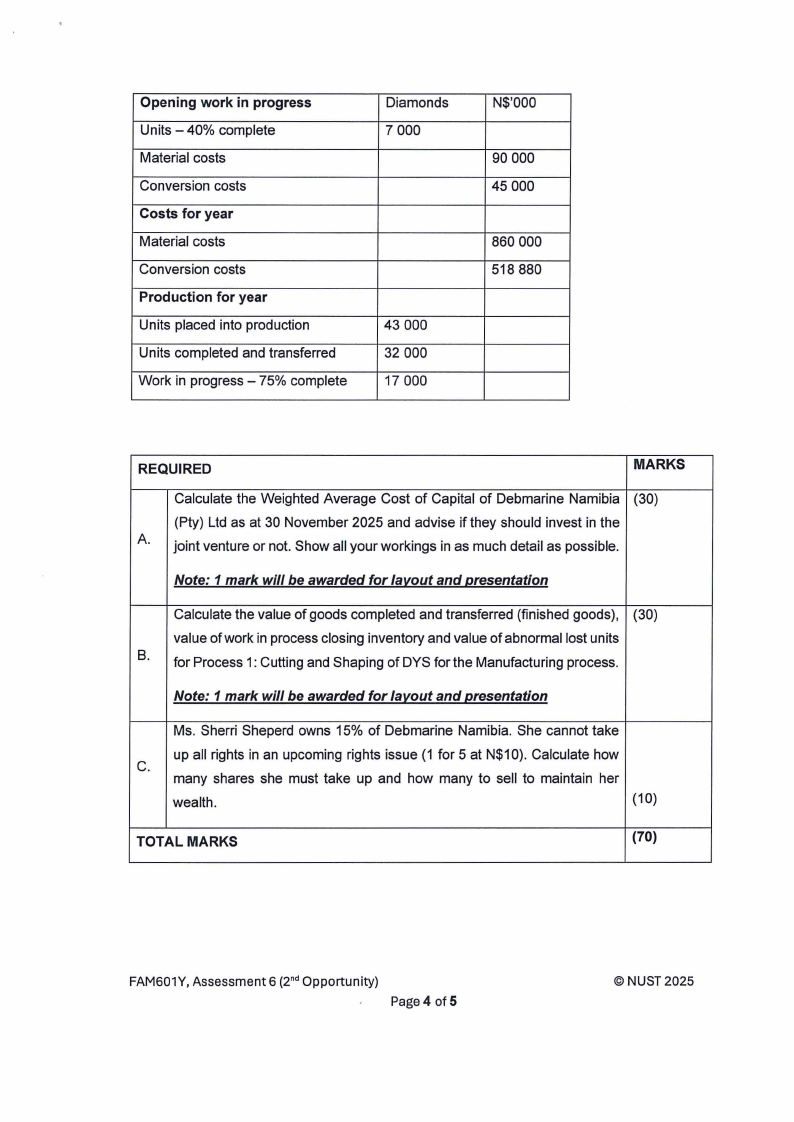
Opening work in progress
Units - 40% complete
Material costs
Conversion costs
Costs for year
Material costs
Conversion costs
Production for year
Units placed into production
Units completed and transferred
Work in progress - 75% complete
Diamonds
7 000
43 000
32 000
17 000
N$'000
90 000
45 000
860 000
518 880
REQUIRED
MARKS
Calculate the Weighted Average Cost of Capital of Debmarine Namibia (30)
(Pty) Ltd as at 30 November 2025 and advise if they should invest in the
A. joint venture or not. Show all your workings in as much detail as possible.
Note: 1 mark will be awarded for la'l.,out and 12.resentation
Calculate the value of goods completed and transferred (finished goods), (30)
value of work in process closing inventory and value of abnormal lost units
B. for Process 1: Cutting and Shaping of DYS for the Manufacturing process.
Note: 1 mark will be awarded for /a'f..OUt and 12.resentation
Ms. Sherri Sheperd owns 15% of Debmarine Namibia. She cannot take
up all rights in an upcoming rights issue (1 for 5 at N$10). Calculate how
C.
many shares she must take up and how many to sell to maintain her
wealth .
(10)
TOTAL MARKS
(70)
FAM601Y, Assessment 6 (2nd Opportunity)
Page 4 of 5
© NUST 2025
|
|
5 Page 5 |
▲back to top |
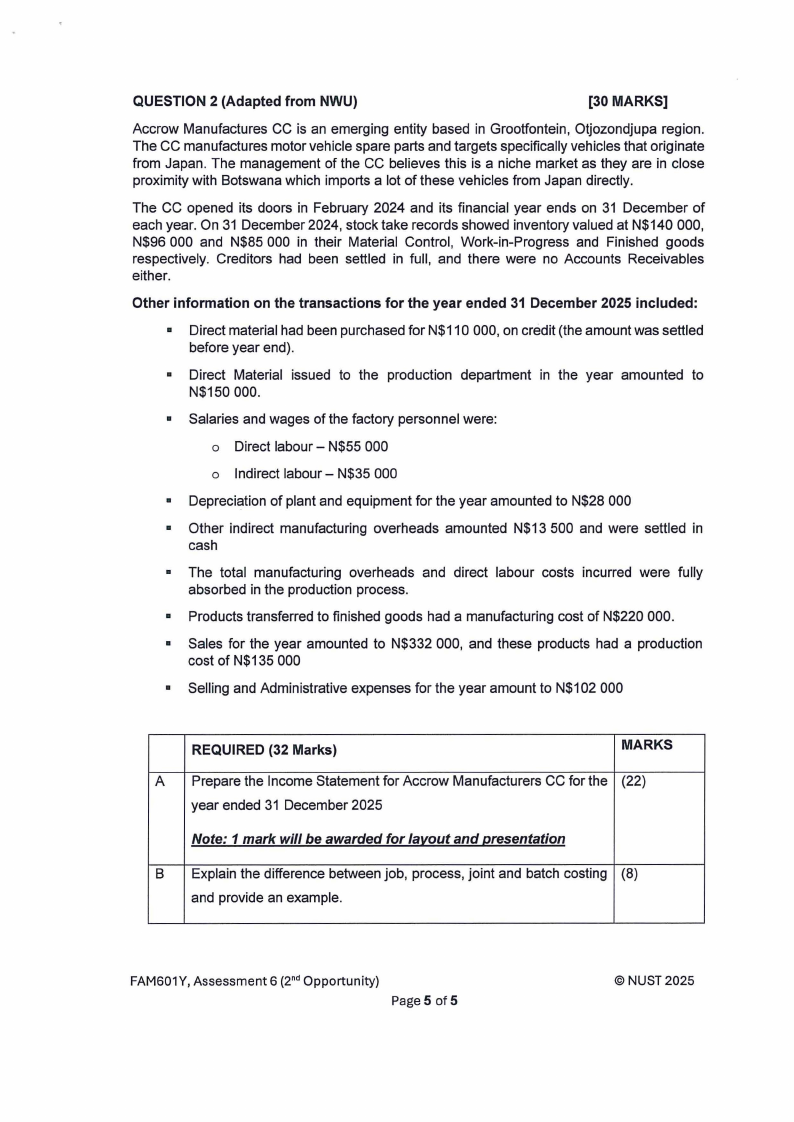
QUESTION 2 (Adapted from NWU)
[30 MARKS]
Accrow Manufactures CC is an emerging entity based in Grootfontein, Otjozondjupa region.
The CC manufactures motor vehicle spare parts and targets specifically vehicles that originate
from Japan. The management of the CC believes this is a niche market as they are in close
proximity with Botswana which imports a lot of these vehicles from Japan directly.
The CC opened its doors in February 2024 and its financial year ends on 31 December of
each year. On 31 December 2024, stock take records showed inventory valued at N$140 000,
N$96 000 and N$85 000 in their Material Control, Work-in-Progress and Finished goods
respectively. Creditors had been settled in full, and there were no Accounts Receivables
either.
Other information on the transactions for the year ended 31 December 2025 included:
■ Direct material had been purchased for N$110 000, on credit (the amount was settled
before year end).
■ Direct Material issued to the production department in the year amounted to
N$150 000.
■ Salaries and wages of the factory personnel were:
o Direct labour - N$55 000
o Indirect labour - N$35 000
■ Depreciation of plant and equipment for the year amounted to N$28 000
■ Other indirect manufacturing overheads amounted N$13 500 and were settled in
cash
■ The total manufacturing overheads and direct labour costs incurred were fully
absorbed in the production process.
■ Products transferred to finished goods had a manufacturing cost of N$220 000.
■ Sales for the year amounted to N$332 000, and these products had a production
cost of N$135 000
■ Selling and Administrative expenses for the year amount to N$102 000
REQUIRED (32 Marks)
MARKS
A Prepare the Income Statement for Accrow Manufacturers CC for the (22)
year ended 31 December 2025
Note: 1 mark will be awarded for lay,.out and ll,resentation
B Explain the difference between job, process, joint and batch costing (8)
and provide an example.
FAM601Y, Assessment 6 (2nd Opportunity)
Page 5 of 5
© NUST 2025