


 |
FAM601Y-FINANCIAL MANAGEMENT 200-1ST OPP-NOV 2025 |
|
|
1 Page 1 |
▲back to top |
'9
nAm I BI A un IVE RSITY
OF SCI En CE An □ TECHn OLOGY
FACULTY OF COMMERCE, HUMAN SCIENCES & EDUCATION
DEPARTMENT OF ECONOMICS, ACCOUNTING & FINANCE
QUALIFICATION: BACHELOR OF ACCOUNTING (CHARTERED ACCOUNTANCY)
QUALIFICATION CODE: 07BACC
LEVEL: 6
COURSE CODE: FAM601Y
COURSE NAME: FINANCIAL MANAGEMENT 200
SESSION: OCTOBER/NOVEMBER 2025
DURATION: 2 HOURS 20 MINUTES
PAPER: PRACTICAL AND THEORY
MARKS: 100
ASSESSMENT 6 - FIRST OPPORTUNITY EXAMINATIONS
EXAMINERS: Mr. Immanuel-King Kenaruzo
MODERATOR: Mr. Simeon Nghiwilepo
INSTRUCTIONS
• This question consists of two questions with five (5) required.
• Start each part of the required on a new page.
• Answer All the questions in blue or black ink.
• Show all your work on the answer sheet.
• The use of a pencil is not allowed.
• Questions relating to this paper may be raised in the initial 30 minutes after the start
of the paper. Thereafter, candidates must use their initiative to deal with any
perceived error or ambiguities and any assumption made by the candidate should be
clearly stated.
PERMISSIBLE MATERIALS
Non-programmable calculator/financial calculator
THIS QUESTION PAPER CONSISTS OF 8 PAGES (Including this front page)
FAM601 Y, Assessment 6 (1 sr Opportunity)
©NUST2025
1
|
|
2 Page 2 |
▲back to top |
Question 1
75 Marks
I BUSINESS OVERVIEW
NamPower, Namibia's national power utility, has for decades been a mainstay of the nation's
economy and is now positioned, in a free, independent and stable Namibia, to be a main driver
of Vision 2030, Namibia's blueprint for broad-based , sustainable economic growth.
NamPower's core business is the generation, transmission and energy trading, which takes
place within the Southern African Power Pool (SAPP) , the largest multilateral energy platform
on the African continent. NamPower supplies bulk electricity to Regional Electricity Distributors
(REDs), Mines, Farms and Local Authorities (where REDs are not operational) throughout
Namibia.
I CENORED
CENORED is the 3rd licensed regional electricity distribution company to be established in
Namibia, after NORED and Erongo RED in 2002 and 2004 respectively.
CE NORED license area covers the Otjozondjupa, part of Oshikoto and Omaheke and Kunene
regions and has a customer base of approximately 34,000 customers in its main supply area
(plus some 3,300 in the Omaheke Region and some 6,400 in Okahandja), ranging from large
power users to single-phase prepayment clients over an area of approximately 120 000 square
kilometres and 8 000 kilometres line infrastructure.
CENORED runs a coal-fired cogeneration (CHP) plant on the outskirts of Ruacana Waterfalls
(RW). The plant jointly produces:
• Electricity (sold into the grid), and
• Process steam (sold to nearby industrial clients).
• It also generates minor by-products (fly ash and gypsum) which are saleable.
Which are produced in three processes:
Process 1 - Fuel Preparation
At RW coal-fired cogeneration plant, the production process begins with fuel preparation .
Large consignments of raw coal are received, screened, crushed, and stored in silos before
being conveyed to the boiler bunkers. During this stage, normal handling losses such as dust
and moisture evaporation are expected of 2% of input with no scarp value. There is no opening
or closing inventory in any given month in this process.
Process 2 - Boiler & HP Steam Generation
• Prepared coal is burned to produce high-pressure (HP) steam
• Water treatment chemicals and demineralised water added; blowdown and
evaporation losses occur with normal loss as 5% of input and scrap value of N$40 per
tonne.
• Material and conversion cost both occur evenly throughout the process, with inspection
done when material & conversion are 50% complete.
FAM601Y, Assessment 6 (1 5r Opportunity)
2
© NUST2025
|
|
3 Page 3 |
▲back to top |
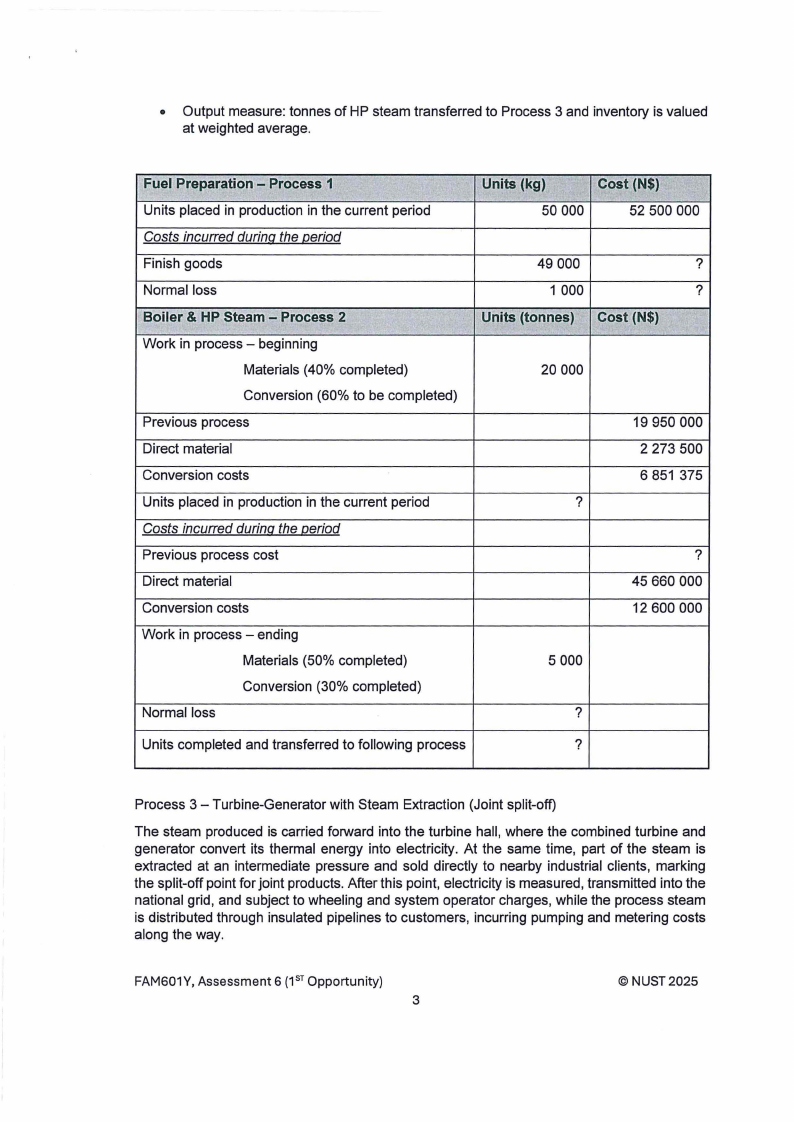
• Output measure: tonnes of HP steam transferred to Process 3 and inventory is valued
at weighted average.
Fuel Preparation - Process 1
Units placed in production in the current period
Costs incurred during the g_eriod
Finish goods
Normal loss
Boiler & HP Steam - Process 2
Work in process - beginning
Materials (40% completed)
Conversion (60% to be completed)
Previous process
Direct material
Conversion costs
Units placed in production in the current period
Costs incurred during the g_eriod
Previous process cost
Direct material
Conversion costs
Work in process - ending
Materials (50% completed)
Conversion (30% completed)
Normal loss
Units (kg)
Cost (N$)
50 000
52 500 000
49 000
?
1 000
?
Units (tonnes) Cost (N$)
20 000
19 950 000
2 273 500
6 851 375
?
?
45 660 000
12 600 000
5 000
?
Units completed and transferred to following process
?
Process 3 - Turbine-Generator with Steam Extraction (Joint split-off)
The steam produced is carried forward into the turbine hall, where the combined turbine and
generator convert its thermal energy into electricity. At the same time, part of the steam is
extracted at an intermediate pressure and sold directly to nearby industrial clients, marking
the split-off point for joint products. After this point, electricity is measured, transmitted into the
national grid, and subject to wheeling and system operator charges, while the process steam
is distributed through insulated pipelines to customers, incurring pumping and metering costs
along the way.
FAM601Y, Assessment 6 (1 5r Opportunity)
3
© NUST 2025
|
|
4 Page 4 |
▲back to top |
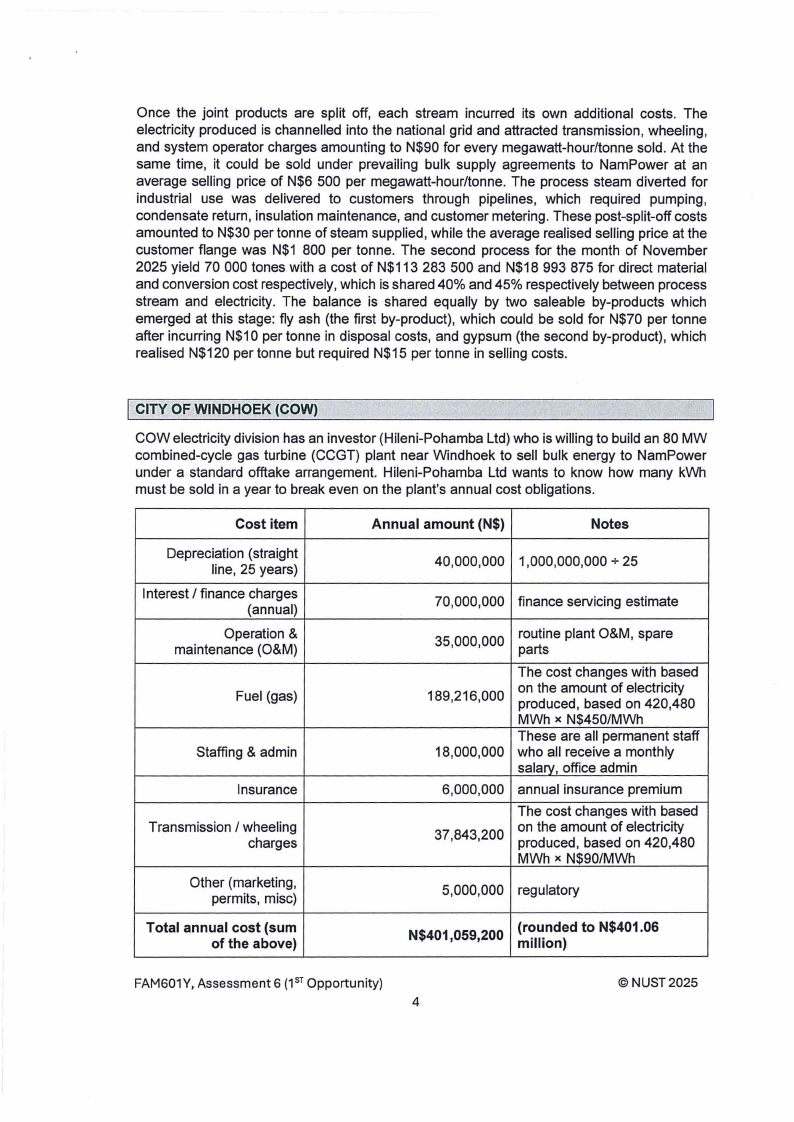
Once the joint products are split off, each stream incurred its own additional costs. The
electricity produced is channelled into the national grid and attracted transmission, wheeling,
and system operator charges amounting to N$90 for every megawatt-hour/tonne sold. At the
same time, it could be sold under prevailing bulk supply agreements to NamPower at an
average selling price of N$6 500 per megawatt-hour/tonne. The process steam diverted for
industrial use was delivered to customers through pipelines, which required pumping ,
condensate return, insulation maintenance, and customer metering. These post-split-off costs
amounted to N$30 per tonne of steam supplied , while the average realised selling price at the
customer flange was N$1 800 per tonne. The second process for the month of November
2025 yield 70 000 tones with a cost of N$113 283 500 and N$18 993 875 for direct material
and conversion cost respectively, which is shared 40% and 45% respectively between process
stream and electricity. The balance is shared equally by two saleable by-products which
emerged at this stage: fly ash (the first by-product), which could be sold for N$70 per tonne
after incurring N$10 per tonne in disposal costs, and gypsum (the second by-product), which
realised N$120 per tonne but required N$15 per tonne in selling costs.
I CITY OF WINDHOEK (COW)
COW electricity division has an investor (Hileni-Pohamba Ltd) who is willing to build an 80 MW
combined-cycle gas turbine (CCGT) plant near Windhoek to sell bulk energy to NamPower
under a standard offtake arrangement. Hileni-Pohamba Ltd wants to know how many kWh
must be sold in a year to break even on the plant's annual cost obligations.
Cost item
Depreciation (straight
line, 25 years)
Interest I finance charges
(annual)
Operation &
maintenance (O&M)
Fuel (gas)
Staffing & admin
Insurance
Transmission / wheeling
charges
Other (marketing ,
permits, misc)
Total annual cost (sum
of the above)
Annual amount (N$)
Notes
40,000,000 1,000,000,000 + 25
70,000,000 finance servicing estimate
35,000,000
routine plant O&M, spare
parts
189,216,000
18,000,000
The cost changes with based
on the amount of electricity
produced , based on 420,480
MWh x N$450/MWh
These are all permanent staff
who all receive a monthly
salary, office admin
6,000,000 annual insurance premium
37,843,200
The cost changes with based
on the amount of electricity
produced , based on 420,480
MWh x N$90/MWh
5,000,000 regulatory
N$401,059,200
(rounded to N$401.06
million)
FAM601Y, Assessment 6 (1 5r Opportunity)
4
©NUST2025
|
|
5 Page 5 |
▲back to top |
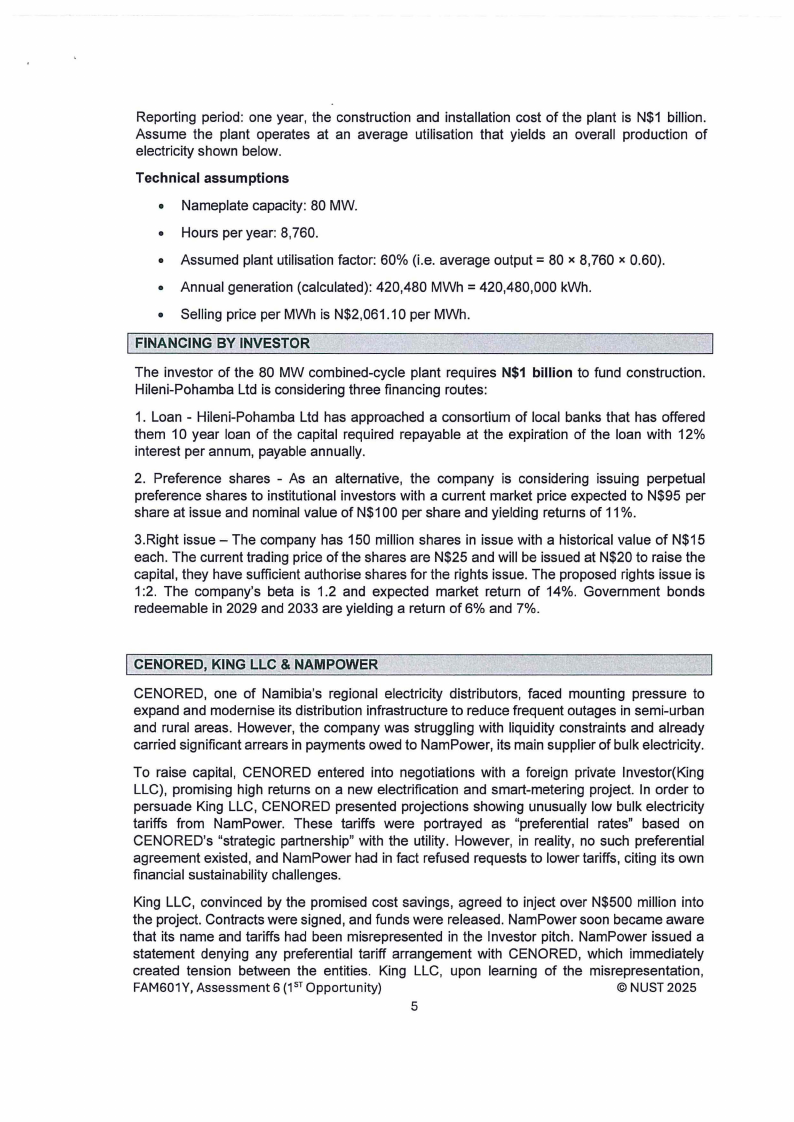
Reporting period : one year, the construction and installation cost of the plant is N$1 billion.
Assume the plant operates at an average utilisation that yields an overall production of
electricity shown below.
Technical assumptions
• Nameplate capacity: 80 MW.
• Hours per year: 8,760.
• Assumed plant utilisation factor: 60% (i.e. average output = 80 x 8,760 x 0.60).
• Annual generation (calculated): 420,480 MWh = 420,480,000 kWh.
• Selling price per MWh is N$2,061.10 per MWh.
I FINANCING BY INVESTOR
The investor of the 80 MW combined-cycle plant requires N$1 billion to fund construction.
Hileni-Pohamba Ltd is considering three financing routes:
1. Loan - Hileni-Pohamba Ltd has approached a consortium of local banks that has offered
them 10 year loan of the capital required repayable at the expiration of the loan with 12%
interest per annum, payable annually.
2. Preference shares - As an alternative, the company is considering issuing perpetual
preference shares to institutional investors with a current market price expected to N$95 per
share at issue and nominal value of N$100 per share and yielding returns of 11 %.
3.Right issue -The company has 150 million shares in issue with a historical value of N$15
each . The current trading price of the shares are N$25 and will be issued at N$20 to raise the
capital, they have sufficient authorise shares for the rights issue. The proposed rights issue is
1:2. The company's beta is 1.2 and expected market return of 14%. Government bonds
redeemable in 2029 and 2033 are yielding a return of 6% and 7%.
I CENORED, KING LLC & NAMPOWER
CENORED, one of Namibia's reg ional electricity distributors, faced mounting pressure to
expand and modernise its distribution infrastructure to reduce frequent outages in semi-urban
and rural areas. However, the company was struggling with liquidity constraints and already
carried significant arrears in payments owed to NamPower, its main supplier of bulk electricity.
To raise capital, CENORED entered into negotiations with a foreign private lnvestor(King
LLC), promising high returns on a new electrification and smart-metering project. In order to
persuade King LLC , CENORED presented projections showing unusually low bulk electricity
tariffs from NamPower. These tariffs were portrayed as "preferential rates" based on
CENORED's "strategic partnership" with the utility. However, in reality, no such preferential
agreement existed, and NamPower had in fact refused requests to lower tariffs, citing its own
financial sustainability challenges.
King LLC, convinced by the promised cost savings, agreed to inject over N$500 million into
the project. Contracts were signed , and funds were released. NamPower soon became aware
that its name and tariffs had been misrepresented in the Investor pitch. NamPower issued a
statement denying any preferential tariff arrangement with CENORED, which immediately
created tension between the entities. King LLC, upon learning of the misrepresentation,
FAM601Y, Assessment 6 (1 5r Opportunity)
© NUST 2025
5
|
|
6 Page 6 |
▲back to top |
threatened legal action but was locked into the financing agreement, exposing them to
potential losses.
At the same time, CENORED continued to enjoy the benefits of the financing and proceeded
with partial implementation of the project. In the· background, communities served by
CENORED began to worry that if the project failed or costs escalated, electricity tariffs might
increase further to cover losses. Local employees at CENORED also expressed discomfort,
as some had been asked to prepare promotional materials for the Investor that they knew
were misleading.
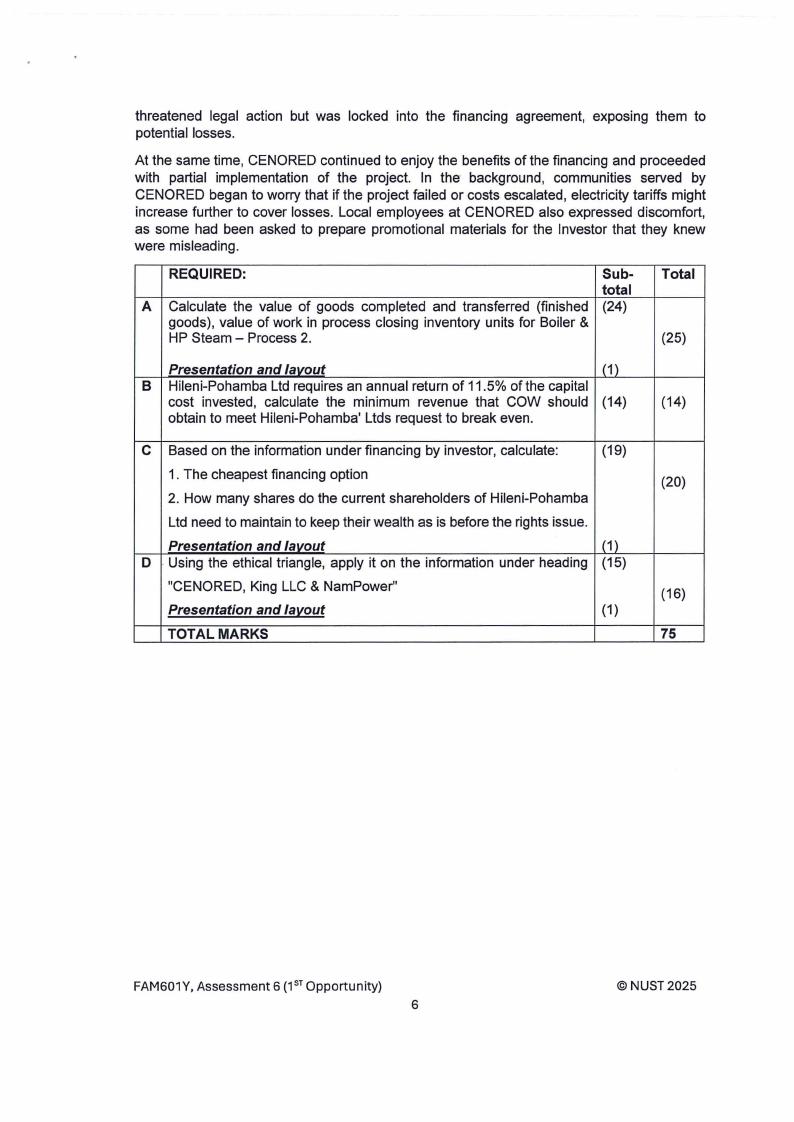
REQUIRED:
Sub-
total
A Calculate the value of goods completed and transferred (finished (24)
goods), value of work in process closing inventory units for Boiler &
HP Steam - Process 2.
Total
(25)
Presentation and lavout
(1)
B Hileni-Pohamba Ltd requires an annual return of 11 .5% of the capital
cost invested, calculate the minimum revenue that COW should (14) (14)
obtain to meet Hileni-Pohamba' Ltds request to break even.
C Based on the information under financing by investor, calculate:
(19)
1. The cheapest financing option
(20)
2. How many shares do the current shareholders of Hileni-Pohamba
Ltd need to maintain to keep their wealth as is before the rights issue.
Presentation and lavout
(1)
D . Using the ethical triangle, apply it on the information under heading (15)
"CENORED, King LLC & NamPower"
Presentation and la'i,OUt
(16)
(1)
TOTAL MARKS
75
FAM601Y, Assessment 6 (1 51 Opportunity)
6
© NUST2025
|
|
7 Page 7 |
▲back to top |
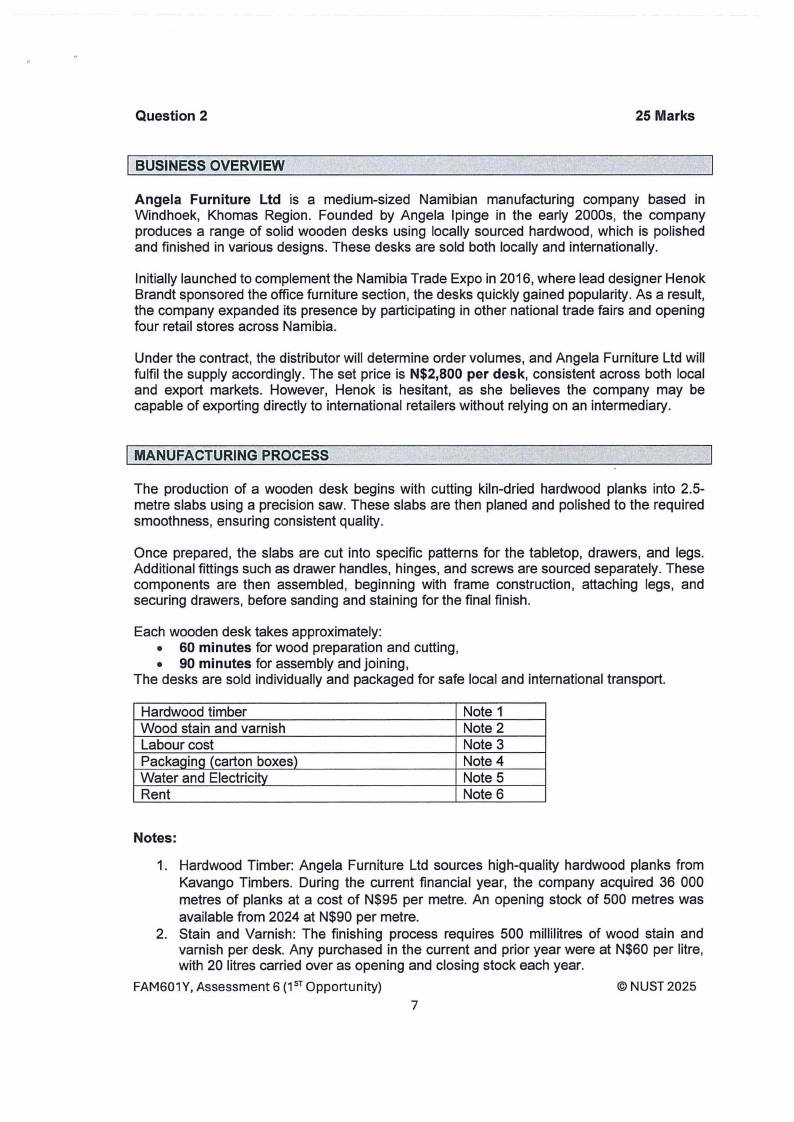
Question 2
25 Marks
I BUSINESS OVERVIEW
Angela Furniture Ltd is a medium-sized Namibian manufacturing company based in
Windhoek, Khomas Region. Founded by Angela lpinge in the early 2000s, the company
produces a range of solid wooden desks using locally sourced hardwood, which is polished
and finished in various designs. These desks are sold both locally and internationally.
Initially launched to complement the Namibia Trade Expo in 2016, where lead designer Henok
Brandt sponsored the office furniture section, the desks quickly gained popularity. As a result,
the company expanded its presence by participating in other national trade fairs and opening
four retail stores across Namibia.
Under the contract, the distributor will determine order volumes, and Angela Furniture Ltd will
fulfil the supply accordingly. The set price is N$2,800 per desk, consistent across both local
and export markets. However, Henok is hesitant, as she believes the company may be
capable of exporting directly to international retailers without relying on an intermediary.
I MANUFACTURING PROCESS
The production of a wooden desk begins with cutting kiln-dried hardwood planks into 2.5-
metre slabs using a precision saw. These slabs are then planed and polished to the required
smoothness, ensuring consistent quality.
Once prepared , the slabs are cut into specific patterns for the tabletop, drawers, and legs.
Additional fittings such as drawer handles, hinges, and screws are sourced separately. These
components are then assembled, beginning with frame construction , attaching legs, and
securing drawers, before sanding and staining for the final finish.
Each wooden desk takes approximately:
• 60 minutes for wood preparation and cutting,
• 90 minutes for assembly and joining,
The desks are sold individually and packaged for safe local and international transport.
Hardwood timber
Wood stain and varnish
Labour cost
Packaqinq (carton boxes)
Water and Electricity
Rent
Note 1
Note 2
Note 3
Note4
Note 5
Note 6
Notes:
1. Hardwood Timber: Angela Furniture Ltd sources high-quality hardwood planks from
Kavango Timbers. During the current financial year, the company acquired 36 000
metres of planks at a cost of N$95 per metre. An opening stock of 500 metres was
available from 2024 at N$90 per metre.
2. Stain and Varnish: The finishing process requires 500 millilitres of wood stain and
varnish per desk. Any purchased in the current and prior year were at N$60 per litre,
with 20 litres carried over as opening and closing stock each year.
FAM601Y, Assessment 6 (1 5r Opportunity)
©NUST2025
7
|
|
8 Page 8 |
▲back to top |
'<
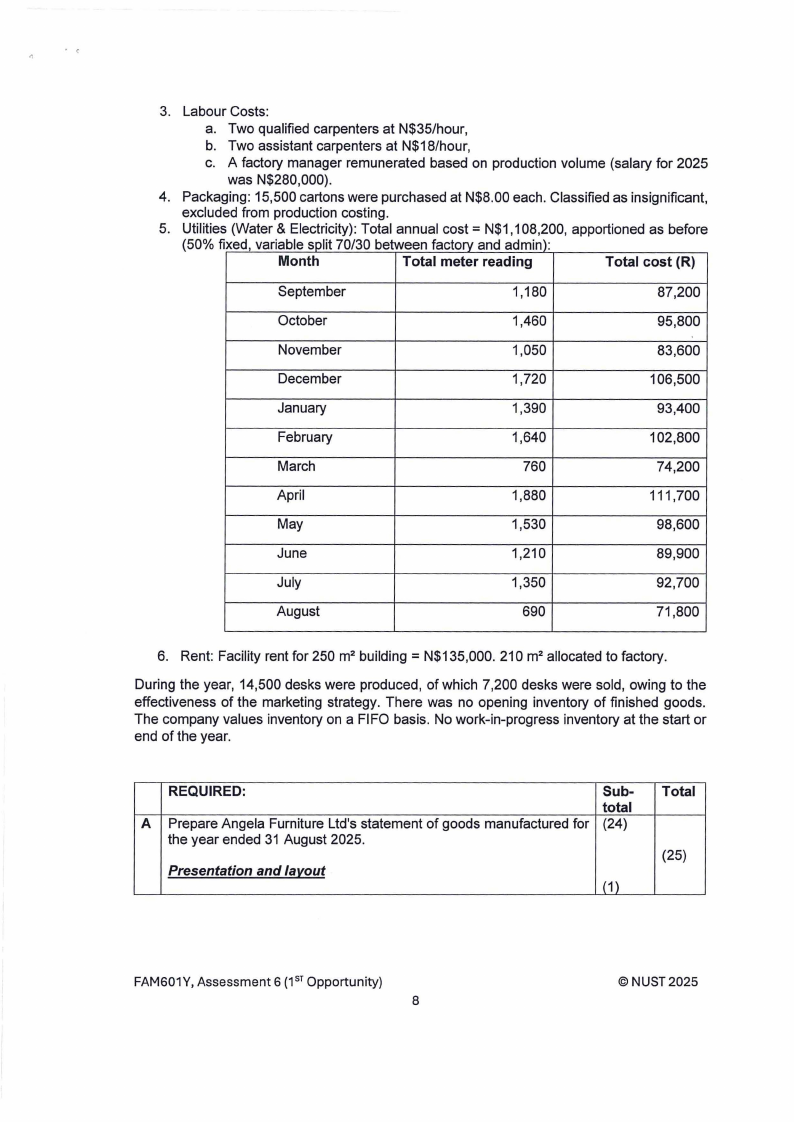
3. Labour Costs:
a. Two qualified carpenters at N$35/hour,
b. Two assistant carpenters at N$18/hour,
c. A factory manager remunerated based on production volume (salary for 2025
was N$280,000).
4. Packaging : 15,500 cartons were purchased at N$8.00 each. Classified as insignificant,
excluded from production costing.
5. Utilities (Water & Electricity): Total annual cost= N$1, 108,200, apportioned as before
(50% fixed , variable split 70/30 between factorv and admin):
Month
Total meter reading
Total cost {R)
September
1,180
87,200
October
1,460
95,800
November
1,050
83,600
December
1,720
106,500
January
1,390
93,400
February
1,640
102,800
March
760
74,200
April
1,880
111 ,700
May
1,530
98,600
June
1,210
89,900
July
1,350
92,700
August
690
71 ,800
6. Rent: Facility rent for 250 m2 building= N$135,000. 210 m2 allocated to factory.
During the year, 14,500 desks were produced, of which 7,200 desks were sold, owing to the
effectiveness of the marketing strategy. There was no opening inventory of finished goods.
The company values inventory on a FIFO basis . No work-in-progress inventory at the start or
end of the year.
REQUIRED:
Sub-
total
A Prepare Angela Furniture Ltd's statement of goods manufactured for (24)
the year ended 31 August 2025.
Presentation and layout
(1)
Total
(25)
FAM601 Y, Assessment 6 (1 sr Opportunity)
8
© NUST2025