


 |
PWR611S - PROFESSIONAL WRITING - 1ST OPP - NOVEMBER 2025 |
|
|
1 Page 1 |
▲back to top |
r
n Am I BI A u n IVE RS ITV
OF SCIEnCE Ano TECHnOLOGY
FACULTY OF COMMERCE, HUMAN SCIENCES AND EDUCATION
DEPARTMENT OF COMMUNICATION AND LANGUAGES
QUALIFICATION: ALL
QUALIFICATION CODE: VARIOUS MODE: DISTANCE ONLY
COURSE CODE: PWR611S
COURSE NAME: PROFESSIONAL WRITING
SESSION: NOVEMBER 2025
DURATION: 3 HOURS
PAPER:1
MARKS: 100
EXAMINER:
15r OPPORTUNITY EXAMINATION QUESTION PAPER
DR. T. FRANS
MODERATOR: MS.K. DU PLESSIS
INSTRUCTIONS
1. Answer ALL the questions
2. Read all questions carefully before answering.
3. Number answers according to the numbering structure provided in the question
paper.
4. WRITE CLEARLY AND NEATLY
THIS QUESTION PAPER CONSISTS OF 5 PAGES (lncluding:this front page)
|
|
2 Page 2 |
▲back to top |
r
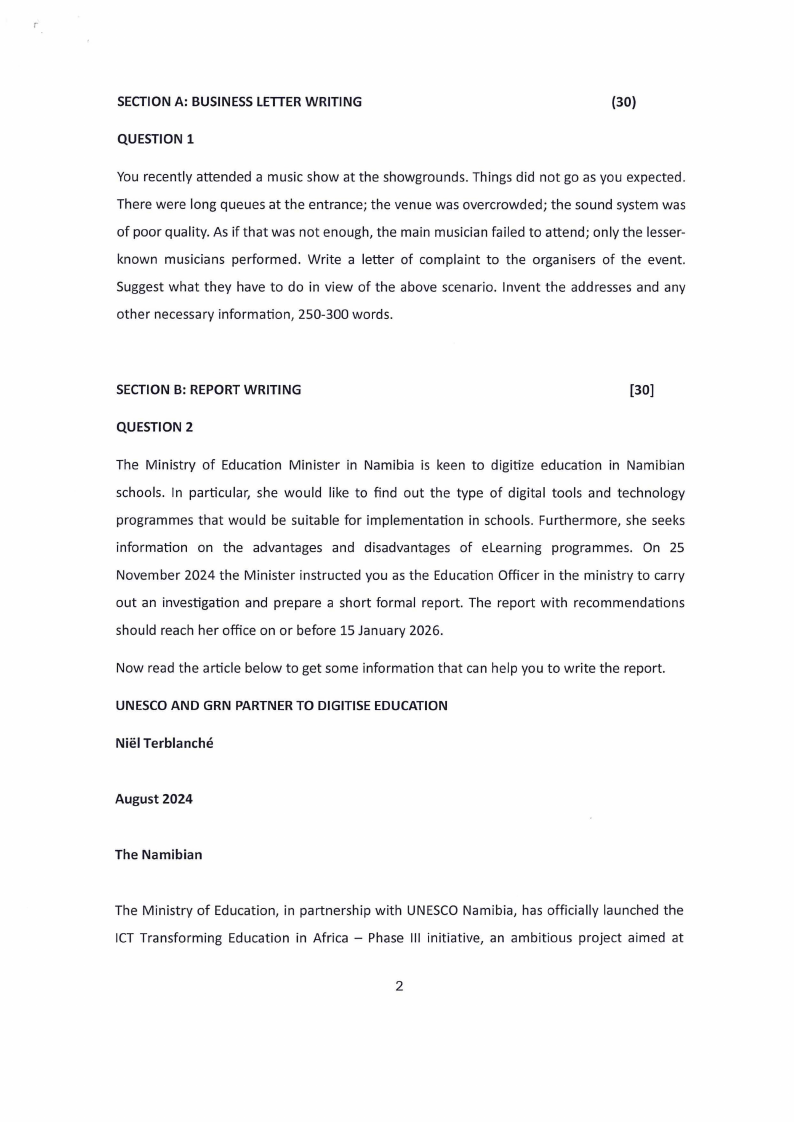
SECTION A: BUSINESS LETTER WRITING
{30)
QUESTION 1
You recently attended a music show at the showgrounds. Things did not go as you expected .
There were long queues at the entrance; the venue was overcrowded; the sound system was
of poor quality. As if that was not enough, the main musician failed to attend; only the lesser-
known musicians performed. Write a letter of complaint to the organisers of the event.
Suggest what they have to do in view of the above scenario. Invent the addresses and any
other necessary information, 250-300 words .
SECTION B: REPORT WRITING
[30]
QUESTION 2
The Ministry of Education Minister in Namibia is keen to digitize education in Namibian
schools. In particular, she would like to find out the type of digital tools and technology
programmes that would be suitable for implementation in schools. Furthermore, she seeks
information on the advantages and disadvantages of elearning programmes. On 25
November 2024 the Minister instructed you as the Education Officer in the ministry to carry
out an investigation and prepare a short formal report. The report with recommendations
should reach her office on or before 15 January 2026.
Now read the article below to get some information that can help you to write the report.
UNESCO AND GRN PARTNER TO DIGITISE EDUCATION
Niel Terblanche
August 2024
The Namibian
The Ministry of Education, in partnership with UNESCO Namibia, has officially launched the
ICT Transforming Education in Africa - Phase Ill initiative, an ambitious project aimed at
2
|
|
3 Page 3 |
▲back to top |
r
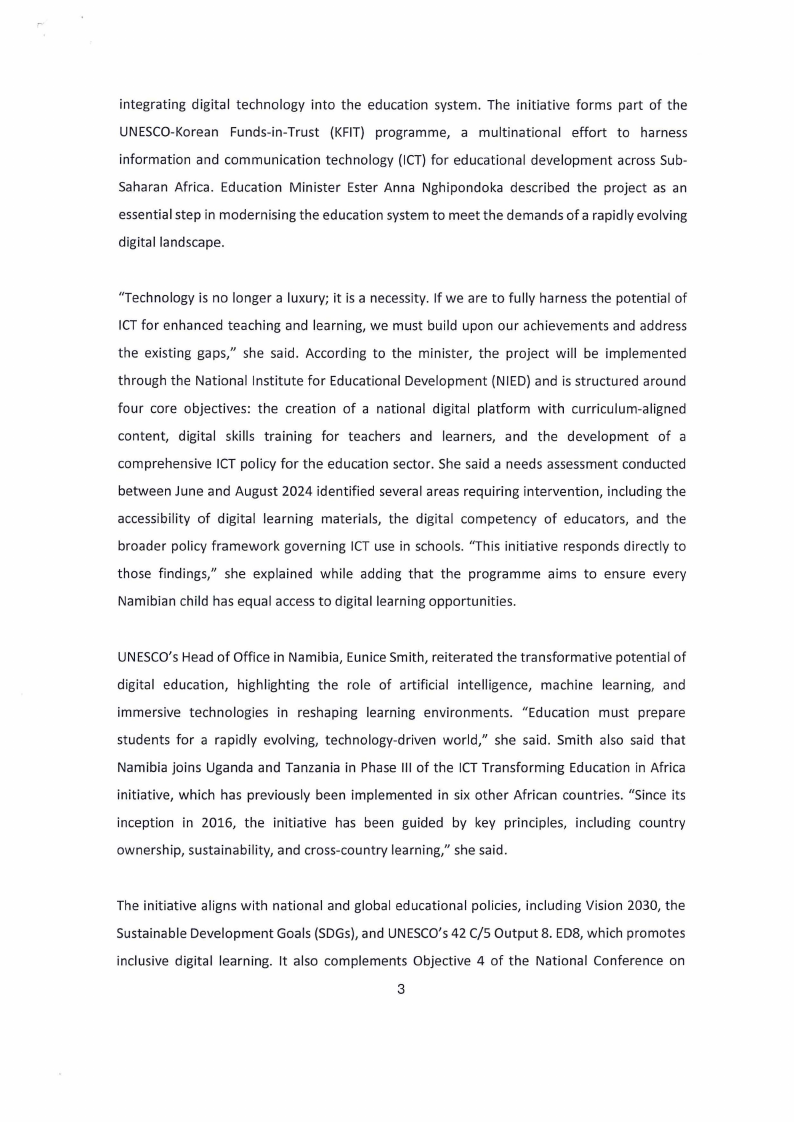
integrating digital technology into the education system. The initiative forms part of the
UNESCO-Korean Funds-in-Trust {KFIT) programme, a multinational effort to harness
information and communication technology {ICT) for educational development across Sub-
Saharan Africa . Education Minister Ester Anna Nghipondoka described the project as an
essential step in modernising the education system to meet the demands of a rapidly evolving
digital landscape.
"Technology is no longer a luxury; it is a necessity. If we are to fully harness the potential of
ICT for enhanced teaching and learning, we must build upon our achievements and address
the existing gaps," she said. According to the minister, the project w ill be implemented
through the National Institute for Educational Development {NIED) and is structured around
four core objectives : the creation of a national digital platform with curriculum-aligned
content, digital skills training for teachers and learners, and the development of a
comprehensive ICT policy for the education sector. She said a needs assessment conducted
between June and August 2024 identified several areas requiring intervention, including the
accessibility of digital learning materials, the digital competency of educators, and the
broader policy framework governing ICT use in schools. "This initiative responds directly to
those findings," she explained while adding that the programme aims to ensure every
Namibian chi ld has equal access to digital learning opportunities.
UNESCO's Head of Office in Namibia, Eunice Smith, reiterated the transformative potential of
digital education, highlighting the role of artificial intelligence, machine learning, and
immersive technologies in reshaping learning environments. "Education must prepare
students for a rapidly evolving, technology-driven world," she said. Smith also said that
Namibia joins Uganda and Tanzania in Phase Ill of the ICT Transforming Education in Africa
initiative, which has previously been implemented in six other African countries . "Since its
inception in 2016, the initiative has been guided by key principles, including country
ownership, sustainability, and cross-country learning," she said.
The initiative aligns with national and global educational policies, including Vision 2030, the
Sustainable Development Goals {SDGs), and UNESCO's 42 C/5 Output 8. ED8, which promotes
inclusive digital learning. It also complements Objective 4 of the National Conference on
3
|
|
4 Page 4 |
▲back to top |
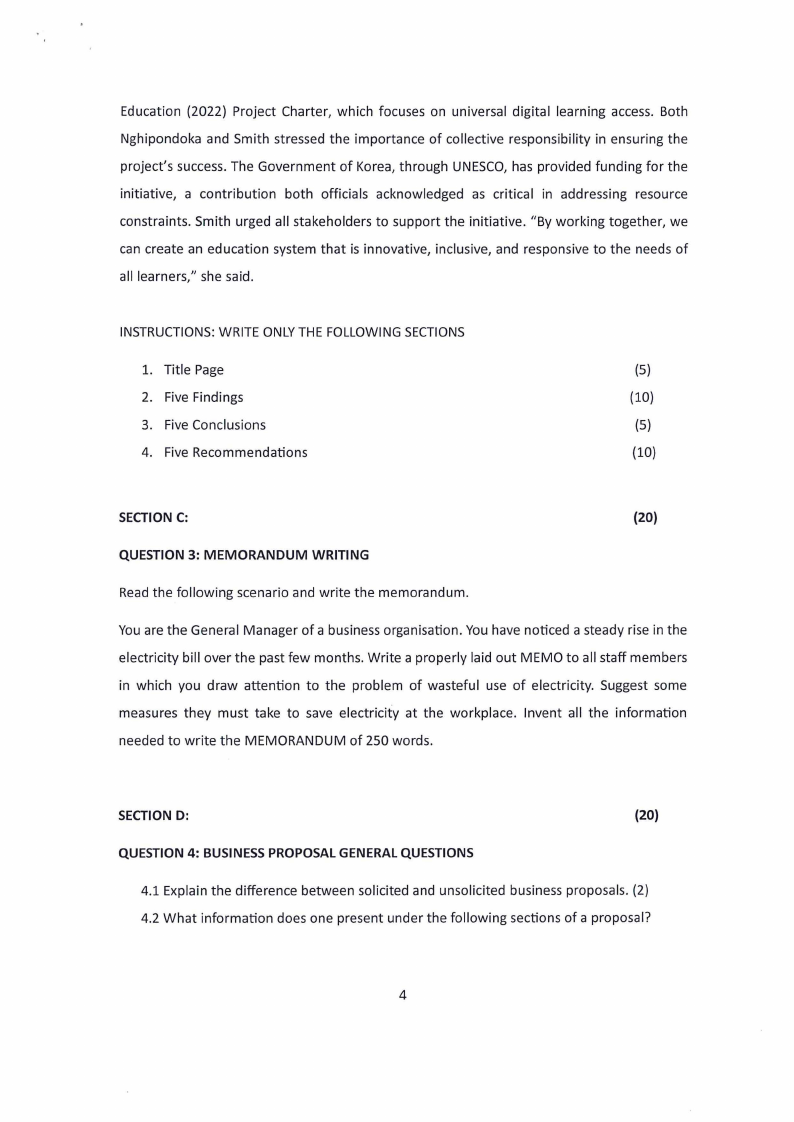
Education {2022) Project Charter, which focuses on universal digital learning access. Both
Nghipondoka and Smith stressed the importance of collective responsibility in ensuring the
project's success. The Government of Korea, through UNESCO, has provided funding for the
initiative, a contribution both officials acknowledged as critical in addressing resource
constraints . Smith urged all stakeholders to support the initiative. "By working together, we
can create an education system that is innovative, inclusive, and responsive to the needs of
all learners," she said.
INSTRUCTIONS: WRITE ONLY THE FOLLOWING SECTIONS
1. Title Page
(5)
2. Five Findings
{10)
3. Five Conclusions
(5)
4. Five Recommendations
{10)
SECTION C:
(20)
QUESTION 3: MEMORANDUM WRITING
Read the following scenario and write the memorandum .
You are the General Manager of a business organisation. You have noticed a steady rise in the
electricity bill over the past few months. Write a properly laid out MEMO to all staff members
in which you draw attention to the problem of wasteful use of electricity. Suggest some
measures they must take to save electricity at the workplace. Invent all the information
needed to write the MEMORANDUM of 250 words.
SECTION D:
(20)
QUESTION 4: BUSINESS PROPOSAL GENERAL QUESTIONS
4.1 Explain the difference between solicited and unsolicited business proposals. {2)
4.2 What information does one present under the following sections of a proposal?
4
|
|
5 Page 5 |
▲back to top |
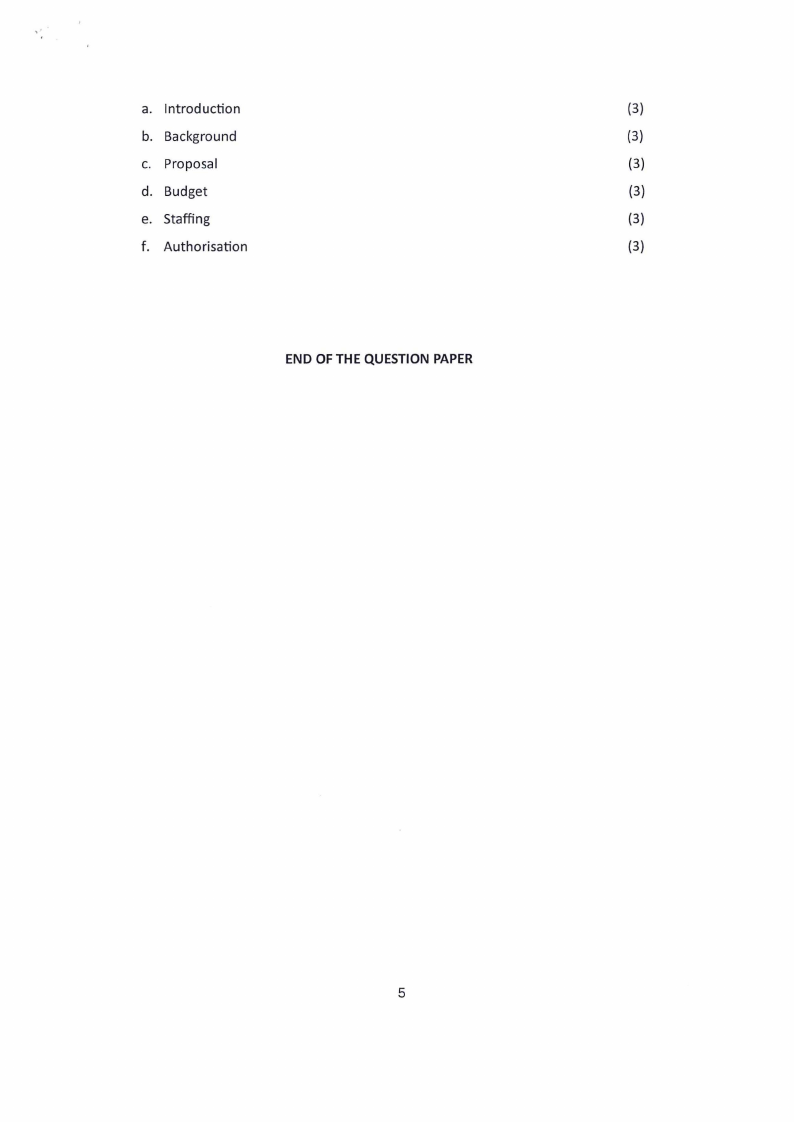
a. Introduction
(3)
b. Background
(3)
C. Proposal
(3)
d. Budget
(3)
e. Staffing
(3)
f. Authorisation
(3)
END OF THE QUESTION PAPER
5