|
GRS811S-GIS AND REMOTE SENSING IN PRACTICE -1ST OPP- JUNE 2025 |
|
|
1 Page 1 |
▲back to top |
nAmlBIA unlVERSITY
OF SCIEnCE Ano TECHnOLOGY
FACULTY OF HEALTH, NATURAL RESOURCESAND APPLIED SCIENCES
SCHOOLOF AGRICULTUREAND NATURALRESOURCESCIENCES
DEPARTMENT OF NATURALRESOURCESSCIENCES
QUALIFICATION: BACHELOROF NATURAL RESOURCESMANAGEMENT HONOURS
QUALIFICATION CODE: 08BNRH
COURSECODE: GRS811S
LEVEL: 8
COURSENAME: GIS AND REMOTE SENSING IN
PRACTICE
DATE:JUNE 2025
DURATION: 3 HOURS
MARKS: 120
FIRST OPPORTUNITY EXAMINATION QUESTION PAPER
EXAMINER(S) Prof. Vera De Cauwer
MODERATOR: Ms. Foibe Nelao Johannes
INSTRUCTIONS
1. Answer ALL the questions.
2. Write clearly and neatly.
3. Number the answers clearly.
PERMISSIBLEMATERIALS
1. Calculator
THIS QUESTION PAPERCONSISTSOF 4 PAGES(Excluding this front page}
|
|
2 Page 2 |
▲back to top |
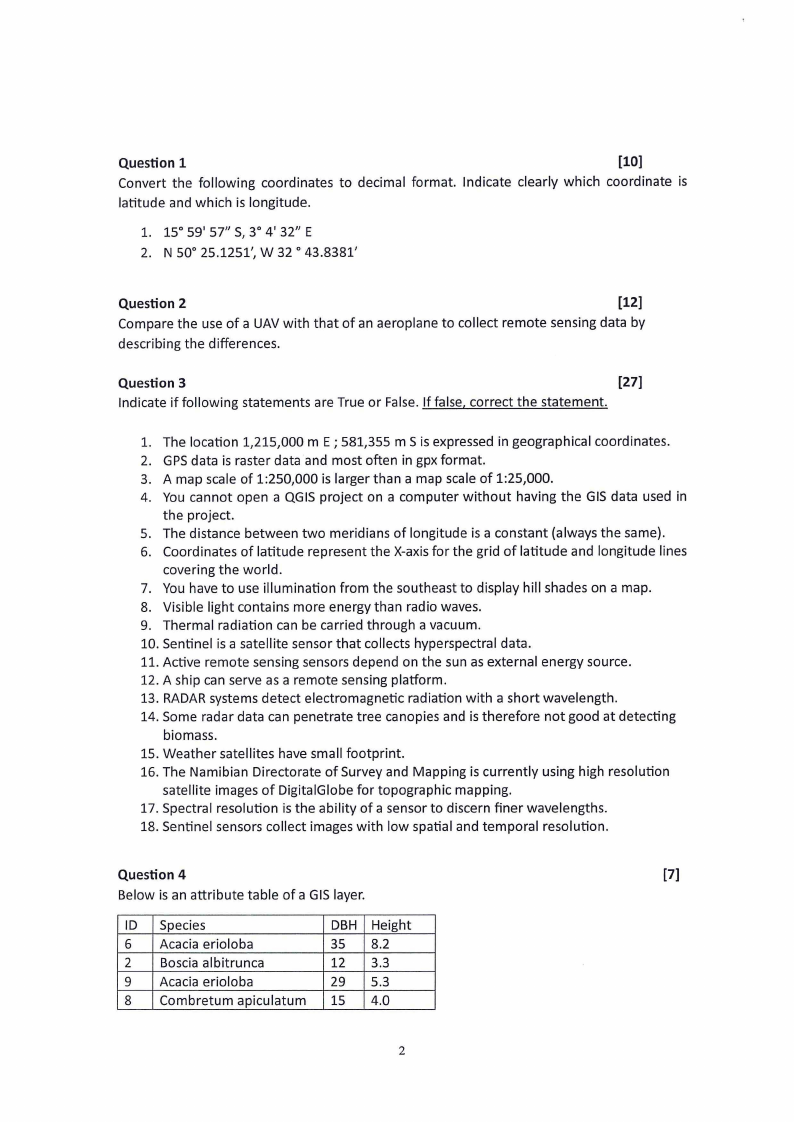
Question 1
(10)
Convert the following coordinates to decimal format. Indicate clearly which coordinate is
latitude and which is longitude.
1. 15° 59' 57" S, 3° 4' 32" E
2. N 50° 25.1251', W 32 ° 43.8381'
Question 2
(12)
Compare the use of a UAV with that of an aeroplane to collect remote sensing data by
describing the differences.
Question 3
(27)
Indicate if following statements are True or False. If false, correct the statement.
1. The location 1,215,000 m E; 581,355 m Sis expressed in geographical coordinates.
2. GPSdata is raster data and most often in gpx format.
3. A map scale of 1:250,000 is larger than a map scale of 1:25,000.
4. You cannot open a QGIS project on a computer without having the GIS data used in
the project.
5. The distance between two meridians of longitude is a constant (always the same).
6. Coordinates of latitude represent the X-axis for the grid of latitude and longitude lines
covering the world.
7. You have to use illumination from the southeast to display hill shades on a map.
8. Visible light contains more energy than radio waves.
9. Thermal radiation can be carried through a vacuum.
10. Sentinel is a satellite sensor that collects hyperspectral data.
11. Active remote sensing sensors depend on the sun as external energy source.
12. A ship can serve as a remote sensing platform.
13. RADARsystems detect electromagnetic radiation with a short wavelength.
14. Some radar data can penetrate tree canopies and is therefore not good at detecting
biomass.
15. Weather satellites have small footprint.
16. The Namibian Directorate of Survey and Mapping is currently using high resolution
satellite images of DigitalGlobe for topographic mapping.
17. Spectral resolution is the ability of a sensor to discern finer wavelengths.
18. Sentinel sensors collect images with low spatial and temporal resolution.
Question 4
(7)
Below is an attribute table of a GIS layer.
ID Species
6 Acacia erioloba
2 Boscia albitrunca
9 Acacia erioloba
8 Combretum apiculatum
DBH
35
12
29
15
Height
8.2
3.3
5.3
4.0
2
|
|
3 Page 3 |
▲back to top |
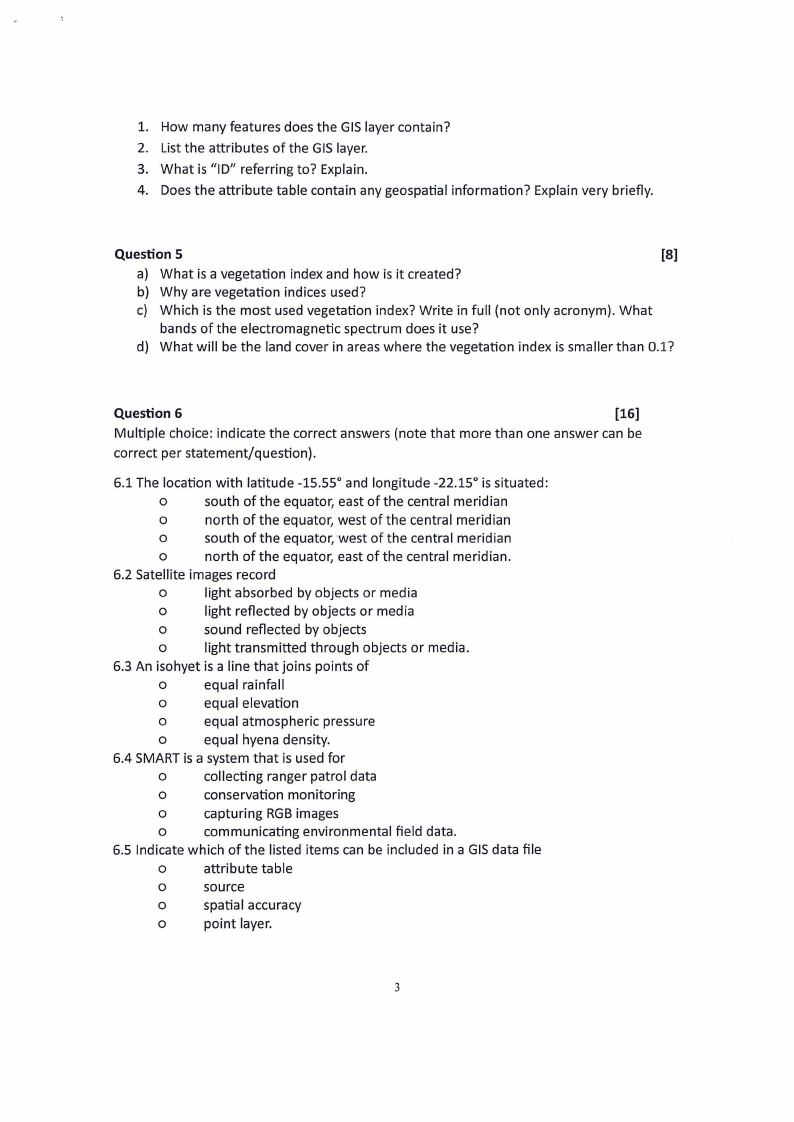
1. How many features does the GISlayer contain?
2. List the attributes of the GIS layer.
3. What is "ID" referring to? Explain.
4. Does the attribute table contain any geospatial information? Explain very briefly.
Question 5
[8]
a) What is a vegetation index and how is it created?
b) Why are vegetation indices used?
c) Which is the most used vegetation index? Write in full {not only acronym). What
bands of the electromagnetic spectrum does it use?
d) What will be the land cover in areas where the vegetation index is smaller than 0.1?
Question 6
[16]
Multiple choice: indicate the correct answers {note that more than one answer can be
correct per statement/question).
6.1 The location with latitude -15.55° and longitude -22.15° is situated:
o
south of the equator, east of the central meridian
o
north of the equator, west of the central meridian
o
south of the equator, west of the central meridian
o
north of the equator, east of the central meridian.
6.2 Satellite images record
o
light absorbed by objects or media
o
light reflected by objects or media
o
sound reflected by objects
o
light transmitted through objects or media.
6.3 An isohyet is a line that joins points of
o
equal rainfall
o
equal elevation
o
equal atmospheric pressure
o
equal hyena density.
6.4 SMART is a system that is used for
o
collecting ranger patrol data
o
conservation monitoring
o
capturing RGBimages
o
communicating environmental field data.
6.5 Indicate which of the listed items can be included in a GISdata file
o
attribute table
o
source
o
spatial accuracy
o
point layer.
3
|
|
4 Page 4 |
▲back to top |
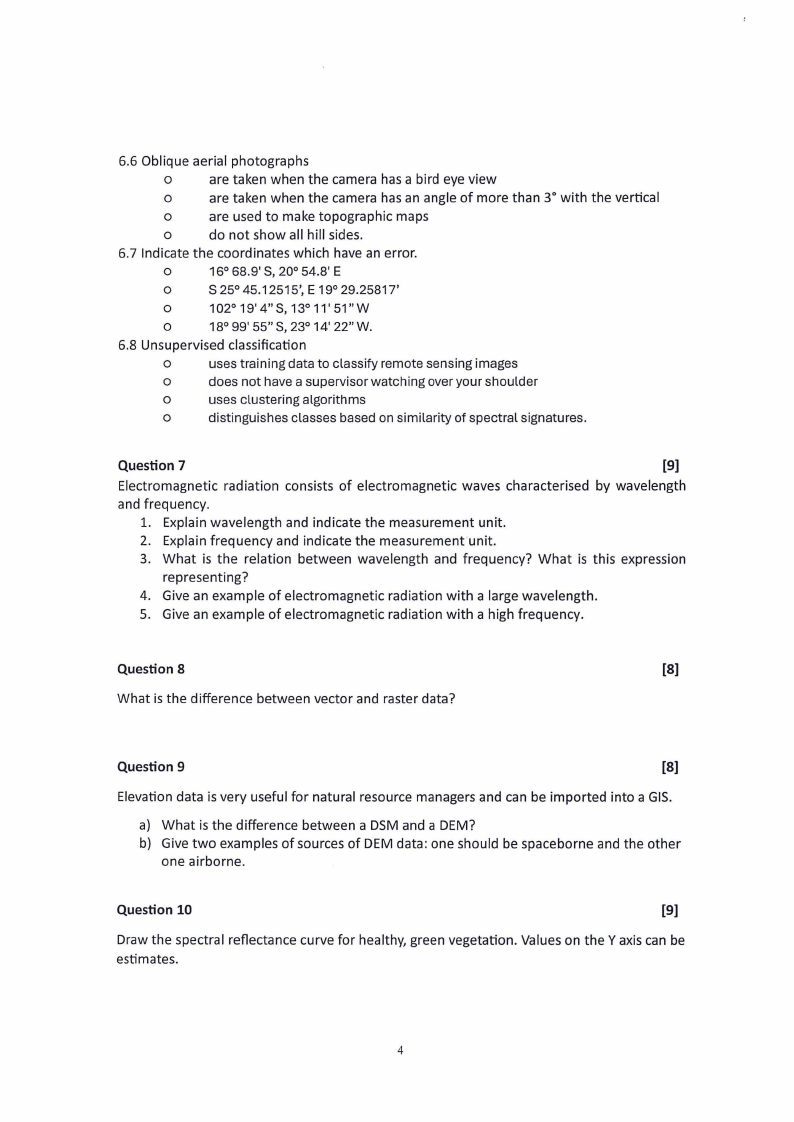
6.6 Oblique aerial photographs
o
are taken when the camera has a bird eye view
o
are taken when the camera has an angle of more than 3° with the vertical
o
are used to make topographic maps
o
do not show all hill sides.
6.7 Indicate the coordinates which have an error.
o
16° 68.9' S, 20° 54.8' E
o
S 25° 45.12515', E 19° 29.25817'
0
102° 19' 4" s, 13° 11' 51 "w
0
18° 99' 55" s,23° 14' 22" w.
6.8 Unsupervised classification
o
uses training data to classify remote sensing images
o
does not have a supervisor watching over your shoulder
o
uses clustering algorithms
o
distinguishes classes based on similarity of spectral signatures.
Question 7
[9]
Electromagnetic radiation consists of electromagnetic waves characterised by wavelength
and frequency.
1. Explain wavelength and indicate the measurement unit.
2. Explain frequency and indicate the measurement unit.
3. What is the relation between wavelength and frequency? What is this expression
representing?
4. Give an example of electromagnetic radiation with a large wavelength.
5. Give an example of electromagnetic radiation with a high frequency.
Question 8
[8]
What is the difference between vector and raster data?
Question 9
[8]
Elevation data is very useful for natural resource managers and can be imported into a GIS.
a) What is the difference between a DSM and a DEM?
b) Give two examples of sources of DEM data: one should be spaceborne and the other
one airborne.
Question 10
[9]
Draw the spectral reflectance curve for healthy, green vegetation. Values on the Y axis can be
estimates.
4
|
|
5 Page 5 |
▲back to top |

Question 11
[6]
a) What are microwaves?
b) How do microwaves travel when transmitted?
c) What are the advantages of using an active microwave sensor compared to
passive sensors for remote sensing purposes?
5
|
|
6 Page 6 |
▲back to top |