


 |
LAE612S-LABOUR ECONOMICS-1ST OPP-NOV 2025 |
|
|
1 Page 1 |
▲back to top |

nAm I BIA un IVERSITY
OF SCIEnCE Ano TECH n OLOGY
FACULTY OF COMMERCE, HUMAN SCIENCE AND EDUCATION
DEPARTMENT OF ECONOMICS, ACCOUNTING AND FINANCE
QUALIFICATION: BACHELOR OF ECONOMICS
QUALIFICATION CODE:
07BECO
LEVEL: 7
COURSE CODE: LAE612S
COURSE NAME: LABOUR ECONOMICS
SESSION: NOVEMBER 2025
PAPER: THEORY
DURATION: 3 HOURS
MARKS: 100
/
FIRST OPPORTUNITY EXAMINATION QUESTION PAPER
EXAMINER(S) MR. PINEHAS NANGULA
MODERATOR: MR ESLON NGEENDEPI
INSTRUCTIONS
1. Answer ALL the questions
2. Write clearly and neatly.
3. Number the answers clearly.
PERMISSIBLE MATERIALS
1. Scientific calculator
2. Pen and Pencil
3. Ruler
THIS QUESTION PAPER CONSISTS OF _5_PAGES (Including this front page)
|
|
2 Page 2 |
▲back to top |

QUESTION ONE
MULTIPLE CHOICE QUESTIONS
1. The demand for labour is considered a derived demand because:
[25MARKS]
[2 marks],
a) Workers demand higher wages
b) Labour demand depends on government policy
c) Labour is demanded for the goods and services it produces
d) Firms want to reduce costs
2. In the labour market, two inputs are called gross substitutes when:
[2 marks]
a) An increase in the price of one input raises the demand for the other
b) An increase in the price of one input lowers the demand for the other
c) They are always used together in fixed proportions
d) Labour demand curve shifts left
3. A backward-bending labour supply curve occurs because:
[2 marks]
a) Substitution effect always dominates
b) Income effect eventually dominates at high wage rates
c) Wages are fixed
d) Labor demand is perfectly inelastic
4. Capital and labour are gross complements if:
[2 marks]
a) More machines reduce the demand for labour
b) More machines increase the demand for labour
c) A wage increase increases capital demand
d) They can easily replace one another
5. The elasticity of substitution between labour and capital measures:
[2 marks]
a) How much output changes when labour changes
b) The percentage change in labour employed when wages change
c) The ease with which labour can be substituted for capital
d) The slope of the labour demand curve
6. If the elasticity of substitution between labour and capital is high, it means: [2 marks]
a) Labour and capital cannot replace each other
b) Labour can easily replace capital, and vice versa
|
|
3 Page 3 |
▲back to top |

c) Output is fixed
d) Wages will not affect employment
7. Which ofthe following scenarios shows both substitution and scale effects?
a) Wages rise, firm uses more machines and reduces output
b) Wages fall, firm replaces labour with capital only
c) Output increases without changing input mix
d) Labour productivity falls but output rises
[2 marks]
I
I
I
8. Which ofthe following best describes the difference between substitution and scale effects?
[2 marks]
a) Substitution is about changes in input mix, while scale is about changes in overall
production level
b) b) Scale is short run, substitution is long run
c) c) Substitution is caused by technology, scale by wages
d) Scale effect always increases employment
9. In the labour market, a firm's hiring decision is primarily based on:
a) Average product of labour
b) Value for marginal product of labour
c) Total revenue
d) Wage elasticity of demand
[2 marks]
10. When the wage rate increases, the substitution effect dominates, a worker is likely to:
[2 marks]
a) Work fewer hours because leisure is a normal good
b) Work more hours because leisure becomes relatively more expensive
c) Stop working entirely
d) Be unaffected in their labour supply
|
|
4 Page 4 |
▲back to top |
QUESTION TWO
I
[20MARKS]
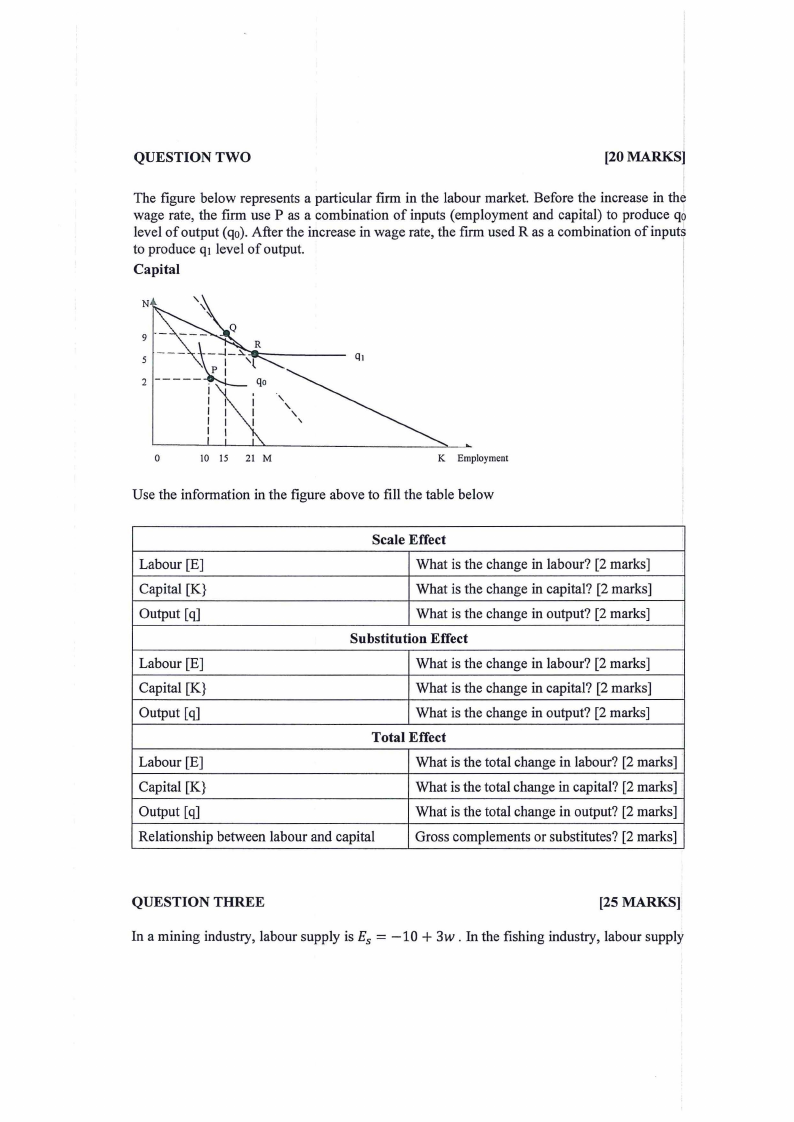
The figure below represents a particular firm in the labour market. Before the increase in the
wage rate, the firm use Pas a combination of inputs (employment and capital) to produce qo
level of output (qo). After the increase in wage rate, the firm used Ras a combination of inputs
to produce q1 level of output.
Capital
N
5-
~R~ - - - - -
pI
2 ----- .
Qo
I
I
I
I
I
0
10 15 21 M
K Employment
Use the information in the figure above to fill the table below
Scale Effect
Labour [E]
What is the change in labour? [2 marks]
Capital [K}
What is the change in capital? [2 marks]
Output [q]
What is the change in output? [2 marks] ;
Substitution Effect
Labour[E]
What is the change in labour? [2 marks]
Capital [K}
What is the change in capital? [2 marks]
Output [q]
What is the change in output? [2 marks]
Total Effect
Labour[E]
What is the total change in labour? [2 marks]
Capital [K}
What is the total change in capital? [2 marks]
Output [q]
What is the total change in output? [2 marks]
Relationship between labour and capital
Gross complements or substitutes? [2 marks]
QUESTION THREE
[25MARKS]
= In a mining industry, labour supply is £5 -10 + 3w. In the fishing industry, labour supply
|
|
5 Page 5 |
▲back to top |
I
= =I
is E5
-5 + 2w and labour demand in both industry is Ed
15 - 2w, where Eis the level
1
of employment and w is the hourly wage.
a) Draw the demand and supply curves for labour using the information above for eacJ
m• dustry.
[10 marks]I
b) Calculate the market wage rate in each industry where the unemployment rate is equal tq
zero.
[5 marks]
c) Calculate the market wage rate in mining industry where the unemployment value is 5l
I
[5 marks]
d) Calculate the market wage rate in fishing industry where the unemployment value is 4:
I
[5 marks]
QUESTION FOUR
[35MARKS]!
a) The table below reports the unemployment rate, labor force participation rate, and
(working-age) population for India in January 2015, and 2024. Using these data, answer 1
question below.
2015
2024
Unemployment Rate
28.0%
45.0%
Labor Force Participation Rate
56.2%
52.7%
Working-age Population
235m
410m
How many people were officially unemployed at the start of each year?
[10 marks]
b) M & J enterprises is operating in the short-run with capital fixed at 5 level of inputs and
labour is a variable input.
Labour hours
Total Product
Per unit price
1
40
5
2
134
5
3
246
5
4
340
5
5
400
5
6
440
5
7
470
5
8
492
5
i. Use the information in the table above to draw the demand curve for labour in the short
run.
[15 marks] :
11. Advice M & J enterprises on how many employees must be recruited for them to
maximize their profits if market wage is N$200.00.
[10 marks] ·
All the best