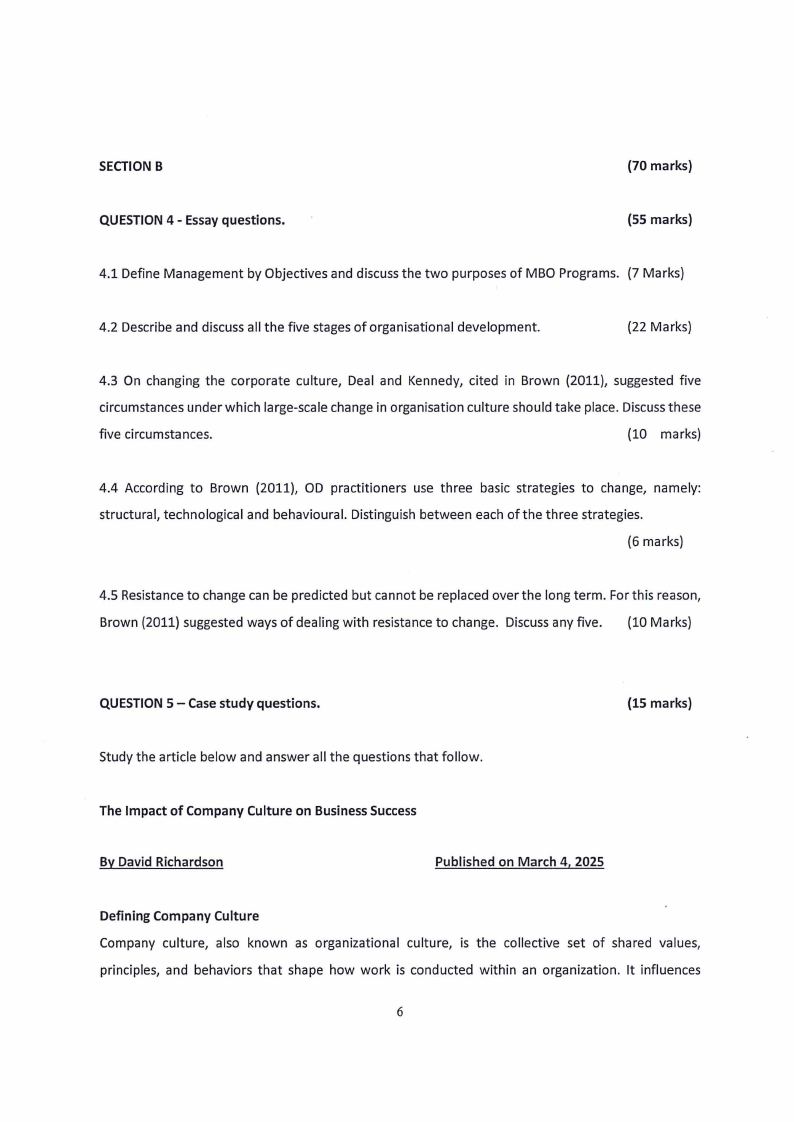
ODC711S - ORG DEVELOPEMENT AND CHANGE - 1ST OPP - JUNE 2025


ODC711S - ORG DEVELOPEMENT AND CHANGE - 1ST OPP - JUNE 2025


1 Page 1

▲back to top


FACULTY OF COMMERCE,
EDUCATION
nAmlBIA unlVERSITY
OF SCIEnCE Ano
HUMAN SCIENCESAND
DEPARTMENT OF GOVERNANCE AND MANAGEMENT SCIENCES
QUALIFICATION: BACHELOR OF HUMAN RESOURCES MANAGEMENT
QUALIFICATION CODE: 07BHRM
LEVEL: 7
COURSE CODE: ODC711S
COURSE NAME: ORGANISATIONAL DEVELOPMENT AND
CHANGE
DATE: JUNE 2025
DURATION: 3 HOURS
PAPER: 1
MARKS: 100
EXAMINER:
FIRST OPPORTUNITY QUESTION PAPER
MR SIMASIKU KAMWI
MS. JOYCE MUKUBI
MODERATOR:
MS. ELAINEJANUARY- ENKALI
INSTRUCTIONS
1. Answer all questions
2. Read the case study before attempting the questions
3. Write clearly and neatly.
4. Number your answers.
THIS QUESTION PAPER CONSISTS OF 10 PAGES{Including the cover front page)

2 Page 2

▲back to top


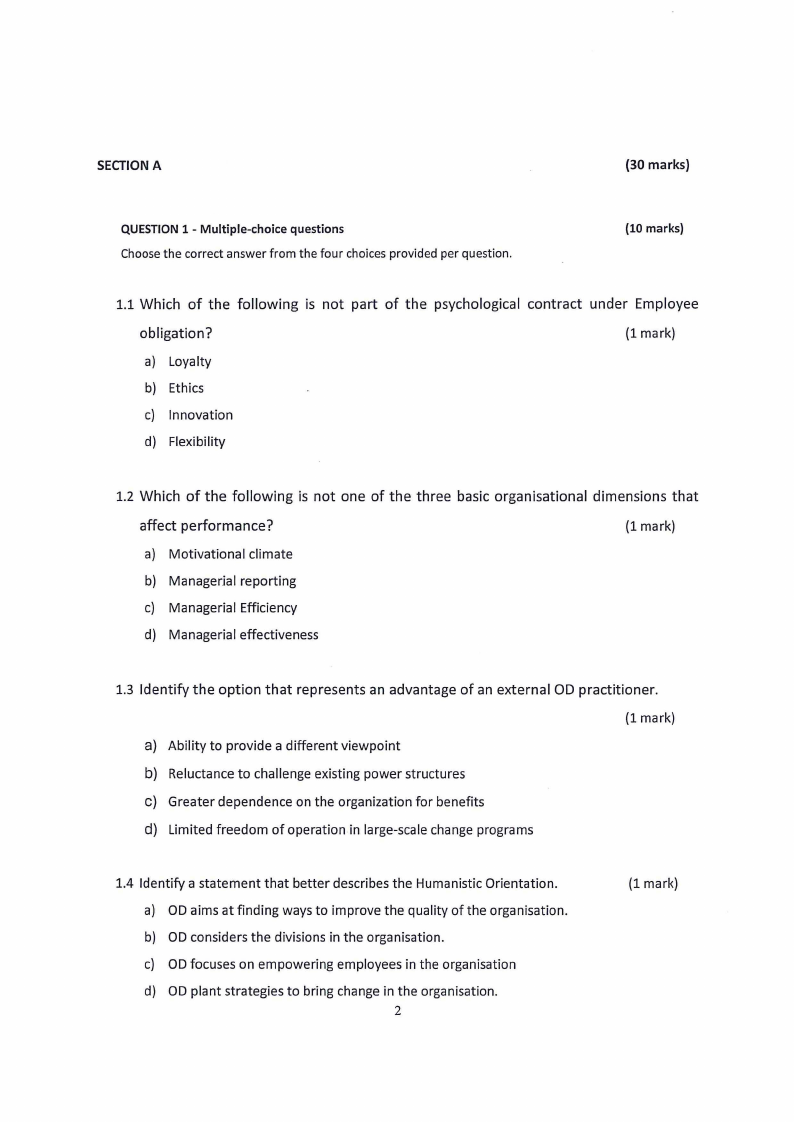
SECTIONA
(30 marks)
QUESTION 1 - Multiple-choice questions
Choose the correct answer from the four choices provided per question.
(10 marks)
1.1 Which of the following is not part of the psychological contract under Employee
obligation?
{1 mark)
a) Loyalty
b) Ethics
c) Innovation
d) Flexibility
1.2 Which of the following is not one of the three basic organisational dimensions that
affect performance?
{1 mark)
a) Motivational climate
b) Managerial reporting
c) Managerial Efficiency
d) Managerial effectiveness
1.3 Identify the option that represents an advantage of an external OD practitioner.
(1 mark)
a) Ability to provide a different viewpoint
b) Reluctance to challenge existing power structures
c) Greater dependence on the organization for benefits
d) Limited freedom of operation in large-scalechange programs
1.4 Identify a statement that better describes the Humanistic Orientation.
a) OD aims at finding ways to improve the quality of the organisation.
b) OD considers the divisions in the organisation.
c) OD focuses on empowering employees in the organisation
d) OD plant strategies to bring change in the organisation.
2
(1 mark)

3 Page 3

▲back to top


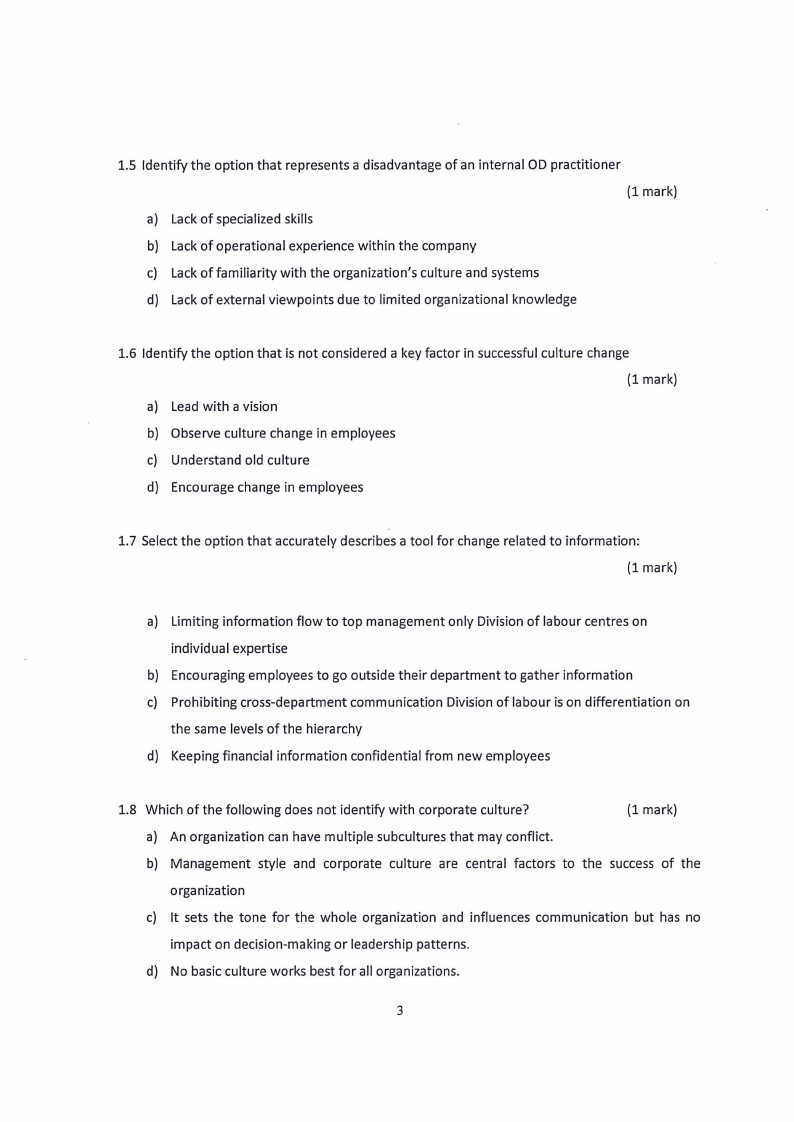
1.5 Identify the option that represents a disadvantage of an internal OD practitioner
(1 mark)
a) Lack of specialized skills
b) Lack of operational experience within the company
c) Lack of familiarity with the organization's culture and systems
d) Lack of external viewpoints due to limited organizational knowledge
1.6 Identify the option that is not considered a key factor in successful culture change
{1 mark)
a) Lead with a vision
b) Observe culture change in employees
c) Understand old culture
d) Encourage change in employees
1.7 Select the option that accurately describes a tool for change related to information:
{1 mark)
a) Limiting information flow to top management only Division of labour centres on
individual expertise
b) Encouraging employees to go outside their department to gather information
c) Prohibiting cross-department communication Division of labour is on differentiation on
the same levels of the hierarchy
d) Keeping financial information confidential from new employees
1.8 Which of the following does not identify with corporate culture?
{1 mark)
a) An organization can have multiple subcultures that may conflict.
b) Management style and corporate culture are central factors to the success of the
organization
c) It sets the tone for the whole organization and influences communication but has no
impact on decision-making or leadership patterns.
d) No basic culture works best for all organizations.
3

4 Page 4

▲back to top


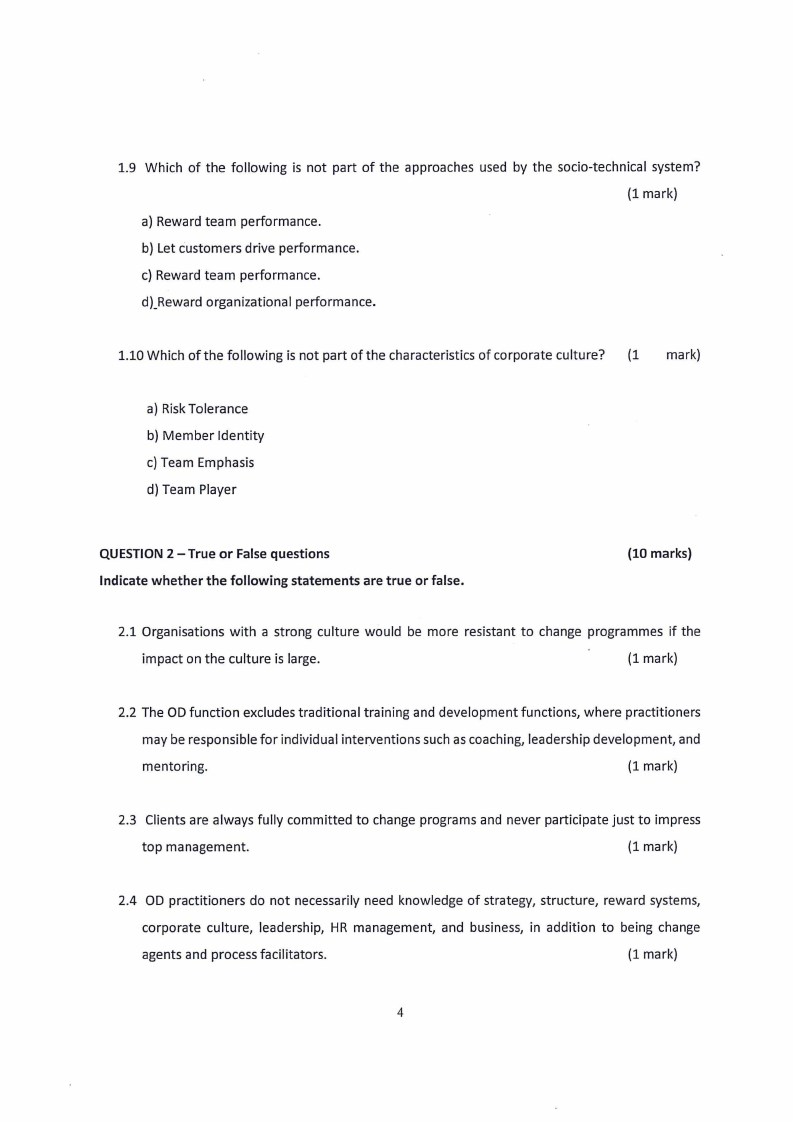
1.9 Which of the following is not part of the approaches used by the socio-technical system?
(1 mark)
a) Reward team performance.
b) Let customers drive performance.
c) Reward team performance.
d)_Rewardorganizational performance.
1.10 Which of the following is not part of the characteristics of corporate culture? (1 mark)
a) RiskTolerance
b) Member Identity
c) Team Emphasis
d) Team Player
QUESTION 2 - True or False questions
Indicate whether the following statements are true or false.
(10 marks)
2.1 Organisations with a strong culture would be more resistant to change programmes if the
impact on the culture is large.
(1 mark)
2.2 The OD function excludes traditional training and development functions, where practitioners
may be responsible for individual interventions such as coaching, leadership development, and
mentoring.
(1 mark)
2.3 Clients are always fully committed to change programs and never participate just to impress
top management.
(1 mark)
2.4 OD practitioners do not necessarily need knowledge of strategy, structure, reward systems,
corporate culture, leadership, HR management, and business, in addition to being change
agents and process facilitators.
(1 mark)
4

5 Page 5

▲back to top


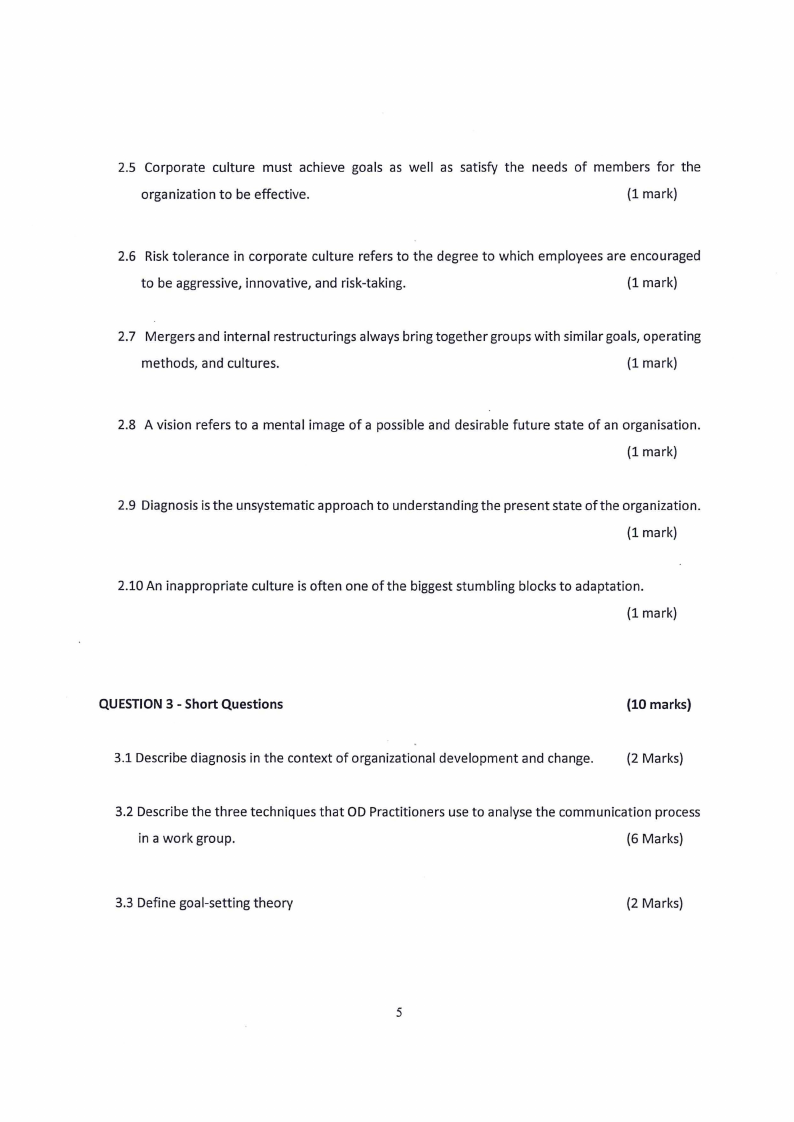
2.5 Corporate culture must achieve goals as well as satisfy the needs of members for the
organization to be effective.
(1 mark)
2.6 Risk tolerance in corporate culture refers to the degree to which employees are encouraged
to be aggressive, innovative, and risk-taking.
(1 mark)
2.7 Mergers and internal restructurings always bring together groups with similar goals, operating
methods, and cultures.
(1 mark)
2.8 A vision refers to a mental image of a possible and desirable future state of an organisation.
(1 mark)
2.9 Diagnosis is the unsystematic approach to understanding the present state of the organization.
(1 mark)
2.10 An inappropriate culture is often one of the biggest stumbling blocks to adaptation.
(1 mark)
QUESTION 3 - Short Questions
(10 marks)
3.1 Describe diagnosis in the context of organizational development and change. (2 Marks)
3.2 Describe the three techniques that OD Practitioners use to analyse the communication process
in a work group.
(6 Marks)
3.3 Define goal-setting theory
(2 Marks)
5

6 Page 6

▲back to top


SECTIONB
(70 marks)
QUESTION 4 - Essay questions.
{55 marks)
4.1 Define Management by Objectives and discuss the two purposes of MBO Programs. (7 Marks)
4.2 Describe and discuss all the five stages of organisational development.
(22 Marks)
4.3 On changing the corporate culture, Deal and Kennedy, cited in Brown (2011), suggested five
circumstances under which large-scale change in organisation culture should take place. Discussthese
five circumstances.
(10 marks)
4.4 According to Brown (2011), OD practitioners use three basic strategies to change, namely:
structural, technological and behavioural. Distinguish between each of the three strategies.
(6 marks)
4.5 Resistanceto change can be predicted but cannot be replaced over the long term. For this reason,
Brown (2011) suggested ways of dealing with resistance to change. Discussany five. (10 Marks)
QUESTION 5 - Case study questions.
{15 marks)
Study the article below and answer all the questions that follow.
The Impact of Company Culture on Business Success
By David Richardson
Published on March 4, 2025
Defining Company Culture
Company culture, also known as organizational culture, is the collective set of shared values,
principles, and behaviors that shape how work is conducted within an organization. It influences
6

7 Page 7

▲back to top


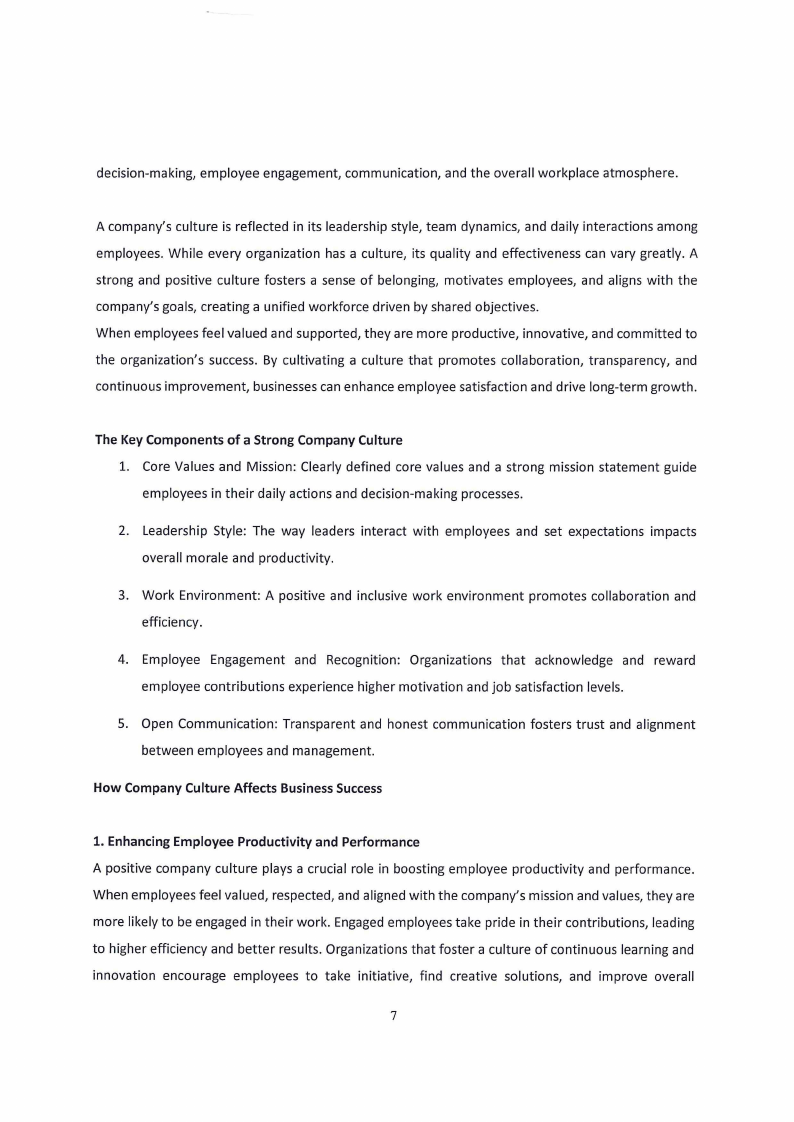
decision-making, employee engagement, communication, and the overall workplace atmosphere.
A company's culture is reflected in its leadership style, team dynamics, and daily interactions among
employees. While every organization has a culture, its quality and effectiveness can vary greatly. A
strong and positive culture fosters a sense of belonging, motivates employees, and aligns with the
company's goals, creating a unified workforce driven by shared objectives.
When employees feel valued and supported, they are more productive, innovative, and committed to
the organization's success. By cultivating a culture that promotes collaboration, transparency, and
continuous improvement, businesses can enhance employee satisfaction and drive long-term growth.
The Key Components of a Strong Company Culture
1. Core Values and Mission: Clearly defined core values and a strong mission statement guide
employees in their daily actions and decision-making processes.
2. Leadership Style: The way leaders interact with employees and set expectations impacts
overall morale and productivity.
3. Work Environment: A positive and inclusive work environment promotes collaboration and
efficiency.
4. Employee Engagement and Recognition: Organizations that acknowledge and reward
employee contributions experience higher motivation and job satisfaction levels.
5. Open Communication: Transparent and honest communication fosters trust and alignment
between employees and management.
How Company Culture Affects Business Success
1. Enhancing Employee Productivity and Performance
A positive company culture plays a crucial role in boosting employee productivity and performance.
When employees feel valued, respected, and aligned with the company's mission and values, they are
more likely to be engaged in their work. Engagedemployees take pride in their contributions, leading
to higher efficiency and better results. Organizations that foster a culture of continuous learning and
innovation encourage employees to take initiative, find creative solutions, and improve overall
7

8 Page 8

▲back to top


performance.
2. Improving Employee Retention and Satisfaction
"Employee retention is a significant challenge for many organizations, but a strong company culture
can help mitigate high turnover rates. Employees who feel connected to their workplace, leadership,
and team members are more likely to remain loyal to their company," adds Matthew Holland, Head
of Marketing at Well PCB.When individuals align with a company's values and mission, they develop
a sense of belonging and purpose, making them less inclined to seek opportunities elsewhere. High
employee turnover can be costly for businesses due to the expenses related to recruitment,
onboarding, and training. Additionally, frequent staff changes can disrupt workflow and reduce overall
efficiency.
3. Driving Innovation and Creativity
A company culture that encourages innovation and creativity can lead to groundbreaking
advancements and competitive advantages. Organizations that embrace a growth mindset empower
employees to take risks, experiment with new ideas, and challenge conventional practices. Companies
such as Google and Apple have established cultures that prioritize creativity, resulting in revolutionary
technological developments.
4. Enhancing Brand Reputation and Customer Satisfaction
A company's internal culture is often reflected in its interactions with customers. Employees who are
happy, engaged, and committed to their organization's mission provide better customer service,
leading to increased customer satisfaction and loyalty. When a company prioritizes employee well-
being, it creates a positive work environment that translates into better client experiences.
5. Facilitating Effective Collaboration
Effective collaboration is essential for achieving business goals, and a strong company culture fosters
teamwork, communication, and mutual respect. When employees work well together, they can
efficiently solve problems, complete projects, and drive innovation. Organizations that prioritize
collaboration create an environment where employees feel comfortable sharing ideas, seeking
feedback, and supporting one another.
Companies that encourage cross-departmental teamwork benefit from improved efficiency and
stronger relationships among employees.
The Challenges of Maintaining a Strong Company Culture
While the benefits of a strong company culture are clear, maintaining and improving it presents
8'

9 Page 9

▲back to top


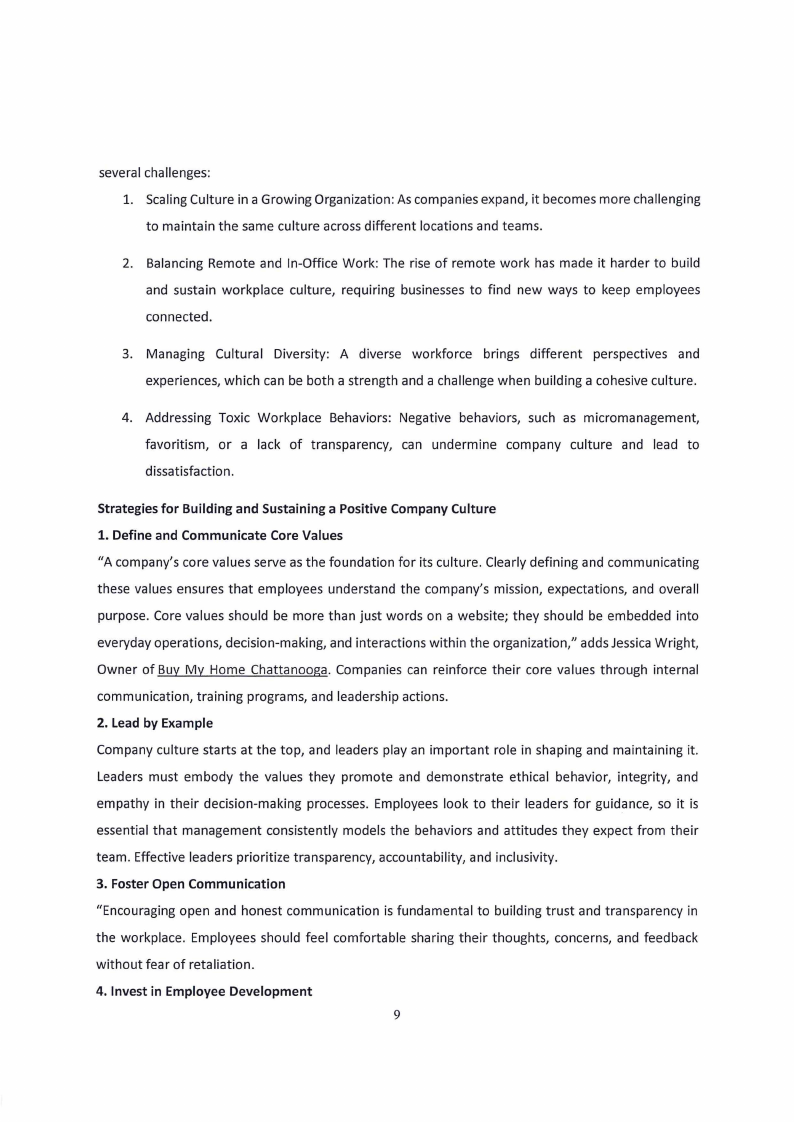
several challenges:
1. Scaling Culture in a Growing Organization: As companies expand, it becomes more challenging
to maintain the same culture across different locations and teams.
2. Balancing Remote and In-Office Work: The rise of remote work has made it harder to build
and sustain workplace culture, requiring businesses to find new ways to keep employees
connected.
3. Managing Cultural Diversity: A diverse workforce brings different perspectives and
experiences, which can be both a strength and a challenge when building a cohesive culture.
4. Addressing Toxic Workplace Behaviors: Negative behaviors, such as micromanagement,
favoritism, or a lack of transparency, can undermine company culture and lead to
dissatisfaction.
Strategies for Building and Sustaining a Positive Company Culture
1. Define and Communicate Core Values
"A company's core values serve as the foundation for its culture. Clearly defining and communicating
these values ensures that employees understand the company's mission, expectations, and overall
purpose. Core values should be more than just words on a website; they should be embedded into
everyday operations, decision-making, and interactions within the organization," adds JessicaWright,
Owner of Buy My Home Chattanooga. Companies can reinforce their core values through internal
communication, training programs, and leadership actions.
2. Lead by Example
Company culture starts at the top, and leaders play an important role in shaping and maintaining it.
Leaders must embody the values they promote and demonstrate ethical behavior, integrity, and
empathy in their decision-making processes. Employees look to their leaders for guidance, so it is
essential that management consistently models the behaviors and attitudes they expect from their
team. Effective leaders prioritize transparency, accountability, and inclusivity.
3. Foster Open Communication
"Encouraging open and honest communication is fundamental to building trust and transparency in
the workplace. Employees should feel comfortable sharing their thoughts, concerns, and feedback
without fear of retaliation.
4. Invest in Employee Development
9

10 Page 10

▲back to top


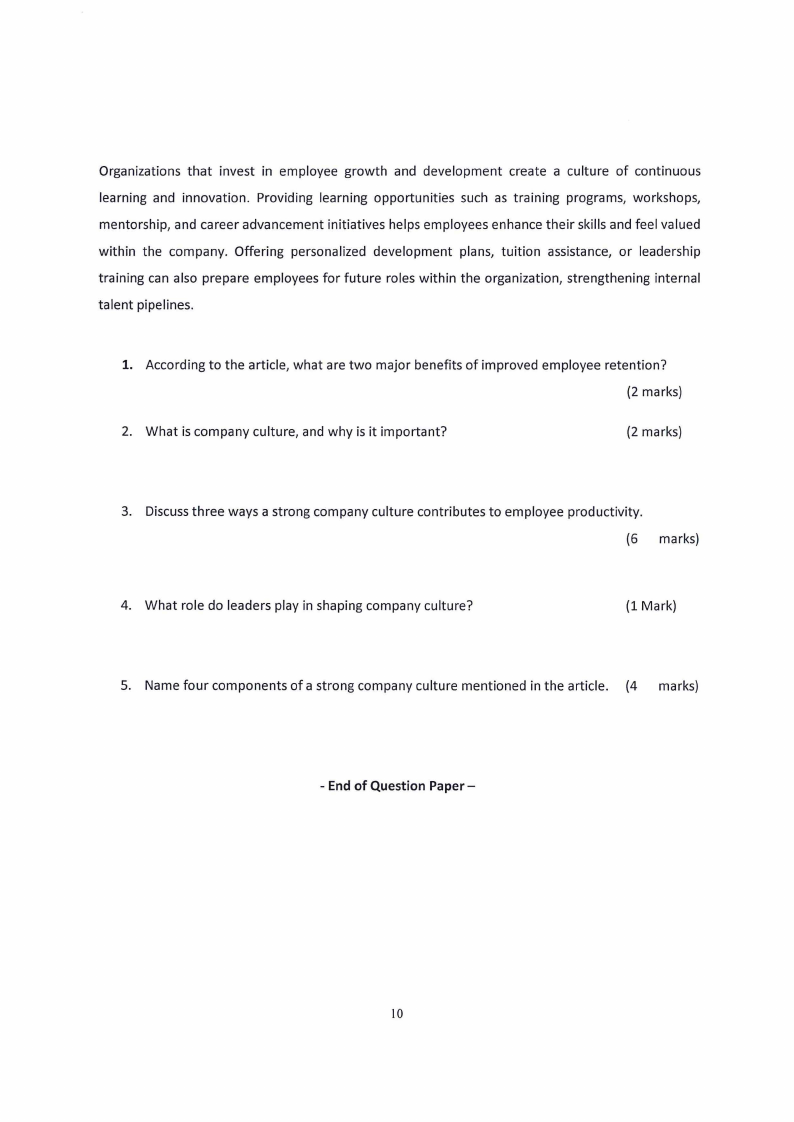
Organizations that invest in employee growth and development create a culture of continuous
learning and innovation. Providing learning opportunities such as training programs, workshops,
mentorship, and career advancement initiatives helps employees enhance their skills and feel valued
within the company. Offering personalized development plans, tuition assistance, or leadership
training can also prepare employees for future roles within the organization, strengthening internal
talent pipelines.
1. According to the article, what are two major benefits of improved employee retention?
(2 marks)
2. What is company culture, and why is it important?
(2 marks)
3. Discussthree ways a strong company culture contributes to employee productivity.
(6
marks)
4. What role do leaders play in shaping company culture?
(1 Mark)
5. Name four components of a strong company culture mentioned in the article. (4 marks)
- End of Question Paper -