FINANCIAL MANAGEMENT FAM701V (FAM300) NOVEMBER 2025 2nd OPPORTUNITY ASSESSMENT
Question 1
[60 Marks]
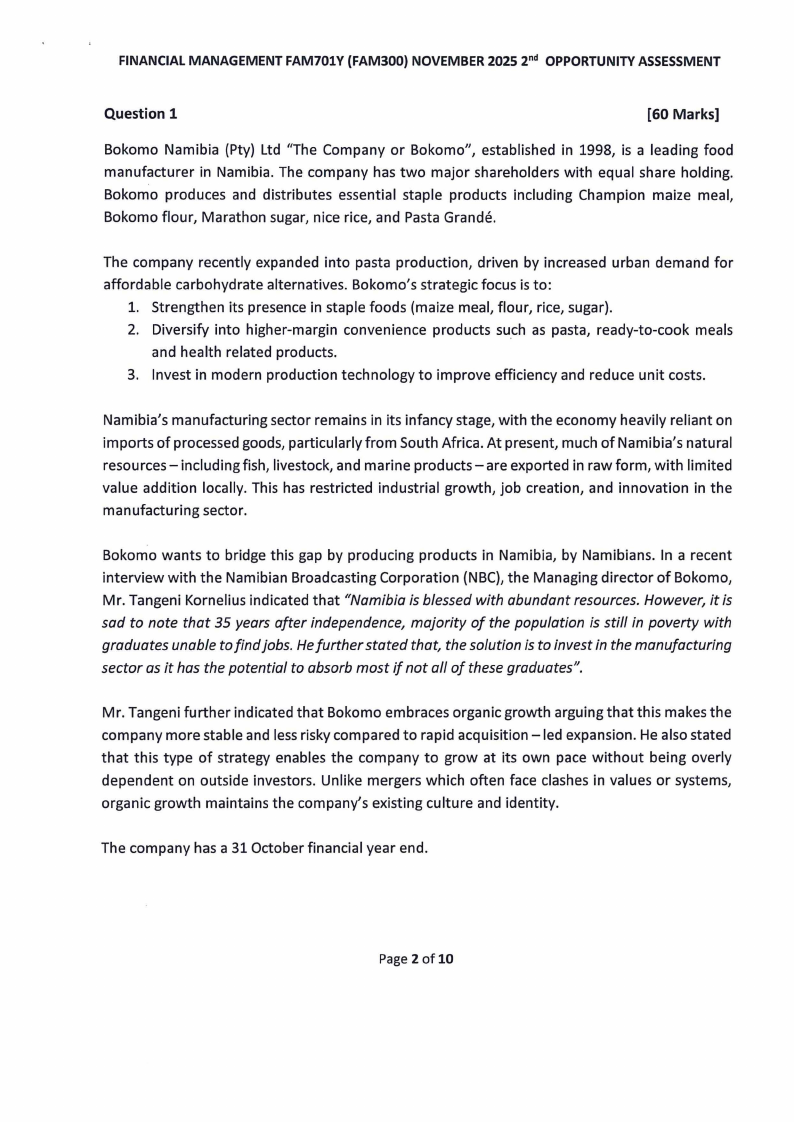
Bokomo Namibia (Pty) Ltd "The Company or Bokomo", established in 1998, is a leading food
manufacturer in Namibia. The company has two major shareholders with equal share holding.
Bokomo produces and distributes essential staple products including Champion maize meal,
Bokomo flour, Marathon sugar, nice rice, and Pasta Grande.
The company recently expanded into pasta production, driven by increased urban demand for
affordable carbohydrate alternatives. Bokomo's strategic focus is to:
1. Strengthen its presence in staple foods (maize meal, flour, rice, sugar).
2. Diversify into higher-margin convenience products su_ch as pasta, ready-to-cook meals
and health related products.
3. Invest in modern production technology to improve efficiency and reduce unit costs.
Namibia's manufacturing sector remains in its infancy stage, with the economy heavily reliant on
imports of processed goods, particularly from South Africa. At present, much of Namibia's natural
resources-including fish, livestock, and marine products- are exported in raw form, with limited
value addition locally. This has restricted industrial growth, job creation, and innovation in the
manufacturing sector.
Bokomo wants to bridge this gap by producing products in Namibia, by Namibians. In a recent
interview with the Namibian Broadcasting Corporation (NBC), the Managing director of Bokomo,
Mr. Tangeni Kornelius indicated that "Namibia is blessed with abundant resources. However, it is
sad to note that 35 years after independence, majority of the population is still in poverty with
graduates unable to find jobs. He further stated that, the solution is to invest in the manufacturing
sector as it has the potential to absorb most if not all of these graduates".
Mr. Tangeni further indicated that Bokomo embraces organic growth arguing that this makes the
company more stable and less risky compared to rapid acquisition - led expansion. He also stated
that this type of strategy enables the company to grow at its own pace without being overly
dependent on outside investors. Unlike mergers which often face clashes in values or systems,
organic growth maintains the company's existing culture and identity.
The company has a 31 October financial year end.
Page 2 of 10