FAM701Y-FINANCIAL MANAGEMENT 300-1ST OPP-NOV 2025


FAM701Y-FINANCIAL MANAGEMENT 300-1ST OPP-NOV 2025


1 Page 1

▲back to top


FINANCIAL MANAGEMENT FAM701Y (FAM300) NOVEMBER 2025 FIRST OPPORTUNITY
ASSESSMENT
n Am I BI A u n IVER s I TY
OF SCI En CE Ano TECH n OLOGY
FACULTY OF COMMERCE, HUMAN SCIENCES & EDUCATION
DEPARTMENT OF ECONOMICS, ACCOUNTING & FINANCE
QUALIFICATION : BACHELOR OF ACCOUNTING (CHARTERED ACCOUNTANCY)
COURSE CODE: FAM701Y
COURSE NAME: FINANCIAL MANAGEMENT 300
DATE: NOVEMBER 2025
DURATION: 3 HOURS
PAPER: PRACTICAL AND THEORY
MARKS: 100
NOVEMBER 2025 FIRST OPPORTUNITY ASSESSMENT QUESTION PAPER
EXAMINER:
MODERATOR:
Mr. S. Nghiwilepo (Namibia University of Science & Technology)
Mr. T. Lunga (University of Limpopo)
INSTRUCTIONS:
• This paper consists of 9 pages including the cover page.
• Answer ALL questions in blue or black ink only. No PENCIL.
• Start each question on a new page.
• Silent, non-programmable calculators may be used, unless otherwise instructed.
• Show all your workings clearly. Unless otherwise instructed, round all calculations to two
decimal places.
1

2 Page 2

▲back to top


FINANCIAL MANAGEMENT FAM701Y (FAM300) NOVEMBER 2025 FIRST OPPORTUNITY
ASSESSMENT
Question 1
[15 Marks]
I BACKGROUND
Cheetah Cement is a prominent cement brand in Namibia, produced by Whale Rock Cement
(Pty) Ltd. The company's production facility is situated near Otjiwarongo, and its head office
is located at 64 Jenner Street, Windhoek, Khomas, 9000 Namibia.
Established to meet the growing demand for cement in Namibia and neighbouring countries,
Cheetah Cement has contributed to the local economy by creating employment opportunities
and supporting infrastructure development. The company's manufacturing plant utilizes
modern technology to produce high-quality cement products suitable for various
construction needs. Cheetah Cement is committed to sustainable practices, implementing
measures to minimize environmental impact and ensure the well-being of the surrounding
communities.
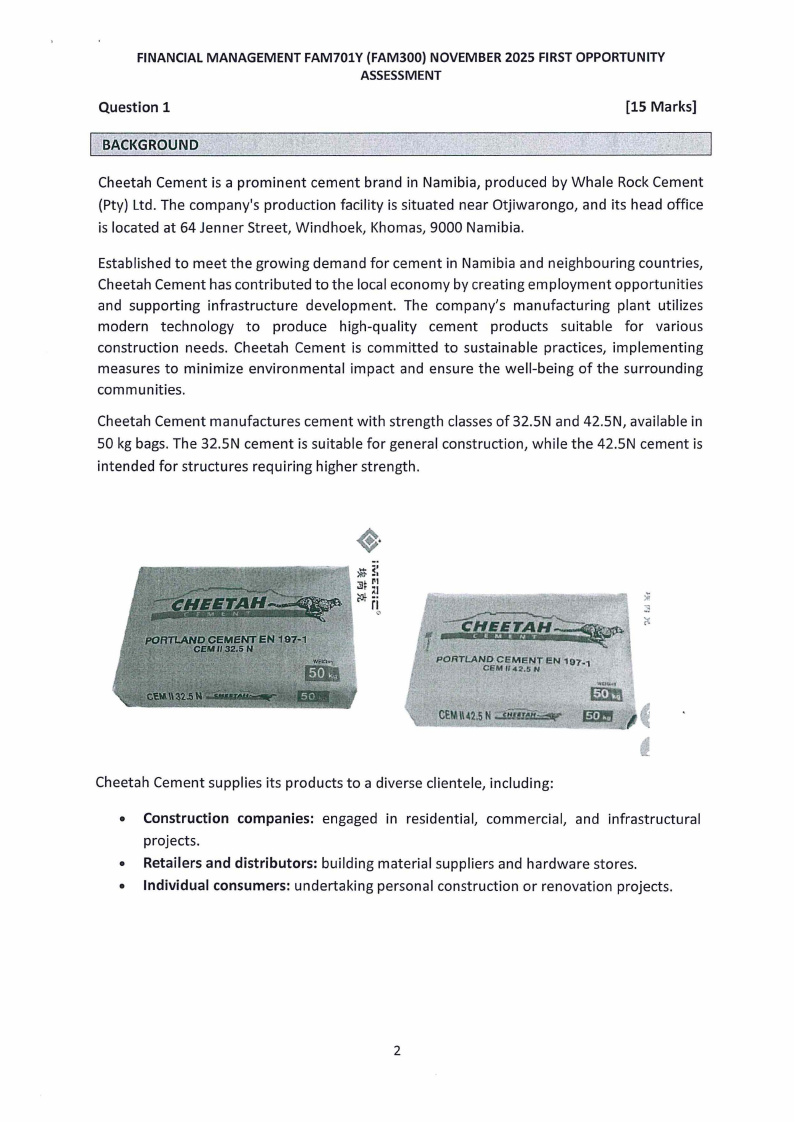
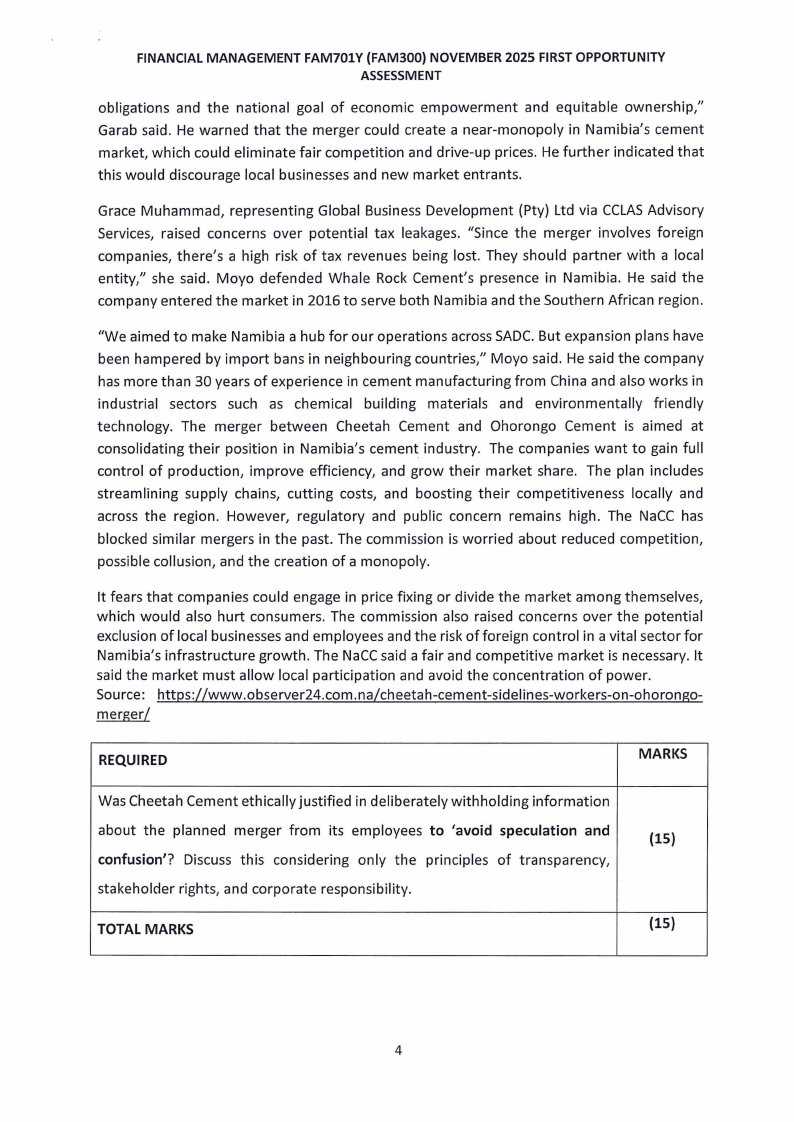
Cheetah Cement manufactures cement with strength classes of 32.SN and 42.SN, available in
50 kg bags. The 32.SN cement is suitable for general construction, while the 42.SN cement is
intended for structures requiring higher strength.
1 ~~
PORTLAND CEMEN T EN 1~7-i
CEM1r,U,5N
CEM 1142.5 N~ ~
Cheetah Cement supplies its products to a diverse clientele, including:
Construction companies: engaged in residential, commercial, and infrastructural
projects.
Retailers and distributors: building material suppliers and hardware stores.
Individual consumers: undertaking personal construction or renovation projects.
2

3 Page 3

▲back to top


FINANCIAL MANAGEMENT FAM701Y (FAM300) NOVEMBER 2025 FIRST OPPORTUNITY
ASSESSMENT
I MEDIA REPORTS
Report 1: Whale Rock plans to acquire Schwenk Namibia, 18 March 2025
In March 2025, Whale Rock Cement {Pty) Ltd, the parent company of Cheetah Cement, has
filed a notice to acquire Schwenk Namibia, which holds a majority stake in Ohorongo Cement.
Ohorongo Cement serves both the local Namibian market and exports to neighbouring
countries like Angola, South Africa, Zambia, Botswana and Zimbabwe.
If successful, the transaction, filed with the Namibian Competition Commission {NCC) would
give Whale Rock Cement complete control over cement production in Namibia.
The deal involves Whale Rock Cement acquiring the entire issued share capital of Schwenk
Namibia from SCHWENK Zement International GmbH & Co KG. Schwenk Namibia holds a
69.83 per cent stake in Ohorongo Cement, with the remaining shares held by Industrial Corp
South Africa {14.27 per cent), Development Bank of Namibia {11 .73 per cent) and
Development Bank of Southern Africa {4.17 per cent).
The company is not the first to attempt acquisition of Schwenk Namibia. In 2020, a proposed
merger between Schwenk Namibia and West China Cement Ltd was blocked due to concerns
over collusion between two cement producers. It followed a SGD1.5bn {US$1126.87m)
acquisition announcement by Singapore-listed International Cement Group that did not
materialise.
Source: Whale Rock plans to acquire Schwenk Namibia from International Cement Review
Report 2: Cheetah Cement sidelines workers on Ohorongo merger
Cheetah Cement did not inform its workers about the planned merger with Ohorongo
Cement. This came to light during a stakeholders' conference held in Windhoek by the
Namibian Competition Commission {NaCC). Cheetah Cement said it deliberately withheld the
information from workers. A spokesperson for the company, Tabby Moyo, stated that they
deliberately withheld the information to prevent speculation and confusion . "The decision is
to avoid speculations and confusion among employees," Moyo said . Meanwhile, Meyer van
den Berg, the legal representative of Ohorongo Cement, informed their employees about the
planned acquisition through a memo. The proposed merger has faced rejection from several
stakeholders at the conference. Most raised concerns about a monopoly forming in the
cement sector. Others questioned why local companies were not given a chance to buy
Ohorongo Cement, which is owned by Schwenk Namibia {Pty) Ltd.
George Garab, representing Otavi Cement Group {Pty) Ltd, said local ownership is key and
that the merger goes against government efforts to promote it. "Even though Otavi Cement
Group owns the licence to the farm where Ohorongo Cement operates, we were never given
an opportunity to purchase Ohorongo," said Garab.
He said Ohorongo Cement was supported by the Otavi Town Council and other authorities to
obtain an operational license. Now, he claimed, the company is being sold off in secret,
excluding local investors and the government. "This undermines the spirit of its foundational
3

4 Page 4

▲back to top


FINANCIAL MANAGEMENT FAM701Y {FAM300} NOVEMBER 2025 FIRST OPPORTUNITY
ASSESSMENT
obligations and the national goal of economic empowerment and equitable ownership,"
Garab said. He warned that the merger could create a near-monopoly in Namibia's cement
market, which could eliminate fair competition and drive-up prices. He further indicated that
this would discourage local businesses and new market entrants.
Grace Muhammad, representing Global Business Development (Pty) Ltd via CCLAS Advisory
Services, raised concerns over potential tax leakages. "Since the merger involves foreign
companies, there's a high risk of tax revenues being lost. They should partner with a local
entity," she said. Moyo defended Whale Rock Cement's presence in Namibia. He said the
company entered the market in 2016 to serve both Namibia and the Southern African region.
"We aimed to make Namibia a hub for our operations across SADC. But expansion plans have
been hampered by import bans in neighbouring countries," Moyo said. He said the company
has more than 30 years of experience in cement manufacturing from China and also works in
industrial sectors such as chemical building materials and environmentally friendly
technology. The merger between Cheetah Cement and Ohorongo Cement is aimed at
consolidating their position in Namibia's cement industry. The companies want to gain full
control of production, improve efficiency, and grow their market share. The plan includes
streamlining supply chains, cutting costs, and boosting their competitiveness locally and
across the region. However, regulatory and public concern remains high. The NaCC has
blocked similar mergers in the past. The commission is worried about reduced competition,
possible collusion, and the creation of a monopoly.
It fears that companies could engage in price fixing or divide the market among themselves,
which would also hurt consumers. The commission also raised concerns over the potential
exclusion of local businesses and employees and the risk of foreign control in a vital sector for
Namibia's infrastructure growth. The NaCC said a fair and competitive market is necessary. It
said the market must allow local participation and avoid the concentration of power.
Source: https://www.observer24.com.na/cheetah-cement-sidelines-workers-on-ohorongo-
merger/
REQUIRED
MARKS
Was Cheetah Cement ethically justified in deliberately withholding information
about the planned merger from its employees to 'avoid speculation and
(15)
confusion'? Discuss this considering only the principles of transparency,
stakeholder rights, and corporate responsibility.
TOTAL MARKS
(15)
4

5 Page 5

▲back to top


FINANCIAL MANAGEMENT FAM701Y (FAM300) NOVEMBER 2025 FIRST OPPORTUNITY
ASSESSMENT
Question 2
[50 Marks]
SnapGuds (Pty) Ltd "the company or SnapGuds", is a family-owned business. The company
commenced operations in 2012, and solely operates from its headquarters in Southern
Industrial, Windhoek. The company was founded by three Van Wyk cousins, Nelson, Benson
& Madison Van Wyk, and has received good reaction from the market since its inception. The
company's shareholders are as follows:
Director's Name
Mr. Nelson Van Wyk
Mr. Benson Van Wyk
Ms. Madison Van Wyk
Position in the company
Director Finance & Operations
Director IT & Infrastructure
Director Sales & Marketing
Shareholding
45%
35%
20%
SnapGuds is a Namibian retailer of solar-powered systems. The company exclusively
specialises in solar powered products. These offerings are particularly transformative for
communities in rural Namibia, where traditional electricity access is limited or non-existent.
Product Offering
The company's product range has grown rapidly over the years and currently includes:
• solar lighting kits
• solar panels & batteries
• Solar powered cooling fans
• Solar power banks
SnapGuds prides itself as one of the private-sector catalyst for energy inclusion, balancing
affordability with quality. All products are sourced directly from suppliers in South Africa and
Asia.
Payment Options
The company offers a variety of payment methods, including:
• Cash payments
• Digital Wallets (eWallet, PayToday, BlueWallet etc.).
• Direct Bank Transfers.
• Lay-Buy Arrangements
• Payment on Account
The Electrification Challenge in Namibia
• Only about SO to 59% of Namibian households have access to electricity, highlighting
a significant gap in universal access.
• In rural areas, the electrification rate is especially low: just 20 to 34% of rural
households are connected to the grid.
• This means that 70 to 80% of rural households remain without electricity, leaving a
significant proportion of the Namibian population in the dark.
5

6 Page 6

▲back to top


FINANCIAL MANAGEMENT FAM701Y (FAM300) NOVEMBER 2025 FIRST OPPORTUNITY
ASSESSMENT
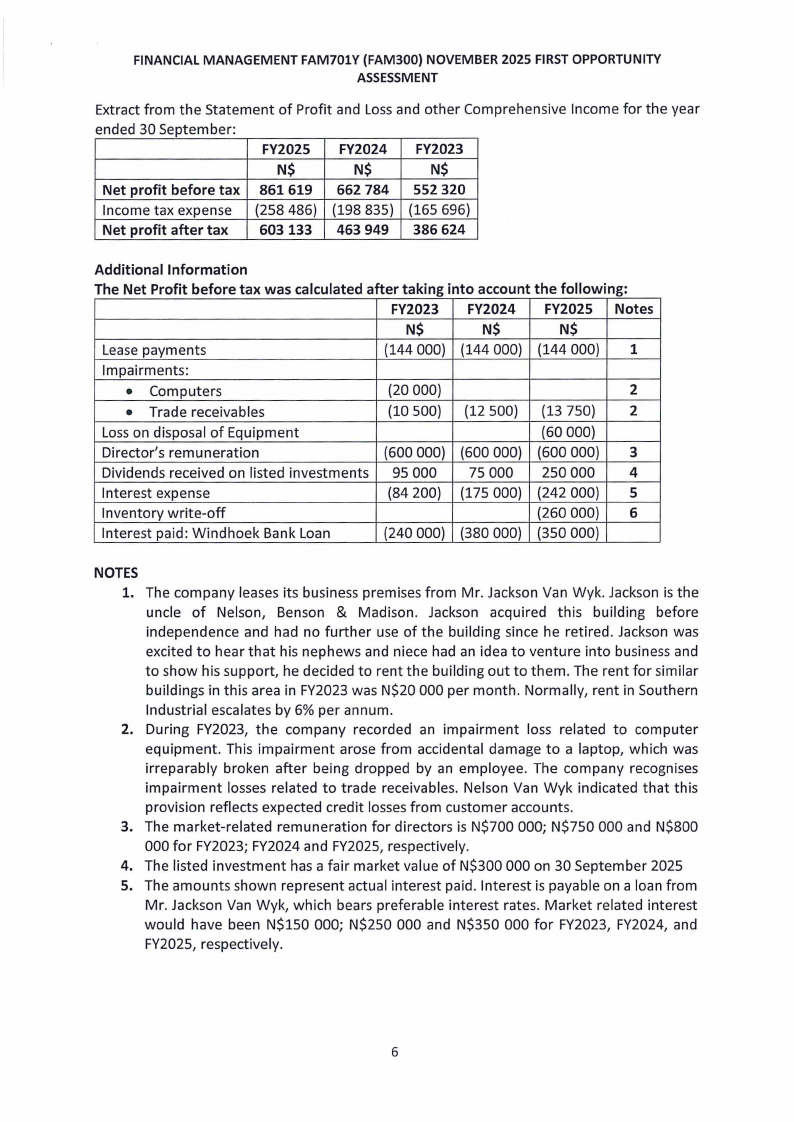
Extract from the Statement of Profit and Loss and other Comprehensive Income for the year
ended 30 September:
FY2025 FY2024 FY2023
N$
N$
N$
Net profit before tax 861619 662 784 552 320
Income tax expense (258 486} (198 835} (165 696}
Net profit after tax 603133 463 949 386 624
Additional Information
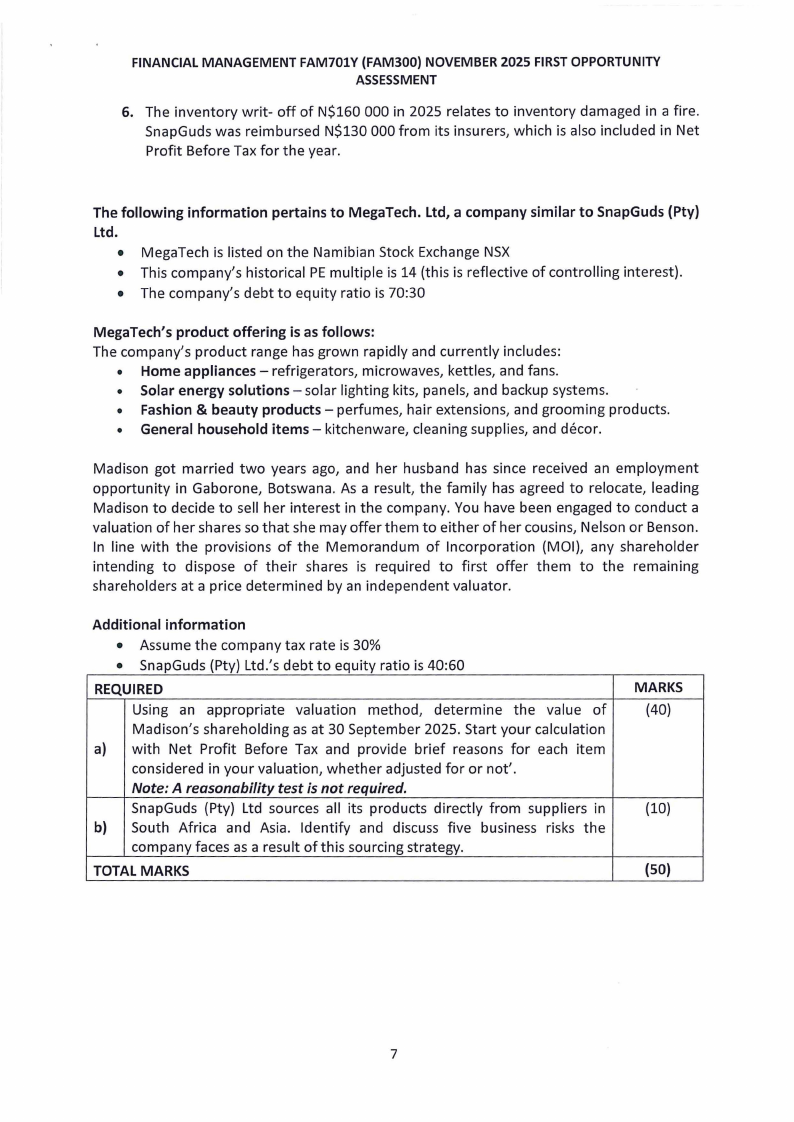
The Net Profit before tax was calculated after taking into account the following:
FY2023 FY2024 FY2025 Notes
N$
N$
N$
Lease payments
(144 000} (144 000} (144 000} 1
Impairments:
Computers
Trade receivables
Loss on disposal of Equipment
(20 000}
2
(10 500} (12 500} (13 750} 2
(60 000}
Director's remuneration
(600 000} (600 000} (600 000} 3
Dividends received on listed investments 95 000 75 000 250 000 4
Interest expense
(84 200} (175 000} (242 000} 5
Inventory write-off
(260 000} 6
Interest paid: Windhoek Bank Loan
(240 000} (380 000} (350 000}
NOTES
1. The company leases its business premises from Mr. Jackson Van Wyk. Jackson is the
uncle of Nelson, Benson & Madison. Jackson acquired this building before
independence and had no further use of the building since he retired. Jackson was
excited to hear that his nephews and niece had an idea to venture into business and
to show his support, he decided to rent the bu ilding out to them . The rent for similar
buildings in th is area in FY2023 was N$20 000 per month . Normally, rent in Southern
Industrial escalates by 6% per annum .
2. During FY2023, the company recorded an impairment loss related to computer
equipment. This impairment arose from accidental damage to a laptop, which was
irreparably broken after being dropped by an employee. The company recognises
impairment losses related to trade receivables. Nelson Van Wyk indicated that this
provision reflects expected credit losses from customer accounts.
3. The market-related remuneration for directors is N$700 000; N$750 000 and N$800
000 for FY2023; FY2024 and FY2025, respectively.
4. The listed investment has a fair market value of N$300 000 on 30 September 2025
5. The amounts shown represent actual interest paid. Interest is payable on a loan from
Mr. Jackson Van Wyk, which bears preferable interest rates . Market related interest
would have been N$150 000; N$250 000 and N$350 000 for FY2023, FY2024, and
FY2025, respectively.
6

7 Page 7

▲back to top


FINANCIAL MANAGEMENT FAM701Y (FAM300) NOVEMBER 2025 FIRST OPPORTUNITY
ASSESSMENT
6. The inventory writ- off of N$160 000 in 2025 relates to inventory damaged in a fire.
SnapGuds was reimbursed N$130 000 from its insurers, which is also included in Net
Profit Before Tax for the year.
The following information pertains to MegaTech. Ltd, a company similar to SnapGuds (Pty)
Ltd.
• MegaTech is listed on the Namibian Stock Exchange NSX
• This company's historical PE multiple is 14 (this is reflective of controlling interest).
• The company's debt to equity ratio is 70:30
MegaTech's product offering is as follows:
The company's product range has grown rapidly and currently includes:
Home appliances - refrigerators, microwaves, kettles, and fans.
Solar energy solutions - solar lighting kits, panels, and backup systems.
Fashion & beauty products - perfumes, hair extensions, and grooming products.
General household items - kitchenware, cleaning supplies, and decor.
Madison got married two years ago, and her husband has since received an employment
opportunity in Gaborone, Botswana. As a result, the family has agreed to relocate, leading
Madison to decide to sell her interest in the company. You have been engaged to conduct a
valuation of her shares so that she may offer them to either of her cousins, Nelson or Benson .
In line with the provisions of the Memorandum of Incorporation (MOI), any shareholder
intending to dispose of their shares is required to first offer them to the remaining
shareholders at a price determined by an independent valuator.
Additional information
• Assume the company tax rate is 30%
• SnapGuds (Pty) Ltd.'s debt to equity ratio is 40:60
REQUIRED
Using an appropriate valuation method, determine the value of
Madison's shareholding as at 30 September 2025. Start your calculation
a) with Net Profit Before Tax and provide brief reasons for each item
considered in your valuation, whether adjusted for or not'.
Note: A reasonability test is not required.
SnapGuds (Pty) Ltd sources all its products directly from suppliers in
b) South Africa and Asia. Identify and discuss five business risks the
company faces as a result of this sourcing strategy.
TOTAL MARKS
MARKS
(40)
(10)
(50)
7

8 Page 8

▲back to top


FINANCIAL MANAGEMENT FAM701Y (FAM300) NOVEMBER 2025 FIRST OPPORTUNITY
ASSESSMENT
Question 3
[35 Marks]
Juiceit is a shop that sells various mixed fruit juices in the central business area of
Grootfontein. The shop is well known for its exotic mix of different types of fruit juice. For
example, the product that is most favoured by the public is the "Cotavo", which is the
combination of avocado and apricot juices.
The standard mix of the Cotavo is 60% avocado juice and 40% apricot juice, which will give
the best creamy taste of the mix. However, human error does occur, which usually results in
slightly different input ratio. The company employs a standard variable costing system.
The production process starts by pouring the juices into a big pot, after which one worker
stirs the pot continuously for 2 hours until it is ready to be packaged and sold. The company
prefers to use manual stirring by workers as a machine destroys the taste in the process of
stirring. No initial material loss is expected at the pouring of the juices into the pot. Each pot
takes 20 litres of juice and the mixing of every 20 litres of juice is treated as one batch.
The company only sells freshly blended fruit mixes at the shop. Every morning the inspection
workers (pickers) will select good quality fruits, which will be blended and sold as fruit juices.
These workers are permanently employed because of their experience and skills in selecting
the best fruits.
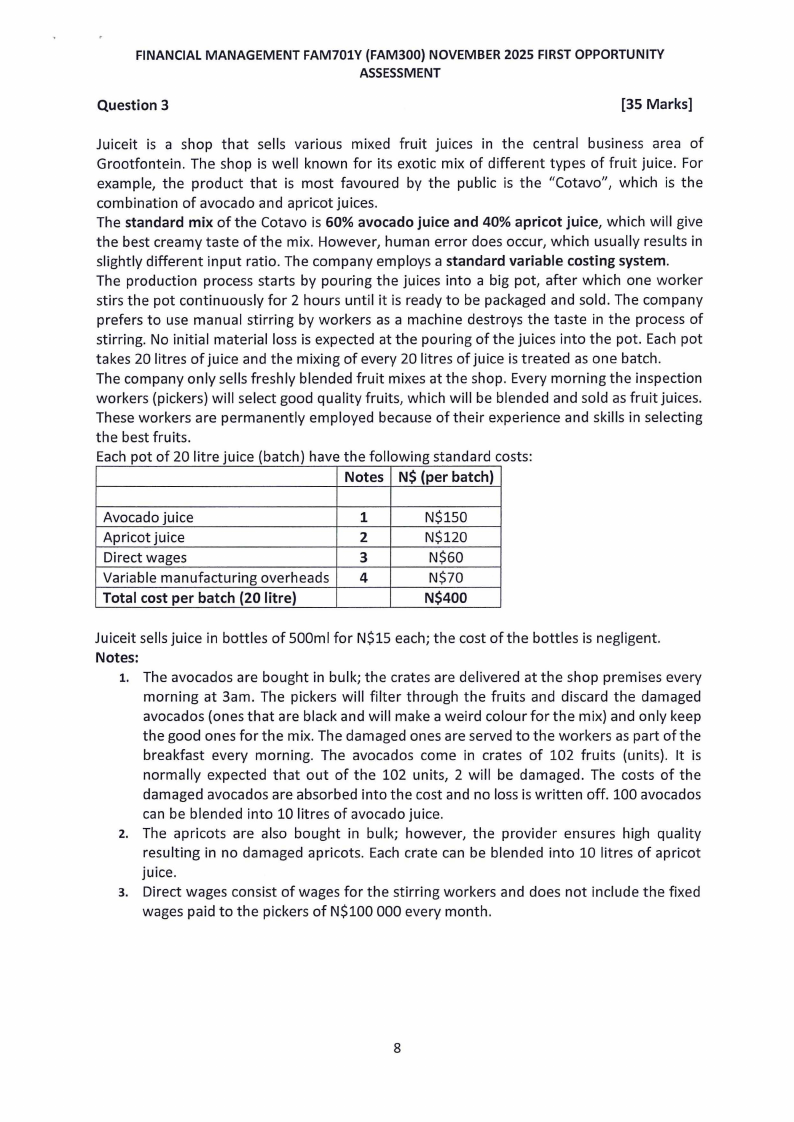
Each pot of 20 litre juice (batch) have the following standard costs:
Notes N$ (per batch)
Avocado juice
1
Apricot juice
2
Direct wages
3
Variable manufacturing overheads 4
Total cost per batch (20 litre)
N$150
N$120
N$60
N$70
N$400
Juiceit sells juice in bottles of 500ml for N$15 each; the cost of the bottles is negligent.
Notes:
1. The avocados are bought in bulk; the crates are delivered at the shop premises every
morning at 3am. The pickers will filter through the fruits and discard the damaged
avocados (ones that are black and will make a weird colour for the mix) and only keep
the good ones for the mix. The damaged ones are served to the workers as part of the
breakfast every morning. The avocados come in crates of 102 fruits (units). It is
normally expected that out of the 102 units, 2 will be damaged . The costs of the
damaged avocados are absorbed into the cost and no loss is written off. 100 avocados
can be blended into 10 litres of avocado juice.
2. The apricots are also bought in bulk; however, the provider ensures high quality
resulting in no damaged apricots. Each crate can be blended into 10 litres of apricot
juice.
3. Direct wages consist of wages for the stirring workers and does not include the fixed
wages paid to the pickers of N$100 000 every month.
8

9 Page 9

▲back to top


FINANCIAL MANAGEMENT FAM701Y (FAM300) NOVEMBER 2025 FIRST OPPORTUNITY
ASSESSMENT
4. Variable overheads are allocated per litre produced. Other than the variable overhead
mentioned above, Juiceit also incurs N$30 000 fixed overhead every month for the
rent of the shop premises.
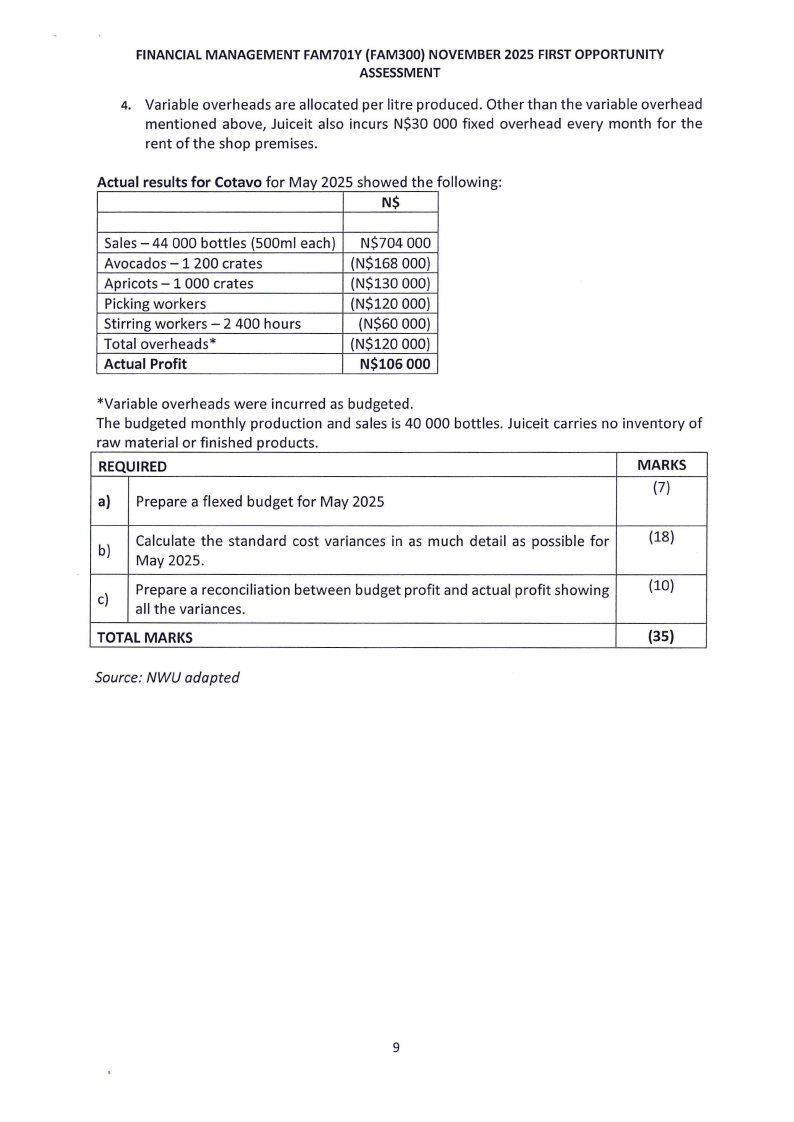
Actual results for Cotavo for May 2025 showed the following:
N$
Sales -44 000 bottles (500ml each}
Avocados -1 200 crates
Apricots - 1 000 crates
Picking workers
Stirring workers - 2 400 hours
Total overheads*
Actua I Profit
N$704 000
(N$168 000}
(N$130 000}
(N$120 000}
(N$60 000}
(N$120 000}
N$106 000
*Variable overheads were incurred as budgeted.
The budgeted monthly production and sales is 40 000 bottles. Juiceit carries no inventory of
raw material or finished products.
REQUIRED
MARKS
(7)
a) Prepare a flexed budget for May 2025
b} Calculate the standard cost variances in as much detail as possible for
{18}
May 2025.
c} Prepare a reconciliation between budget profit and actual profit showing
(10}
all the variances.
TOTAL MARKS
(35)
Source: NWU adapted
9