


 |
COT721S - COMMUNICATION THEORIES - 1ST OPP - NOVEMBER 2025 |
|
|
1 Page 1 |
▲back to top |
nAmlBIA UnlVERSITY
OF SCIEnCE Ano TECHn0L0GY
FACULTY OF COMMERCE, HUMAN SCIENCES AND EDUCATION
DEPARTMENT OF COMMUNICATION AND LANGUAGES
QUALIFICATION: BACHELOR OF COMMUNICATION
QUALIFICATION CODE: 07BCMM MODE: 7
COURSE CODE: COT721S
.
SESSION: NOVEMBER 2025
DURATION: 3 HOURS
COURSE NAME: COMMUNICATION THEORIES
PAPER: THEORY
MARKS: 100
EXAMINER:
15T OPPORTUNITY EXAMINATION QUESTION PAPER
DR. B. KAMWI
MODERATOR: MR. I. HAMATA
INSTRUCTIONS
1. Answer ALL the questions and start each question on a new page.
2. Read all questions carefully before answering.
3. Number answers according to the numbering structure provided in the question
paper.
4. INDICATE WHETHER YOU ARE FM; PM OR A DI STUDENT
THIS QUESTION PAPER CONSISTS OF 2 PAGES (Including this front page)
|
|
2 Page 2 |
▲back to top |
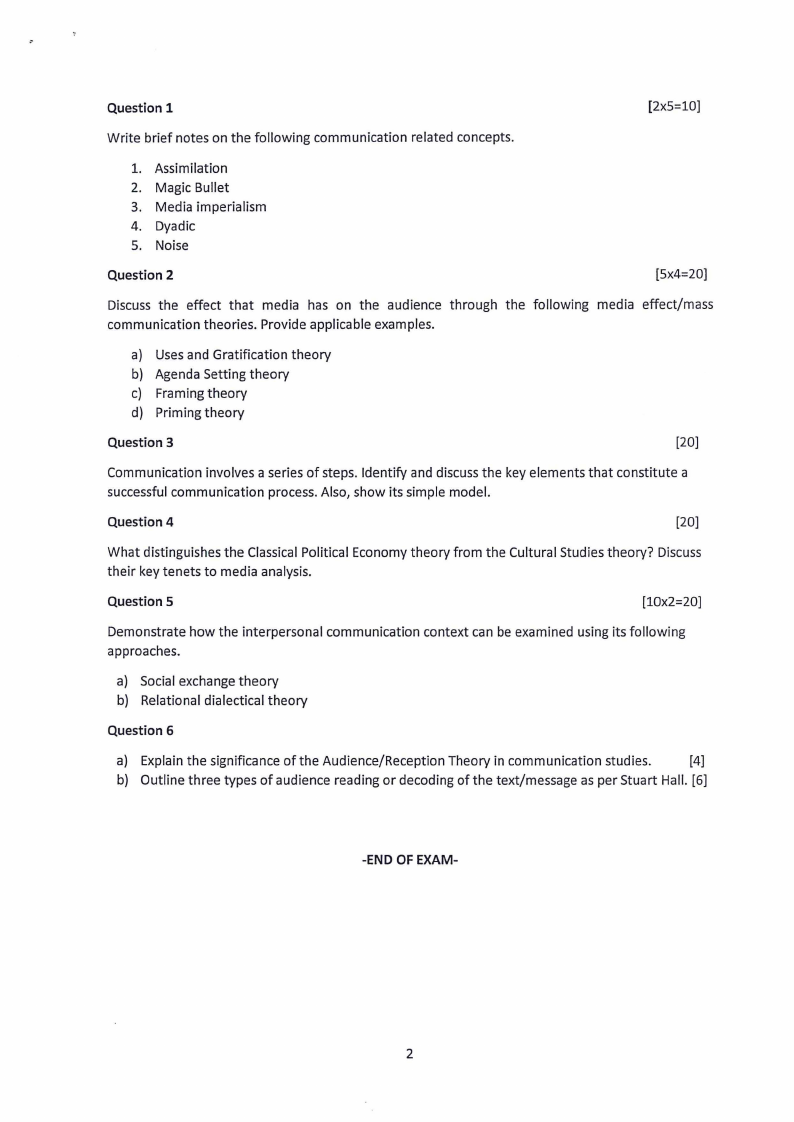
Question 1
[2x5=10]
Write brief notes on the following communication related concepts.
1. Assimilation
2. Magic Bullet
3. Media imperialism
4. Dyadic
5. Noise
Question 2
[Sx4=20]
Discuss the effect that media has on the audience through the following media effect/mass
communication theories. Provide applicable examples.
a) Uses and Gratification theory
b) Agenda Setting theory
c) Framing theory
d) Priming theory
Question 3
[20]
Communication involves a series of steps. Identify and discuss the key elements that constitute a
successful communication process. Also, show its simple model.
Question 4
[20]
What distinguishes the Classical Political Economy theory from the Cultural Studies theory? Discuss
their key tenets to media analysis.
Question 5
[10x2=20]
Demonstrate how the interpersonal communication context can be examined using its following
approaches.
a) Social exchange theory
b) Relational dialectical theory
Question 6
a) Explain the significance of the Audience/Reception Theory in communication studies.
[4]
b) Outline three types of audience reading or decoding of the text/message as per Stuart Hall. [6]
-END OF EXAM-
2