


 |
BNS511S-BIOLOGY FOR NATURAL SCIENCES-2ND OPP-JULY 2025 |
|
|
1 Page 1 |
▲back to top |
nAmlBIA UnlVERSITY
OF SCIEn CE Ano TECHn OLOGY
FACULTYOF HEALTH,NATURALRESOURCESAND APPLIEDSCIENCES
DEPARTMENTOF NATURALRESOURCESCIENCES
QUALIFICATION:BACHELOROF NATURALRESOURCEMANAGEMENT
QUALIFICATIONCODE: 07BNRS
LEVEL: 7
COURSECODE: BNSSllS
COURSENAME: Biology for Natural Sciences
SESSION:JULY 2025
DURATION: 3 HOURS
PAPER:THEORY(PAPER1)
MARKS: 120
SECONDOPPORTUNITYEXAMINATION QUESTION PAPER
EXAMINER{S) Mrs. G.L. THERON
MODERATOR: Mr. H TJIKURUNDA
INSTRUCTIONS
1. Answer ALL the questions.
2. Read all the questions carefully before answering.
3. Number the answers clearly
THIS QUESTION PAPERCONSISTSOF_ 4_ PAGES(Including this front page)
1
|
|
2 Page 2 |
▲back to top |
SECTIONA: Short questions
[40 marks]
QUESTION 1
[15]
Give the scientific term for each of the following:
1.1
An atom that has gained one or more electrons.
1.2
The process whereby a gas is cooled, the movement of the particles slows down, and
eventually a liquid is formed.
1.3
The way Amoeba feeds - engulfing the entire organism it feeds on.
1.4
The type of lichens that grow as a thin crust on the surface of rocks.
1.5
The Phylum that Amoeba belongs to.
1.6
The structures used to anchor Laminaria (similar to the roots of plants)?
1.7
Fungal hyphae that lack cross-walls completely.
1.8
The Phylum that the field mushroom (Agaricus) belongs to.
1.9
The type of mixture where the particles are blended completely.
1.10
The process whereby a gas changes directly into a solid.
1.11
The collective name for the elements in group 8 on the Periodic table.
1.12
The Phylum (Protoctista) with TWO nuclei in each unicellular organism.
1.13
The organelle responsible for regulating the water content in cells.
1.14
The cell wall material (compound) found in Bacillariophyta
1.15
The type of lichens that grow as a thin crust on the surface of rocks.
QUESTION 2
[10]
Explain the difference between the following pairs of terms.
2.1
Chemosynthetic bacteria and Photosynthetic bacteria.
2.2
Antheridium and Archegonium
2.3
lsogametes and Oogametes
2.4
Ascocarp and Basidiocarp
2.5
Zoospores and Aplanospores
QUESTION 3
[15]
State whether each of the following statements is True OR False.
3.1
The kinetic theory of matter states that the higher the temperature, the lower the
average kinetic energy of the particles.
3.2
Melting ice cubes on the stove is an example of an exothermic reaction.
3.3
Compounds can be decomposed by ordinary chemical means.
3.4
Porphyra and Ulva are typical examples of algae that have alternation of isomorphic
generations.
3.5
Agar and Carrageenan are commercially important cell wall products harvested from
Chlorophyta.
3.6
Mushrooms have chitin in their cell walls.
3.7
Members of the Phylum Phaeophyta are commonly known as brown algae.
3.8
Members of the Phylum Apicomplexa are multinucleated.
3.9
The granular cytoplasm of Amoeba is known as the ectoplasm, and is responsible for
the formation of the pseudopodia.
3.10
During plasmogamy, the cytoplasm of two cells fuse.
3.11
The "bracket fungi" belong to the phylum Deuteromycota.
3.12
Fruticose lichens are small, fine fern-like bushes that are unattached to the substrate.
3.13
The horizontal above-ground hyphae found in some fungi are known as stolons.
2
|
|
3 Page 3 |
▲back to top |
3.14
The causal agent for malaria is Plasmodium.
3.15
Members of the phylum Apicomplexa have an infectious stage known as sporozoites.
SUB - TOTAL {40)
SECTION B: Longer questions
[80 marks]
QUESTION 4
[15]
4.1
In TABLE format, explain 5 differences between mixtures and compounds.
(5)
4.2
Give the scientific term for each of the following:
(4)
4.2.1 The liquid in which the solution is made.
4.2.2 A solution that contains as much solute as can be dissolved at a particular temperature.
4.2.3 The process that separates an insoluble solid from a liquid.
4.2.4 Atoms of the same element, with the same number of protons, but different numbers
of neutrons.
4.3
Indicate how many neutrons each of the following elements have.
(3)
4.3.1 131 ls3
4.3.2 201 Hgso
4.3.3 207 Pbs2
4.4
Indicate how many electrons each of the following elements has.
(2)
4.4.2 226 Rass2·
4.5
Which is larger - a proton or an atom of Lead?
QUESTION 5
5.1
Provide the correct term for each of the following statements:
5.1.1 The protein shell of a virus, enclosing its genetic material.
5.1.2 Archaebacteria found in salt pans.
5.1.3 The "polymer" found in the cell walls of bacteria.
5.1.4 The process by which bacteria reproduce.
5.2
Explain the difference between a virulent phage and a temperate phage.
5.3
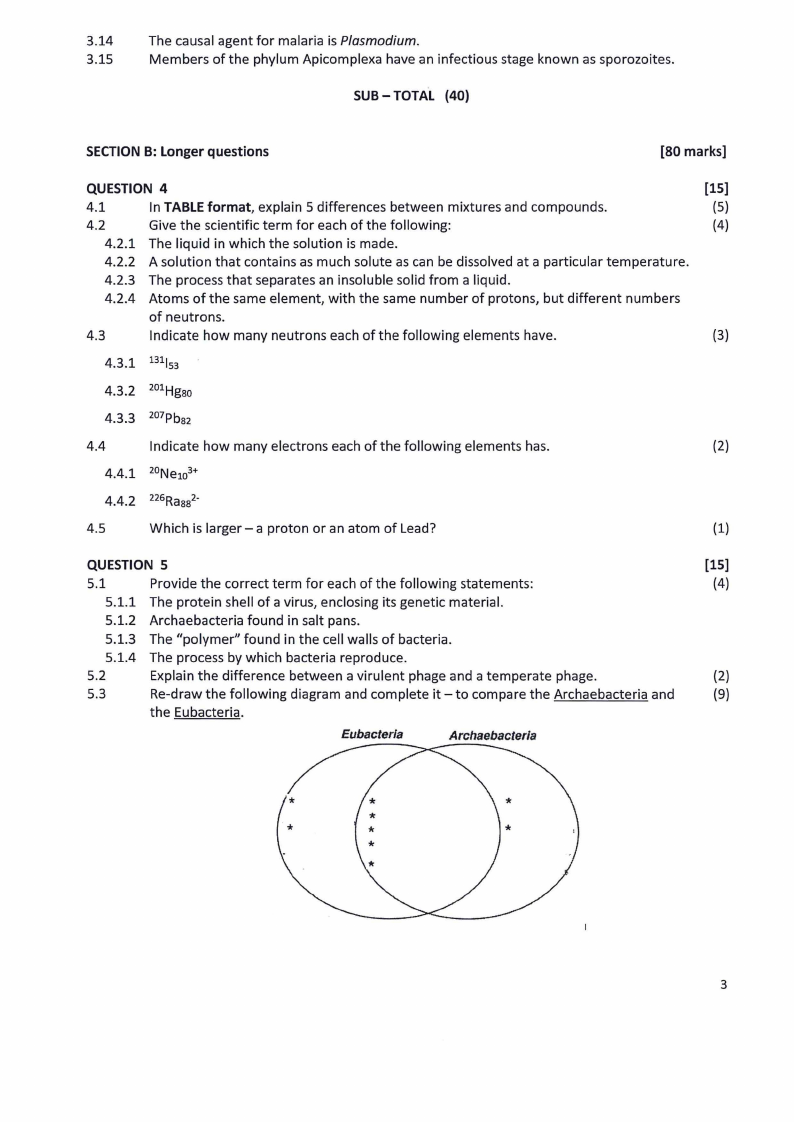
Re-draw the following diagram and complete it - to compare the Archaebacteria and
the Eubacteria.
Eubacterla
Archaebacterla
(1)
[15]
(4)
(2)
(9)
*
*
*
*
*
3
|
|
4 Page 4 |
▲back to top |
QUESTION 6
6.1
Distinguish between the ecto- and endoplasm of the Rhizopoda. Explain how they
differ and also name the function of each.
6.2
Explain - in detail - how Paramecium feeds. Make use of FULLsentences!
QUESTION 7
7.1
Write a report on the ecological and economic importance of the Phaeophyta.
7.2
Explain the difference between "Alternation of Isomorphic generations" and
"Alternation of Heteromorphic generations" as found in the life-cycles of seaweed.
Also provide an algal example {Genus names only) for each.
7.3
Name the Phylum that "red" algae belong to.
QUESTION 8
8.1
Explain the difference between dikaryotic and monokaryotic hyphae.
8.2
How does the feeding of fungi differ from that of most animals? Name at least
ONE animal that has a similar type of digestion to that of fungi.
8.3
What is your understanding of the term "mycorrhiza"?
8.4
Explain why it is important for us to protect the lichens that grow near Wlotzkasbaken as well
as the ones found on the rocks at Waterberg.
QUESTION 9
9.1
Define the term diffusion.
9.2
List the products and the waste products produced during the light-dependent phase
of photosynthesis.
9.3
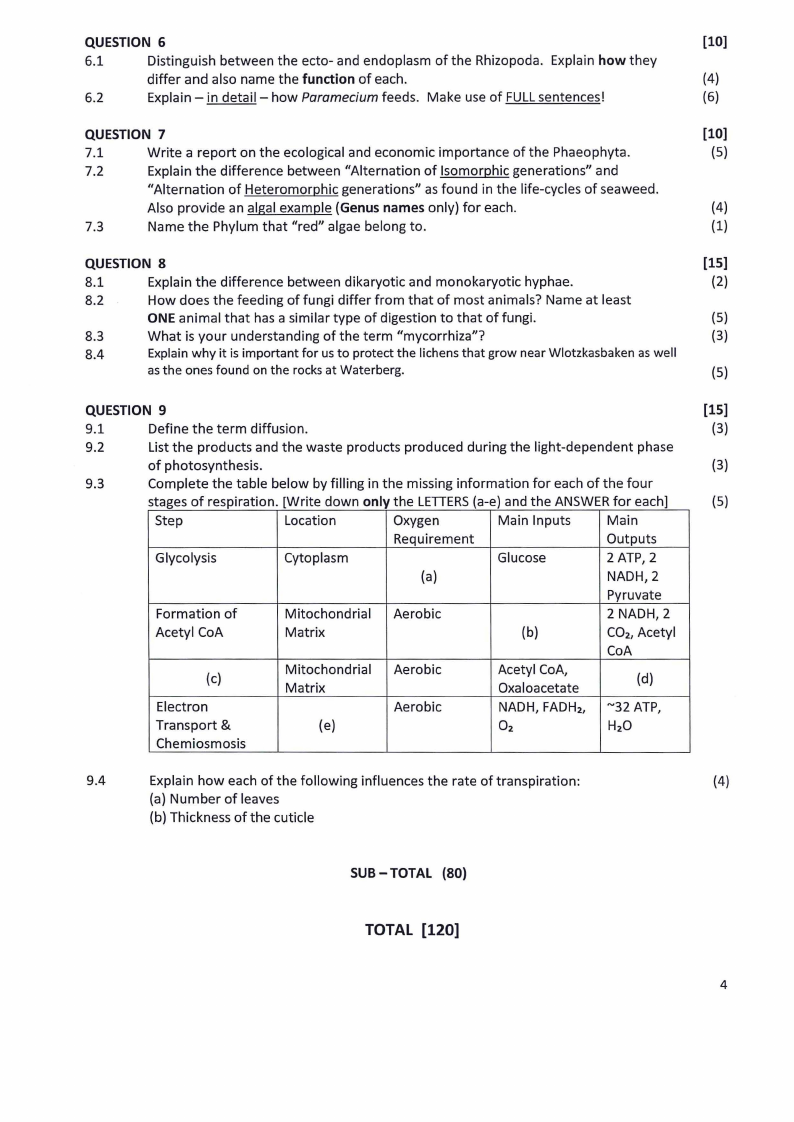
Complete the table below by filling in the missing information for each of the four
stages of respiration. [Write down only the LETTERS(a-e) and the ANSWERfor each]
Step
Location
Oxygen
Main Inputs
Main
Requirement
Outputs
Glycolysis
Cytoplasm
Glucose
2 ATP, 2
(a)
NADH, 2
Pyruvate
Formation of
Mitochondrial Aerobic
2 NADH, 2
Acetyl CoA
Matrix
(b)
CO2,Acetyl
CoA
(c)
Mitochondrial
Matrix
Aerobic
Acetyl CoA,
Oxaloacetate
(d)
Electron
Aerobic
NADH, FADH2, ~32 ATP,
Transport &
(e)
02
H20
Chemiosmosis
9.4
Explain how each of the following influences the rate of transpiration:
(a) Number of leaves
(b) Thickness of the cuticle
[10]
(4)
(6)
[10]
(5)
(4)
(1)
[15]
(2)
(5)
(3)
(5)
[15]
(3)
(3)
(5)
(4)
SUB -TOTAL (80)
TOTAL [120]
4