


 |
PSR521S - Procurement And Supply Chain Risk Management - 1st Opp - Nov 2025 |
|
|
1 Page 1 |
▲back to top |
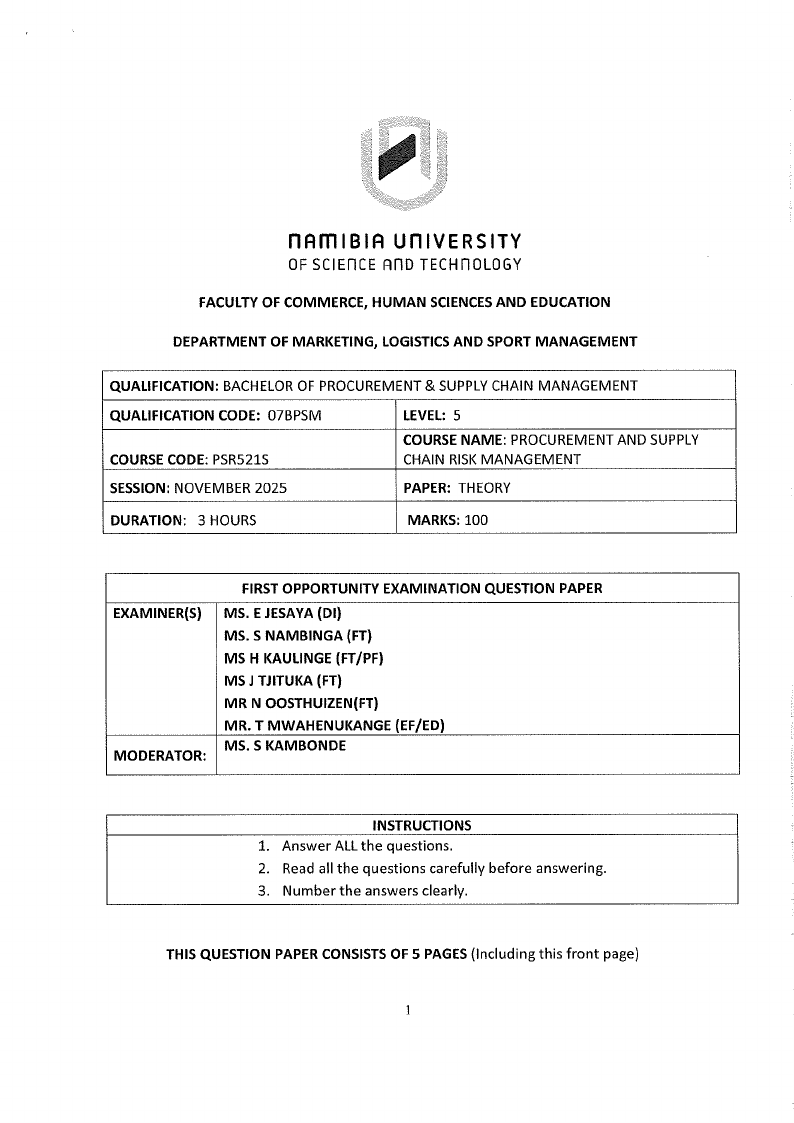
nAm I BIA un IVE RSITY
OF SCIEnCE Ano TECHnOLOGY
FACULTY OF COMMERCE, HUMAN SCIENCES AND EDUCATION
DEPARTMENT OF MARKETING, LOGISTICS AND SPORT MANAGEMENT
QUALIFICATION: BACHELOR OF PROCUREMENT & SUPPLY CHAIN MANAGEMENT
QUALIFICATION CODE: 07BPSM
COURSE CODE: PSR521S
SESSION: NOVEMBER 2025
LEVEL: 5
COURSE NAME: PROCUREMENT AND SUPPLY
CHAIN RISK MANAGEMENT
PAPER: THEORY
DURATION: 3 HOURS
MARKS: 100
EXAMINER(S)
MODERATOR:
FIRST OPPORTUNITY EXAMINATION QUESTION PAPER
MS. E JESAYA (DI)
MS. S NAMBINGA (FT)
MS H KAULINGE (FT/PF)
MS J TJITUKA (FT)
MR N OOSTHUIZEN(FT)
MR. T MWAHENUKANGE (EF/ED)
MS. S KAMBONDE
INSTRUCTIONS
1. Answer ALL the questions.
2. Read all the questions carefully before answering.
3. Number the answers clearly.
THIS QUESTION PAPER CONSISTS OF S PAGES (Including this front page)
|
|
2 Page 2 |
▲back to top |
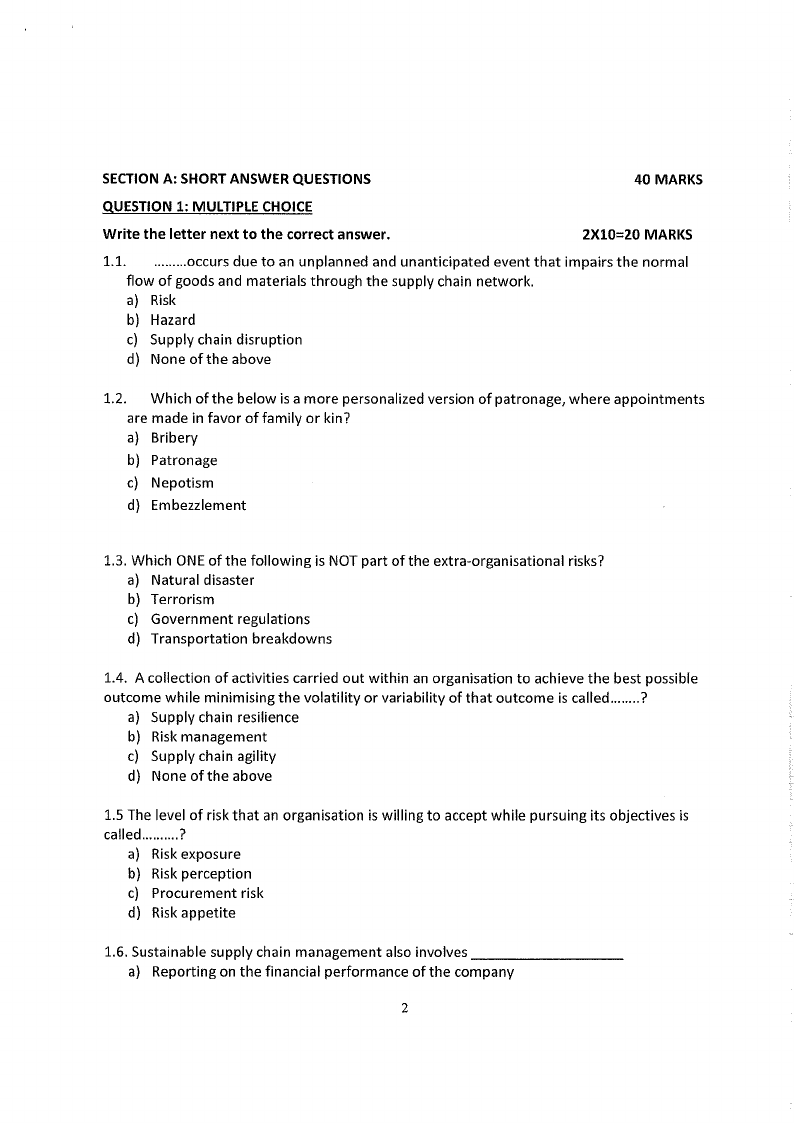
SECTION A: SHORT ANSWER QUESTIONS
40 MARKS
QUESTION 1: MULTIPLE CHOICE
Write the letter next to the correct answer.
2X10=20 MARKS
1.1. .........occurs due to an unplanned and unanticipated event that impairs the normal
flow of goods and materials through the supply chain network.
a) Risk
b) Hazard
c) Supply chain disruption
d) None of the above
1.2. Which of the below is a more personalized version of patronage, where appointments
are made in favor of family or kin?
a) Bribery
b) Patronage
c) Nepotism
d) Embezzlement
1.3. Which ONE of the following is NOT part of the extra-organisational risks?
a) Natural disaster
b) Terrorism
c) Government regulations
d) Transportation breakdowns
1.4. A collection of activities carried out within an organisation to achieve the best possible
outcome while minimising the volatility or variability of that outcome is called ........?
a) Supply chain resilience
b) Risk management
c) Supply chain agility
d) None of the above
1.5 The level of risk that an organisation is willing to accept while pursuing its objectives is
called .......... ?
a) Risk exposure
b) Risk perception
c) Procurement risk
d) Risk appetite
1.6. Sustainable supply chain management also involves _ _ _ _ _ _ __
a) Reporting on the financial performance of the company
2
|
|
3 Page 3 |
▲back to top |
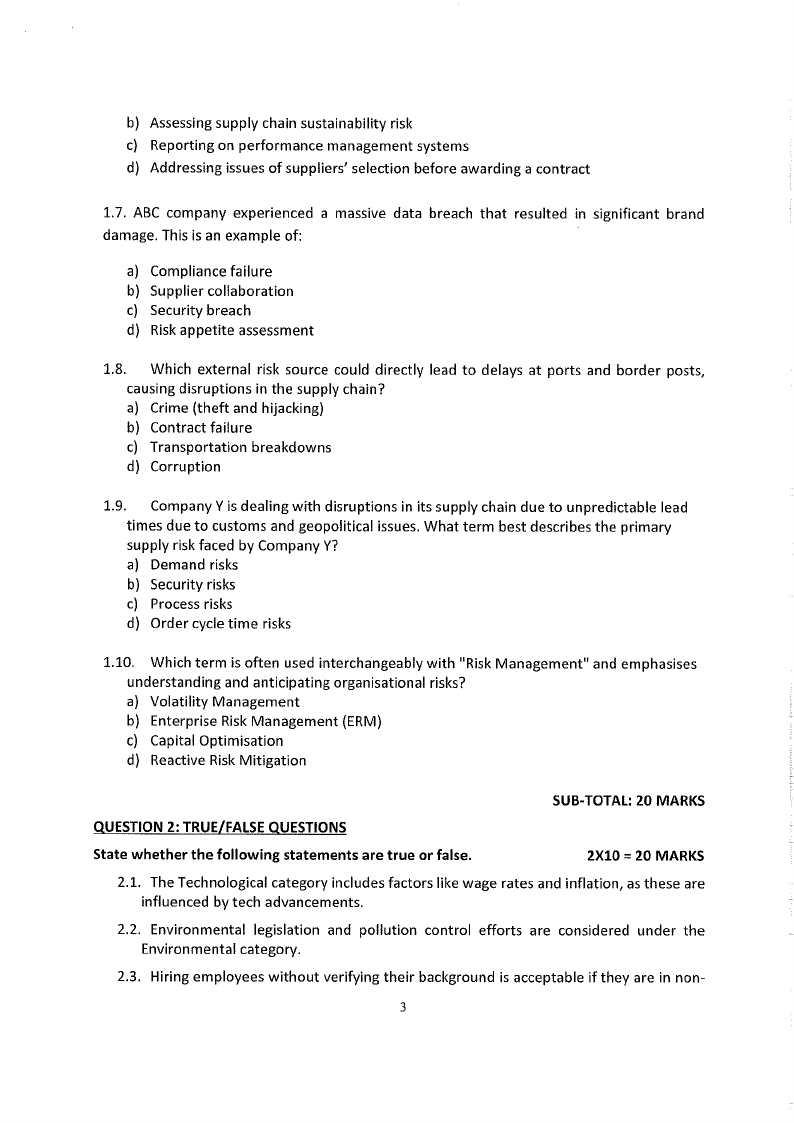
b) Assessing supply chain sustainability risk
c) Reporting on performance management systems
d) Addressing issues of suppliers' selection before awarding a contract
1.7. ABC company experienced a massive data breach that resulted in significant brand
damage. This is an example of:
a) Compliance failure
b) Supplier collaboration
c) Security breach
d) Risk appetite assessment
1.8. Which external risk source could directly lead to delays at ports and border posts,
causing disruptions in the supply chain?
a) Crime (theft and hijacking)
b) Contract failure
c) Transportation breakdowns
d) Corruption
1.9. Company Y is dealing with disruptions in its supply chain due to unpredictable lead
times due to customs and geopolitical issues. What term best describes the primary
supply risk faced by Company Y?
a) Demand risks
b) Security risks
c) Process risks
d) Order cycle time risks
1.10. Which term is often used interchangeably with "Risk Management" and emphasises
understanding and anticipating organisational risks?
a) Volatility Management
b) Enterprise Risk Management (ERM)
c) Capital Optimisation
d) Reactive Risk Mitigation
SUB-TOTAL: 20 MARKS
QUESTION 2: TRUE/FALSE QUESTIONS
State whether the following statements are true or false.
2X10 = 20 MARKS
2.1. The Technological category includes factors like wage rates and inflation, as these are
influenced by tech advancements.
2.2. Environmental legislation and pollution control efforts are considered under the
Environmental category.
2.3. Hiring employees without verifying their background is acceptable if they are in non-
3
|
|
4 Page 4 |
▲back to top |
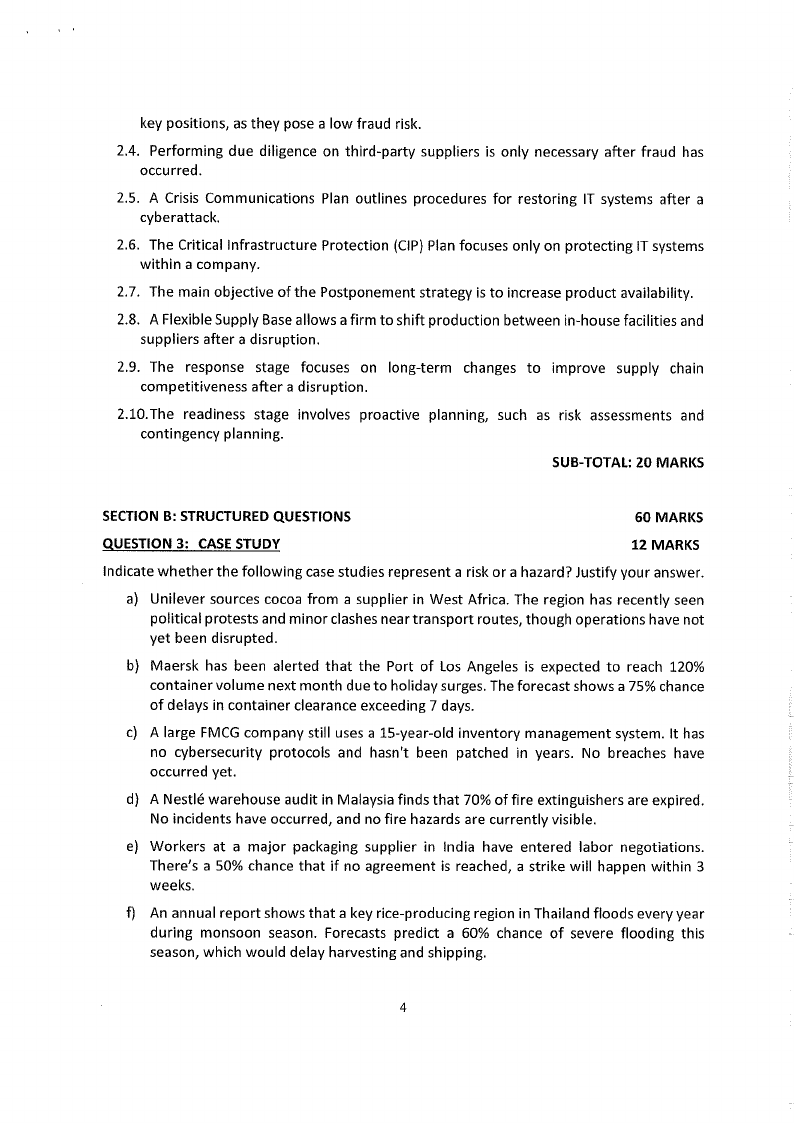
key positions, as they pose a low fraud risk.
2.4. Performing due diligence on third-party suppliers is only necessary after fraud has
occurred.
2.5. A Crisis Communications Plan outlines procedures for restoring IT systems after a
cyberattack.
2.6. The Critical Infrastructure Protection (CIP) Plan focuses only on protecting IT systems
within a company.
2. 7. The main objective of the Postponement strategy is to increase product availability.
2.8. A Flexible Supply Base allows a firm to shift production between in-house facilities and
suppliers after a disruption.
2.9. The response stage focuses on long-term changes to improve supply chain
competitiveness after a disruption.
2.10. The readiness stage involves proactive planning, such as risk assessments and
contingency planning.
SUB-TOTAL: 20 MARKS
SECTION B: STRUCTURED QUESTIONS
60 MARKS
QUESTION 3: CASE STUDY
12 MARKS
Indicate whether the following case studies represent a risk or a hazard? Justify your answer.
a) Unilever sources cocoa from a supplier in West Africa. The region has recently seen
political protests and minor clashes near transport routes, though operations have not
yet been disrupted.
b) Maersk has been alerted that the Port of Los Angeles is expected to reach 120%
container volume next month due to holiday surges. The forecast shows a 75% chance
of delays in container clearance exceeding 7 days.
c) A large FMCG company still uses a 15-year-old inventory management system. It has
no cybersecurity protocols and hasn't been patched in years. No breaches have
occurred yet.
d) A Nestle warehouse audit in Malaysia finds that 70% of fire extinguishers are expired.
No incidents have occurred, and no fire hazards are currently visible.
e) Workers at a major packaging supplier in India have entered labor negotiations.
There's a 50% chance that if no agreement is reached, a strike will happen within 3
weeks.
f) An annual report shows that a key rice-producing region in Thailand floods every year
during monsoon season. Forecasts predict a 60% chance of severe flooding this
season, which would delay harvesting and shipping.
4
|
|
5 Page 5 |
▲back to top |
''
QUESTION4
Explain six steps of preventing corruption in the supply chain?
12 MARKS
QUESTION 5
Discuss six benefits of risk management to an organisation,
12 MARKS
QUESTION 6
6.1. What is a risk register?
6.2. Discuss any five steps of the risk register?
12 MARKS
2 MARKS
10 Marks
QUESTION 7
12 MARKS
Apple Inc. is a multinational technology company known for its consumer electronics,
software, and services. The company has demonstrated a remarkable ability to achieve supply
chain resilience, ensuring the continuous availability of its products even in the face of
significant disruptions. One significant test of Apple's supply chain resilience came during the
COVID-19 pandemic. While many companies experienced severe disruptions, Apple adapted
swiftly. They:
✓ Adjusted manufacturing and logistics to accommodate remote work and social
distancing measures.
✓ Worked closely with suppliers to secure necessary components.
✓ Collaborated with logistics partners to prioritise essential shipments.
✓ Managed customer expectations and communicated effectively about product
availability.
As a result, Apple maintained a consistent supply of its products to meet customer demand,
showcasing its supply chain resilience in the face of a global crisis.
Required: assess any six advantages Apple Inc. has accrued from its resilience in the supply
chain.
SUB-TOTAL: 60 MARKS
TOTAL: 100 MARKS
THE END
5