BBE612C-BUSINESS ETHICS -1ST OPP- JUNE 2025


BBE612C-BUSINESS ETHICS -1ST OPP- JUNE 2025


1 Page 1

▲back to top


nAmlBIA UnlVERSITY
OF SCIEnCE Ano TECHnOLOGY
FACULTYOF COMMERCEH, UMANSCIENCESAND EDUCATION
HAROLDPUPKEWITZGRADUATESCHOOLOF BUSINESS
QUALIFICATIONCODE:06DBPM
COURSECODE BBE612C
LEVEL:6
COURSENAME: BUSINESSETHICS
DATE:JUNE 2025
MODE: PM
DURATION: 3 HOURS
MARKS: 100
EXAMINER(S)
MODERATOR:
FIRSTOPPORTUNITYEXAMINATION PAPER
Ms O.N Kangandjo
Ms J Hambabi
INSTRUCTIONS
1. Answer ALLthe questions.
2. Write clearly and neatly.
3. Number the answers clearly.
PERMISSIBLEMATERIALS
1. Examination paper
2. Examination script
THIS QUESTION PAPERMEMO CONSISTSOF 9 PAGES(INCLUDINGTHIS FRONTPAGE)
1

2 Page 2

▲back to top


!SECTION A]
Question 1
[20 x 2 = 40 Marks]
Multiple choice questions from 1.1 - 1.20. Indicate the letter of the correct answer next to the
question number. For example, 1.2 d.
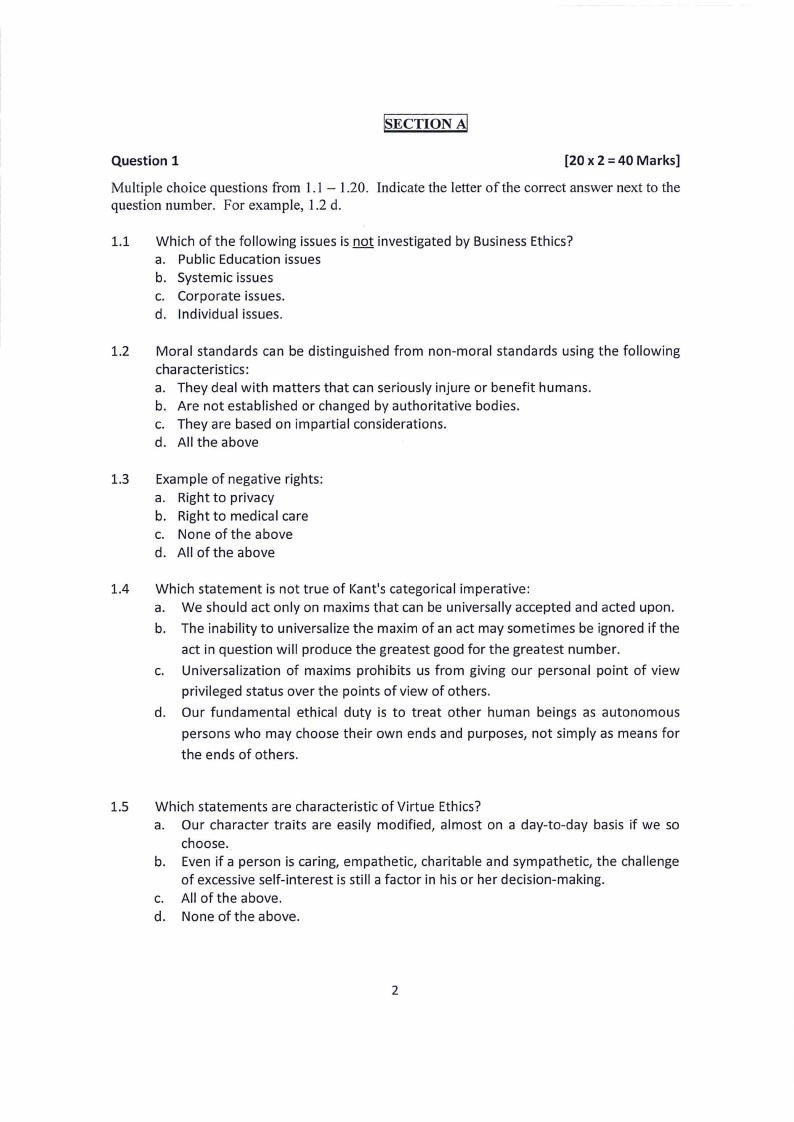
1.1 Which of the following issues is not investigated by Business Ethics?
a. Public Education issues
b. Systemic issues
c. Corporate issues.
d. Individual issues.
1.2 Moral standards can be distinguished from non-moral standards using the following
characteristics:
a. They deal with matters that can seriously injure or benefit humans.
b. Are not established or changed by authoritative bodies.
c. They are based on impartial considerations.
d. All the above
1.3 Example of negative rights:
a. Right to privacy
b. Right to medical care
c. None of the above
d. All of the above
1.4 Which statement is not true of Kant's categorical imperative:
a. We should act only on maxims that can be universally accepted and acted upon.
b. The inability to universalize the maxim of an act may sometimes be ignored if the
act in question will produce the greatest good for the greatest number.
c. Universalization of maxims prohibits us from giving our personal point of view
privileged status over the points of view of others.
d. Our fundamental ethical duty is to treat other human beings as autonomous
persons who may choose their own ends and purposes, not simply as means for
the ends of others.
1.5 Which statements are characteristic of Virtue Ethics?
a. Our character traits are easily modified, almost on a day-to-day basis if we so
choose.
b. Even if a person is caring, empathetic, charitable and sympathetic, the challenge
of excessive self-interest is still a factor in his or her decision-making.
c. All of the above.
d. None of the above.
2

3 Page 3

▲back to top


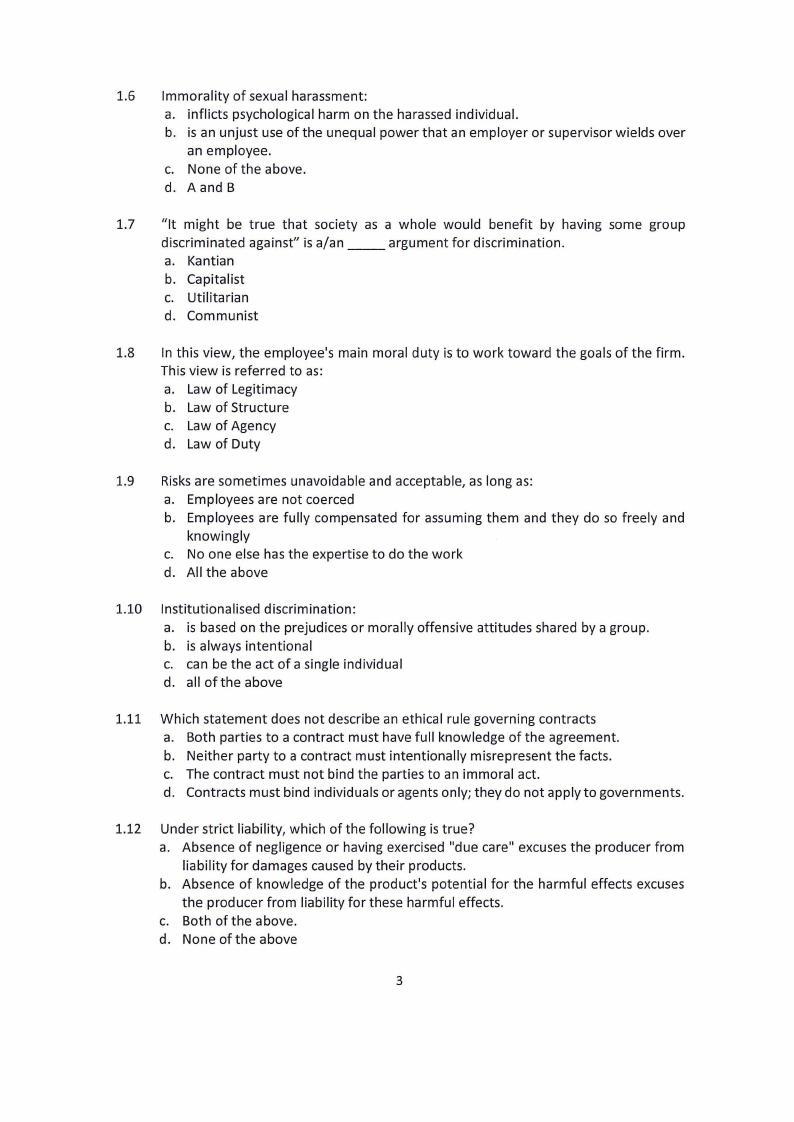
1.6 Immorality of sexual harassment:
a. inflicts psychological harm on the harassed individual.
b. is an unjust use of the unequal power that an employer or supervisor wields over
an employee.
c. None of the above.
d. A and B
1.7 "It might be true that society as a whole would benefit by having some group
discriminated against" is a/an __ argument for discrimination.
a. Kantian
b. Capitalist
c. Utilitarian
d. Communist
1.8 In this view, the employee's main moral duty is to work toward the goals of the firm.
This view is referred to as:
a. Law of Legitimacy
b. Law of Structure
c. Law of Agency
d. Law of Duty
1.9 Risks are sometimes unavoidable and acceptable, as long as:
a. Employees are not coerced
b. Employees are fully compensated for assuming them and they do so freely and
knowingly
c. No one else has the expertise to do the work
d. All the above
1.10 Institutionalised discrimination:
a. is based on the prejudices or morally offensive attitudes shared by a group.
b. is always intentional
c. can be the act of a single individual
d. alloftheabove
1.11 Which statement does not describe an ethical rule governing contracts
a. Both parties to a contract must have full knowledge of the agreement.
b. Neither party to a contract must intentionally misrepresent the facts.
c. The contract must not bind the parties to an immoral act.
d. Contracts must bind individuals or agents only; they do not apply to governments.
1.12 Under strict liability, which of the following is true?
a. Absence of negligence or having exercised "due care" excuses the producer from
liability for damages caused by their products.
b. Absence of knowledge of the product's potential for the harmful effects excuses
the producer from liability for these harmful effects.
c. Both of the above.
d. None of the above
3

4 Page 4

▲back to top


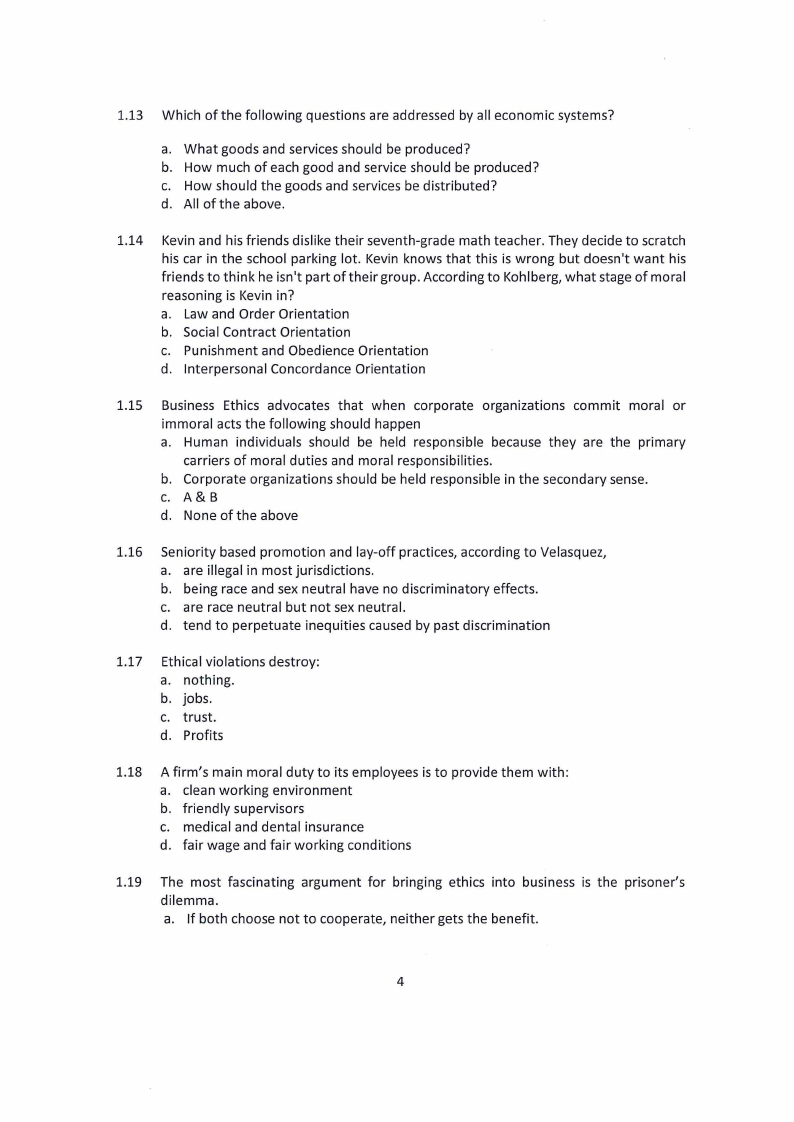
1.13 Which of the following questions are addressed by all economic systems?
a. What goods and services should be produced?
b. How much of each good and service should be produced?
c. How should the goods and services be distributed?
d. Alloftheabove.
1.14 Kevin and his friends dislike their seventh-grade math teacher. They decide to scratch
his car in the school parking lot. Kevin knows that this is wrong but doesn't want his
friends to think he isn't part oftheir group. According to KohIberg, what stage of moral
reasoning is Kevin in?
a. Law and Order Orientation
b. Social Contract Orientation
c. Punishment and Obedience Orientation
d. Interpersonal Concordance Orientation
1.15 Business Ethics advocates that when corporate organizations commit moral or
immoral acts the following should happen
a. Human individuals should be held responsible because they are the primary
carriers of moral duties and moral responsibilities.
b. Corporate organizations should be held responsible in the secondary sense.
c. A& B
d. None of the above
1.16 Seniority based promotion and lay-off practices, according to Velasquez,
a. are illegal in most jurisdictions.
b. being race and sex neutral have no discriminatory effects.
c. are race neutral but not sex neutral.
d. tend to perpetuate inequities caused by past discrimination
1.17 Ethical violations destroy:
a. nothing.
b. jobs.
c. trust.
d. Profits
1.18 A firm's main moral duty to its employees is to provide them with:
a. clean working environment
b. friendly supervisors
c. medical and dental insurance
d. fair wage and fair working conditions
1.19 The most fascinating argument for bringing ethics into business is the prisoner's
dilemma.
a. If both choose not to cooperate, neither gets the benefit.
4

5 Page 5

▲back to top


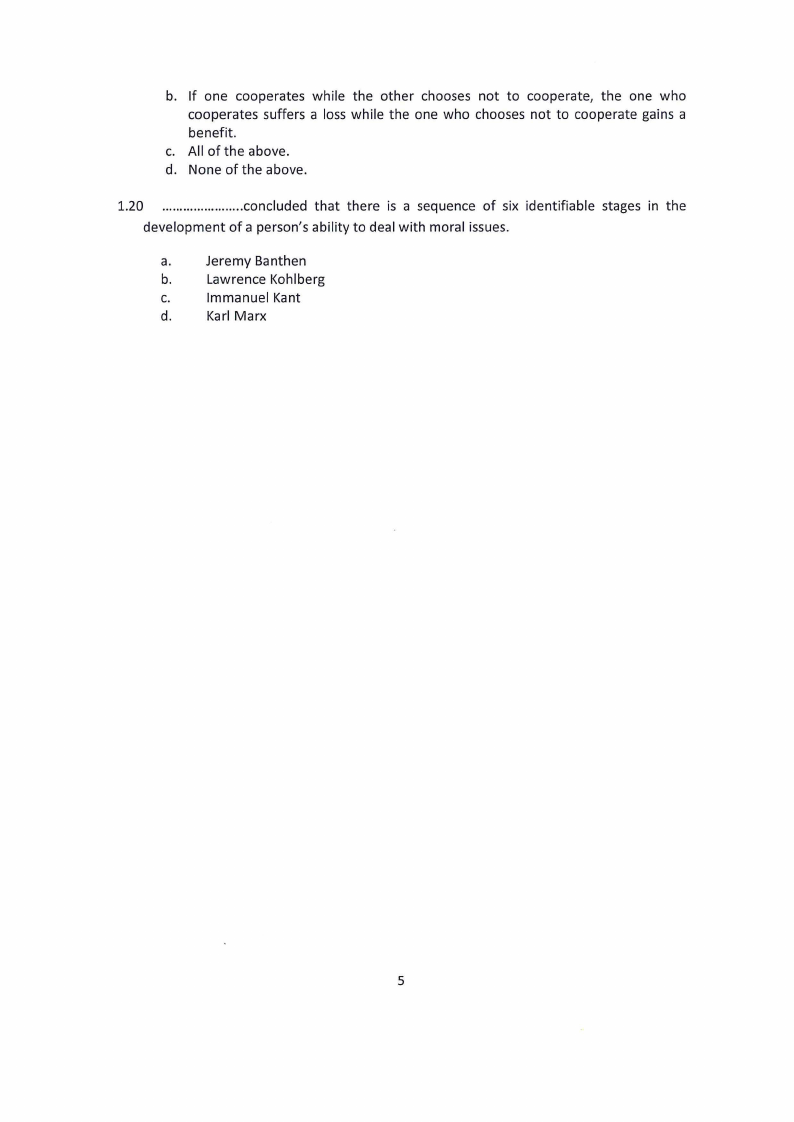
b. If one cooperates while the other chooses not to cooperate, the one who
cooperates suffers a loss while the one who chooses not to cooperate gains a
benefit.
c. All of the above.
d. None of the above.
1.20 .......................concluded that there is a sequence of six identifiable stages in the
development of a person's ability to deal with moral issues.
a.
Jeremy Banthen
b.
Lawrence Kohlberg
c.
Immanuel Kant
d.
Karl Marx
5

6 Page 6

▲back to top


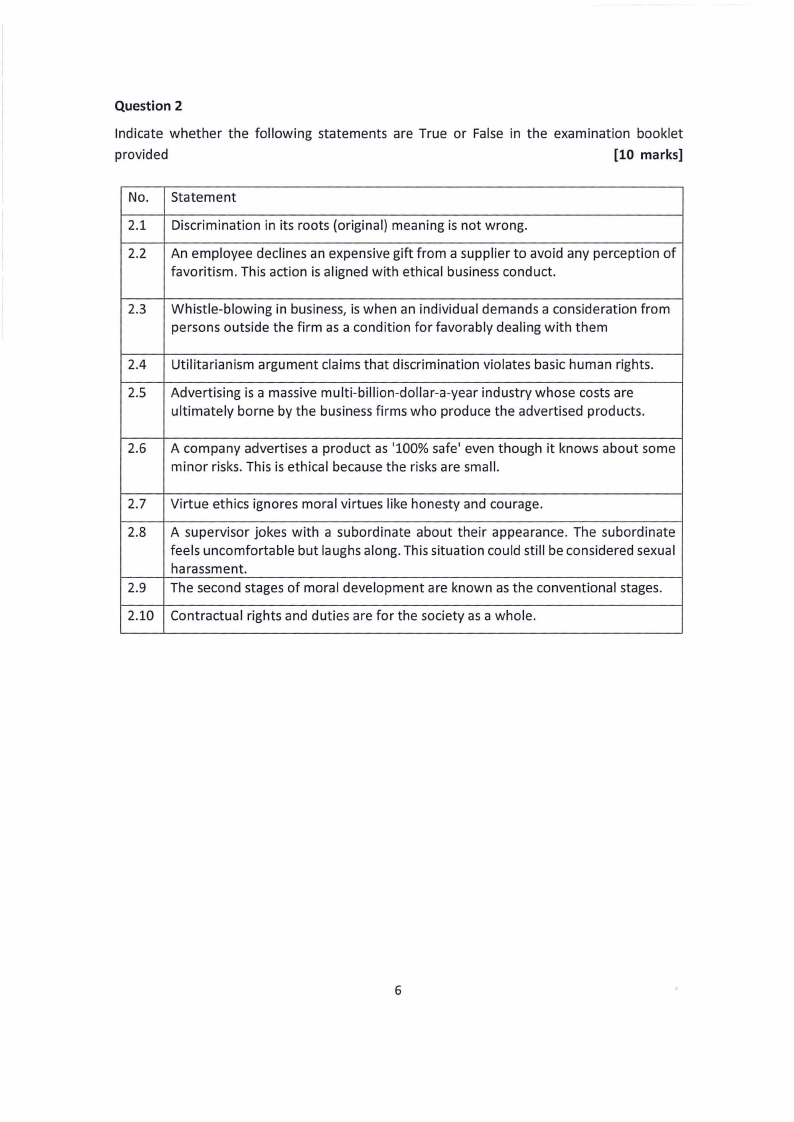
Question 2
Indicate whether the following statements are True or False in the examination booklet
provided
[10 marks]
No. Statement
2.1 Discrimination in its roots (original} meaning is not wrong.
2.2 An employee declines an expensive gift from a supplier to avoid any perception of
favoritism. This action is aligned with ethical business conduct.
2.3 Whistle-blowing in business, is when an individual demands a consideration from
persons outside the firm as a condition for favorably dealing with them
2.4 Utilitarianism argument claims that discrimination violates basic human rights.
2.5 Advertising is a massive multi-billion-dollar-a-year industry whose costs are
ultimately borne by the business firms who produce the advertised products.
2.6 A company advertises a product as '100% safe' even though it knows about some
minor risks. This is ethical because the risks are small.
2.7 Virtue ethics ignores moral virtues like honesty and courage.
2.8 A supervisor jokes with a subordinate about their appearance. The subordinate
feels uncomfortable but laughs along. This situation could still be considered sexual
harassment.
2.9 The second stages of moral development are known as the conventional stages.
2.10 Contractual rights and duties are for the society as a whole.
6

7 Page 7

▲back to top


5ECTION ij
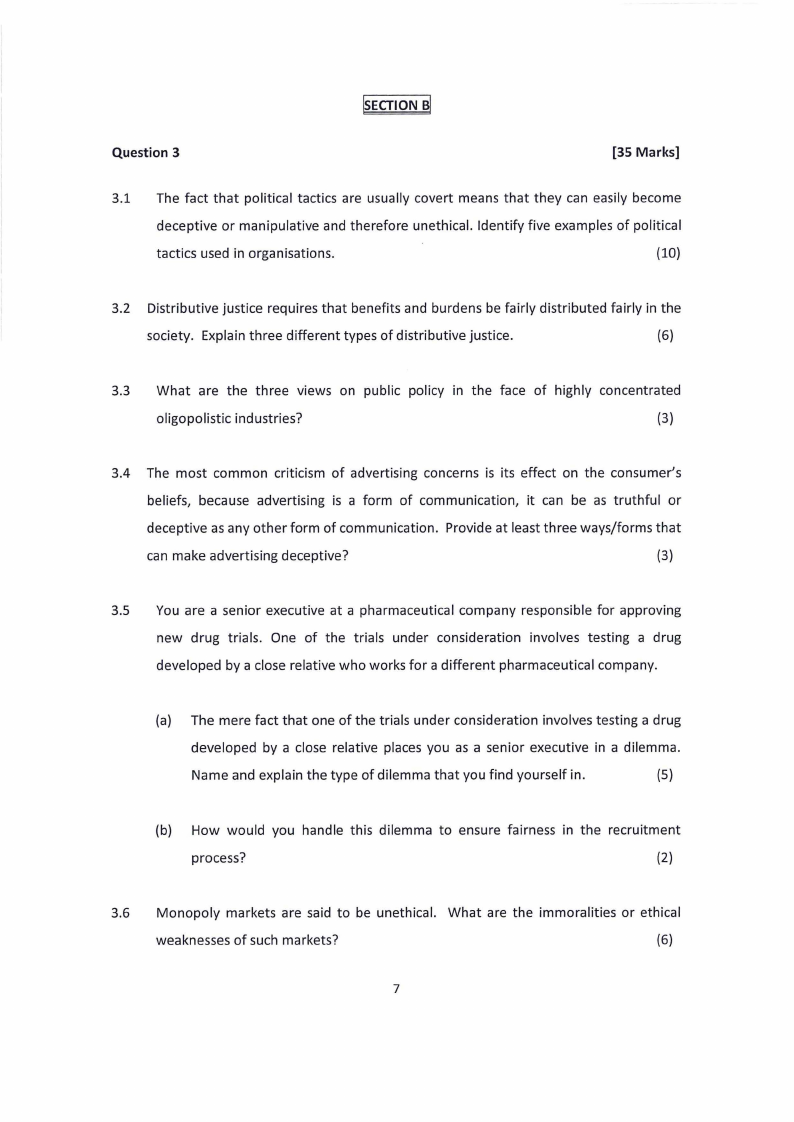
Question 3
[35 Marks]
3.1 The fact that political tactics are usually covert means that they can easily become
deceptive or manipulative and therefore unethical. Identify five examples of political
tactics used in organisations.
{10)
3.2 Distributive justice requires that benefits and burdens be fairly distributed fairly in the
society. Explain three different types of distributive justice.
(6)
3.3 What are the three views on public policy in the face of highly concentrated
oligopolistic industries?
{3)
3.4 The most common criticism of advertising concerns is its effect on the consumer's
beliefs, because advertising is a form of communication, it can be as truthful or
deceptive as any other form of communication. Provide at least three ways/forms that
can make advertising deceptive?
(3)
3.5 You are a senior executive at a pharmaceutical company responsible for approving
new drug trials. One of the trials under consideration involves testing a drug
developed by a close relative who works for a different pharmaceutical company.
(a) The mere fact that one of the trials under consideration involves testing a drug
developed by a close relative places you as a senior executive in a dilemma.
Name and explain the type of dilemma that you find yourself in.
(5)
(b) How would you handle this dilemma to ensure fairness in the recruitment
process?
(2)
3.6 Monopoly markets are said to be unethical. What are the immoralities or ethical
weaknesses of such markets?
(6)
7

8 Page 8

▲back to top


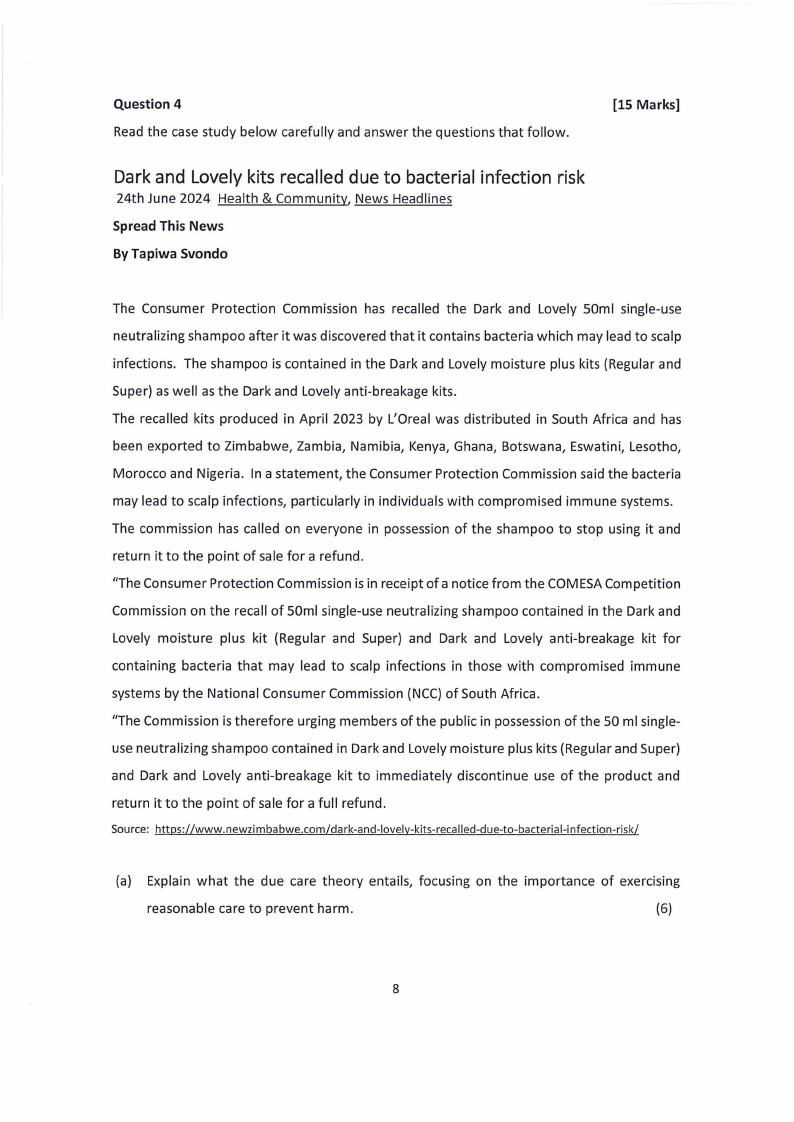
Question 4
Read the case study below carefully and answer the questions that follow.
[15 Marks]
Darkand Lovelykitsrecalleddue to bacterialinfectionrisk
24th June 2024 Health & Community, News Headlines
Spread This News
By Tapiwa Svondo
The Consumer Protection Commission has recalled the Dark and Lovely 50ml single-use
neutralizing shampoo after it was discovered that it contains bacteria which may lead to scalp
infections. The shampoo is contained in the Dark and Lovely moisture plus kits (Regular and
Super) as well as the Dark and Lovely anti-breakage kits.
The recalled kits produced in April 2023 by L'Oreal was distributed in South Africa and has
been exported to Zimbabwe, Zambia, Namibia, Kenya, Ghana, Botswana, Eswatini, Lesotho,
Morocco and Nigeria. In a statement, the Consumer Protection Commission said the bacteria
may lead to scalp infections, particularly in individuals with compromised immune systems.
The commission has called on everyone in possession of the shampoo to stop using it and
return it to the point of sale for a refund.
"The Consumer Protection Commission is in receipt of a notice from the COMESACompetition
Commission on the recall of 50ml single-use neutralizing shampoo contained in the Dark and
Lovely moisture plus kit (Regular and Super) and Dark and Lovely anti-breakage kit for
containing bacteria that may lead to scalp infections in those with compromised immune
systems by the National Consumer Commission (NCC)of South Africa.
"The Commission is therefore urging members of the public in possession of the SO ml single-
use neutralizing shampoo contained in Dark and Lovely moisture plus kits (Regular and Super)
and Dark and Lovely anti-breakage kit to immediately discontinue use of the product and
return it to the point of sale for a full refund.
Source: https://www.newzimbabwe.com/dark-and-lovely-kits-recalled-due-to-bacterial-infection-risk/
(a) Explain what the due care theory entails, focusing on the importance of exercising
reasonable care to prevent harm.
(6)
8

9 Page 9

▲back to top


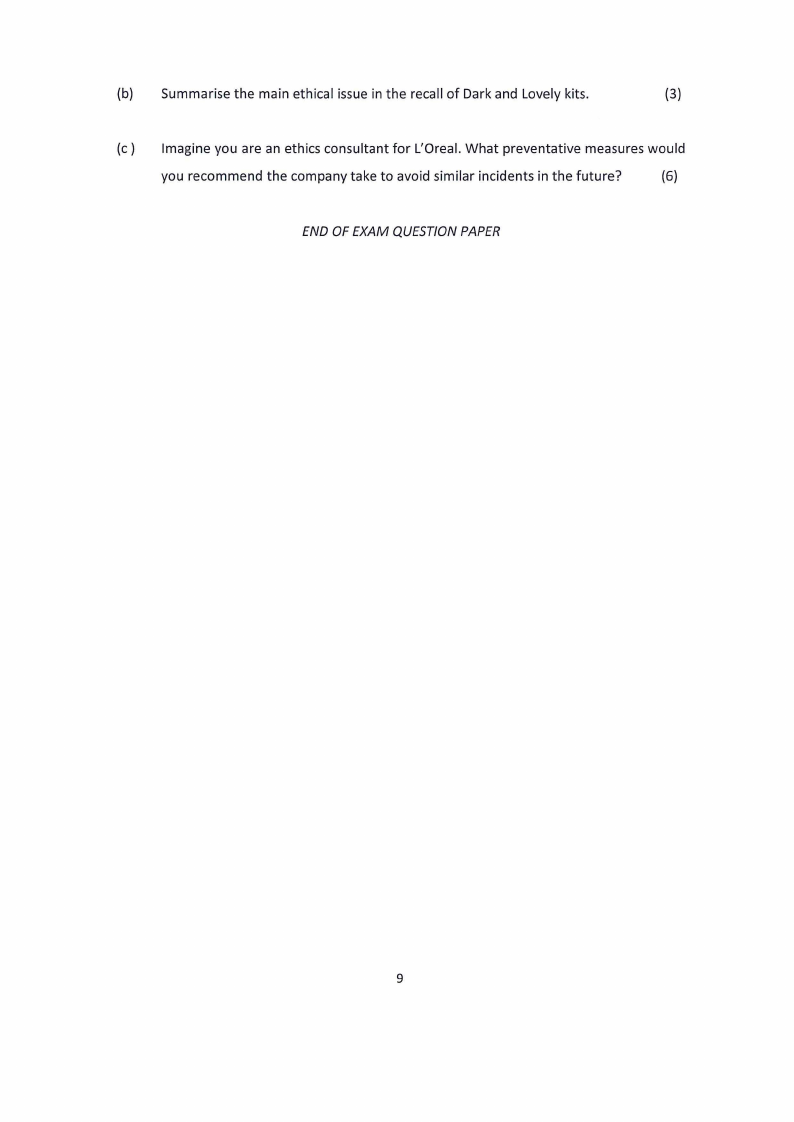
(b) Summarise the main ethical issue in the recall of Dark and Lovely kits.
(3)
(c) Imagine you are an ethics consultant for L'Oreal. What preventative measures would
you recommend the company take to avoid similar incidents in the future?
(6)
END OF EXAM QUESTIONPAPER
9