


 |
CCG620S - COUNSELLING AND CAREER GUIDANCE - 1ST OPP - NOVEMBER 2025 |
|
|
1 Page 1 |
▲back to top |
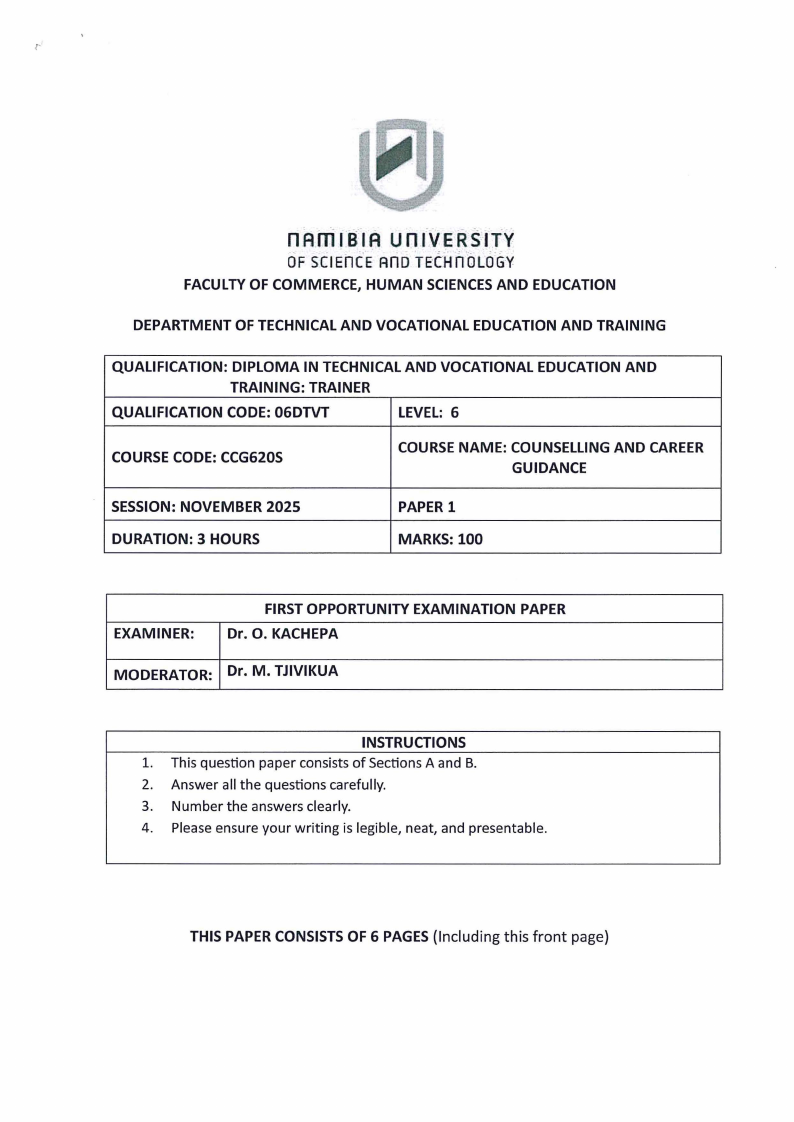
nArTi !Bl A un fvE RS 1r v
OF SCIEnc'E An □ TECHn □ LOG-Y.
FACULTY OF COMMERCE, HUMAN SCIENCES AND EDUCATION
DEPARTMENT OF TECHNICAL AND VOCATIONAL EDUCATION AND TRAINING
QUALIFICATION: DIPLOMA IN TECHNICAL AND VOCATIONAL EDUCATION AND
TRAINING: TRAINER
QUALIFICATION CODE: 0GDTVT
LEVEL: 6
COURSE CODE: CCG620S
COURSE NAME: COUNSELLING AND CAREER
GUIDANCE
SESSION: NOVEMBER 2025
DURATION: 3 HOURS
PAPER 1
MARKS: 100
EXAMINER:
FIRST OPPORTUNITY EXAMINATION PAPER
Dr. 0. KACHEPA
MODERATOR: Dr. M. TJIVIKUA
INSTRUCTIONS
1. This question paper consists of Sections A and B.
2. Answer all the questions carefully.
3. Number the answers clearly.
4. Please ensure your writing is legible, neat, and presentable.
THIS PAPER CONSISTS OF 6 PAGES (Including this front page)
|
|
2 Page 2 |
▲back to top |
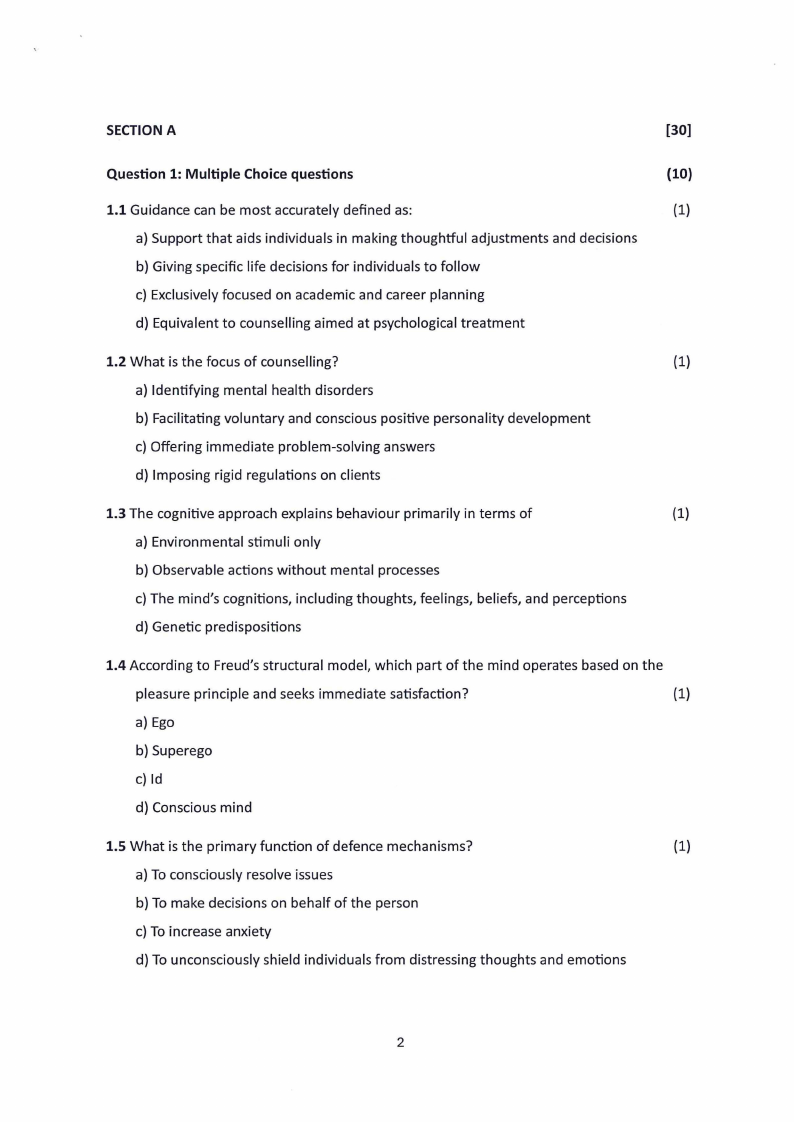
SECTION A
[30)
Question 1: Multiple Choice questions
(10)
1.1 Guidance can be most accurately defined as:
(1)
a) Support that aids individuals in making thoughtful adjustments and decisions
b) Giving specific life decisions for individuals to follow
c) Exclusively focused on academic and career planning
d) Equivalent to counselling aimed at psychological treatment
1.2 What is the focus of counselling?
(1)
a) Identifying mental health disorders
b) Facilitating voluntary and conscious positive personality development
c) Offering immediate problem-solving answers
d) Imposing rigid regulations on clients
1.3 The cognitive approach explains behaviour primarily in terms of
(1)
a) Environmental stimuli only
b) Observable actions without mental processes
c) The mind's cognitions, including thoughts, feelings, beliefs, and perceptions
d) Genetic predispositions
1.4 According to Freud's structural model, which part of the mind operates based on the
pleasure principle and seeks immediate satisfaction?
(1)
a) Ego
b) Superego
c) Id
d) Conscious mind
1.5 What is the primary function of defence mechanisms?
(1)
a) To consciously resolve issues
b) To make decisions on behalf of the person
c) To increase anxiety
d) To unconsciously shield individuals from distressing thoughts and emotions
2
|
|
3 Page 3 |
▲back to top |
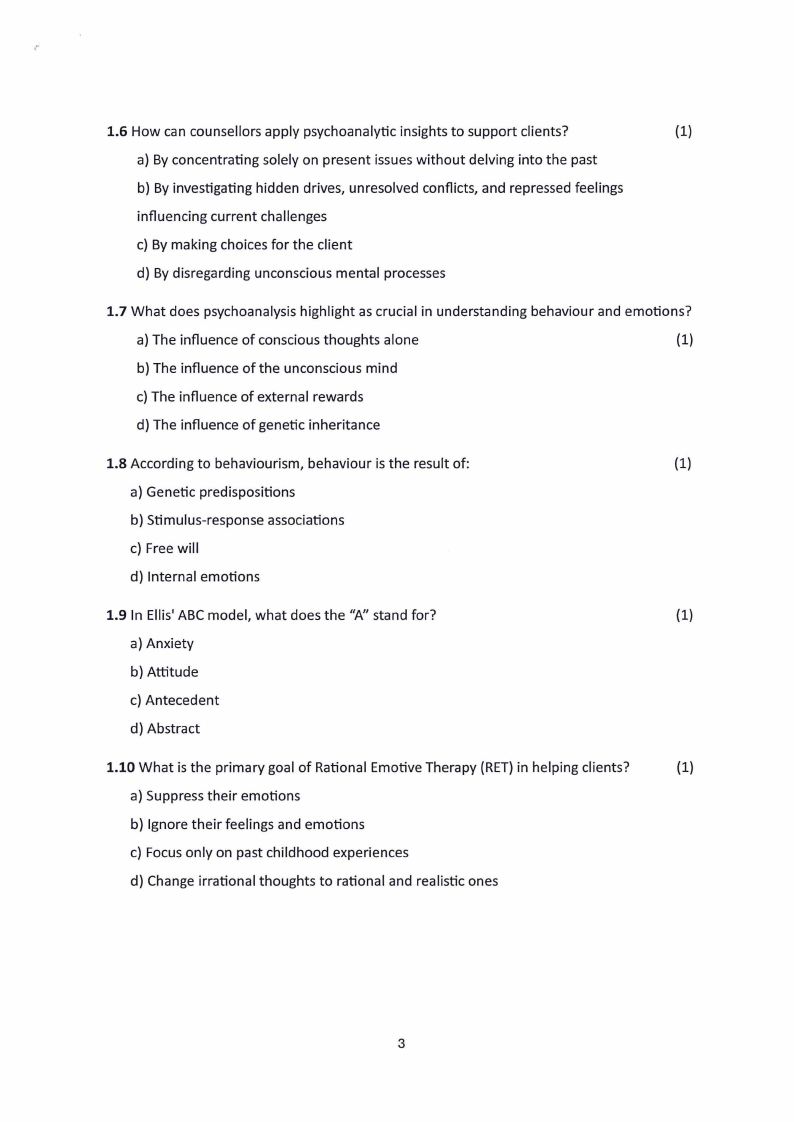
1.6 How can counsellors apply psychoanalytic insights to support clients?
(1)
a) By concentrating solely on present issues without delving into the past
b) By investigating hidden drives, unresolved conflicts, and repressed feelings
influencing current challenges
c) By making choices for the client
d) By disregarding unconscious mental processes
1.7 What does psychoanalysis highlight as crucial in understanding behaviour and emotions?
a) The influence of conscious thoughts alone
(1)
b) The influence of the unconscious mind
c) The influence of external rewards
d) The influence of genetic inheritance
1.8 According to behaviourism, behaviour is the result of:
(1)
a) Genetic predispositions
b) Stimulus-response associations
c) Free will
d) Internal emotions
1.9 In Ellis' ABC model, what does the "A" stand for?
(1)
a) Anxiety
b) Attitude
c) Antecedent
d) Abstract
1.10 What is the primary goal of Rational Emotive Therapy {RET) in helping clients?
(1)
a) Suppress their emotions
b) Ignore their feelings and emotions
c) Focus only on past childhood experiences
d) Change irrational thoughts to rational and realistic ones
3
|
|
4 Page 4 |
▲back to top |
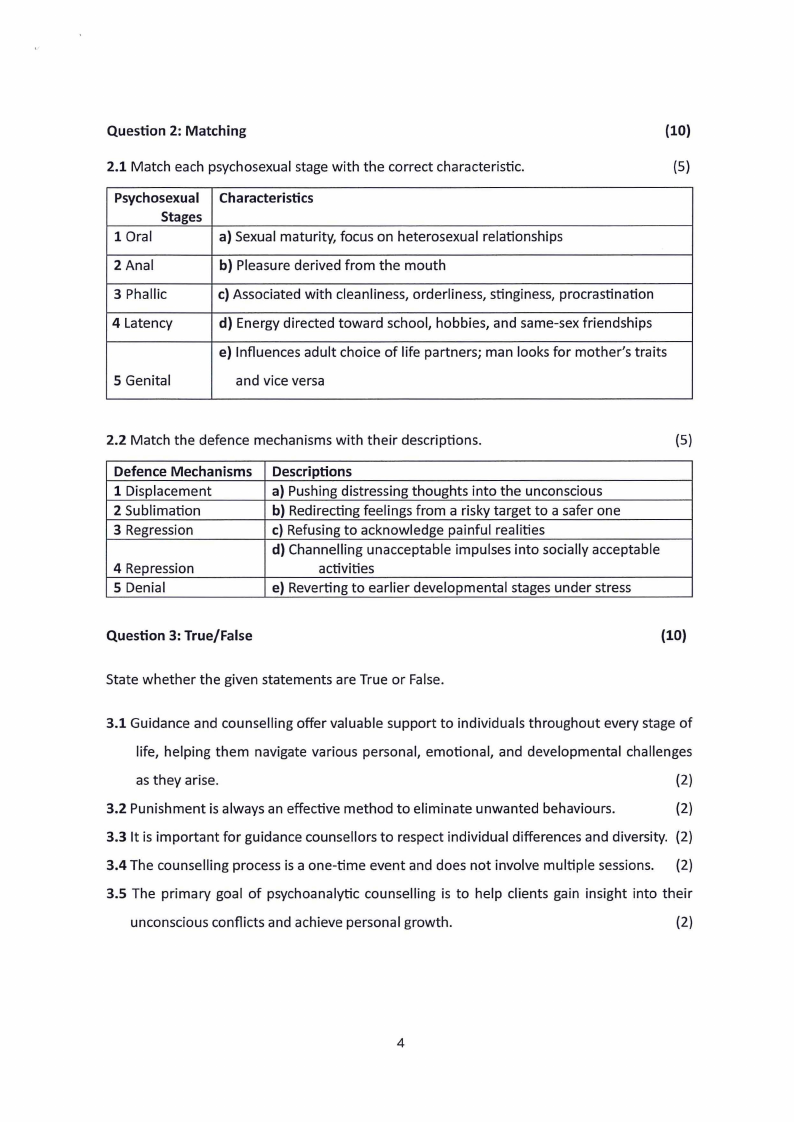
Question 2: Matching
(10)
2.1 Match each psychosexual stage with the correct characteristic.
(5)
Psychosexual
Stages
1 Oral
Characteristics
a) Sexual maturity, focus on heterosexual relationships
2 Anal
b) Pleasure derived from the mouth
3 Phallic
c) Associated with cleanliness, orderliness, stinginess, procrastination
4 Latency
d) Energy directed toward school, hobbies, and same-sex friendships
e) Influences adult choice of life partners; man looks for mother's traits
5 Genital
and vice versa
2.2 Match the defence mechanisms with their descriptions.
(5)
Defence Mechanisms
1 Displacement
2 Sublimation
3 Regression
4 Repression
5 Denial
Descriptions
a) Pushing distressing thoughts into the unconscious
b) Redirecting feelings from a risky target to a safer one
c) Refusing to acknowledge painful realities
d) Channelling unacceptable impulses into socially acceptable
activities
e) Reverting to earlier developmental stages under stress
Question 3: True/False
(10)
State whether the given statements are True or False.
3.1 Guidance and counselling offer valuable support to individuals throughout every stage of
life, helping them navigate various personal, emotional, and developmental challenges
as they arise.
(2)
3.2 Punishment is always an effective method to eliminate unwanted behaviours.
(2)
3.3 It is important for guidance counsellors to respect individual differences and diversity. {2)
3.4 The counselling process is a one-time event and does not involve multiple sessions. (2)
3.5 The primary goal of psychoanalytic counselling is to help clients gain insight into their
unconscious conflicts and achieve personal growth.
(2)
4
|
|
5 Page 5 |
▲back to top |
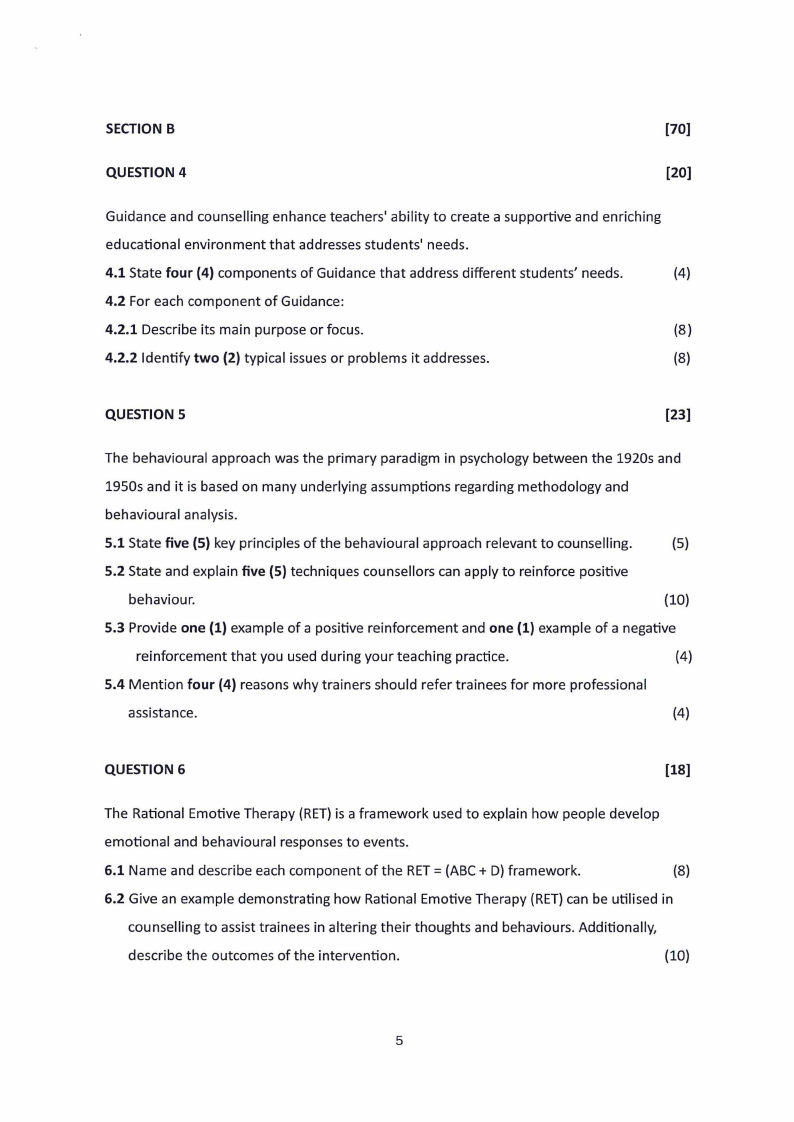
SECTION B
[70)
QUESTION 4
[20)
Guidance and counselling enhance teachers' ability to create a supportive and enriching
educational environment that addresses students' needs.
4.1 State four (4) components of Guidance that address different students' needs.
(4)
4.2 For each component of Guidance:
4.2.1 Describe its main purpose or focus.
(8)
4.2.2 Identify two (2) typical issues or problems it addresses.
(8)
QUESTION 5
[23)
The behavioural approach was the primary paradigm in psychology between the 1920s and
1950s and it is based on many underlying assumptions regarding methodology and
behavioural analysis.
5.1 State five (5) key principles of the behavioural approach relevant to counselling.
(S)
5.2 State and explain five (5) techniques counsellors can apply to reinforce positive
behaviour.
(10)
5.3 Provide one (1) example of a positive reinforcement and one (1) example of a negative
reinforcement that you used during your teaching practice.
(4)
5.4 Mention four (4) reasons why trainers should refer trainees for more professional
ass i stance.
(4)
QUESTION 6
[18)
The Rational Emotive Therapy (RET) is a framework used to explain how people develop
emotional and behavioural responses to events.
6.1 Name and describe each component of the RET = (ABC+ D) framework.
(8)
6.2 Give an example demonstrating how Rational Emotive Therapy (RET) can be utilised in
counselling to assist trainees in altering their thoughts and behaviours. Additionally,
describe the outcomes of the intervention.
(10)
5
|
|
6 Page 6 |
▲back to top |

QUESTION 7
[9]
Carl Rogers was a humanistic psychologist who developed a theory of personality
development. Name and explain three (3) core conditions that Rogers claimed parents and
caregivers must create for a child to achieve healthy personality development.
TOTAL MARKS [100]
[END]
6