BBN810S - BROADBAND NETWORKS - 1ST OPP - JUNE 2025


BBN810S - BROADBAND NETWORKS - 1ST OPP - JUNE 2025


1 Pages 1-10

▲back to top


1.1 Page 1

▲back to top


nAmlBIA UnlVERSITY
OF SCIEn CE Ano TECHnOLOGY
FACULTYOF COMPUTING AND INFORMATICS
DEPARTMENTOF COMPUTERSCIENCE
QUALIFICATION:BACHELOROF COMPUTERSCIENCE
QUALIFICATIONCODE: 0SBCSH
COURSE:BROADBAND NETWORKS
LEVEL: 8
COURSECODE:BBN810S
DATE:JUNE 2025
DURATION: 3 HOURS
SESSION:1
MARKS: 100
FIRSTOPPORTUNITYEXAMINATION QUESTION PAPER
EXAMINER(S) PROFGUY-ALAINLUSILAOZODI
MODERATOR: MS EMILIA WEYULU
INSTRUCTIONS
1. Answer ALL the questions.
2. Write clearly and neatly.
3. Number the answers clearly.
THIS QUESTION-PAPERCONSISTSOF 14 PAGES(Including this front page)

1.2 Page 2

▲back to top


Question 1 [6 marks]
Marking
Scheme
(a)
What is an advantage of statistical multiplexing over frequency division
2
multiplexing?
marks
(b) What is the difference between the flow control and congestion control
2
mechanisms provided by TCP
marks
(c) Why are ATM-based networks preferred to STM?
2
marks
QUESTION 2 [10 Marks]
We consider two Internet access providers who have deployed numerous points of presence in
Namibia. These providers are identified by the autonomous systems denoted X and V. Autonomous
system Z is a video content delivery company connected to Y.
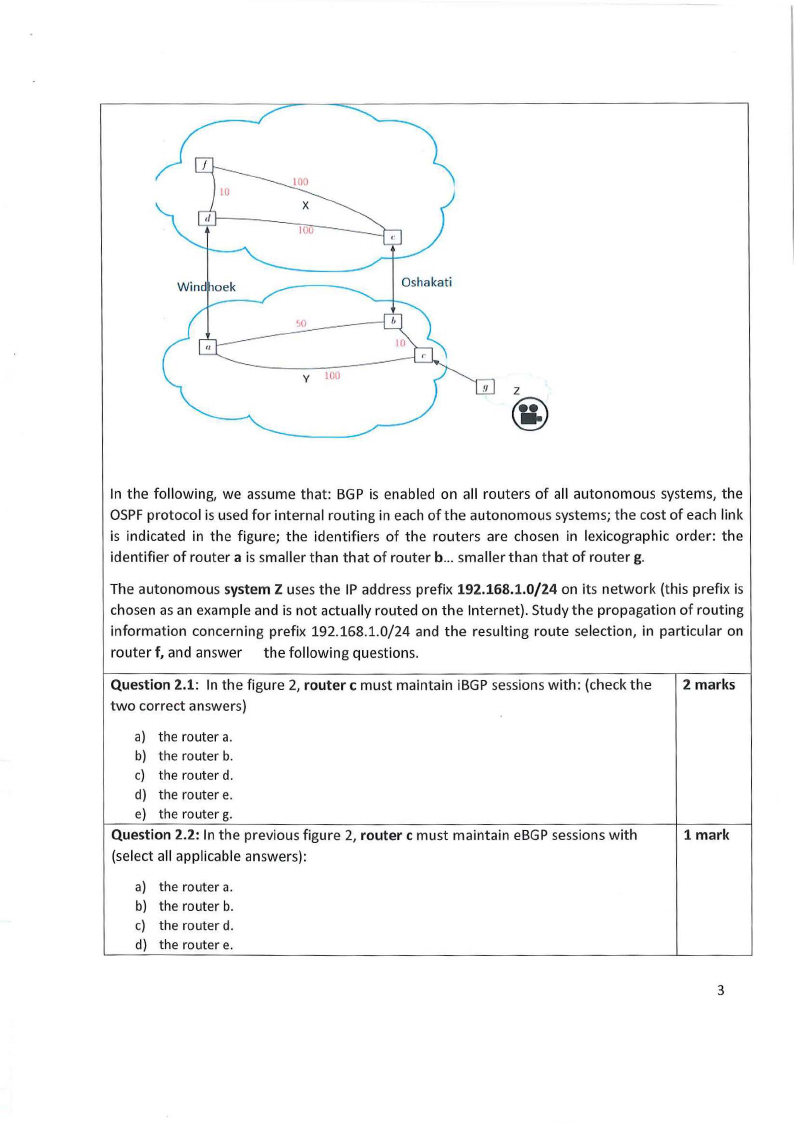
The letters a through g represent IP routers on the networks of each of these autonomous systems.
X and V have entered into a peering agreement to exchange their traffic. This agreement is set up
at an exchange point in Windhoek through routers a and d, and at an exchange point in Oshakati
through routers band e.
Z has signed a transit agreement with provider Y. This agreement is implemented through routers
c and g.
2

1.3 Page 3

▲back to top


z
@
In the following, we assume that: BGP is enabled on all routers of all autonomous systems, the
OSPFprotocol is used for internal routing in each of the autonomous systems; the cost of each link
is indicated in the figure; the identifiers of the routers are chosen in lexicographic order: the
identifier of router a is smaller than that of router b... smaller than that of router g.
The autonomous system Z uses the IP address prefix 192.168.1.0/24 on its network (this prefix is
chosen as an example and is not actually routed on the Internet). Study the propagation of routing
information concerning prefix 192.168.1.0/24 and the resulting route selection, in particular on
router f, and answer the following questions.
Question 2.1: In the figure 2, router c must maintain iBGP sessions with: (check the
two correct answers)
2 marks
a) the router a.
b) the router b.
c) the router d.
d) the router e.
e) the router g.
Question 2.2: In the previous figure 2, router c must maintain eBGPsessions with
(select all applicable answers):
1 mark
a) the router a.
b) the router b.
c) the router d.
d) the router e.
3

1.4 Page 4

▲back to top


e) the router g.
Question 2.3: Using the BGP router g, what prefix(es) must Z announce to make its
entire network reachable from the Internet?
Question 2.4: How many iBGP advertisements does the router a receive containing
the 192.168.1.0/24 prefix?
1 mark
1 marks
Question 2.5: How many eBGP advertisements containing the 192.168.1.0/24 prefix 1 mark
does router d receive??
Question 2.6: Taking into account the BGPadvertisements received by router d, which
BGP decision rule allows selecting router a as the next hop to the prefix
192.168.1.0/24?
2 marks
Question 2.7: Taking into account the BGPadvertisements received by router e, what 2 marks
does it choose as the next hop to the 192.168.1.0/24 prefix?
4

1.5 Page 5

▲back to top


Question 3 [ 10 marks]
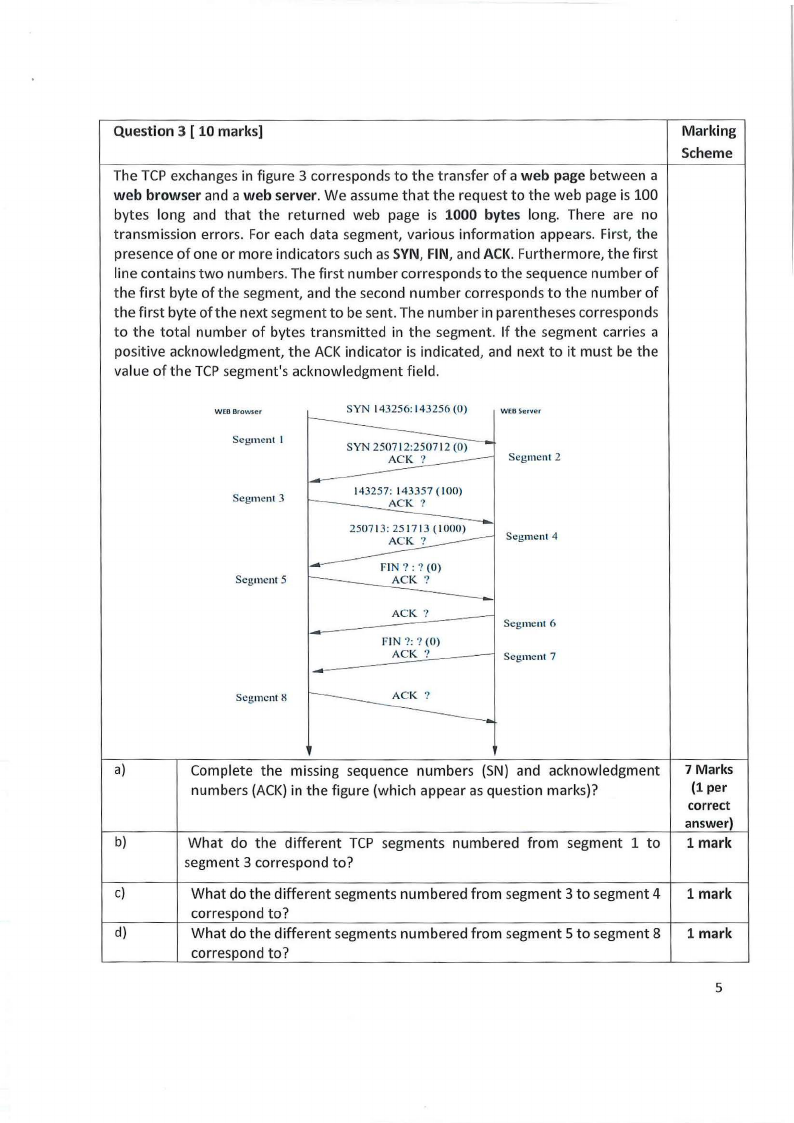
The TCP exchanges in figure 3 corresponds to the transfer of a web page between a
web browser and a web server. We assume that the request to the web page is 100
bytes long and that the returned web page is 1000 bytes long. There are no
transmission errors. For each data segment, various information appears. First, the
presence of one or more indicators such as SYN, FIN, and ACK.Furthermore, the first
line contains two numbers. The first number corresponds to the sequence number of
the first byte of the segment, and the second number corresponds to the number of
the first byte of the next segment to be sent. The number in parentheses corresponds
to the total number of bytes transmitted in the segment. If the segment carries a
positive acknowledgment, the ACK indicator is indicated, and next to it must be the
value of the TCPsegment's acknowledgment field.
Marking
Scheme
WED Browser
Segment I
SYN 143256: 143256 (0)
WEB Server
Segment 2
Segment 3
143257: 143357 (100)
ACK?
Segment 4
Segment 5
ACK?
FIN?:? (0)
ACK?
Segment 6
Segment 7
Segment 8
a)
Complete the missing sequence numbers (SN) and acknowledgment 7 Marks
numbers (ACK)in the figure (which appear as question marks)?
(1 per
correct
answer)
b)
What do the different TCP segments numbered from segment 1 to 1 mark
segment 3 correspond to?
c)
What do the different segments numbered from segment 3 to segment 4 1 mark
correspond to?
d)
What do the different segments numbered from segment 5 to segment 8 1 mark
correspond to?
5

1.6 Page 6

▲back to top


Question 4 [ 8 marks]
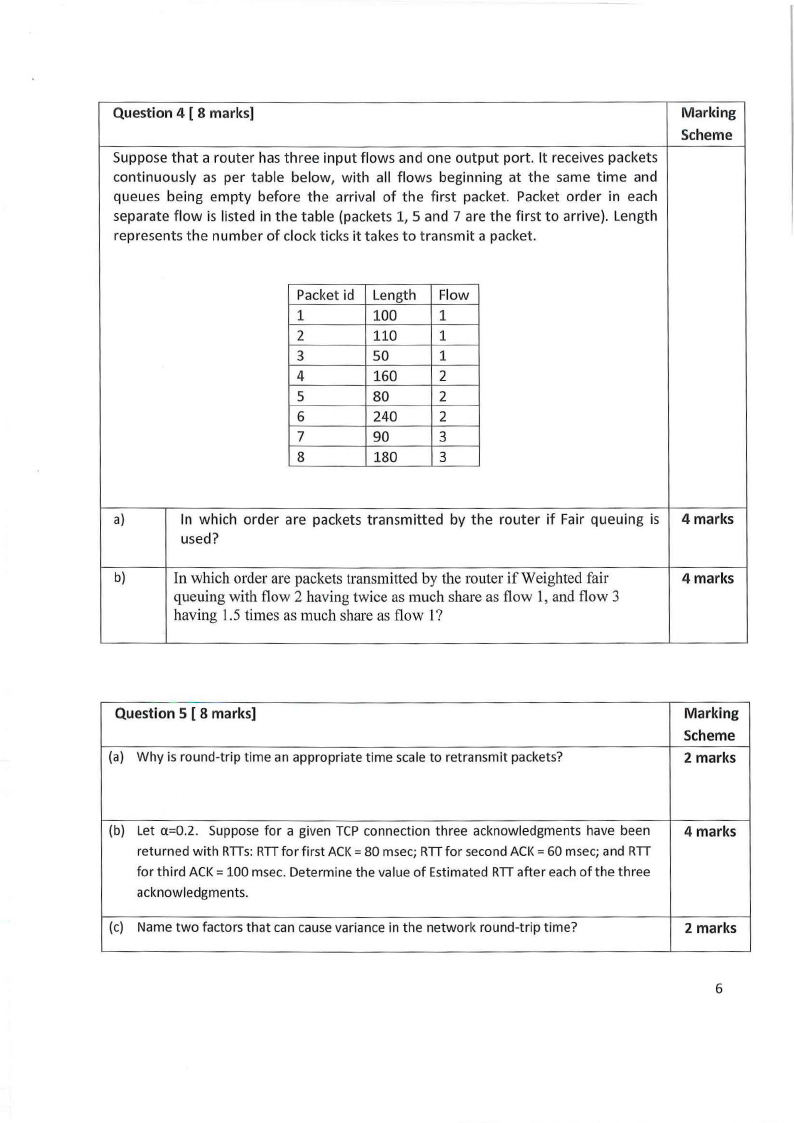
Suppose that a router has three input flows and one output port. It receives packets
continuously as per table below, with all flows beginning at the same time and
queues being empty before the arrival of the first packet. Packet order in each
separate flow is listed in the table (packets 1, 5 and 7 are the first to arrive). Length
represents the number of clock ticks it takes to transmit a packet.
Marking
Scheme
Packet id
1
2
3
4
5
6
7
8
Length
100
110
50
160
80
240
90
180
Flow
1
1
1
2
2
2
3
3
a)
In which order are packets transmitted by the router if Fair queuing is 4 marks
used?
b)
In which order are packets transmitted by the router if Weighted fair
queuing with flow 2 having twice as much share as flow 1, and flow 3
having 1.5 times as much share as flow 1?
4 marks
Question 5 [ 8 marks]
(a) Why is round-trip time an appropriate time scale to retransmit packets?
Marking
Scheme
2 marks
(b) Let a=0.2. Suppose for a given TCP connection three acknowledgments have been
returned with RTTs:RTTfor first ACK= 80 msec; RTTfor second ACK= 60 msec; and RTT
for third ACK= 100 msec. Determine the value of Estimated RTTafter each of the three
acknowledgments.
(c) Name two factors that can causevariance in the network round-trip time?
4 marks
2 marks
6

1.7 Page 7

▲back to top


Question 6 [ 12 marks]
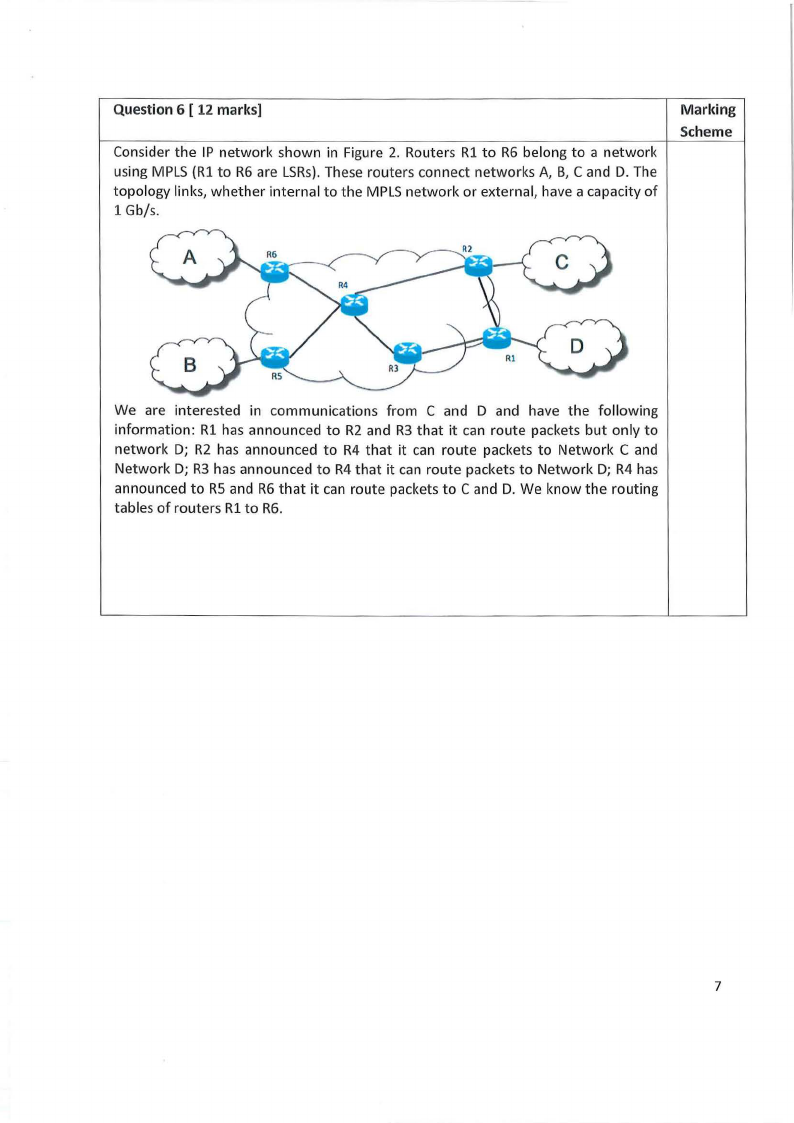
Consider the IP network shown in Figure 2. Routers Rl to R6 belong to a network
using MPLS (Rl to R6 are LSRs).These routers connect networks A, 8, C and D. The
topology links, whether internal to the MPLS network or external, have a capacity of
1 Gb/s.
Marking
Scheme
We are interested in communications from C and D and have the following
information: Rl has announced to R2 and R3 that it can route packets but only to
network D; R2 has announced to R4 that it can route packets to Network C and
Network D; R3 has announced to R4 that it can route packets to Network D; R4 has
announced to RS and R6 that it can route packets to C and D. We know the routing
tables of routers Rl to R6.
7

1.8 Page 8

▲back to top


Rl Routin1Table
Dest. NH Cost
Rl
-
-
R2
R2
10
R3
R3 10
R4
R2 10
RS
R2
10
RG
R2 10
A
R2
10
B
R2
10
C
R2
10
D
D
10
Default R2
10
R2RoutingTable
Dest. NH Cost
Rl
Rl
10
R2
-
-
R3
R4 20
R4
R4 10
RS
R4 20
RG
R4 20
A
R4 30
B
R4 30
C
C
10
D
Rl
20
Default R4 10
R3RoutingTable
Dest. NH Cost
Rl
Rl
10
R2
R4 20
R3
-
-
R4
R4 10
RS
R4 20
RG
R4 20
A
Rl
30
B
R4 30
C
R4 30
D
Rl
20
Default R4 10
R4Routin1Table
Dest. NH Cost
Rl
R3 20
R2
R2 10
R3
R3 10
R4
-
-
RS
RS
10
RG
RG 10
A
RG 20
B
RS 20
C
R2 20
D
R3 20
Default R2 10
RSRoutingTable
Dest. NH Cost
Rl
R4 30
R2
R4 20
R3
R4 20
R4
R4
10
RS
-
-
RG
R4 20
A
R4 20
B
B
10
C
R4 30
D
R4 40
Default R4 10
RGRoutingTable
Dest. NH Cost
Rl
R4 30
R2
R4 20
R3
R4 20
R4
R4 10
RS
R4 20
RG
-
-
A
A
10
B
R4 30
C
R4 30
D
R4 40
Default R4 10
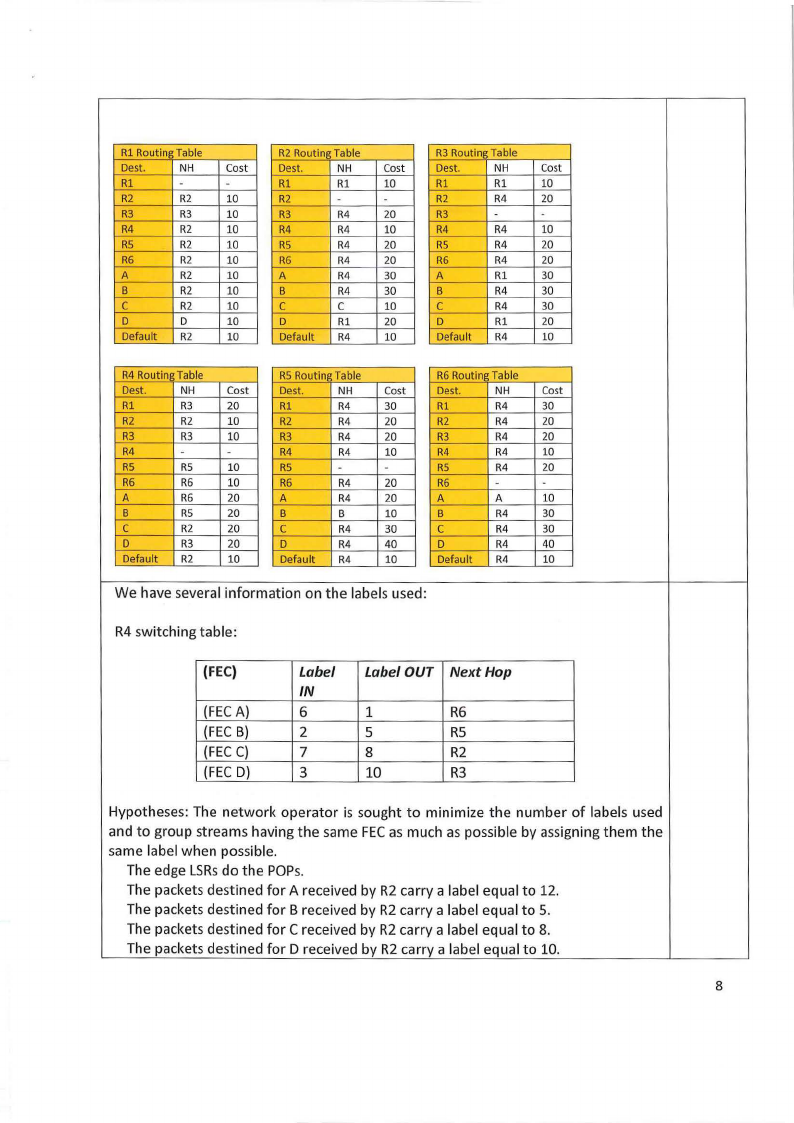
We have several information on the labels used:
R4 switching table:
(FEC)
(FECA)
(FEC B)
(FECC)
(FEC D)
Label
IN
6
2
7
3
Label OUT Next Hop
1
R6
5
RS
8
R2
10
R3
Hypotheses: The network operator is sought to minimize the number of labels used
and to group streams having the same FECas much as possible by assigning them the
same label when possible.
The edge LSRsdo the POPs.
The packets destined for A received by R2 carry a label equal to 12.
The packets destined for B received by R2 carry a label equal to 5.
The packets destined for C received by R2 carry a label equal to 8.
The packets destined for D received by R2 carry a label equal to 10.
8

1.9 Page 9

▲back to top


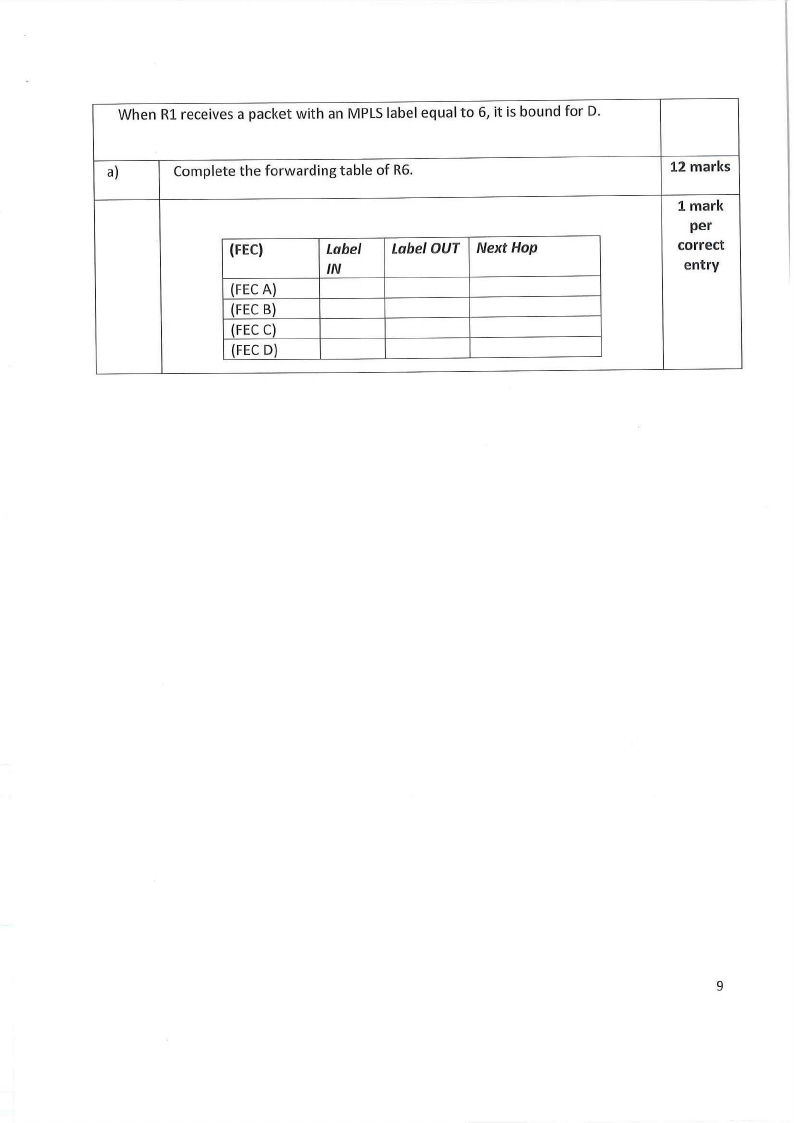
When Rl receives a packet with an MPLS label equal to 6, it is bound for D.
a)
Complete the forwarding table of R6.
(FEC)
(FEC A)
(FEC B)
(FEC C)
(FEC D)
Label
IN
Label OUT Next Hop
12 marks
1 mark
per
correct
entry
9

1.10 Page 10

▲back to top


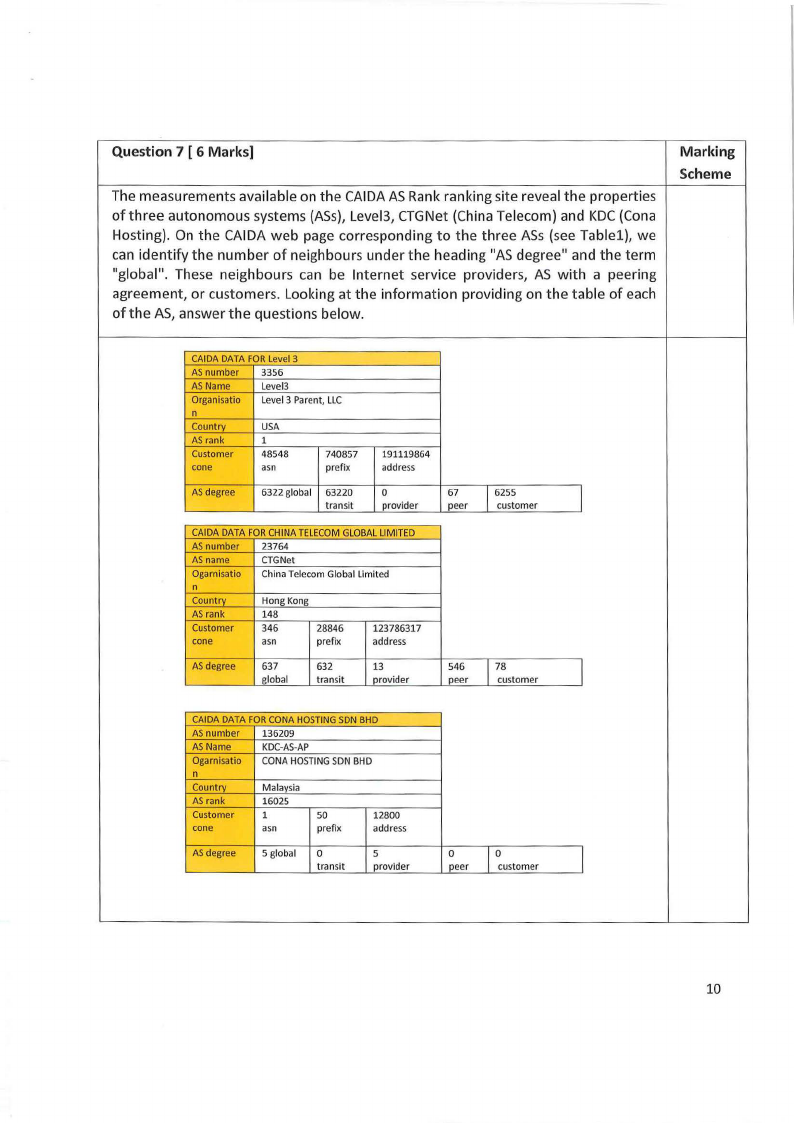
Question 7 [ 6 Marks]
The measurements available on the CAIDAAS Rank ranking site reveal the properties
of three autonomous systems (ASs), Level3, CTGNet (China Telecom) and KOC(Cana
Hosting). On the CAIDA web page corresponding to the three ASs (see Tablel), we
can identify the number of neighbours under the heading "AS degree" and the term
"global". These neighbours can be Internet service providers, AS with a peering
agreement, or customers. Looking at the information providing on the table of each
of the AS, answer the questions below.
Marking
Scheme
CAIDA DATA FOR Level 3
AS number
3356
AS Name
Level3
Organisatio
Level 3 Parent, LLC
n
Country
USA
AS rank
1
Customer
48548
740857
cone
asn
prefix
191119864
address
AS degree
6322 global
63220
transit
0
provider
67
I 6255
peer
customer
I
CAIDA DATA FOR CHINA TELECOM GLOBAL LIMITED
AS number
23764
AS name
CTGNet
Ogarnisatio
China Telecom Global Limited
n
Country
Hong Kong
AS rank
148
Customer
346
28846
123786317
cone
asn
prefix
address
AS degree
637
global
632
transit
13
provider
546
I 78
peer
customer
I
CAIDA DATA FOR CONA HOSTINGSON BHD
AS number
136209
AS Name
KOC-AS-AP
Ogarnisatio
CONA HOSTINGSON BHD
n
Country
Malaysia
AS rank
16025
Customer
1
cone
asn
50
prefix
12800
address
AS degree
5 global
0
transit
5
provider
0
peer
I ~ustomer
I
10

2 Pages 11-20

▲back to top


2.1 Page 11

▲back to top


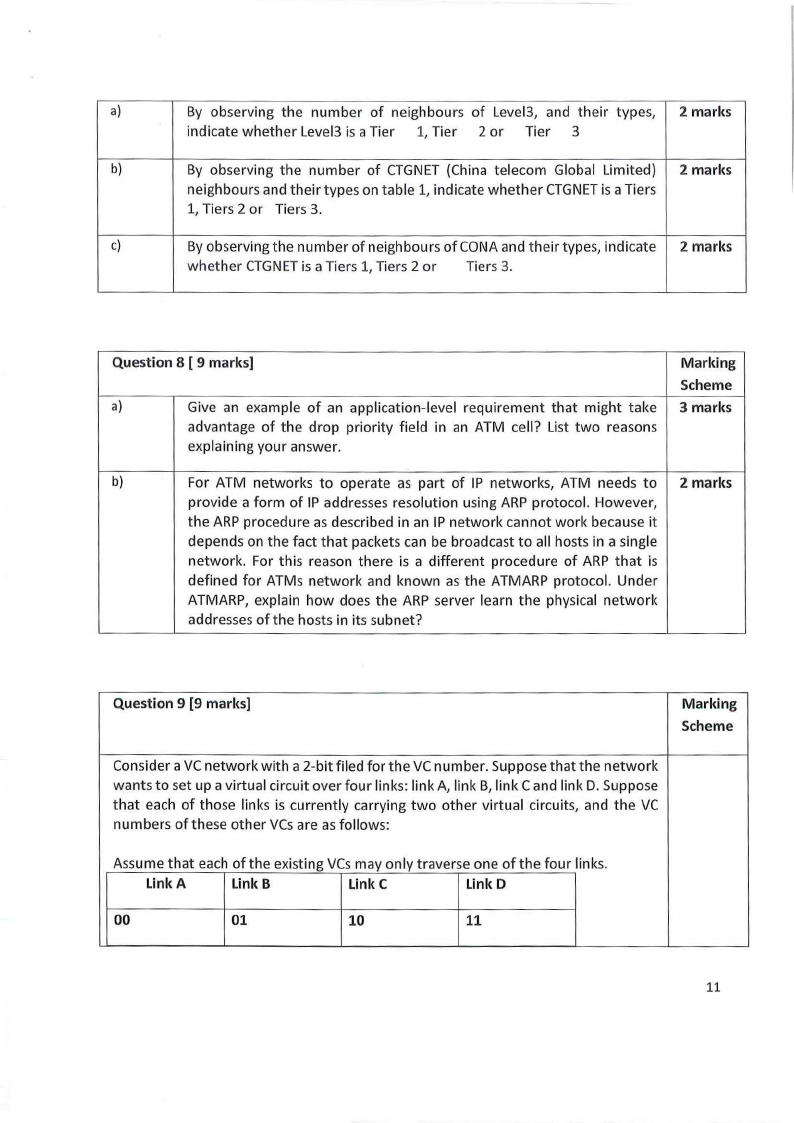
a)
By observing the number of neighbours of Level3, and their types, 2 marks
indicate whether Level3 is a Tier 1, Tier 2 or Tier 3
b)
By observing the number of CTGNET(China telecom Global Limited) 2 marks
neighbours and their types on table 1, indicate whether CTGNETis a Tiers
1, Tiers 2 or Tiers 3.
c)
By observing the number of neighbours of CONAand their types, indicate 2 marks
whether CTGNETis a Tiers 1, Tiers 2 or Tiers 3.
Question 8 [ 9 marks]
a)
Give an example of an application-level requirement that might take
advantage of the drop priority field in an ATM cell? List two reasons
explaining your answer.
Marking
Scheme
3 marks
b)
For ATM networks to operate as part of IP networks, ATM needs to 2 marks
provide a form of IP addresses resolution using ARP protocol. However,
the ARP procedure as described in an IP network cannot work because it
depends on the fact that packets can be broadcast to all hosts in a single
network. For this reason there is a different procedure of ARP that is
defined for ATMs network and known as the ATMARP protocol. Under
ATMARP, explain how does the ARP server learn the physical network
addresses of the hosts in its subnet?
Question 9 [9 marks]
Marking
Scheme
Consider a VC network with a 2-bit filed for the VC number. Suppose that the network
wants to set up a virtual circuit over four links: link A, link B, link C and link D. Suppose
that each of those links is currently carrying two other virtual circuits, and the VC
numbers of these other VCs are as follows:
Assume that each of the existing VCs may only traverse one of the four links.
Link A
Link B
Link C
Link D
00
01
10
11
11

2.2 Page 12

▲back to top


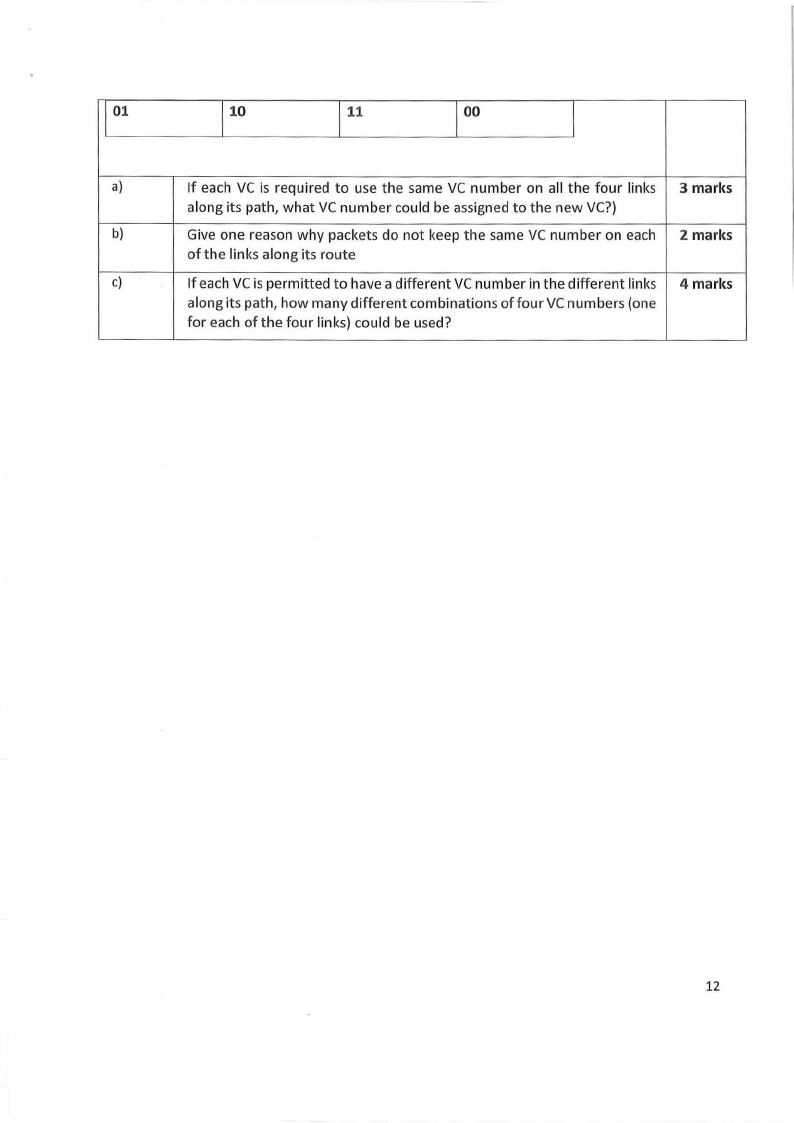
I 01
110
111
I oo
I
a)
If each VC is required to use the same VC number on all the four links 3 marks
along its path, what VC number could be assigned to the new VC?)
b)
Give one reason why packets do not keep the same VC number on each 2 marks
of the links along its route
c)
If each VC is permitted to have a different VC number in the different links 4 marks
along its path, how many different combinations of four VC numbers (one
for each of the four links) could be used?
12

2.3 Page 13

▲back to top


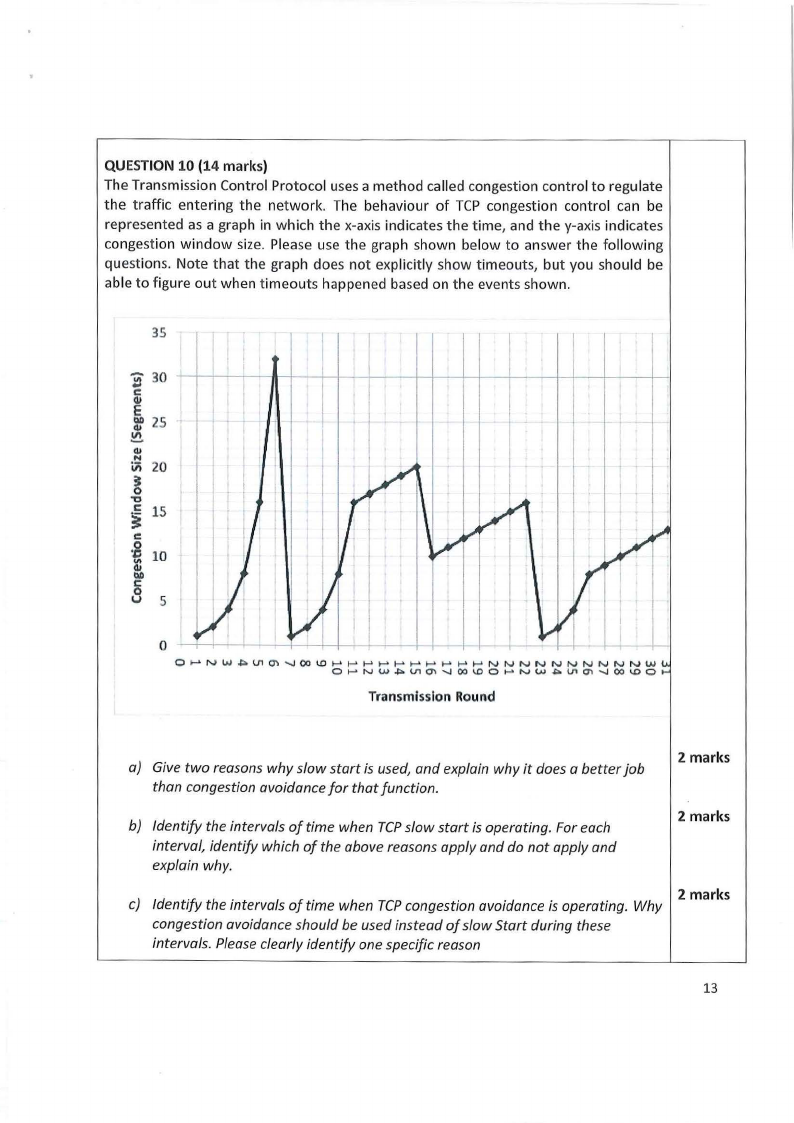
QUESTION 10 {14 marks)
The Transmission Control Protocol uses a method called congestion control to regulate
the traffic entering the network. The behaviour of TCP congestion control can be
represented as a graph in which the x-axis indicates the time, and the y-axis indicates
congestion window size. Please use the graph shown below to answer the following
questions. Note that the graph does not explicitly show timeouts, but you should be
able to figure out when timeouts happened based on the events shown.
35
l
°E'30
C
4>
E
Qb
a.,
25
l
a.,
N
iii
20
'O
C
3
15
C
0
'C
Iall.,
10
tlO
C
u0 5
0
TransmissionRound
a) Give two reasons why slow start is used, and explain why it does a better job
than congestion avoidance for that function.
2 marks
b) Identify the intervals of time when TCPslow start is operating. Foreach
interval, identify which of the above reasons apply and do not apply and
explain why.
2 marks
c) Identify the intervals of time when TCPcongestion avoidance is operating. Why
congestion avoidance should be used instead of slow Start during these
intervals. Please clearly identify one specific reason
2 marks
13

2.4 Page 14

▲back to top


d) Identify the intervals of time when TCPfast retransmission is used. Please
explain what fast retransmission does and how it is triggered.
e) Identify the intervals of time when TCPfast recovery is operating. What does
fast recovery do and explain why is it beneficial?
f) Identify the interval(s) of time when fast recovery could have happened, but
did not. Identify one specific example of a circumstance that may prevent fast
recoveryfrom happening.
g) Which versionof TCPis represented in this Figure?
2 marks
2 marks
2 marks
2 marks
Question 11 [ 8 marks]
a)
What percentage of an ATM link's total bandwidth is consumed by the
ATM cell headers?
Marking
Scheme
2 marks
b)
The IP-datagram for a TCPACK message is 40 bytes long: it contains 20 4 marks
bytes of TCP header and 20 bytes of IP header. Assume that this ACK is
traversing an ATM network that uses AALS to encapsulate IP packets.
How many ATM packets will it take to carry the ACK?
c)
Cell switching methods essentially always use virtual circuit routing 2 marks
rather than datagram routing. Give two arguments why this is so
==========================G=O=OD LUCK===========================
14