


 |
INT711S-INTERNATIONAL TRADE- 1ST OPP-JUNE 2025 |
|
|
1 Page 1 |
▲back to top |
n Am I BI A u n IVER s I TY
OF SCIEnCE Ano TECHn OLOGY
FACULTY OF COMMERCE, HUMAN SCIENCESAND EDUCATION
DEPARTMENT OF ECONOMICS, ACCOUNTING AND FINANCE
QUALIFICATION: BACHELOR OF ECONOMICS
QUALIFICATION CODE: O7BEC0
LEVEL: 7
COURSE CODE: INT711S
COURSE NAME: INTERNATIONALTRADE
SESSION: JUNE 2025
DURATION: 3 HOURS
PAPER: THEORY
MARKS: 100
FIRST OPPORTUNITY EXAMINATION QUESTION PAPER
EXAMINER(S) Ms. Kasnath Kavezeri
MODERATOR: Mr. Immanuel Nashivela
INSTRUCTIONS
1. Answer ALL the questions.
2. Write clearly and neatly.
3. Number the answers clearly.
PERMISSIBLE MATERIALS
1. Pens/pencils/erasers
2. Calculator
3. Ruler
THIS QUESTION PAPER CONSISTS OF 2 PAGES (Including this front page)
|
|
2 Page 2 |
▲back to top |
QUESTION 1
[25 Marks]
1. What is the meaning of the labour theory of value?
(2)
2. List the three components of the economy in the context of mercantilism.
(3)
3. In Mercantilist thinking, why was a positive trade balance so important and why did it
not result in domestic inflation and a loss of international competitiveness?
(5)
4. Discuss five differences between domestic and international trade.
(15)
QUESTION 2
[25 Marks]
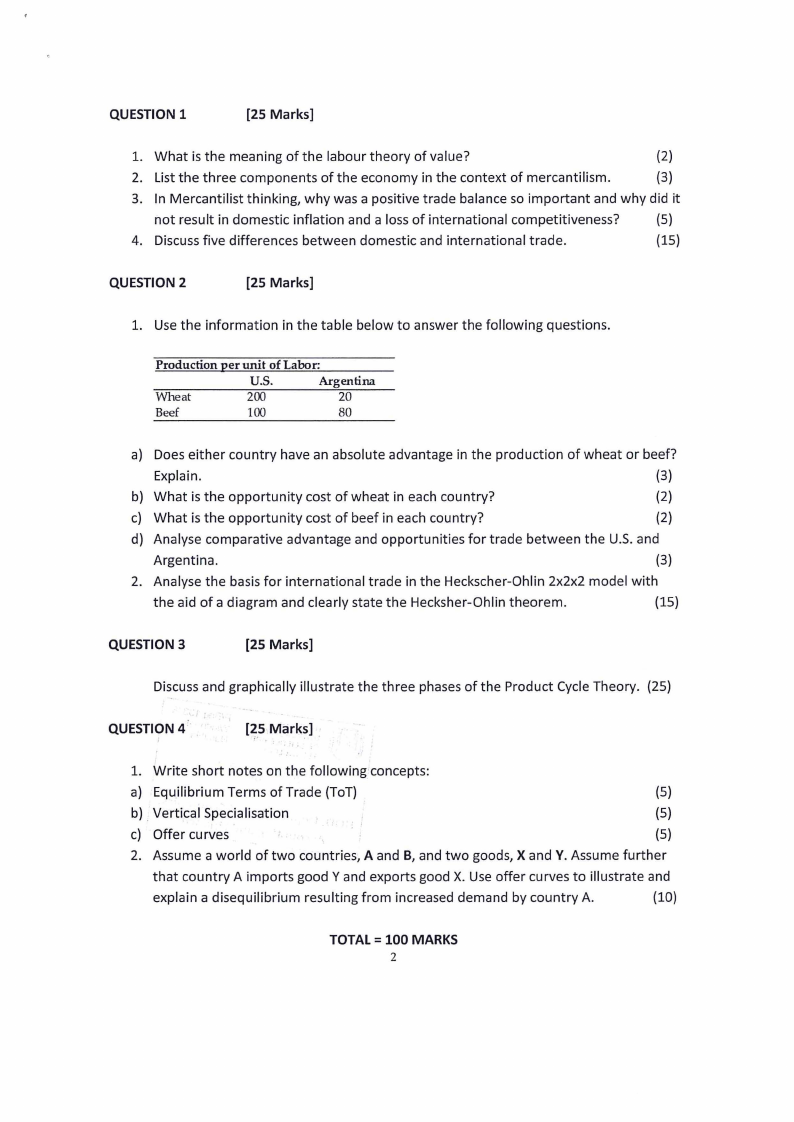
1. Use the information in the table below to answer the following questions.
Production per unit of Labor:
U.S.
Argentina
Wheat
200
20
Beef
100
80
a) Does either country have an absolute advantage in the production of wheat or beef?
Explain.
(3)
b) What is the opportunity cost of wheat in each country?
(2)
c) What is the opportunity cost of beef in each country?
(2)
d) Analyse comparative advantage and opportunities for trade between the U.S. and
Argentina.
(3)
2. Analyse the basis for international trade in the Heckscher-Ohlin 2x2x2 model with
the aid of a diagram and clearly state the Hecksher-Ohlin theorem.
(15)
QUESTION 3
[25 Marks]
Discuss and graphically illustrate the three phases of the Product Cycle Theory. (25)
QUESTION 4
[25 Marks]
i• '
•
1. Write short notes on the following·concepts:
a) Equilibrium Terms of Trade (ToT)
(5)
b). Vertical Specialisation
(5)
c) Offer curves
(5)
2. Assume a world of two countries, A and B, and two goods, X and Y. Assume further
that country A imports good Y and exports good X. Use offer curves to illustrate and
explain a disequilibrium resulting from increased demand by country A.
(10)
TOTAL = 100 MARKS
2