ITE411S-INTODUCTION TO ECONOMICS- 1ST OPP-JUNE 2025


ITE411S-INTODUCTION TO ECONOMICS- 1ST OPP-JUNE 2025


1 Pages 1-10

▲back to top


1.1 Page 1

▲back to top


nAmlBIA UnlVERSITY
OF SCIEnCE Ano TECHnDLOGY
FACULTY OF MANAGEMENT SCIENCES
DEPARTMENT OF ECONOMICS, ACCOUNTING AND FINANCE
QUALIFICATION: BRIDGING PROGRAMME - SOCIAL SCIENCES (04NBPR)
QUALIFICATION CODE:
O4NBPR
LEVEL: 4
COURSE CODE: ITE411 S
COURSE NAME: INTRODUCTION TO
ECONOMICS
SESSION: JUNE 2025
DURATION: 3 HOURS
PAPER:THEORY
MARKS: 100
FIRST OPPORTUNITY EXAMINATION QUESTION PAPER
EXAMINER(S) Mrs Precious Mwikanda
MODERATOR: Ms Kasnath Kavezeri
INSTRUCTIONS
1. Answer ALL the questions.
2. Write clearly and neatly.
3. Number the answers clearly.
4. The use of a scientific pocket calculator is allowed.
5. This examination paper is divided into FOUR sections.
6. Section A and Section B should be answered on the enclosed answer
sheet. After completing your answers, place this sheet in the
examination answer book.
7. Section C, D & E should be answered in your examination book.
THIS QUESTION PAPER CONSISTS OF 12 PAGES Excludin this front a e

1.2 Page 2

▲back to top


1.3 Page 3

▲back to top


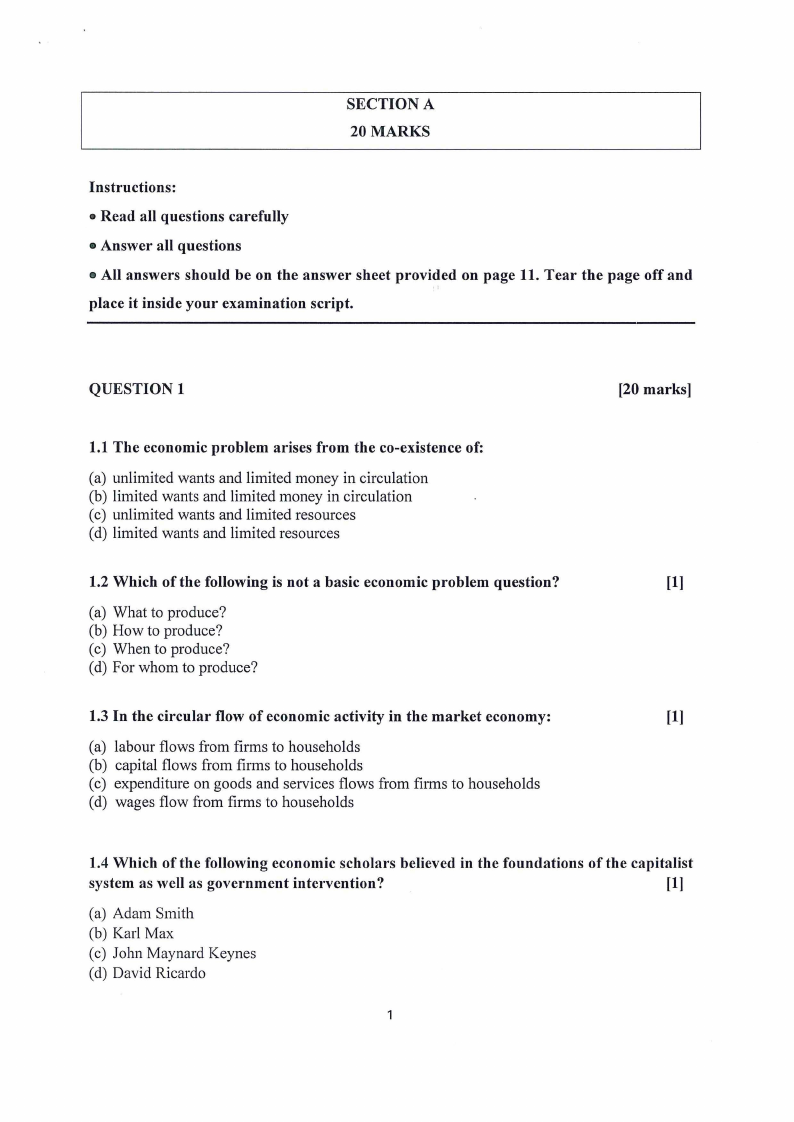
SECTION A
20MARKS
Instructions:
Read all questions carefully
Answer all questions
All answers should be on the answer sheet provid,,ed on page 11. Tear the page off and
place it inside your examination script.
QUESTION 1
1.1 The economic problem arises from the co-existence of:
(a) unlimited wants and limited money in circulation
(b) limited wants and limited money in circulation
(c) unlimited wants and limited resources
(d) limited wants and limited resources
1.2 Which of the following is not a basic economic problem question?
(a) What to produce?
(b) How to produce?
(c) When to produce?
(d) For whom to produce?
1.3 In the circular flow of economic activity in the market economy:
(a) labour flows from firms to households
(b) capital flows from firms to households
(c) expenditure on goods and services flows from foms to households
(d) wages flow from firms to households
[20 marks]
[1]
[1]
1.4 Which of the following economic scholars believed in the foundations of the capitalist
system as well as government intervention?
[1]
(a) Adam Smith
(b) Karl Max
(c) John Maynard Keynes
(d) David Ricardo
1

1.4 Page 4

▲back to top


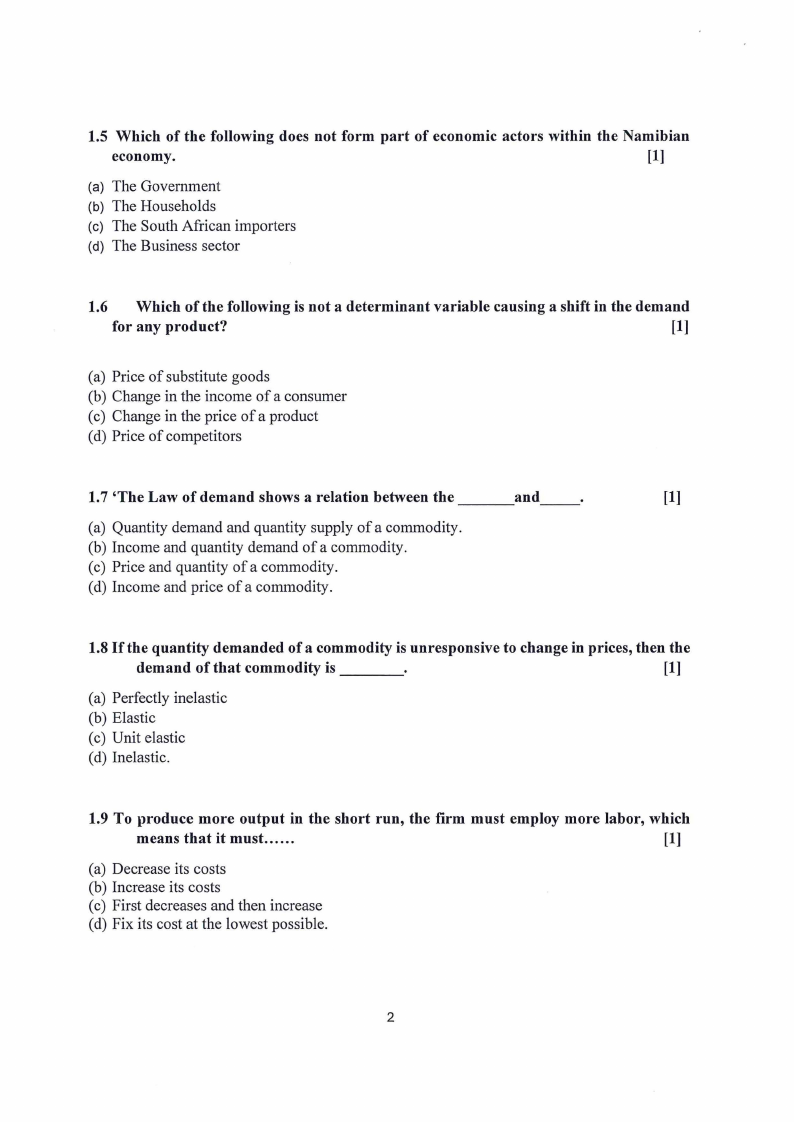
1.5 Which of the following does not form part of economic actors within the Namibian
economy.
[1]
(a) The Government
(b) The Households
(c) The South African importers
(d) The Business sector
1.6 Which of the following is not a determinant variable causing a shift in the demand
for any product?
(1]
(a) Price of substitute goods
(b) Change in the income of a consumer
(c) Change in the price of a product
(d) Price of competitors
1.7 'The Law of demand shows a relation between the ---
and
[1]
(a) Quantity demand and quantity supply of a commodity.
(b) Income and quantity demand of a commodity.
(c) Price and quantity of a commodity.
(d) Income and price of a commodity.
1.8 If the quantity demanded of a commodity is unresponsive to change in prices, then the
demand of that commodity is ____
(1]
(a) Perfectly inelastic
(b) Elastic
(c) Unit elastic
(d) Inelastic.
1.9 To produce more output in the short run, the firm must employ more labor, which
means that it must......
(1]
(a) Decrease its costs
(b) Increase its costs
(c) First decreases and then increase
(d) Fix its cost at the lowest possible.
2

1.5 Page 5

▲back to top


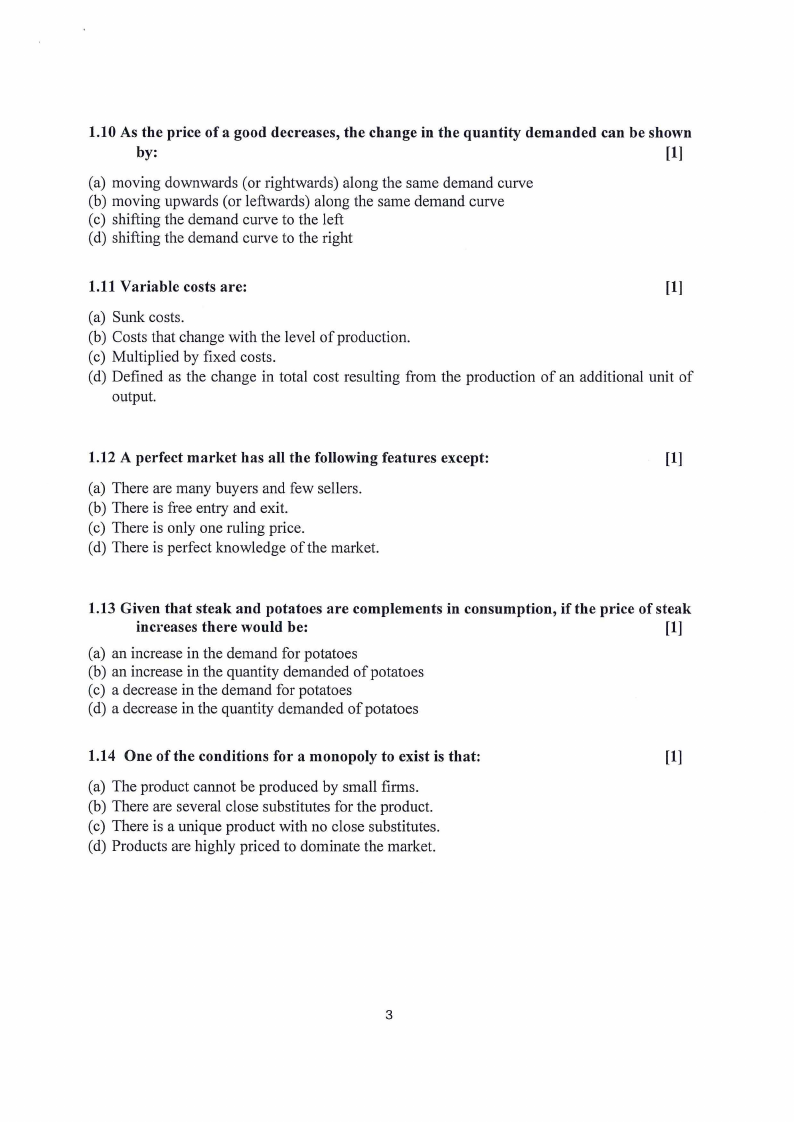
1.10 As the price of a good decreases, the change in the quantity demanded can be shown
by:
[1]
(a) moving downwards (or rightwards) along the same demand curve
(b) moving upwards (or leftwards) along the same demand curve
(c) shifting the demand curve to the left
(d) shifting the demand curve to the right
1.11 Variable costs are:
[1]
(a) Sunk costs.
(b) Costs that change with the level of production.
(c) Multiplied by fixed costs.
(d) Defined as the change in total cost resulting from the production of an additional unit of
output.
1.12 A perfect market has all the following features except:
[1]
(a) There are many buyers and few sellers.
(b) There is free entry and exit.
(c) There is only one ruling price.
(d) There is perfect knowledge of the market.
1.13 Given that steak and potatoes are complements in consumption, if the price of steak
increases there would be:
[1]
(a) an increase in the demand for potatoes
(b) an increase in the quantity demanded of potatoes
(c) a decrease in the demand for potatoes
(d) a decrease in the quantity demanded of potatoes
1.14 One of the conditions for a monopoly to exist is that:
[1]
(a) The product cannot be produced by small firms.
(b) There are several close substitutes for the product.
(c) There is a unique product with no close substitutes.
(d) Products are highly priced to dominate the market.
3

1.6 Page 6

▲back to top


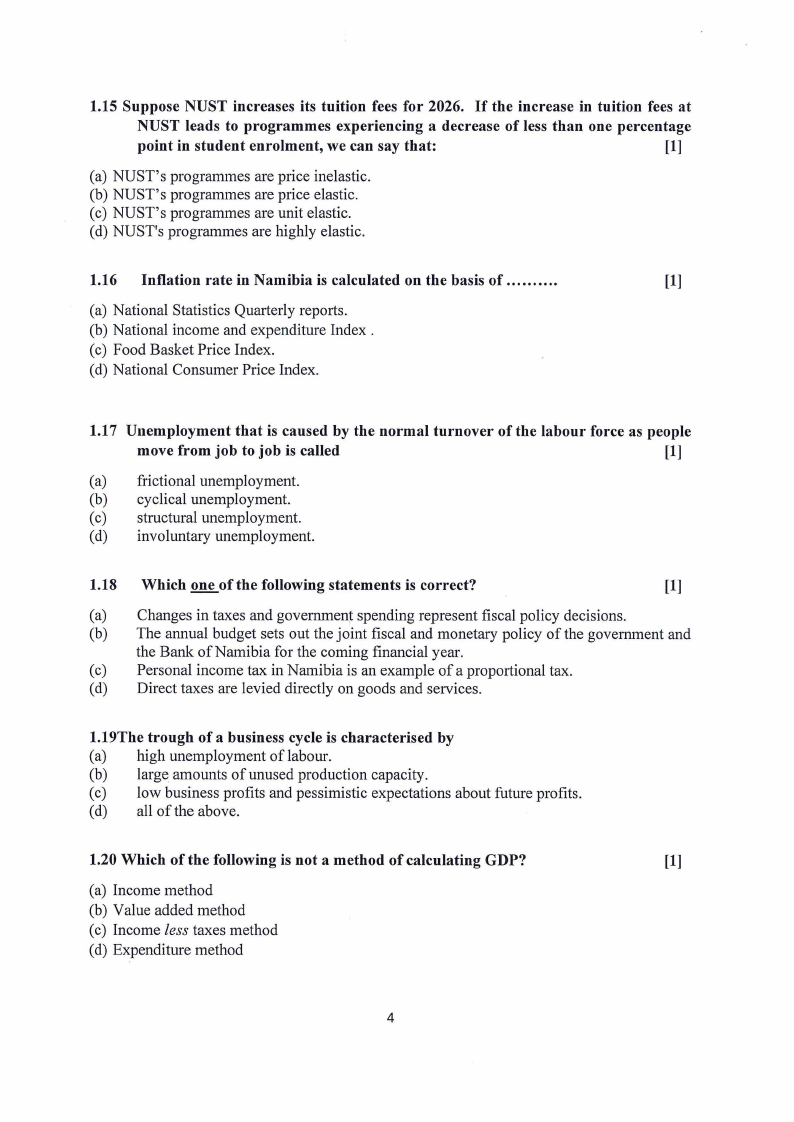
1.15 Suppose NUST increases its tuition fees for 2026. If the increase in tuition fees at
NUST leads to programmes experiencing a decrease of less than one percentage
point in student enrolment, we can say that:
[1]
(a) NUST's programmes are price inelastic.
(b) NUST's programmes are price elastic.
(c) NUST's programmes are unit elastic.
(d) NUST's programmes are highly elastic.
1.16 Inflation rate in Namibia is calculated on the basis of ......... .
[1]
(a) National Statistics Quarterly reports.
(b) National income and expenditure Index.
(c) Food Basket Price Index.
(d) National Consumer Price Index.
1.17 Unemployment that is caused by the normal turnover of the labour force as people
move from job to job is called
[1]
(a) frictional unemployment.
(b) cyclical unemployment.
(c) structural unemployment.
(d) involuntary unemployment.
1.18 Which one of the following statements is correct?
[1]
(a) Changes in taxes and government spending represent fiscal policy decisions.
(b) The annual budget sets out the joint fiscal and monetary policy of the government and
the Bank of Namibia for the coming financial year.
(c) Personal income tax in Namibia is an example of a proportional tax.
(d) Direct taxes are levied directly on goods and services.
1.19The trough of a business cycle is characterised by
(a) high unemployment of labour.
(b) large amounts of unused production capacity.
(c) low business profits and pessimistic expectations about future profits.
(d) all of the above.
1.20 Which of the following is not a method of calculating GDP?
[1]
(a) Income method
(b) Value added method
(c) Income less taxes method
(d) Expenditure method
4

1.7 Page 7

▲back to top


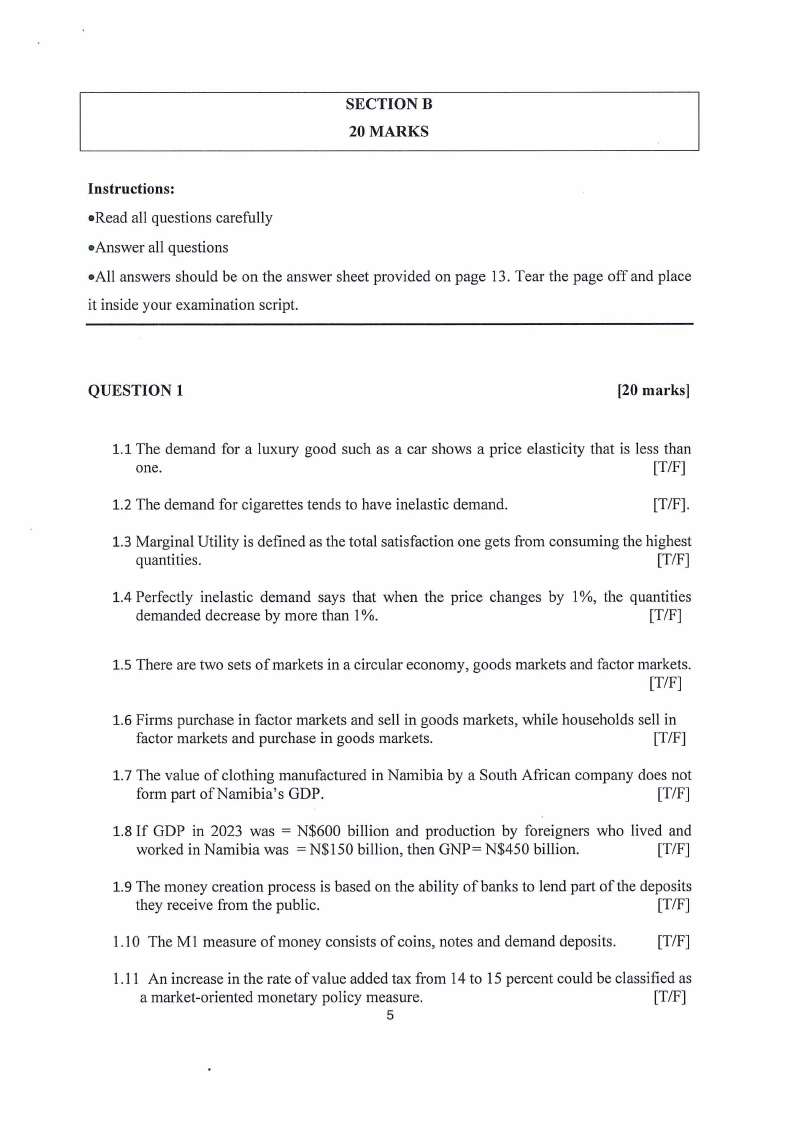
SECTIONB
20MARKS
Instructions:
•Read all questions carefully
•Answer all questions
•All answers should be on the answer sheet provided on page 13. Tear the page off and place
it inside your examination script.
QUESTION 1
[20 marks]
1.1 The demand for a luxury good such as a car shows a price elasticity that is less than
one.
[T/F]
1.2 The demand for cigarettes tends to have inelastic demand.
[T/F].
1.3 Marginal Utility is defined as the total satisfaction one gets from consuming the highest
quantities.
[T/F]
1.4 Perfectly inelastic demand says that when the price changes by 1%, the quantities
demanded decrease by more than 1%.
[T/F]
1.5 There are two sets of markets in a circular economy, goods markets and factor markets.
[T/F]
1.6 Firms purchase in factor markets and sell in goods markets, while households sell in
factor markets and purchase in goods markets.
[T/F]
1.7 The value of clothing manufactured in Namibia by a South African company does not
form part of Namibia's GDP.
[T/F]
1.8 If GDP in 2023 was = N$600 billion and production by foreigners who lived and
worked in Namibia was = N$150 billion, then GNP= N$450 billion.
[T/F]
1.9 The money creation process is based on the ability of banks to lend part of the deposits
they receive from the public.
[T/F]
1.10 The Ml measure of money consists of coins, notes and demand deposits.
[T/F]
1.11 An increase in the rate of value added tax from 14 to 15 percent could be classified as
a market-oriented monetary policy measure.
[T/F]
5

1.8 Page 8

▲back to top


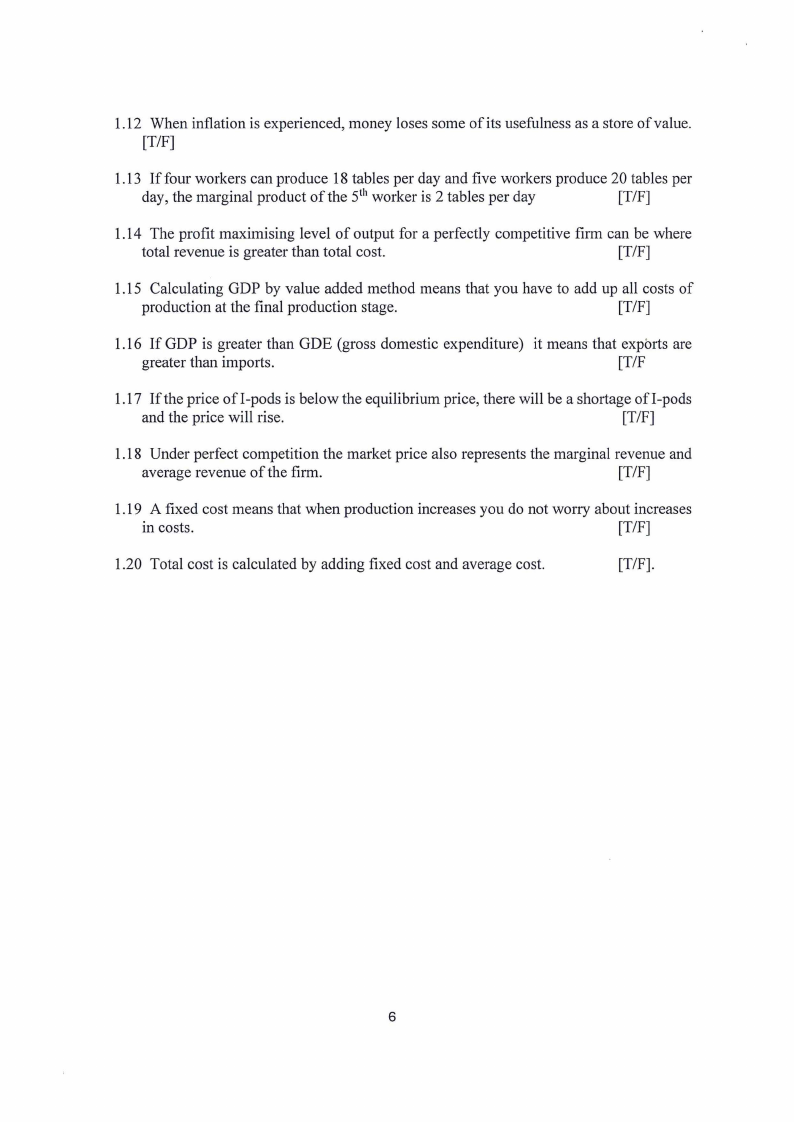
1.12 When inflation is experienced, money loses some of its usefulness as a store of value.
[T/F]
1.13 If four workers can produce 18 tables per day and five workers produce 20 tables per
day, the marginal product of the 5th worker is 2 tables per day
[T/F]
1.14 The profit maximising level of output for a perfectly competitive firm can be where
total revenue is greater than total cost.
[TIF]
1.15 Calculating GDP by value added method means that you have to add up all costs of
production at the final production stage.
[T/F]
1.16 If GDP is greater than GDE (gross domestic expenditure) it means that exports are
greater than imports.
[T/F
1.17 If the price ofl-pods is below the equilibrium price, there will be a sh01tage ofl-pods
and the price will rise.
[T/F]
1.18 Under perfect competition the market price also represents the marginal revenue and
average revenue of the firm.
[T/F]
1.19 A fixed cost means that when production increases you do not worry about increases
in costs.
[T/F]
1.20 Total cost is calculated by adding fixed cost and average cost.
[T/F].
6

1.9 Page 9

▲back to top


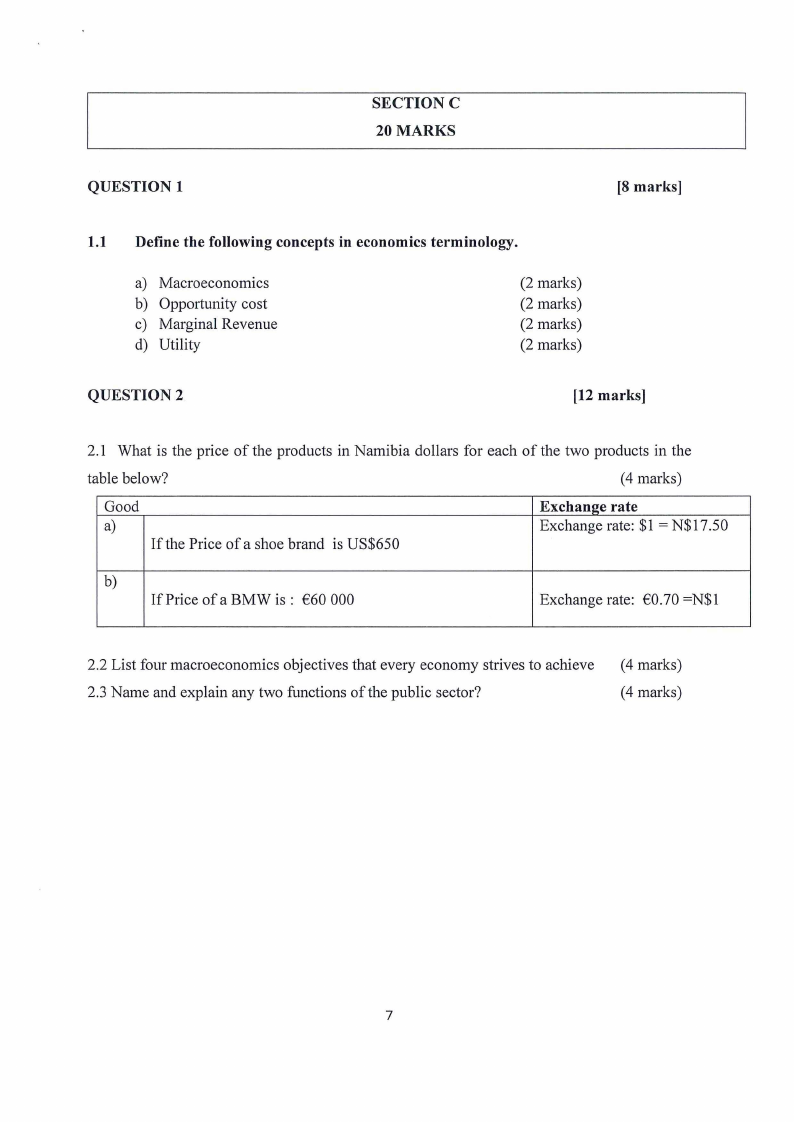
SECTIONC
20 MARKS
QUESTION 1
[8 marks]
1.1 Define the following concepts in economics terminology.
a) Macroeconomics
b) Opportunity cost
c) Marginal Revenue
d) Utility
(2 marks)
(2 marks)
(2 marks)
(2 marks)
QUESTION2
[12 marks]
2.1 What is the price of the products in Namibia dollars for each of the two products in the
table below?
(4 marks)
Good
a)
If the Price of a shoe brand is US$650
Exchange rate
Exchange rate: $1 = N$17.50
b)
If Price of a BMW is : €60 000
Exchange rate: €0.70 =N$1
2.2 List four macroeconomics objectives that every economy strives to achieve
2.3 Name and explain any two functions of the public sector?
(4 marks)
(4 marks)
7

1.10 Page 10

▲back to top


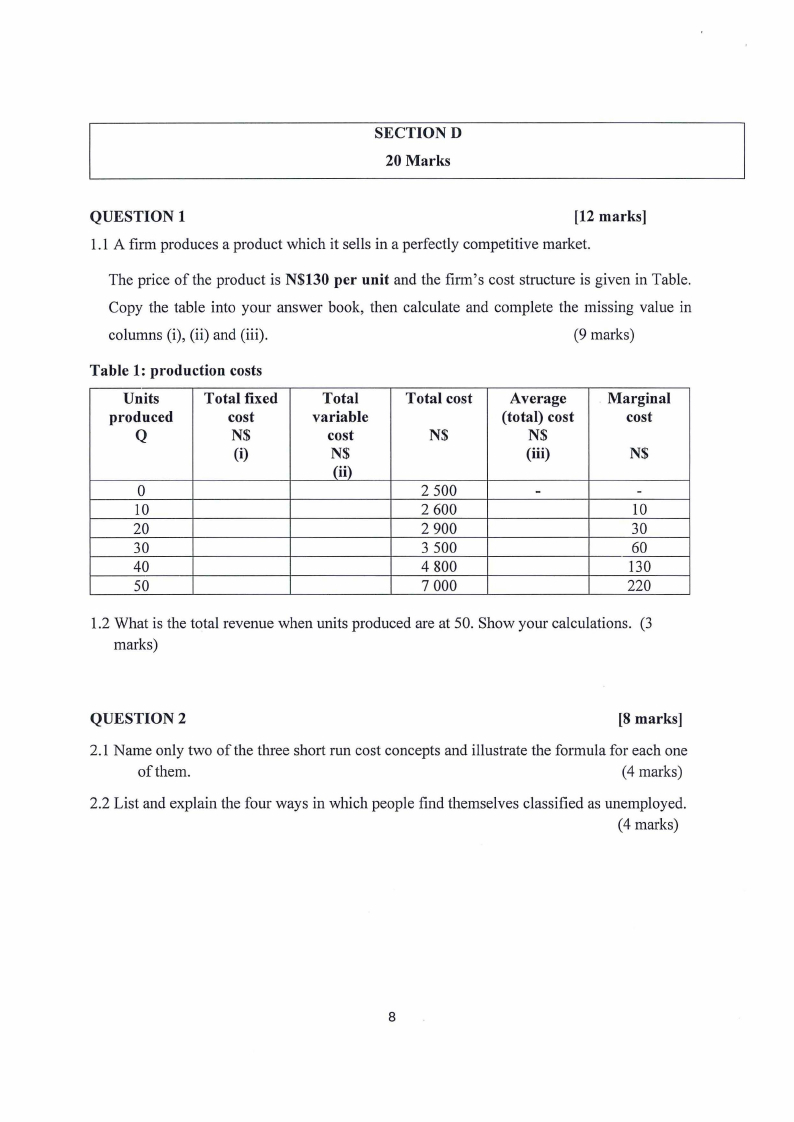
SECTIOND
20 Marks
QUESTION 1
[12 marks]
1.1 A firm produces a product which it sells in a perfectly competitive market.
The price of the product is N$130 per unit and the firm's cost structure is given in Table.
Copy the table into your answer book, then calculate and complete the missing value in
columns (i), (ii) and (iii).
(9 marks)
Table 1: production costs
Units
produced
Q
Total fixed
cost
N$
(i)
0
10
20
30
40
50
Total
variable
cost
N$
(ii)
Total cost
N$
2 500
2 600
2 900
3 500
4 800
7 000
Average
(total) cost
N$
(iii)
-
. Marginal
cost
N$
-
10
30
60
130
220
1.2 What is the total revenue when units produced are at 50. Show your calculations. (3
marks)
QUESTION2
[8 marks]
2.1 Name only two of the three short run cost concepts and illustrate the formula for each one
of them.
(4 marks)
2.2 List and explain the four ways in which people find themselves classified as unemployed.
(4 marks)
8

2 Pages 11-20

▲back to top


2.1 Page 11

▲back to top


SECTIONE
20 MARKS
QUESTION 1
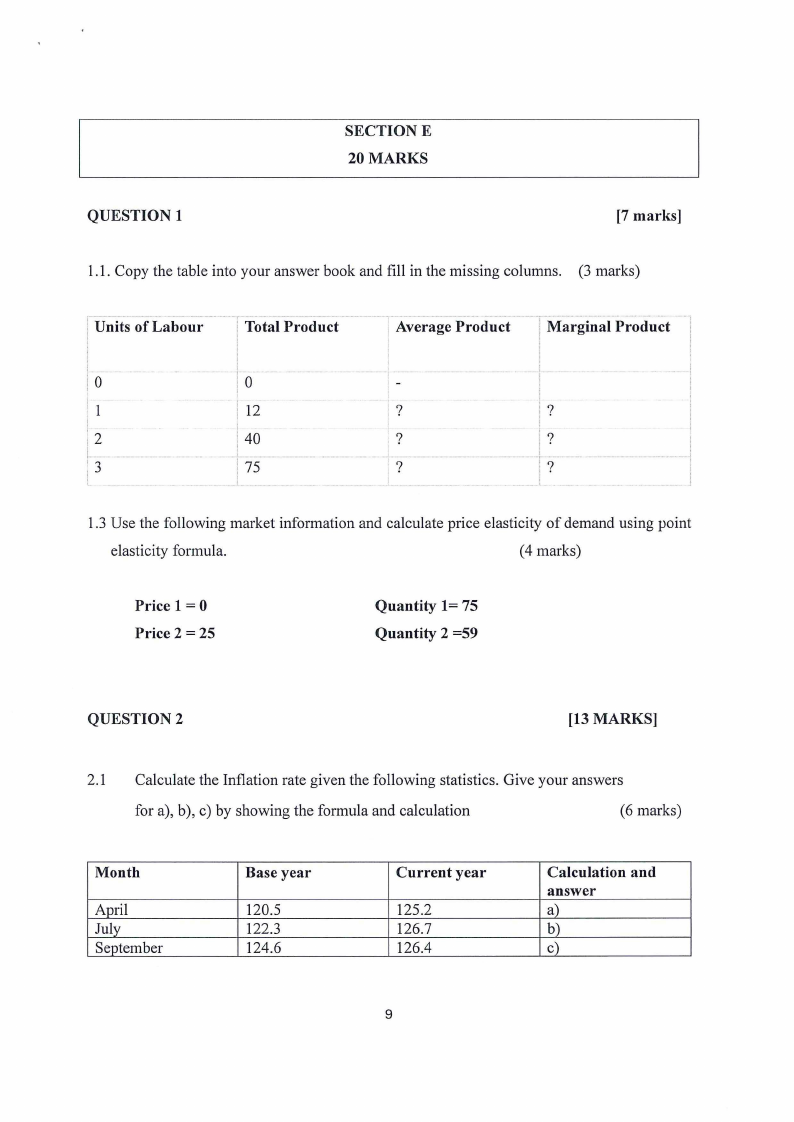
[7 marks]
1.1. Copy the table into your answer book and fill in the missing columns. (3 marks)
I ~nits ofLabour · :ot~i P~~duct
~age Product
Marginal Product
1
i 12
?
2
40
?
?
3
75
?
1.3 Use the following market information and calculate price elasticity of demand using point
elasticity formula.
(4 marks)
Price 1 = 0
Price 2 = 25
Quantity 1= 75
Quantity 2 =59
QUESTION2
[13 MARKS]
2.1 Calculate the Inflation rate given the following statistics. Give your answers
for a), b), c) by showing the formula and calculation
(6 marks)
Month
April
July
September
Base year
120.5
122.3
124.6
Current year
125.2
126.7
126.4
Calculation and
answer
a)
b)
c)
9

2.2 Page 12

▲back to top


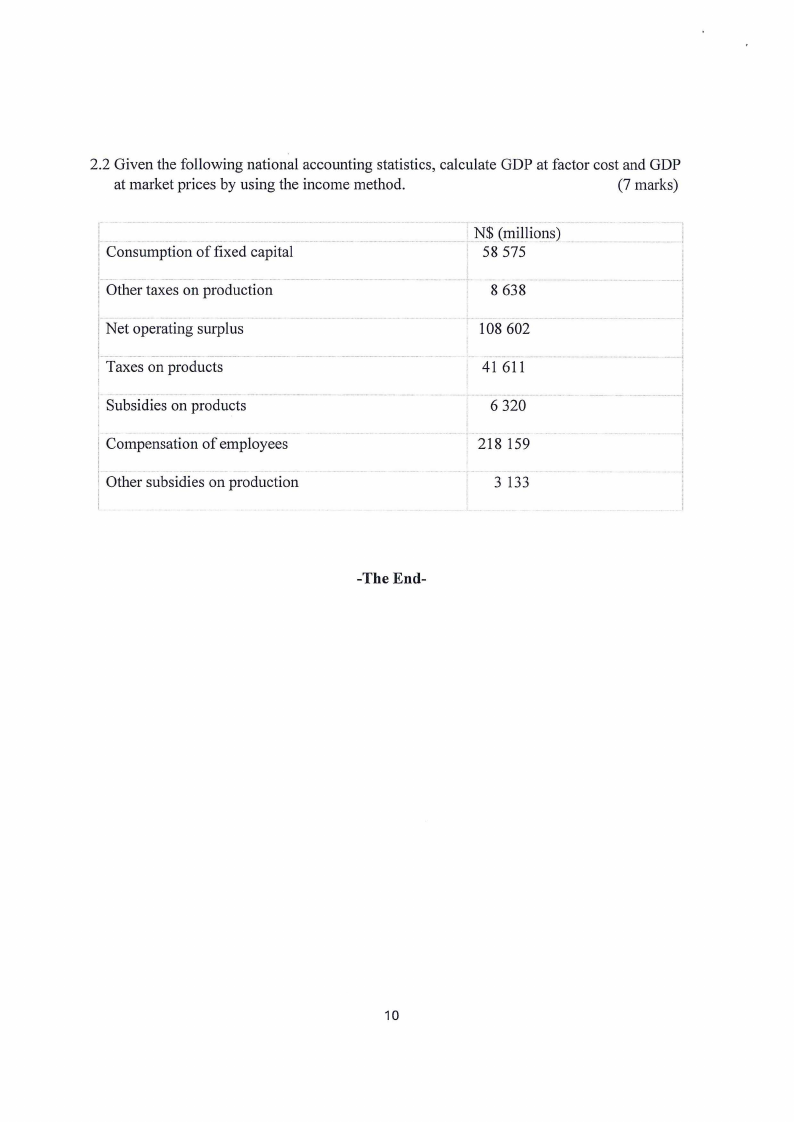
2.2 Given the following national accounting statistics, calculate GDP at factor cost and GDP
at market prices by using the income method.
(7 marks)
Consumption of fixed capital
... ~$(~illions)
58 575
·O1ther't~ax.es.~o.n.p1.ro·.d~u·.ct.i·op.n·.;·..·.·.·..·.·.·..·.·.·..-.·.·.8 ·638
Net operating surplus
108 602
••••••••••••••••••·-•••••••••••••··
•••••~o••••-rn"""'
• Taxes on products
41 611
' Subsidies ~n products
.. ····-·
Compensation of employees
- •.. ....·······-······
6 320
218 159
, Other subsidies on production
3 133
-The End-
10

2.3 Page 13

▲back to top


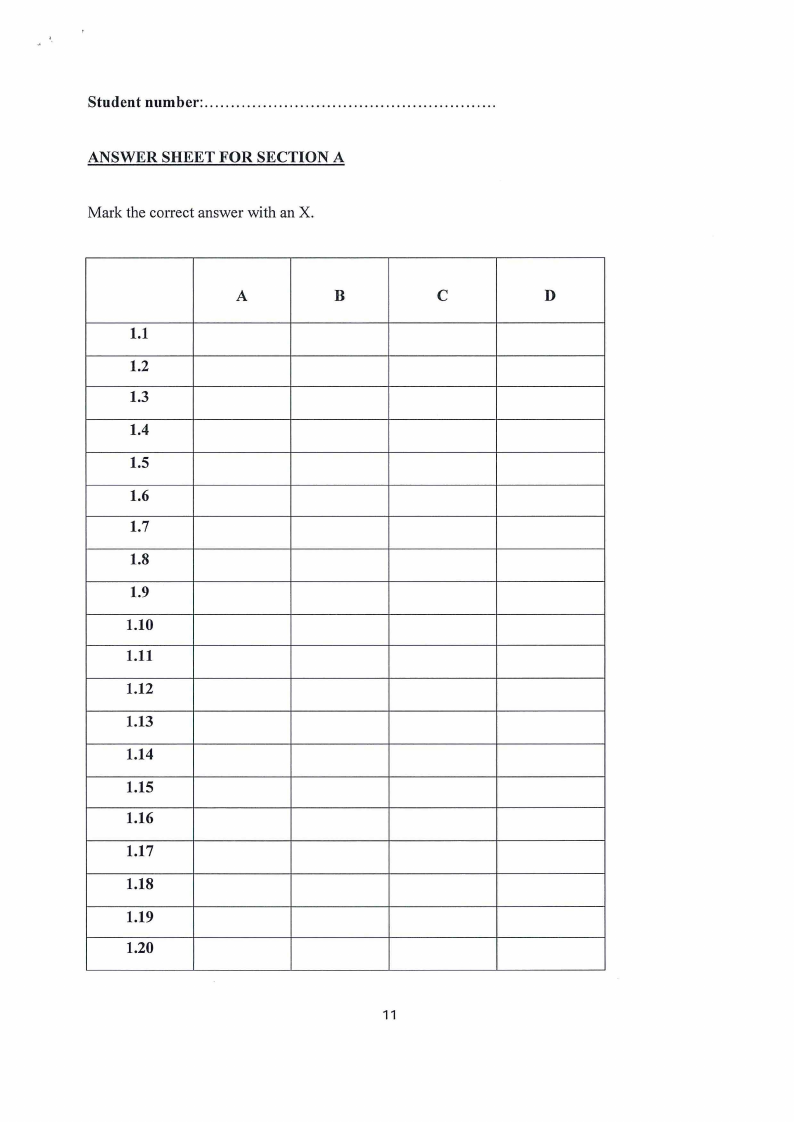
Student number: ......................................................
.
ANSWER SHEET FOR SECTION A
Mark the correct answer with an X.
A
B
C
D
1.1
1.2
1.3
1.4
1.5
1.6
1.7
1.8
1.9
1.10
1.11
1.12
1.13
1.14
1.15
1.16
1.17
1.18
1.19
1.20
11

2.4 Page 14

▲back to top


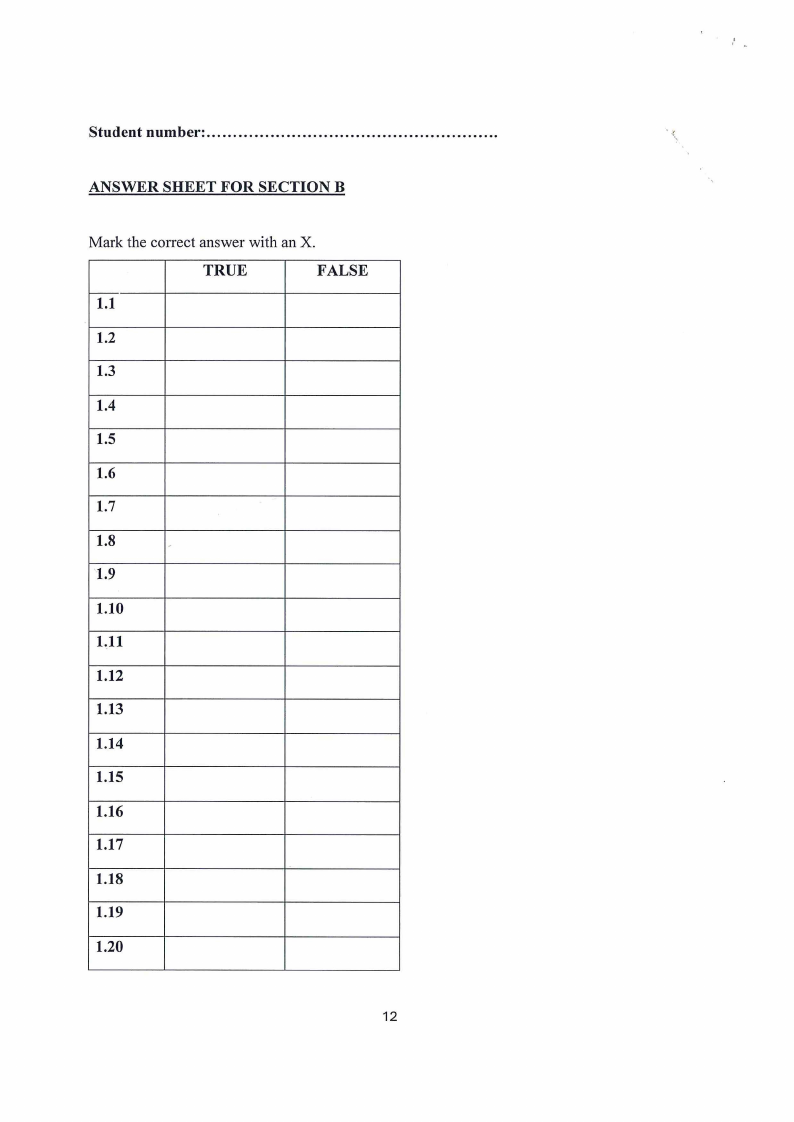
Student number: ......................................................
.
ANSWER SHEET FOR SECTION B
Mark the correct answer with an X.
TRUE
FALSE
1.1
1.2
1.3
1.4
1.5
1.6
1.7
1.8
-
1.9
1.10
1.11
1.12
1.13
1.14
1.15
1.16
1.17
1.18
1.19
1.20
12