BBN810S - BROADBAND NETWORKS - 2ND OPP - JULY 2025


BBN810S - BROADBAND NETWORKS - 2ND OPP - JULY 2025


1 Pages 1-10

▲back to top


1.1 Page 1

▲back to top


nAmI BIAunIVER sITY
OF SCIEnCE Ano TECHnOLOGY
FACULTYOF COMPUTING AND INFORMATICS
DEPARTMENTOF COMPUTERSCIENCE
QUALIFICATION:BACHELOROF COMPUTERSCIENCE
QUALIFICATIONCODE: 08BCSH
LEVEL: 8
COURSE:BROADBANDNETWORKS
COURSECODE: BBN810S
DATE: JULY2025
SESSION:2
DURATION: 3 HOURS
MARKS: 100
SUPPLEMENTARY/ SECONDOPPORTUNITYEXAMINATION QUESTION PAPER
EXAMINER(S} PROFGUY-ALAIN LUSILAO2001
MODERATOR: MS EMILIA WEYULU
INSTRUCTIONS
1. Answer ALL the questions.
2. Write clearly and neatly.
3. Number the answers clearly.
THIS QUESTIONPAPERCONSISTSOF 8 PAGES(Including this front page)

1.2 Page 2

▲back to top


Question 1 [ 10 marks]
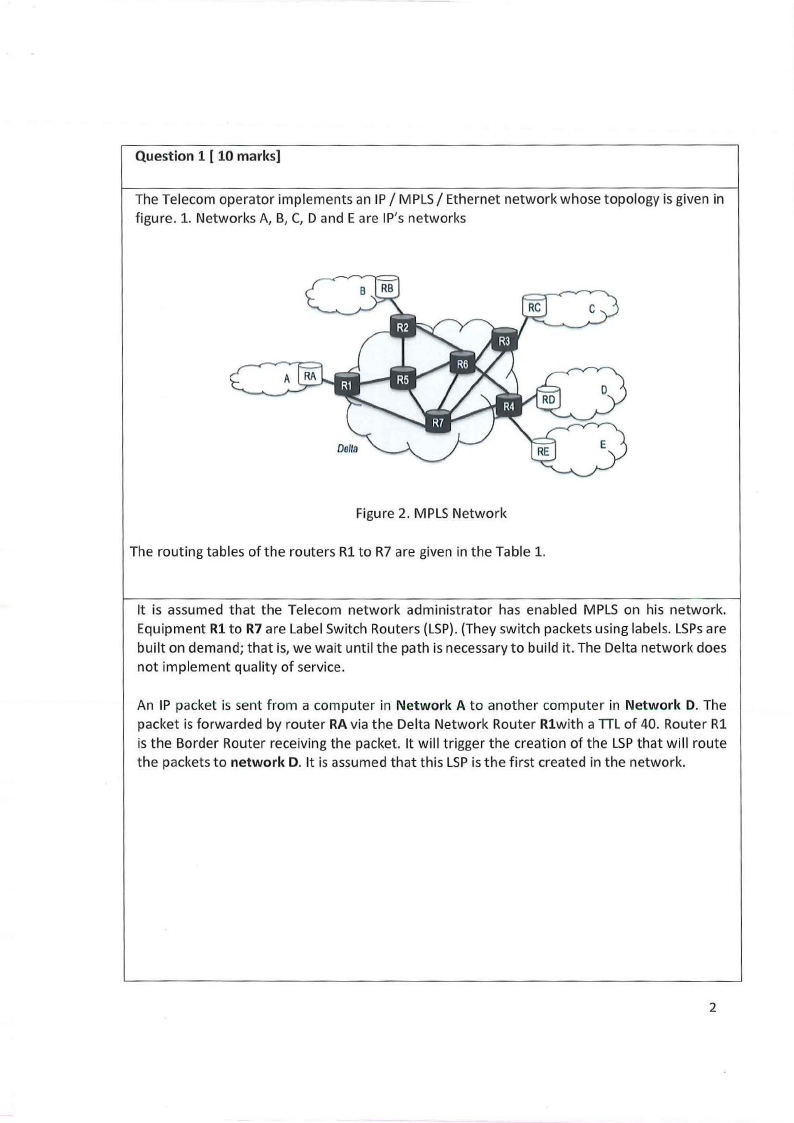
The Telecom operator implements an IP/ MPLS/ Ethernet network whose topology is given in
figure. 1. Networks A, B, C, D and E are IP's networks
Figure 2. MPLSNetwork
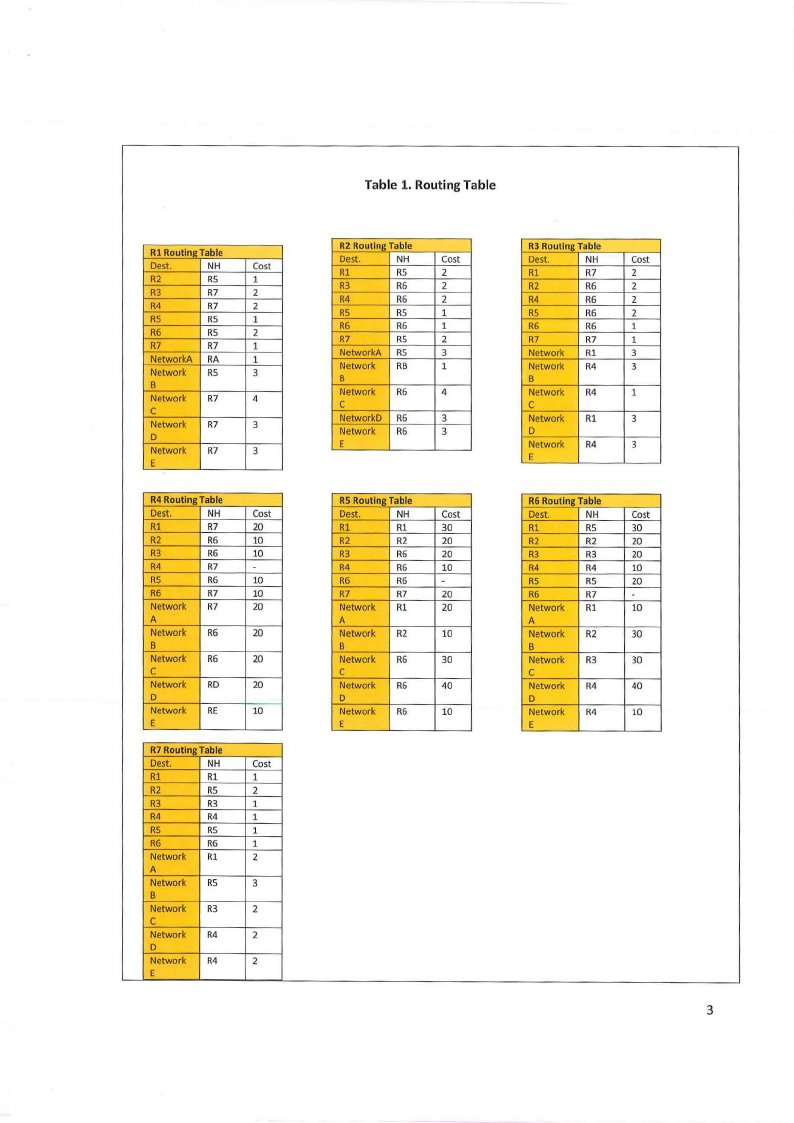
The routing tables of the routers Rl to R7 are given in the Table 1.
It is assumed that the Telecom network administrator has enabled MPLS on his network.
Equipment Rl to R7 are Label Switch Routers (LSP}.(They switch packets using labels. LSPsare
built on demand; that is, we wait until the path is necessary to build it. The Delta network does
not implement quality of service.
An IP packet is sent from a computer in Network A to another computer in Network D. The
packet is forwarded by router RA via the Delta Network Router Rlwith a TTL of 40. Router Rl
is the Border Router receiving the packet. It will trigger the creation of the LSPthat will route
the packets to network D. It is assumed that this LSPis the first created in the network.
2

1.3 Page 3

▲back to top


Rl Routing Table
Dest.
NH
R2
RS
R3
R7
R4
R7
RS
RS
R6
RS
R7
R7
NetworkA RA
Network
RS
B
Network
R7
C
Network
R7
D
Network
R7
E
Cost
1
2
2
1
2
1
1
3
4
3
3
R4 RoutingTable
Dest.
NH
Rl
R7
R2
R6
R3
R6
R4
R7
RS
R6
R6
R7
Network
R7
A
Network
R6
B
Network
R6
C
Network
RD
D
Network
RE
E
R7 RoutingTable
Dest.
NH
Rl
Rl
R2
RS
R3
R3
R4
R4
RS
RS
R6
R6
Network
Rl
A
Network
RS
B
Network
R3
C
Network
R4
D
Network
R4
E
Cost
20
10
10
.
10
10
20
20
20
20
10
Cost
1
2
1
1
1
1
2
3
2
2
2
Table 1. RoutingTable
R2 Routing Table
Dest.
NH
Rl
RS
R3
R6
R4
R6
RS
RS
R6
R6
R7
RS
NetworkA RS
Network
RB
B
Network
R6
C
NetworkD R6
Network
R6
E
Cost
2
2
2
1
1
2
3
1
4
3
3
RSRoutingTable
Dest.
NH
Rl
Rl
R2
R2
R3
R6
R4
R6
R6
R6
R7
R7
Network
Rl
A
Network
R2
B
Network
R6
C
Network
R6
D
Network
R6
E
Cost
30
20
20
10
20
20
10
30
40
10
R3 Routing Table
Dest.
NH
Rl
R7
R2
R6
R4
R6
RS
R6
R6
R6
R7
R7
Network
Rl
Network
R4
B
Network
R4
C
Network
Rl
D
Network
R4
E
Cost
2
2
2
2
1
1
3
3
1
3
3
R6 RoutingTable
Dest.
NH
Rl
RS
R2
R2
R3
R3
R4
R4
RS
RS
R6
R7
Network
Rl
A
Network
R2
B
Network
R3
C
Network
R4
D
Network
R4
E
Cost
30
20
20
10
20
.
10
30
30
40
10
3

1.4 Page 4

▲back to top


a)
Which router will choose the label to use on the LSPlink at the exit of Rl 2 marks
(LSPRl to R7)towards Network D?
b)
The switching table in Rl contains the following line:
Entry Label
Next host
Release Label
2 marks
D
R7
5
In case the IP packet is to leave the Delta network, which router
pops the MPLS header?
c)
Which LSRsent the packets to router R4 for the communication from Rl 2 marks
to D?
d)
Which next hop is associated with these packets in the switching table of 2 marks
R4?
e)
If packets leaving router R7 are labelled 9, draw the switching table of 2 marks
router R7.
Question 2 [ 10 marks]
In TCP the Retransmit Time-Out (RTO) is determined on the basis of RTT observations for
arriving ACKs.
a)
Measured RTTvalues are subject to considerable fluctuations. List three 3 marks
reasons that explain this phenomenon.
b)
What is an optimal value of RTOfor a TCPconnection? Explain Why .
3 marks
c)
What are the implications of a RTOthat is too large or too small?
4 marks
4

1.5 Page 5

▲back to top


Question 3 [ 10 marks]
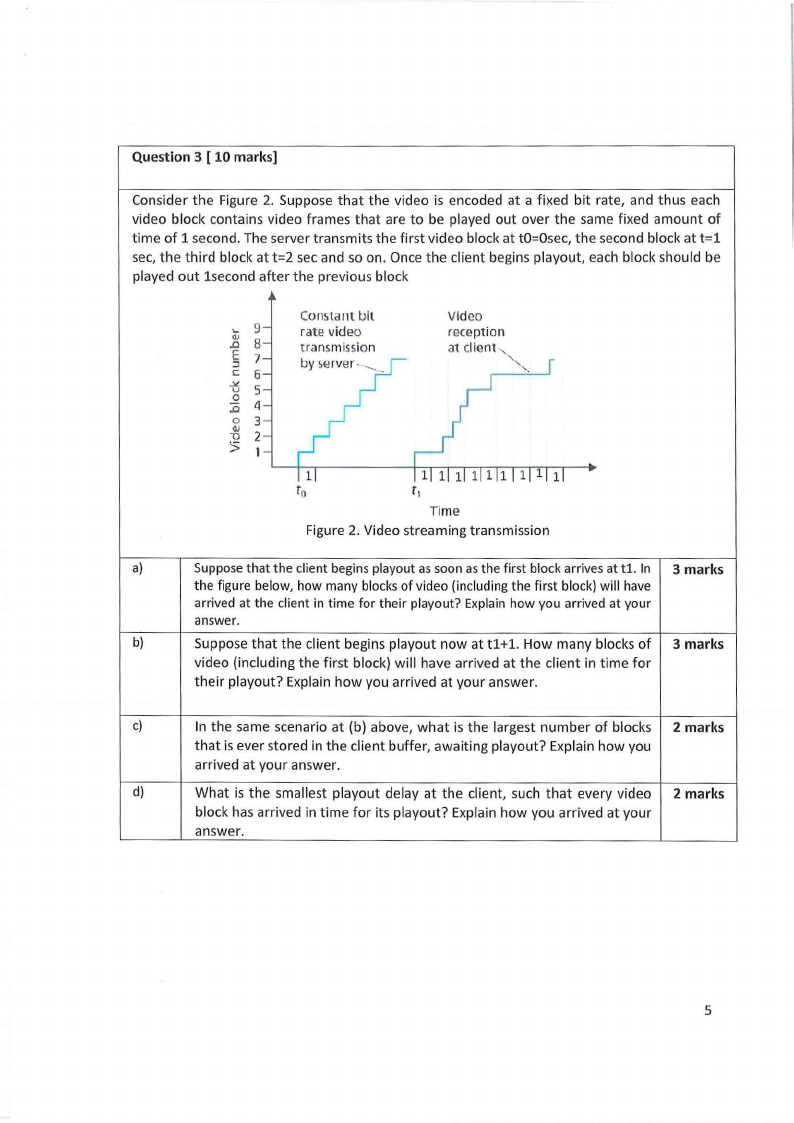
Consider the Figure 2. Suppose that the video is encoded at a fixed bit rate, and thus each
video block contains video frames that are to be played out over the same fixed amount of
time of 1 second. The server transmits the first video block at t0=0sec, the second block at t=l
sec, the third block at t=2 sec and so on. Once the client begins playout, each block should be
played out lsecond after the previous block
... 9
.O.cJ 8
E:, 7
C6
::cu.),ft.
0
5
q
0 3-
>u<); 2-
Con!itant 1.Jit
rate video
transmission
by !i~rver. --.
Video
rnception
at client,"'-
111 1 1 1
tn
t,
Time
Figure 2. Video streaming transmission
a)
Suppose that the client begins playout as soon as the first block arrives at tl. In 3 marks
the figure below, how many blocks of video (including the first block) will have
arrived at the client in time for their playout? Explain how you arrived at your
answer.
b)
Suppose that the client begins playout now at tl+l. How many blocks of 3 marks
video (including the first block) will have arrived at the client in time for
their playout? Explain how you arrived at your answer.
c)
In the same scenario at (b) above, what is the largest number of blocks 2 marks
that is ever stored in the client buffer, awaiting playout? Explain how you
arrived at your answer.
d)
What is the smallest playout delay at the client, such that every video 2 marks
block has arrived in time for its playout? Explain how you arrived at your
answer.
5

1.6 Page 6

▲back to top


Question 4 [ 6 marks]
Compare Go-Back-N (GBN), Selective Repeat, and TCP (no delayed ACK). Assume that the
timeout values for all three protocols are sufficiently long such that 5 consecutive data
segments and their corresponding ACKs can be received (if not lost in the channel) by the
receiving host (Host B) and the sending host (Host A) respectively. Suppose Host A sends 5 data
segments to Host B, and the 2nd segment (sent from A) is lost. In the end, all 5 data segments
have been correctly received by Host B.
a)
How many segments has Host A sent in total and how many ACKs has 4 marks
Host B sent in total? What are their sequence numbers? Answer this
question for all three protocols
b)
If the timeout values for all three protocol are much longer than 5 RTT, 2 marks
then which protocol successfully delivers all five data segments in shortest
time interval?
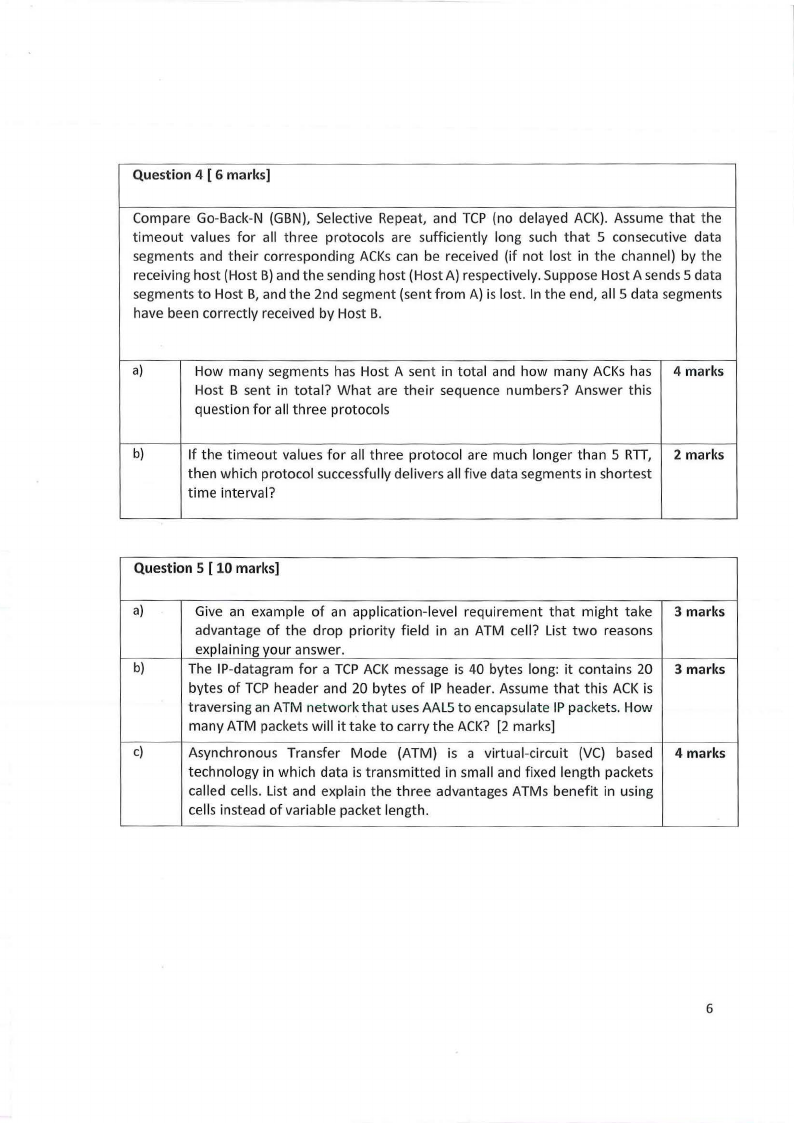
Question 5 [ 10 marks]
a)
Give an example of an application-level requirement that might take 3 marks
advantage of the drop priority field in an ATM cell? list two reasons
explaining your answer.
b)
The IP-datagram for a TCP ACK message is 40 bytes long: it contains 20 3 marks
bytes of TCP header and 20 bytes of IP header. Assume that this ACK is
traversing an ATM network that uses AALSto encapsulate IP packets. How
many ATM packets will it take to carry the ACK? [2 marks]
c)
Asynchronous Transfer Mode (ATM) is a virtual-circuit (VC) based 4 marks
technology in which data is transmitted in small and fixed length packets
called cells. list and explain the three advantages ATMs benefit in using
cells instead of variable packet length.
6

1.7 Page 7

▲back to top


Question 6 [10 marks]
a)
Consider a TCPconnection between Host A and Host B. Suppose that the 2 marks
TCPsegments travelling from Host A to Host B have source port number
x and destination port number y. What are the source and destination
port numbers for the segments travelling from Host B to Host A?
b)
In packet switching, differentiate between networks with virtual circuits 2 marks
(VCs)and networks with datagram.
c)
What characteristic of the network would you care most about to get 2 marks
good performance for Navigating a predominantly text-only website on
the Internet. Explain your answer.
d)
Why does the TCPcongestion control mechanism have a "slow-start" and 2 marks
a "congestion avoidance" phase?
e)
Why will two ISPsat the same level of the hierarchy often peer with each 2 marks
other?
Question 7 [ 6 marks]
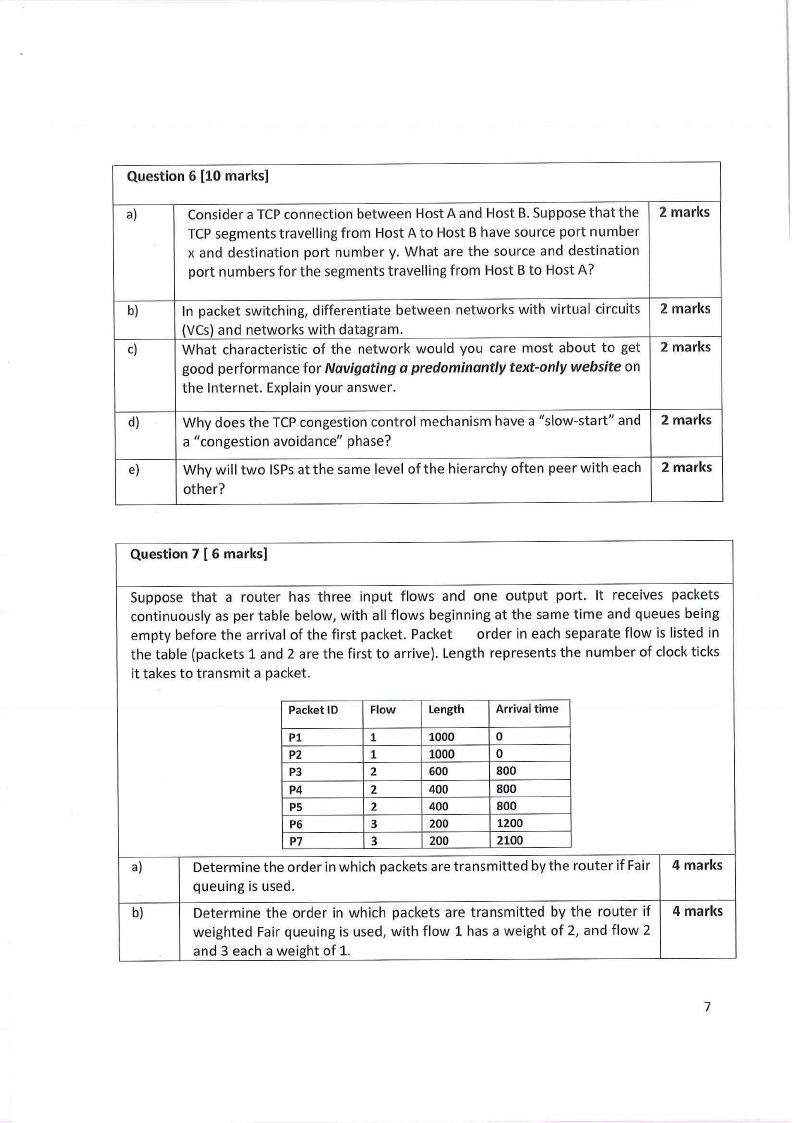
Suppose that a router has three input flows and one output port. It receives packets
continuously as per table below, with all flows beginning at the same time and queues being
empty before the arrival of the first packet. Packet order in each separate flow is listed in
the table (packets 1 and 2 are the first to arrive). Length represents the number of clock ticks
it takes to transmit a packet.
Packet ID Flow Length Arrivaltime
Pl
1
1000
0
P2
1
1000
0
P3
2
600
800
P4
2
400
800
PS
2
400
800
P6
3
200
1200
P7
3
200
2100
a)
Determine the order in which packets are transmitted by the router if Fair 4 marks
queuing is used.
b)
Determine the order in which packets are transmitted by the router if 4 marks
weighted Fair queuing is used, with flow 1 has a weight of 2, and flow 2
and 3 each a weight of 1.
7

1.8 Page 8

▲back to top


Question 8 [ 4 marks]
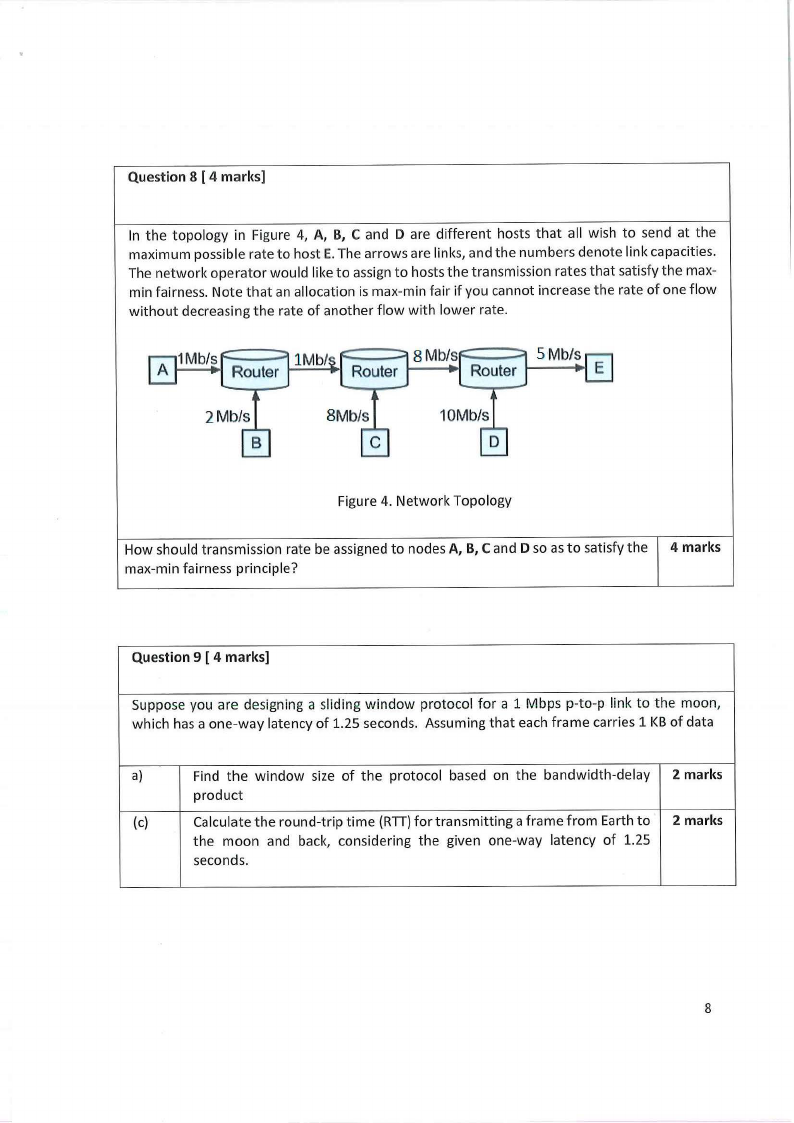
In the topology in Figure 4, A, B, C and D are different hosts that all wish to send at the
maximum possible rate to host E.The arrows are links, and the numbers denote link capacities.
The network operator would like to assign to hosts the transmission rates that satisfy the max-
min fairness. Note that an allocation is max-min fair if you cannot increase the rate of one flow
without decreasing the rate of another flow with lower rate.
2Mb/s
B
8Mb/s
C
10Mb/s
D
Figure 4. Network Topology
How should transmission rate be assigned to nodes A, B, C and D so as to satisfy the 4 marks
max-min fairness principle?
Question 9 [ 4 marks]
Suppose you are designing a sliding window protocol for a 1 Mbps p-to-p link to the moon,
which has a one-way latency of 1.25 seconds. Assuming that each frame carries 1 KB of data
a)
Find the window size of the protocol based on the bandwidth-delay 2 marks
product
(c)
Calculate the round-trip time (RTT)for transmitting a frame from Earth to 2 marks
the moon and back, considering the given one-way latency of 1.25
seconds.
8

1.9 Page 9

▲back to top


Question 10 [ 14 marks]
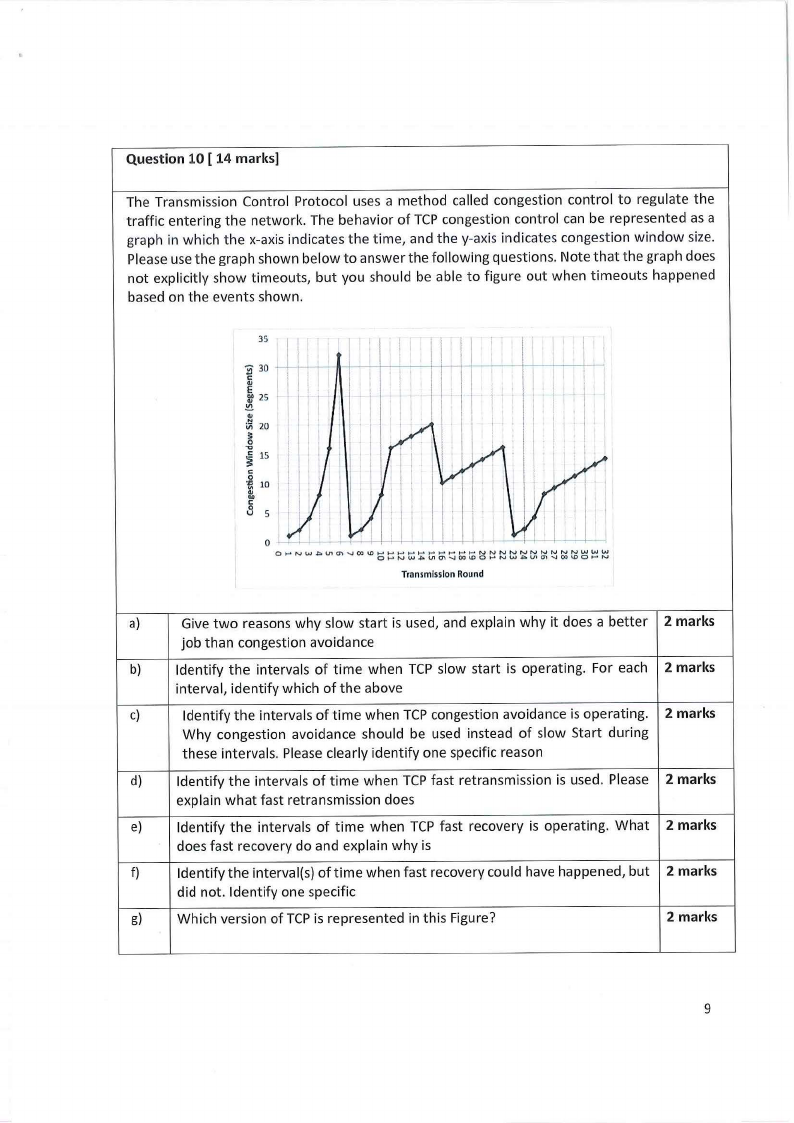
The Transmission Control Protocol uses a method called congestion control to regulate the
traffic entering the network. The behavior of TCP congestion control can be represented as a
graph in which the x-axis indicates the time, and the y-axis indicates congestion window size.
Please use the graph shown below to answer the following questions. Note that the graph does
not explicitly show timeouts, but you should be able to figure out when timeouts happened
based on the events shown.
35
1C.,3"30
,
JE
25
1 I 20
l0
1s
C
-~ 10
C
85
0
Transmlsslo11Round
a)
Give two reasons why slow start is used, and explain why it does a better 2 marks
job than congestion avoidance
b)
Identify the intervals of time when TCP slow start is operating. For each 2 marks
interval, identify which of the above
c)
Identify the intervals of time when TCP congestion avoidance is operating. 2 marks
Why congestion avoidance should be used instead of slow Start during
these intervals. Please clearly identify one specific reason
d)
Identify the intervals of time when TCP fast retransmission is used. Please 2 marks
explain what fast retransmission does
e)
Identify the intervals of time when TCP fast recovery is operating. What 2 marks
does fast recovery do and explain why is
f)
Identify the interval(s) of time when fast recovery could have happened, but 2 marks
did not. Identify one specific
g)
Which version of TCP is represented in this Figure?
2 marks
9

1.10 Page 10

▲back to top


Question 11 [ 14 marks]
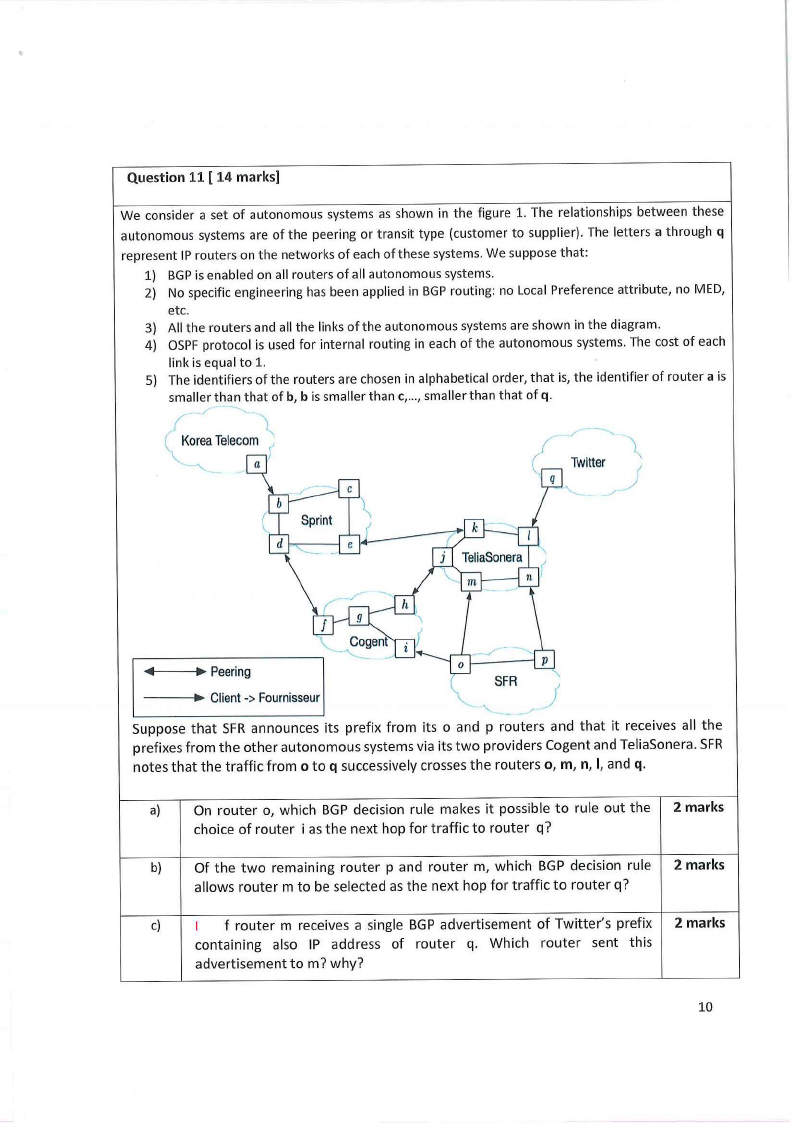
We consider a set of autonomous systems as shown in the figure 1. The relationships between these
autonomous systems are of the peering or transit type (customer to supplier). The letters a through q
represent IP routers on the networks of each of these systems. We suppose that:
1) BGPis enabled on all routers of all autonomous systems.
2) No specific engineering has been applied in BGProuting: no Local Preference attribute, no MED,
etc.
3) All the routers and all the links of the autonomous systems are shown in the diagram.
4) OSPFprotocol is used for internal routing in each of the autonomous systems. The cost of each
link is equal to 1.
5) The identifiers of the routers are chosen in alphabetical order, that is, the identifier of router a is
smaller than that of b, bis smaller than c,..., smaller than that of q.
f (
)
\\_ KoreaTelecom
a
\\
Twitter
1
_/j
Peering
Client-> Fournisseur
j
Suppose that SFR announces its prefix from its o and p routers and that it receives all the
prefixes from the other autonomous systems via its two providers Cogent and TeliaSonera. SFR
notes that the traffic from o to q successively crosses the routers o, m, n, I, and q.
a) On router o, which BGP decision rule makes it possible to rule out the 2 marks
choice of router i as the next hop for traffic to router q?
b) Of the two remaining router p and router m, which BGP decision rule 2 marks
allows router m to be selected as the next hop for traffic to router q?
c)
f router m receives a single BGP advertisement of Twitter's prefix 2 marks
containing also IP address of router q. Which router sent this
advertisement to m? why?
10

2 Pages 11-20

▲back to top


2.1 Page 11

▲back to top


d)
On the TeliaSonera network, why is the path passing through route n 2 marks
preferred to the one passing through router j and router k?
e)
According to the peering agreement between Cogent and TeliaSonera:
(a) The SFRprefix is only announced from h to j.
(b) The SFRprefix is only announced from j to h.
(c) The SFRprefix is announced from h to j and from j to h.
(d) The SFRprefix is announced neither from h to j, nor from j to h.
2 Marks
!)
According to the peering agreement between Cogent and Sprint:
a) The SFRprefix is only announced from f to d.
b) The SFRprefix is only announced from d to f.
c) The SFRprefix is announced from f to d and from d to f.
d) The SFRprefix is neither announced from f to d, nor from d to f.
2 marks
g)
According to the peering agreement between Sprint and TeliaSonera:
a) The SFRprefix is only announced from e to k.
b) The SFRprefix is only announced from k toe.
c) The SFRprefix is announced from e to k and from k toe.
d) The SFRprefix is neither announced from e to k, nor from k toe.
2 marks
==========================G=O=OD LUCK===========================
11