


 |
CPN610S - CROP PRODUCTION - 2ND OPP - JUNE 2025 |
|
|
1 Page 1 |
▲back to top |
nAmlBIA UnlVERSITY
OF SCIEn CE Ano TECHn OLOGY
FACULTY OF HEALTH, NATURAL RESOURCES AND APPLIED SCIENCES
SCHOOL OF AGRICULTURE AND NATURAL RESOURCES SCIENCES
DEPARTMENT OF AGRICULTURAL SCIENCES AND AGRIBUSINESS
QUALIFICATIONS: BACHELOR OF SCIENCE IN HORTICULTURE
QUALIFICATIONS CODE: 07BHOR
LEVEL: 7
COURSE CODE: CPN610S
DATE: JULY 2025
COURSE NAME: CROP PRODUCTION
PAPER: 1
DURATION: 3 HOURS
MARKS: 100
SECOND OPPORTUNITY/SUPPLEMENTARY
EXAMINER:
DR. VENAUNE HEPUTE
MODERATOR: MR. CLIFFORDAKASHAMBATWA
EXAMINATION QUESTION PAPER
INSTRUCTIONS
1.
Answer all the questions.
2.
Write neatly and clearly.
3.
Mark all answers clearly with their respective question numbers.
4.
All written work MUST be done in blue or black ink.
5.
No books, notes and other additional aids are allowed.
PERMISSIBLE MATERIALS
1. Calculator
2. Examination paper
3. Examination script
THIS QUESTION PAPER CONSISTS OF 4 PAGES
(Excluding This Front Page)
|
|
2 Page 2 |
▲back to top |
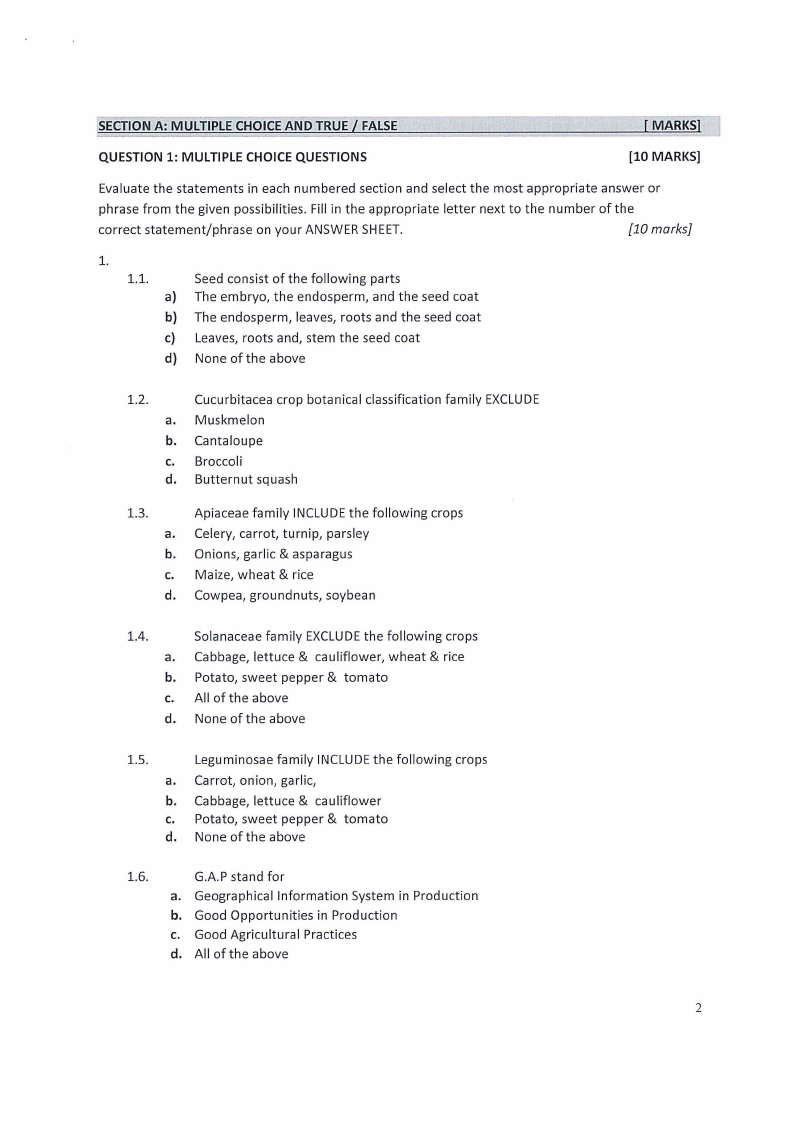
SECTION A: MWLTIPLE CHOICE AND TRUE/ FALSE
[ MARKS)
QUESTION 1: MULTIPLE CHOICE QUESTIONS
[10 MARKS)
Evaluate the statements in each numbered section and select the most appropriate answer or
phrase from the given possibilities. Fill in the appropriate letter next to the number of the
correct statement/phrase on your ANSWER SHEET.
{10 marks]
1.
1.1.
Seed consist of the following parts
a) The embryo, the endosperm, and the seed coat
b) The endosperm, leaves, roots and the seed coat
c) Leaves, roots and, stem the seed coat
d) None of the above
1.2.
Cucurbitacea crop botanical classification family EXCLUDE
a. Muskmelon
b. Cantaloupe
c. Broccoli
d. Butternut squash
1.3.
Apiaceae family INCLUDEthe following crops
a. Celery, carrot, turnip, parsley
b. Onions, garlic & asparagus
c. Maize, wheat & rice
d. Cowpea, groundnuts, soybean
1.4.
Solanaceae family EXCLUDEthe following crops
a. Cabbage, lettuce & cauliflower, wheat & rice
b. Potato, sweet pepper & tomato
c. All of the above
d. None of the above
1.5.
Leguminosae family INCLUDEthe following crops
a. Carrot, onion, garlic,
b. Cabbage, lettuce & cauliflower
c. Potato, sweet pepper & tomato
d. None of the above
1.6.
G.A.P stand for
a. Geographical Information System in Production
b. Good Opportunities in Production
c. Good Agricultural Practices
d. All of the above
2
|
|
3 Page 3 |
▲back to top |
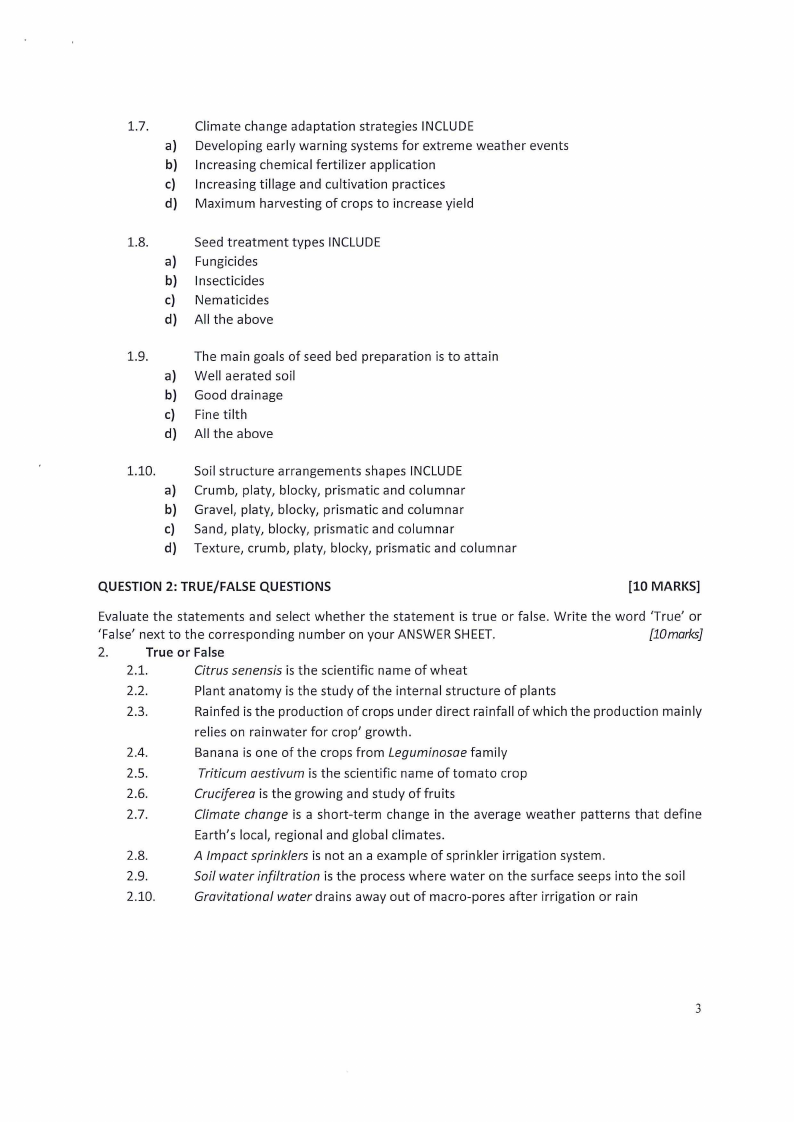
1.7.
Climate change adaptation strategies INCLUDE
a) Developing early warning systems for extreme weather events
b) Increasing chemical fertilizer application
c) Increasing tillage and cultivation practices
d) Maximum harvesting of crops to increase yield
1.8.
Seed treatment types INCLUDE
a) Fungicides
b) Insecticides
c) Nematicides
d) All the above
1.9.
The main goals of seed bed preparation is to attain
a) Well aerated soil
b) Good drainage
c) Fine tilth
d) All the above
1.10.
a)
b)
c)
d)
Soil structure arrangements shapes INCLUDE
Crumb, platy, blocky, prismatic and columnar
Gravel, platy, blocky, prismatic and columnar
Sand, platy, blocky, prismatic and columnar
Texture, crumb, platy, blocky, prismatic and columnar
QUESTION 2: TRUE/FALSEQUESTIONS
[10 MARKS]
Evaluate the statements and select whether the statement is true or false. Write the word 'True' or
'False' next to the corresponding number on your ANSWER SHEET.
{lOmarks]
2.
True or False
2.1.
Citrus senensis is the scientific name of wheat
2.2.
Plant anatomy is the study of the internal structure of plants
2.3.
Rainfed is the production of crops under direct rainfall of which the production mainly
relies on rainwater for crop' growth.
2.4.
Banana is one of the crops from Leguminosae family
2.5.
Triticum aestivum is the scientific name of tomato crop
2.6.
Cruciferea is the growing and study of fruits
2.7.
Climate change is a short-term change in the average weather patterns that define
Earth's local, regional and global climates.
2.8.
A Impact sprinklers is not an a example of sprinkler irrigation system.
2.9.
Soil water infiltration is the process where water on the surface seeps into the soil
2.10.
Gravitational water drains away out of macro-pores after irrigation or rain
3
|
|
4 Page 4 |
▲back to top |
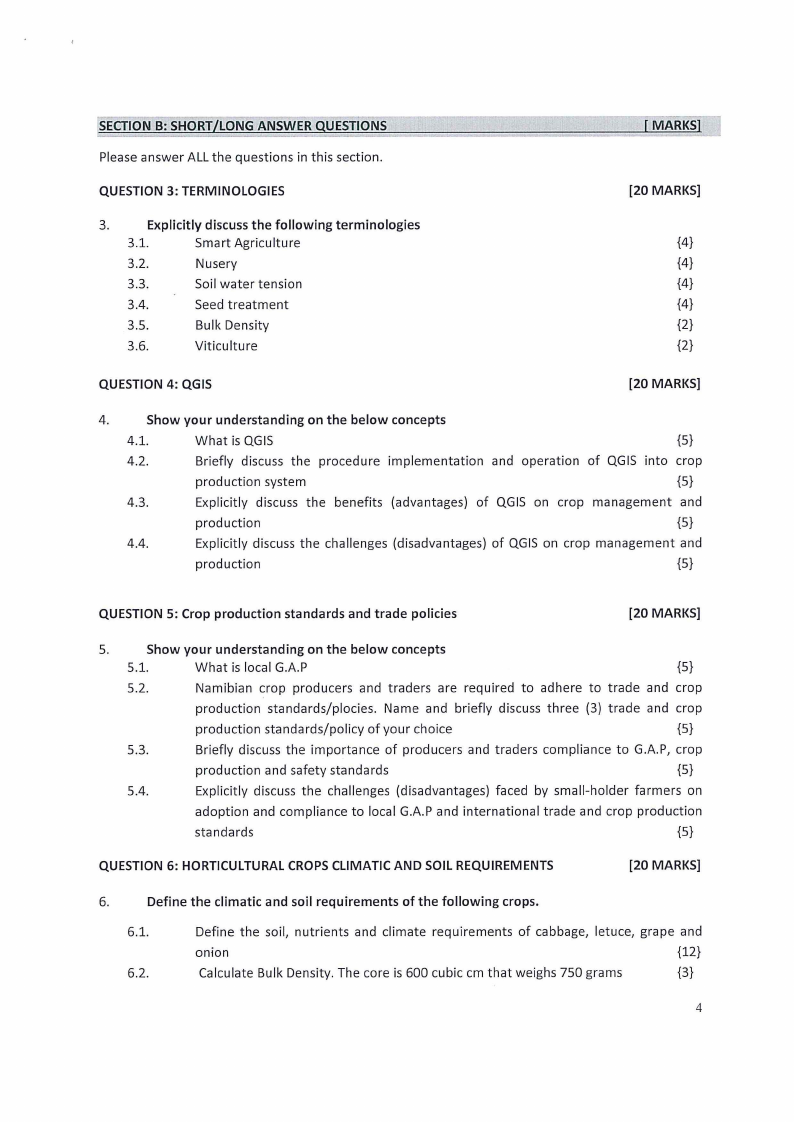
SECTION B: SHORT/LONG ANSWER QUESTIONS
Please answer ALL the questions in this section.
QUESTION 3: TERMINOLOGIES
3.
Explicitly discuss the following terminologies
3.1.
Smart Agriculture
3.2.
Nusery
3.3.
Soil water tension
3.4.
Seed treatment
3.5.
Bulk Density
3.6.
Viticulture
[ MARKS]
[20 MARKS]
{4}
{4}
{4}
{4}
{2}
{2}
QUESTION 4: QGIS
[20 MARKS]
4.
Show your understanding on the below concepts
4.1.
What is QGIS
{5}
4.2.
Briefly discuss the procedure implementation and operation of QGIS into crop
production system
{5}
4.3.
Explicitly discuss the benefits (advantages) of QGIS on crop management and
production
{5}
4.4.
Explicitly discuss the challenges (disadvantages) of QGIS on crop management and
production
{5}
QUESTION 5: Crop production standards and trade policies
[20 MARKS]
5.
Show your understanding on the below concepts
5.1.
What is local G.A.P
{5}
5.2.
Namibian crop producers and traders are required to adhere to trade and crop
production standards/plocies. Name and briefly discuss three (3) trade and crop
production standards/policy of your choice
{5}
5.3.
Briefly discuss the importance of producers and traders compliance to G.A.P, crop
production and safety standards
{5}
5.4.
Explicitly discuss the challenges (disadvantages) faced by small-holder farmers on
adoption and compliance to local G.A.P and international trade and crop production
standards
{S}
QUESTION 6: HORTICULTURAL CROPS CLIMATIC AND SOIL REQUIREMENTS
[20 MARKS]
6.
Define the climatic and soil requirements of the following crops.
6.1.
Define the soil, nutrients and climate requirements of cabbage, letuce, grape and
onion
{12}
6.2.
Calculate Bulk Density. The core is 600 cubic cm that weighs 750 grams
{3}
4
|
|
5 Page 5 |
▲back to top |

6.3.
Fertilizer Calculation. Determine (kg) quantity amount of N, Pand Kin the proportion of
3:2:2(22) compound fertilizer of 100 kg bag total quantity?
{5}
END OF QUESTION PAPER
s