


 |
FLM511C-FUNDAMENTALS OF LOGISTICS MANAGEMENT-2ND OPP-DEC 2025 |
|
|
1 Page 1 |
▲back to top |
n Am I BI A u n IVER s I TY
OF SCI En CE Ano TECH n OLOGY
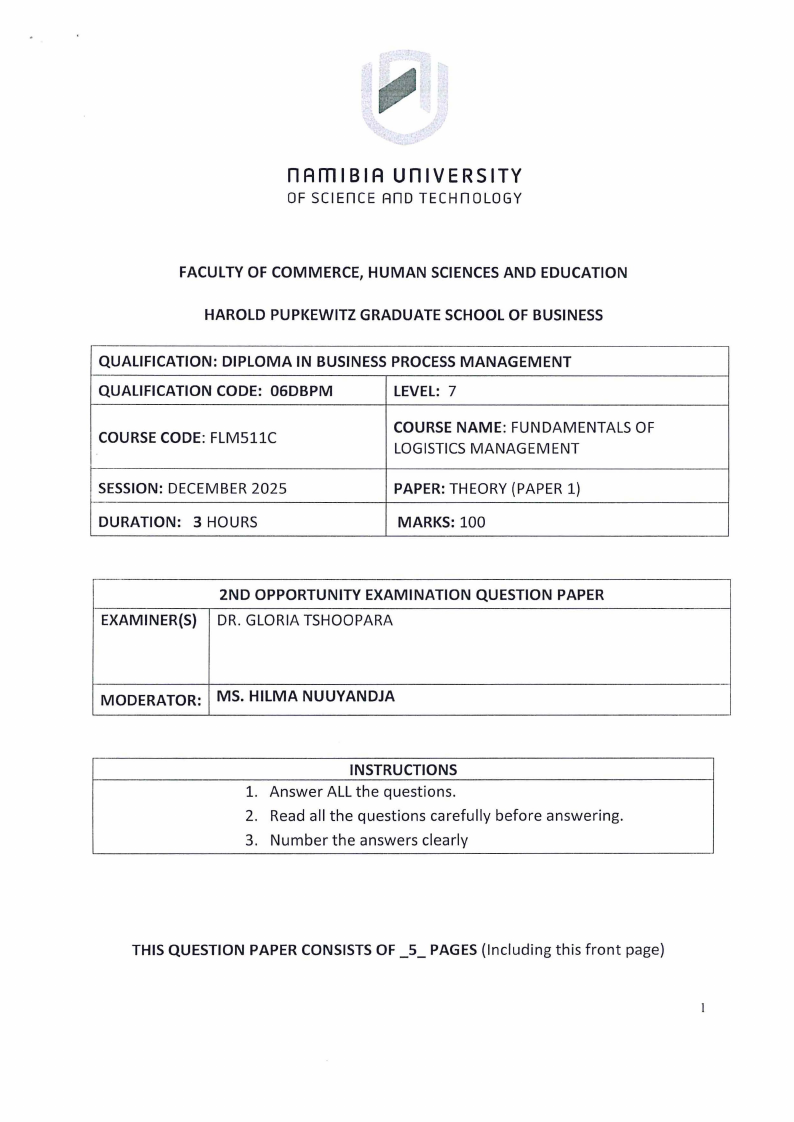
FACULTY OF COMMERCE, HUMAN SCIENCES AND EDUCATION
HAROLD PUPKEWITZ GRADUATE SCHOOL OF BUSINESS
QUALIFICATION: DIPLOMA IN BUSINESS PROCESS MANAGEMENT
QUALIFICATION CODE: 0GDBPM
LEVEL: 7
COURSE CODE: FLMSllC
COURSE NAME: FUNDAMENTALS OF
LOGISTICS MANAGEMENT
SESSION: DECEMBER 2025
DURATION: 3 HOURS
PAPER: THEORY (PAPER 1)
MARKS: 100
2ND OPPORTUNITY EXAMINATION QUESTION PAPER
EXAMINER{S) DR. GLORIA TSHOOPARA
MODERATOR: MS. HILMA NUUYANDJA
INSTRUCTIONS
1. Answer ALL the questions.
2. Read all the questions carefully before answering.
3. Number the answers clearly
THIS QUESTION PAPER CONSISTS OF _5_ PAGES (Including this front page)
|
|
2 Page 2 |
▲back to top |
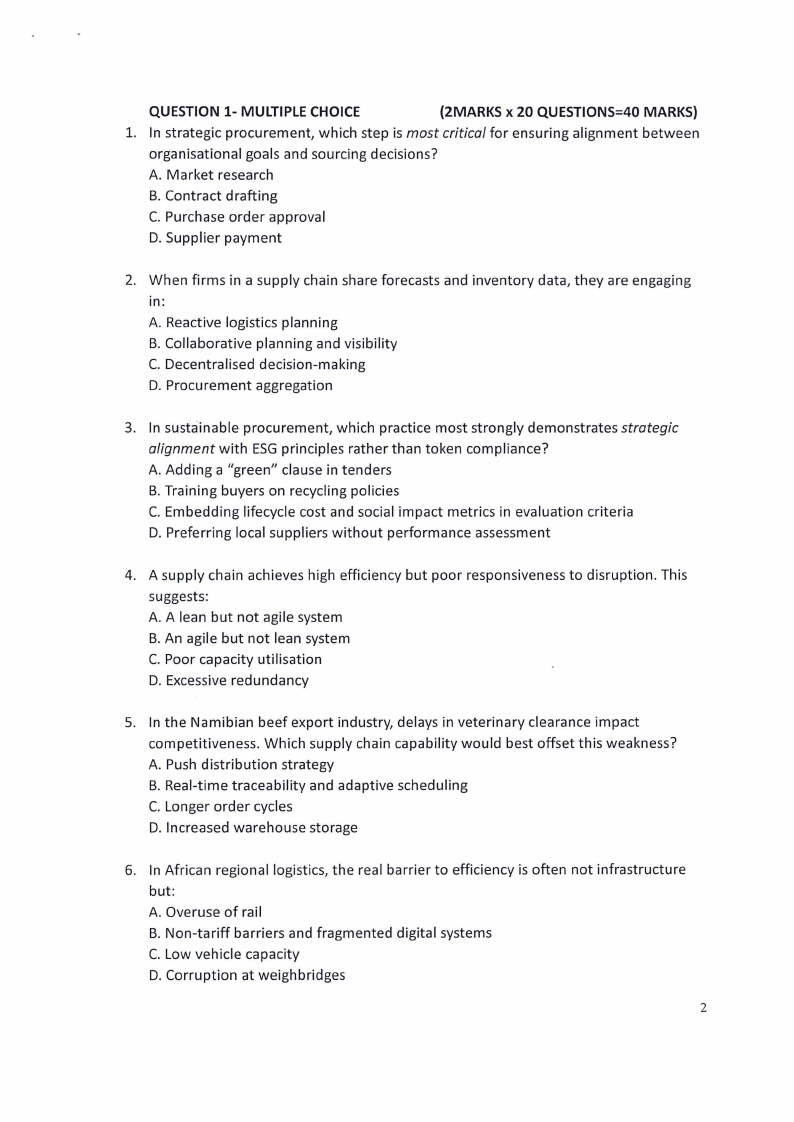
QUESTION 1- MULTIPLE CHOICE
(2MARKS x 20 QUESTIONS=40 MARKS)
1. In strategic procurement, which step is most critical for ensuring alignment between
organisational goals and sourcing decisions?
A. Market research
B. Contract drafting
C. Purchase order approval
D. Supplier payment
2. When firms in a supply chain share forecasts and inventory data, they are engaging
in :
A. Reactive logistics planning
B. Collaborative planning and visibility
C. Decentralised decision-making
D. Procurement aggregation
3. In sustainable procurement, which practice most strongly demonstrates strategic
alignment with ESG principles rather than token compliance?
A. Adding a "green" clause in tenders
B. Training buyers on recycling policies
C. Embedding lifecycle cost and social impact metrics in evaluation criteria
D. Preferring local suppliers without performance assessment
4. A supply chain achieves high efficiency but poor responsiveness to disruption. This
suggests:
A. A lean but not agile system
B. An agile but not lean system
C. Poor capacity utilisation
D. Excessive redundancy
5. In the Namibian beef export industry, delays in veterinary clearance impact
competitiveness. Which supply chain capability would best offset this weakness?
A. Push distribution strategy
B. Real-time traceability and adaptive scheduling
C. Longer order cycles
D. Increased warehouse storage
6. In African regional logistics, the real barrier to efficiency is often not infrastructure
but:
A. Overuse of rail
B. Non-tariff barriers and fragmented digital systems
C. Low vehicle capacity
D. Corruption at weighbridges
2
|
|
3 Page 3 |
▲back to top |
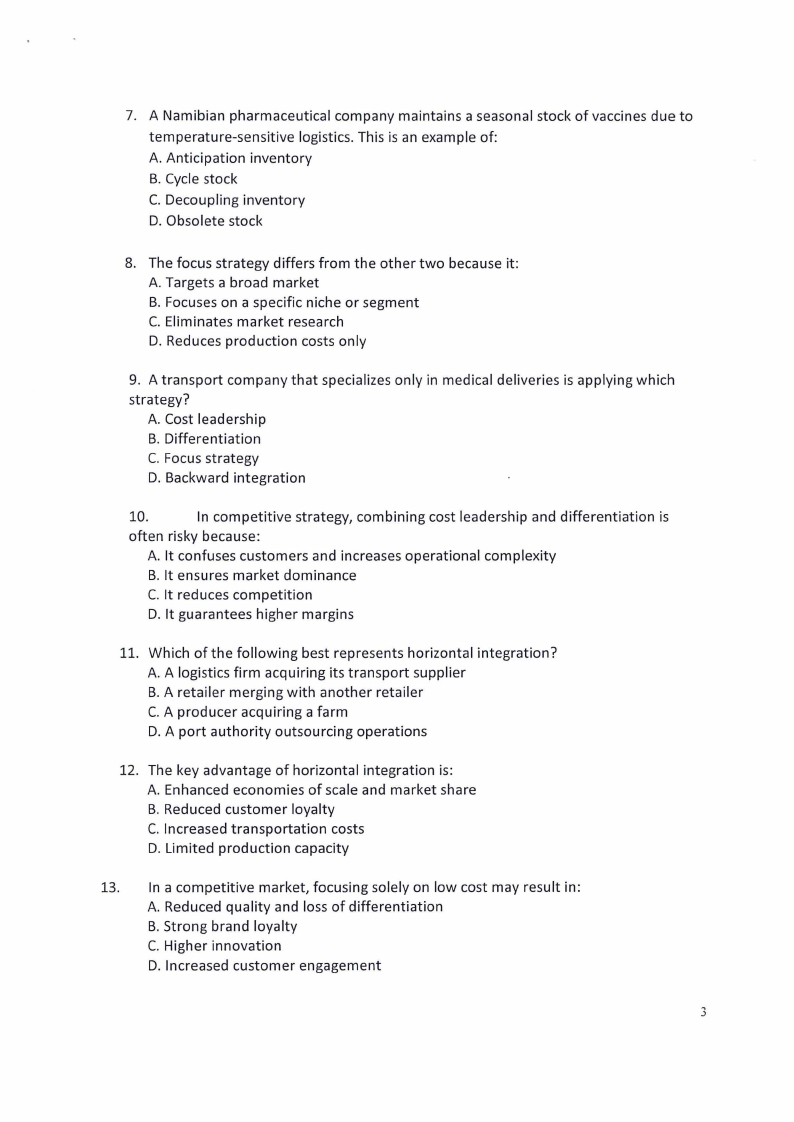
7. A Namibian pharmaceutical company maintains a seasonal stock of vaccines due to
temperature-sensit ive logistics. This is an example of:
A. Anticipation inventory
B. Cycle stock
C. Decoupling inventory
D. Obsolete stock
8. The focus strategy differs from the other two because it:
A. Targets a broad market
B. Focuses on a specific niche or segment
C. Eliminates market research
D. Reduces production costs only
9. A transport company that specializes only in medical deliveries is applying which
strategy?
A. Cost leadership
B. Differentiation
C. Focus strategy
D. Backward integration
10.
In competitive strategy, combining cost leadership and differentiation is
often risky because:
A. It confuses customers and increases operational complexity
B. It ensures market dominance
C. It reduces competition
D. It guarantees higher margins
11. Which of the following best represents horizontal integration?
A. A logistics firm acquiring its transport supplier
B. A retailer merging with another retailer
C. A producer acquiring a farm
D. A port authority outsourcing operations
12. The key advantage of horizontal integration is :
A. Enhanced economies of scale and market share
B. Reduced customer loyalty
C. Increased transportation costs
D. Limited production capacity
13. In a competitive market, focusing solely on low cost may result in:
A. Reduced quality and loss of differentiation
B. Strong brand loyalty
C. Higher innovation
D. Increased customer engagement
3
|
|
4 Page 4 |
▲back to top |
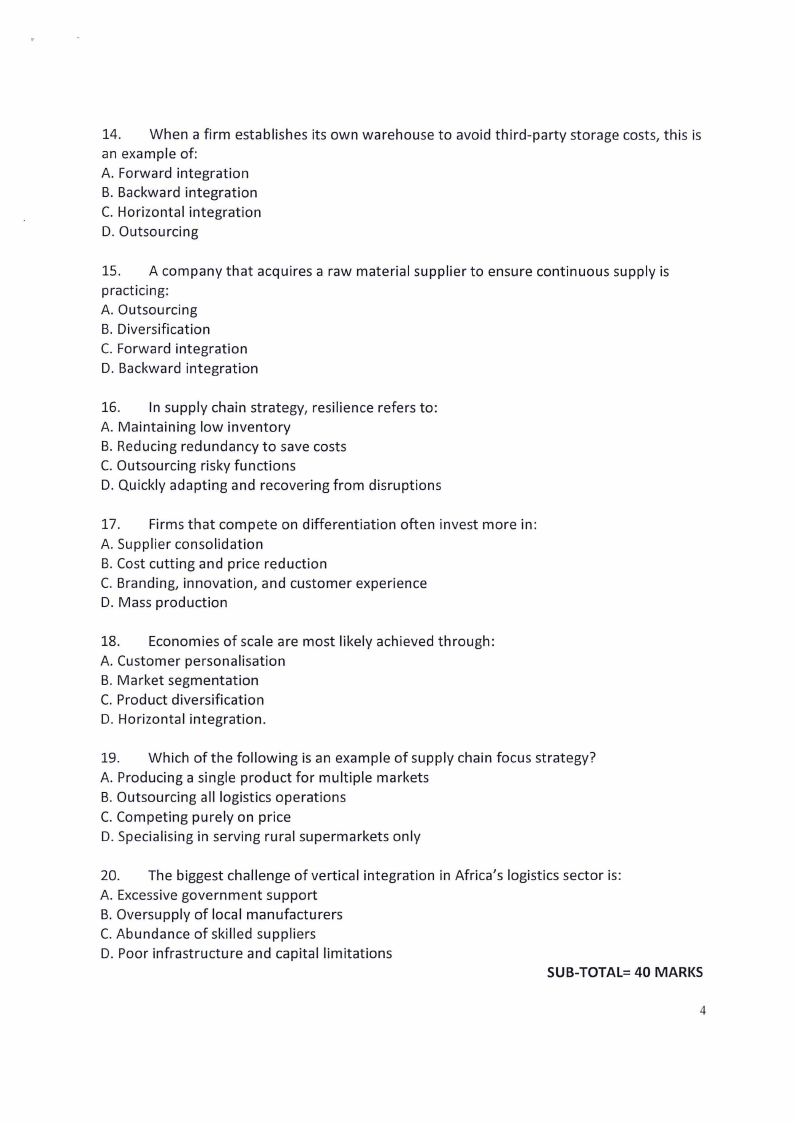
14. When a firm establishes its own warehouse to avoid third-party storage costs, this is
an example of:
A. Forward integration
B. Backward integration
C. Horizontal integration
D. Outsourcing
15. A company that acquires a raw material supplier to ensure continuous supply is
practicing:
A. Outsourcing
B. Diversification
C. Forward integration
D. Backward integration
16. In supply chain strategy, resilience refers to:
A. Maintaining low inventory
B. Reducing redundancy to save costs
C. Outsourcing risky functions
D. Quickly adapting and recovering from disruptions
17. Firms that compete on differentiation often invest more in:
A. Supplier consolidation
B. Cost cutting and price r~duction
C. Branding, innovation, and customer experience
D. Mass production
18. Economies of scale are most likely achieved through:
A. Customer personalisation
B. Market segmentation
C. Product diversification
D. Horizontal integration .
19. Which of the following is an example of supply chain focus strategy?
A. Producing a single product for multiple markets
B. Outsourcing all logistics operations
C. Competing purely on price
D. Specialising in serving rural supermarkets only
20. The biggest challenge of vertical integration in Africa's logistics sector is:
A. Excessive government support
B. Oversupply of local manufacturers
C. Abundance of skilled suppliers
D. Poor infrastructure and capital limitations
SUB-TOTAL= 40 MARKS
4
|
|
5 Page 5 |
▲back to top |
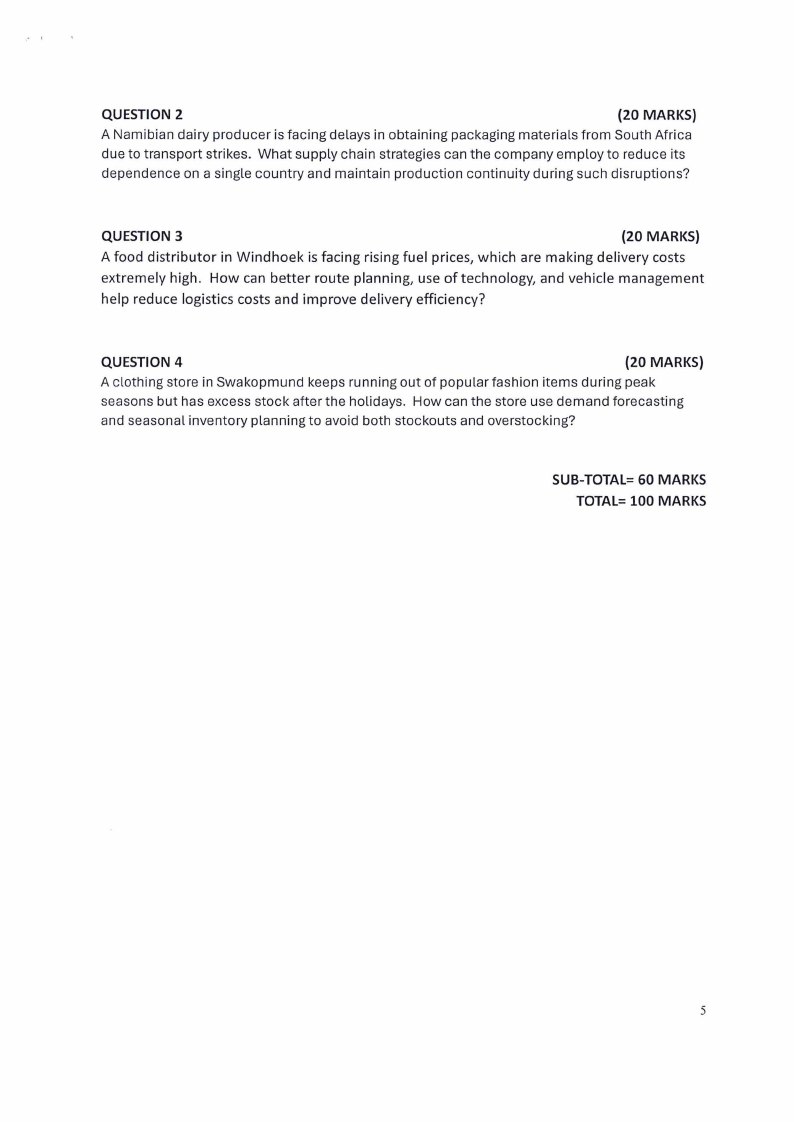
QUESTION 2
(20 MARKS}
A Namibian dairy producer is facing delays in obtaining packaging materials from South Africa
due to transport strikes. What supply chain strategies can the company employ to reduce its
dependence on a single country and maintain production continuity during such disruptions?
QUESTION 3
(20 MARKS}
A food distributor in Windhoek is facing rising fuel prices, which are making delivery costs
extremely high . How can better route planning, use of technology, and vehicle management
help reduce logistics costs and improve delivery efficiency?
QUESTION 4
(20 MARKS}
A clothing store in Swakopmund keeps running out of popular fashion items during peak
seasons but has excess stock after the holidays. How can the store use demand forecasting
and seasonal inventory planning to avoid both stockouts and overstocking?
SUB-TOTAL= 60 MARKS
TOTAL= 100 MARKS
5