EPR511S - ENGLISH IN PRACTICE - 2ND OPP - JULY 2025


EPR511S - ENGLISH IN PRACTICE - 2ND OPP - JULY 2025


1 Page 1

▲back to top


nAmlBIA UnlVERSITY
OF SCIEnCE Ano TECHnDLOGY
FACULTY OF COMMERCE, HUMAN SCIENCES AND EDUCATION
DEPARTMENT OF COMMUNICATION AND LANGUAGES
COURSE CODE: EPR511S
SESSION:JUNE/JULY 2025
DURATION: 3 Hours
COURSE NAME: ENGLISH IN PRACTICE
PAPER:Paper2
MARKS: 100
SECOND OPPORTUNITY EXAMINATION QUESTION PAPER
EXAMINER(S) Mrs T. Kavihuha
Mrs C. Bates
MODERATOR: Mrs T. Kanime
INSTRUCTIONS
1. Answer ALL the questions.
2. Read all the questions carefully before answering.
3. Numoer the answers clearly
THIS QUESTION PAPER CONSISTS OF _9_ PAGES {Including this front page)
1

2 Page 2

▲back to top


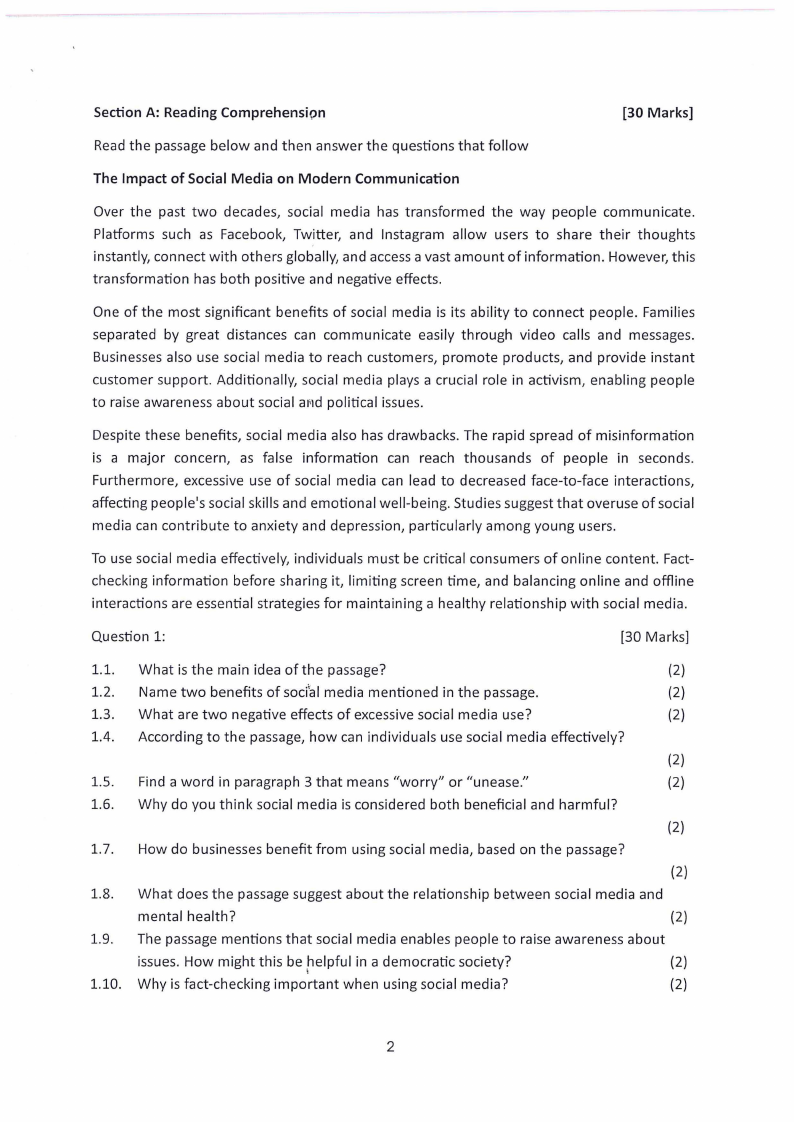
Section A: Reading Comprehension
[30 Marks]
Read the passage below and then answer the questions that follow
The Impact of Social Media on Modern Communication
Over the past two decades, social media has transformed the way people communicate.
Platforms such as Facebook, Twitter, and lnstagram allow users to share their thoughts
instantly, connect with others globally, and access a vast amount of information. However, this
transformation has both positive and negative effects.
One of the most significant benefits of social media is its ability to connect people. Families
separated by great distances can communicate easily through video calls and messages.
Businesses also use social media to reach customers, promote products, and provide instant
customer support. Additionally, social media plays a crucial role in activism, enabling people
to raise awareness about social aMd political issues.
Despite these benefits, social media also has drawbacks. The rapid spread of misinformation
is a major concern, as false information can reach thousands of people in seconds.
Furthermore, excessive use of social media can lead to decreased face-to-face interactions,
affecting people's social skills and emotional well-being. Studies suggest that overuse of social
media can contribute to anxiety and depression, particularly among young users.
To use social media effectively, individuals must be critical consumers of on line content. Fact-
checking information before sharing it, limiting screen time, and balancing online and offline
interactions are essential strategies for maintaining a healthy relationship with social media.
Question 1:
[30 Marks]
1.1.
1.2.
1.3.
1.4.
1.5.
1.6.
1.7.
1.8.
1.9.
1.10.
What is the main idea of the passage?
(2)
Name two benefits of soci'al media mentioned in the passage.
(2)
What are two negative effects of excessive social media use?
(2)
According to the passage, how can individuals use social media effectively?
(2)
Find a word in paragraph 3 that means "worry" or "unease."
(2)
Why do you think social media is considered both beneficial and harmful?
(2)
How do businesses benefit from using social media, based on the passage?
(2)
What does the passage suggest about the relationship between social media and
mental health?
(2)
The passage mentions that social media enables people to raise awareness about
issues. How might this be relpful in a democratic society?
(2)
Why is fact-checking important when using social media?
(2)
2

3 Page 3

▲back to top


1.11.
1.12.
1.13.
1.14.
1.15.
What does the phrase "critical consumers of online content" mean in the last
paragraph?
(2)
Explain the meaning of the term "face-to-face interactions" in the context of the
passage.
{2)
Identify a synonym for "false information" from the passage.
(2)
What does the passage suggest about balancing online and offline interactions?
(2)
Rewrite the sentence: "Social media plays a crucial role in activism." Use your own
words without changing the meaning.
{2)
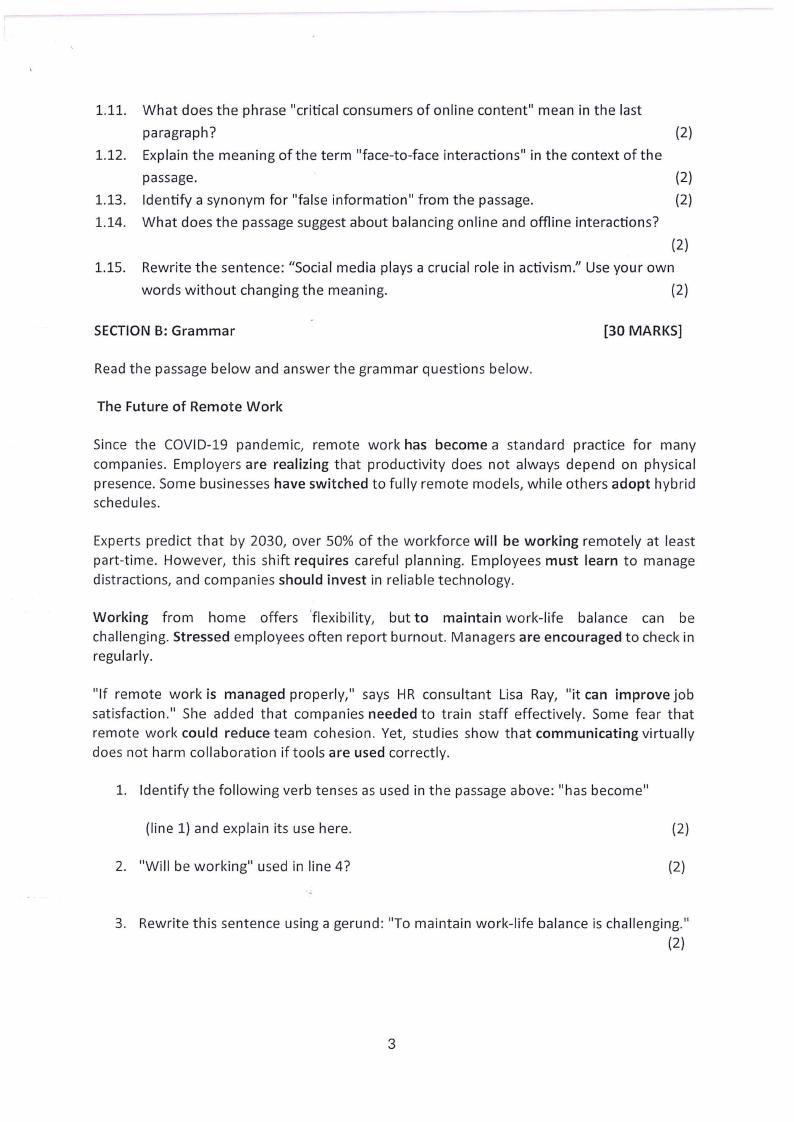
SECTION B: Grammar
Read the passage below and answer the grammar questions below.
[30 MARKS]
The Future of Remote Work
Since the COVID-19 pandemic, remote work has become a standard practice for many
companies. Employers are realizing that productivity does not always depend on physical
presence. Some businesses have switched to fully remote models, while others adopt hybrid
schedules.
Experts predict that by 2030, over 50% of the workforce will be working remotely at least
part-time. However, this shift requires careful planning. Employees must learn to manage
distractions, and companies should invest in reliable technology.
Working from home offers 'flexibility, but to maintain work-life balance can be
challenging. Stressed employees often report burnout. Managers are encouraged to check in
regularly.
"If remote work is managed properly," says HR consultant Lisa Ray, "it can improve job
satisfaction." She added that companies needed to train staff effectively. Some fear that
remote work could reduce team cohesion. Yet, studies show that communicating virtually
does not harm collaboration if tools are used correctly.
1. Identify the following verb tenses as used in the passage above: "has become"
{line 1) and explain its use here.
(2)
2. "Will be working" used in line 4?
(2)
3. Rewrite this sentence using a gerund: "To maintain work-life balance is challenging."
{2)
3

4 Page 4

▲back to top


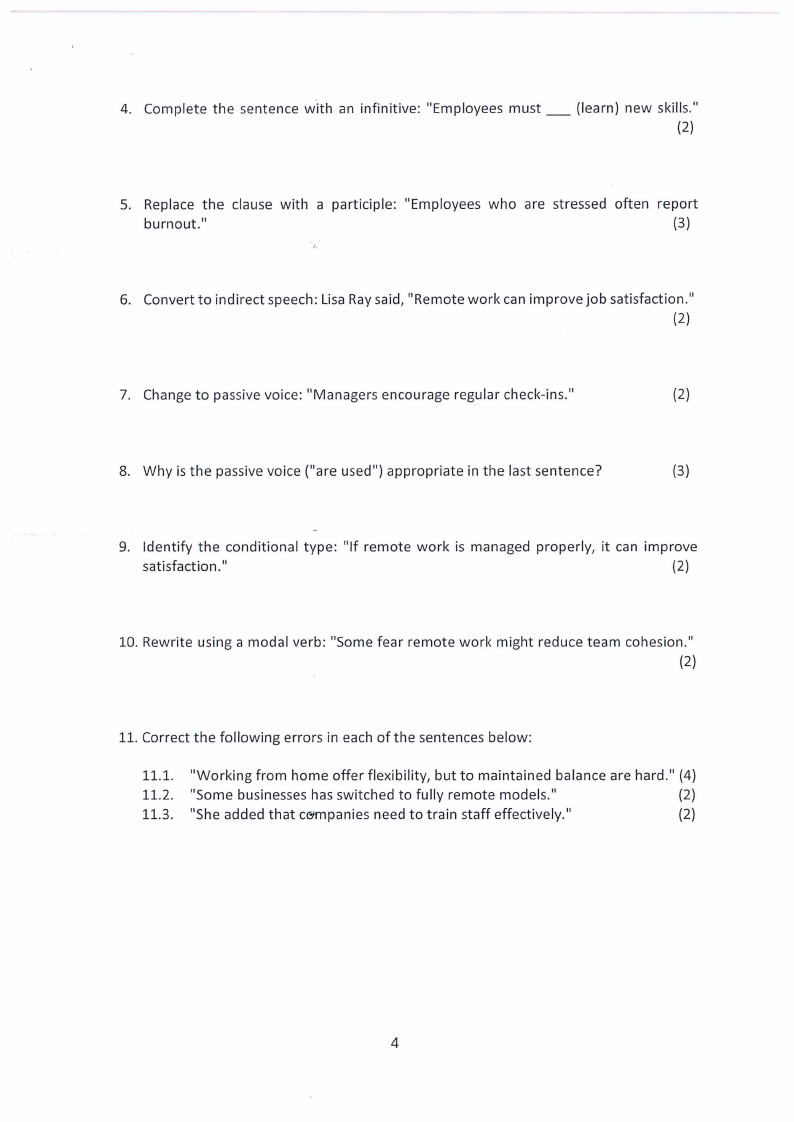
4. Complete the sentence with an infinitive: "Employees must_
(learn) new skills."
(2)
5. Replace the clause with a participle: "Employees who are stressed often report
burnout."
(3)
6. Convert to indirect speech: Lisa Ray said, "Remote work can improve job satisfaction."
(2)
7. Change to passive voice: "Managers encourage regular check-ins."
(2)
8. Why is the passive voice ("are used") appropriate in the last sentence?
(3)
9. Identify the conditional type: "If remote work is managed properly, it can improve
satisfaction."
(2)
10. Rewrite using a modal verb: "Some fear remote work might reduce team cohesion."
(2)
11. Correct the following errors in each of the sentences below:
11.1.
11.2.
11.3.
"Working from home offer flexibility, but to maintained balance are hard." (4)
"Some businesses has switched to fully remote models."
(2)
"She added that c&mpanies need to train staff effectively."
(2)
4

5 Page 5

▲back to top


Section C: Critical Reading and Summarising
Read the Article below and answer the questions that follow.
[40 Marks]
The Paradox of Choice
By Barry Schwartz in his book The Paradox of Choicel
1. As we make social, scientific and technological advances, we find ourselves with more
options than were available to previous generations. The choice of what milk to buy is but
one example of the ways in which we have become privy to an abundance of choices. In
modern society, people are inundated with choices, from grocery store aisles stocked with
dozens of cereal brands to streaming platforms offering endless entertainment options. While
on the surface, the profusion of options might seem like it should increase consumer
satisfaction, since people are more likely to find one option that fits their wants and needs,
we can also become very overwhelmed. While it is easy to choose option A if there is only an
option B, it becomes much harder to gauge the value and utility of A when there are options
A-Z. As a result, we encounter a, choice overload. Psychologist Barry Schwartz argues that
while autonomy is valuable, excessive choice can lead to decision paralysis, anxiety,
dissatisfaction and decision fatigue.
2. Decision fatigue occurs when our limited stamina for making decisions is drained. Not only
does this result in mental exhaustion, but it can also negatively impact our self-control. For
example, one study found that doctors were more likely to prescribe unnecessary antibiotics
after working for several hours, and another found that parole judges were more likely to
grant parole in the morning than at the end of the workday (after making numerous
decisions). Researchers Polman and Vohs suggest this is because decision fatigue reduces our
self-regulatory resources, which are necessary for making ethical decisions.
3. This happens to everyday consumers as well: those facing decision fatigue often opt for
easier, more impulsive decisions, which might mean splurging on more expensive options that
are prominently displayed or recommended by salespeople. For instance, people buying cars
tend to choose more default features at the end of the buying process, suggesting that they
have exhausted their decision-making capacity after selecting among multiple options earlier
in the process. Have you ever grabbed takeout on the way home from a large grocery trip
because you're too mentally exhausted to decide what to make for dinner? Decision fatigue
can lead us toward more convenient choices like these, even if they aren't in our best interest.
4. Schwartz's research highlights two types of decision-makers: maximizers, who exhaustively
seek the best option, and satisfiers, who settle for "good enough." Maximizers often
experience regret, believing a better choice exists, whereas satisfiers report higher life
satisfaction. Rational choice theory has tried to explain preference and choice by assuming
that people are rational choosers (von Neu-mann & Morgenstern, 1944). According to the
rational choice framework, human beings have well-ordered preferences, preferences that
are essentially impervious to variations in the way the alternatives they face are described or
the way in which they are packaged or bundled. The idea is that people go through life with
all their options arrayed before them, as if on a buffet table.
5

6 Page 6

▲back to top


5. They have complete information about the costs and benefits associated with each option.
They compare the options with one another on a single scale of preference, or value, or utility.
And after making the comparisons, people choose to maximize their preferences, or values,
or utilities. Although the science of economics has historically depended on the tenets of
rational choice theory, it is now well established that many of the psychological assumptions
underlying rational choice theory are unrealistic and that human beings routinely violate the
principles of rational choice (e.g., J. Baron, 2000; Kahneman & Tversky, 1979, 1984; Tversky,
1969; Tversky & Kahneman, 1981;for a discussion, see Schwartz, 1986, 1994). Modern
behavioural economics has acknowledged that the assumption of complete information that
characterizes rational choice theory is implausible. Rather than assuming that people possess
all the relevant information for making choices, choice theorists treat information itself as a
"commodity," something that has a price (intime or money), and is thus a candidate for
consumption along with more, traditional goods (e.g., Payne, 1982; Payne, Bettman,
&Johnson, 1993}.Almost a half century ago, Simon (1955, 1956, 1957} suggested an approach
to explaining choice that was more cognizant of human cognitive limitations than rational
choice theory.
6. Simon argued that the presumed goal of maximization (or optimization) is virtually always
unrealizable in real life, owing both to the complexity of the human environment and the
limitations of human information processing. He suggested that in choice situations, people
have the goal of "satisficing" rather than maximizing. To satisfice, people need only to be able
to place goods on some scale in terms of the degree of satisfaction they will afford, and to
have a threshold of acceptability. A satisfier simply encounters and evaluates goods until one
is encountered that exceeds the acceptability threshold. That good is chosen. In subsequent,
accidental encounters with other goods in the relevant domain, the scale of acceptability
enables one to reject a formerly chosen good for a higher ranked one should that one turns
up. A satisfier thus often moves in the direction of maximization without ever having it as a
deliberate goal. Simon's alternati\\i'e to rational choice theory questions not only the processes
by which options are assessed and choices made, but also the motives that underlie choice.
To satisfice is to pursue not the best option, but a good enough option
7. A famous study by Iyengar and Lepper wanted to see how the volume of choice impacted
consumer behaviour. In the first variable, shoppers at a grocery store encountered a display
table with gourmet jam. If shoppers tasted at least one jam (they were free to try as many as
they liked), they were given a $1 discount coupon to use to purchase any jam. In the
extensive-choice condition, the display table had 24 different varieties of gourmet jam. In the
limited-choice condition, the display table had only six different varieties of gourmet jam.
While the larger display attracted more interest, customers were ten times more likely to
purchase from the smaller selection. This suggests that reducing options can enhance
decision-making efficiency and happiness.
8. Critics counter that choice empowers individuals, fostering competition and innovation.
However, Schwartz maintains tha't curated freedom, structured options with clear trade-
offs strikes the ideal balance between liberty and well-being
6

7 Page 7

▲back to top


Select the best option (A, B, C, or D) to answer each question below. Each question is two
(2) marks:
1. What is the main idea of the passage?
(2)
A. All choices lead to anxiety.
B. Excessive choice can reduce happiness.
C. People prefer more options.
D. Satisfiers are poor decision-makers.
2. The term "decision paralysis" (paragraph 1) refers to:
(2)
A. The inability to choose due to overwhelming options.
B. A medical condition affecting the brain.
C. A preference for limited choices.
D. The joy of having many alternatives.
3. According to Schwartz, who is more likely to feel regret?
(2)
A. Satisfiers
B. Maximizers
C. Both equally
D. Neither group
4. The jam study found that customers were more likely to buy when:
(2)
A. Offered 24 varieties.
B. Offered 6 varieties.
C. Given unlimited samples.
D. No options were provided.
5. What is "curated freedom" (paragraph 4)?
(2)
A. Unlimited choices without restrictions.
B. Structured options with clear trade-offs.
C. Government-controlled decisions.
D. Letting others choose for you.
7

8 Page 8

▲back to top


6. Critics argue that choice foster~:
(2)
A. Paralysis and regret.
B. Competition and innovation.
C. Lower satisfaction.
D. Maximizer behaviour.
7. Which group reports higher life satisfaction?
(2)
A. Maximizers
B. Satisfiers
C. Neither
D. Both equally
8. The jam study supports the idea that:
(2)
A. More options increase sales.
B. Fewer options improve decision-making.
C. People dislike jam.
D. All choices are equal.
9. Schwartz's research primarily challenges the belief that:
(2)
A. Less choice is always better.
B. More choice always improves well-being.
C. Satisfiers are irrational.
D. Maximizers are happier.
10. The author's tone in the passage is:
(2)
A. Biased against all choices.
B. Persuasive and evidence based.
C. Humorous and sarcastic.
D. Emotionally neutral.
8

9 Page 9

▲back to top


Section C: Summary Writing
[20 Marks]
Summarize the above passage in no more than 120 words. Your summary should cover the
paradox of choice, Schwartz's two decision-making styles. Evidence from the jam study and
the concept of "curated freedom."
[The End]
9