


 |
IME511C-INTRODUCATION TO MARKETING AND ITS ENVIRONMENT-1ST OPP-NOV 2025 |
|
|
1 Page 1 |
▲back to top |
nAmlBIA
UnlVERSITY
0 F SCIEnCE Ano
TECHn0L0GY
HP-65B◄
HAROLD PUPKEWITZ
Graduate School of Business
FACULTY OF COMMERCE; HUMAN SCIENCES AND EDUCATION
HAROLD PUPKEWITZ GRADUATE SCHOOL OF BUSINESS
QUALIFICATION: DIPLOMA IN BUSINESS PROCESS MANAGEMENT
QUALIFICATION CODE: 06DBPM
LEVEL: 6
COURSE CODE: IME511C
COURSE NAME: INTRODUCTION TO MARKETING AND
ITS ENVIRONMENT
SESSION: NOVEMBER 2025
DURATION: 3 HOURS
PAPER: THEORY
MARKS: 100
FIRST OPPORTUNITY EXAMINATION QUESTION PAPER
EXAMINER(S) Dr. Gloria Veindira Karita
MODERATOR: Professor Maxwell Chufama
INSTRUCTIONS
1. This paper consists of FIVE (5) questions
2. Answer ALL questions
3. Use the table provided on page [8] to answer Question 1: Detach
and insert into your answer booklet
4. Write as legible as possible, and as precise as possible
5. Read each question carefully
6. Allocate your time appropriately
PERMISSIBLE MATERIALS
1. Examination paper
2. Examination script
THIS QUESTION PAPER CONSISTS OF 6 PAGES (Including this front page)
1
|
|
2 Page 2 |
▲back to top |
QUESTION 1
[2 x 15 = 30 Marks]
Multiple choice questions
Choose the correct answer and use the table provided on [page 6] to answer these questions,
detach and insert it into your answer booklet. 2 marks shall be awarded for each correct answer.
1.1 The marketing environment consists of:
A. Internal and external communication channels
B. Actors and forces outside marketing that affect management's ability to build relationships
with customers
C. Only competitors and customers
D. Only technology and culture
1.2. Which of the following is NOT part of the microenvironment?
A. Customers
B. Suppliers
C. Technological environment
D. Competitors
1.3. All the interrelated groups inside the company that should work in harmony to provide
superior customer value belong to the:
A. Internal company environment
B. External stakeholders
C. Macroenvironment
D. Government publics
1.4. Marketing intermediaries help a company primarily to:
A. Finance its research and development
B. Promote, sell, and distribute its products to final buyers
C. Manage its workforce
D. Control competitors' actions
1.5. Which of the following is an example of a reseller?
A. Advertising agency
B. Wholesaler
C. Bank
D. Physical distribution firm
1.6 Financial intermediaries include:
A. Credit companies and insurance firms
2
|
|
3 Page 3 |
▲back to top |
B. Wholesalers and retailers
C. Community organisations
D. Marketing research firms
1.7 A public is defined as:
A. Any group that buys products from a company
B. Any group with actual or potential interest in or impact on an organisation's ability to achieve
its objectives
C. Government employees only
D. A company's suppliers and distributors
1.8 Which of the following is NOT one of the five customer markets identified in the
presentation?
A. Consumer markets
B. Reseller markets
C. Industrial markets
D. Government markets
1.9. Demography studies human populations in terms of:
A. Laws, regulations, and taxes
B. Size, density, age, gender, occupation, and other statistics
C. Attitudes and beliefs
D. Cultural values and norms
1.10 The single most important demographic trend in the United States mentioned in the slides
is:
A. Geographic population shifts
B. Changing age structure of the population
C. Decline in manufacturing
D. Rise in education levels
1.11 The macroenvironment includes all the following EXCEPT:
A. Natural environment
B. Cultural environment
C. Marketing intermediaries
D. Political/legal environment
1.12 The natural environment is concerned with:
A. Human attitudes and lifestyles
B. Natural resources needed as inputs by marketers or affected by marketing activities
3
|
|
4 Page 4 |
▲back to top |
C. Laws and regulations guiding commerce
D. Growth of social media platforms
1.13 Which of the following best describes the cultural environment?
A. Institutions and forces affecting society's basic values, perceptions, preferences, and
behaviours
B. Human population size and growth rate
C. Shifts in family structures and occupations
D. Technological developments that change the marketplace
1.14 A company that reacts and adapts to environmental forces is taking which approach?
A. Proactive
B. Reactive
C. Aggressive
D. Controlling
1. 15. An example of a company demonstrating ethics and social responsibility as highlighted in
the slides is:
A. Apple launching a new smartphone
B. TOMS Shoes donating a pair of shoes for every pair sold
C. McDonald's opening new outlets in rural areas
D. A supermarket offering weekend discounts
QUESTION 2
(20 marks)
List and explain all of the five different Marketing orientations or philosophies that a company
may adopt.
QUESTION 3
(20 marks)
The marketing mix includes a set of tools, commonly referred to as the SEVEN (7S) Ps, that a
company uses to execute its marketing strategy. Discuss with relevant examples, how
organisations can man age these elements effectively to achieve their marketing goals and
objectives - provide practical examples.
4
|
|
5 Page 5 |
▲back to top |
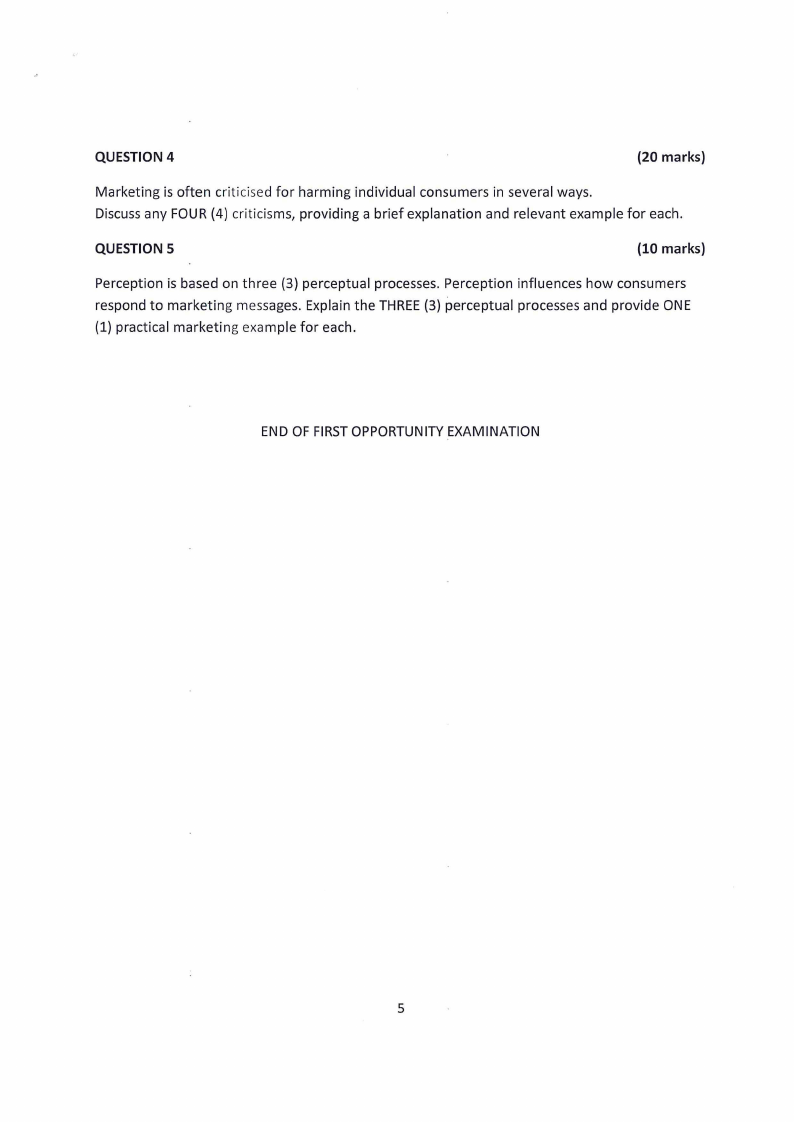
QUESTION 4
(20 marks)
Marketing is often criticised for harming individual consumers in several ways.
Discuss any FOUR (4) criticisms, providing a brief explanation and relevant example for each.
QUESTION 5
(10 marks)
Perception is based on three (3) perceptual processes. Perception influences how consumers
respond to marketing messages. Explain the THREE (3) perceptual processes and provide ONE
(1) practical marketing example for each.
END OF FIRST OPPORTUNITY EXAMINATION
5
|
|
6 Page 6 |
▲back to top |
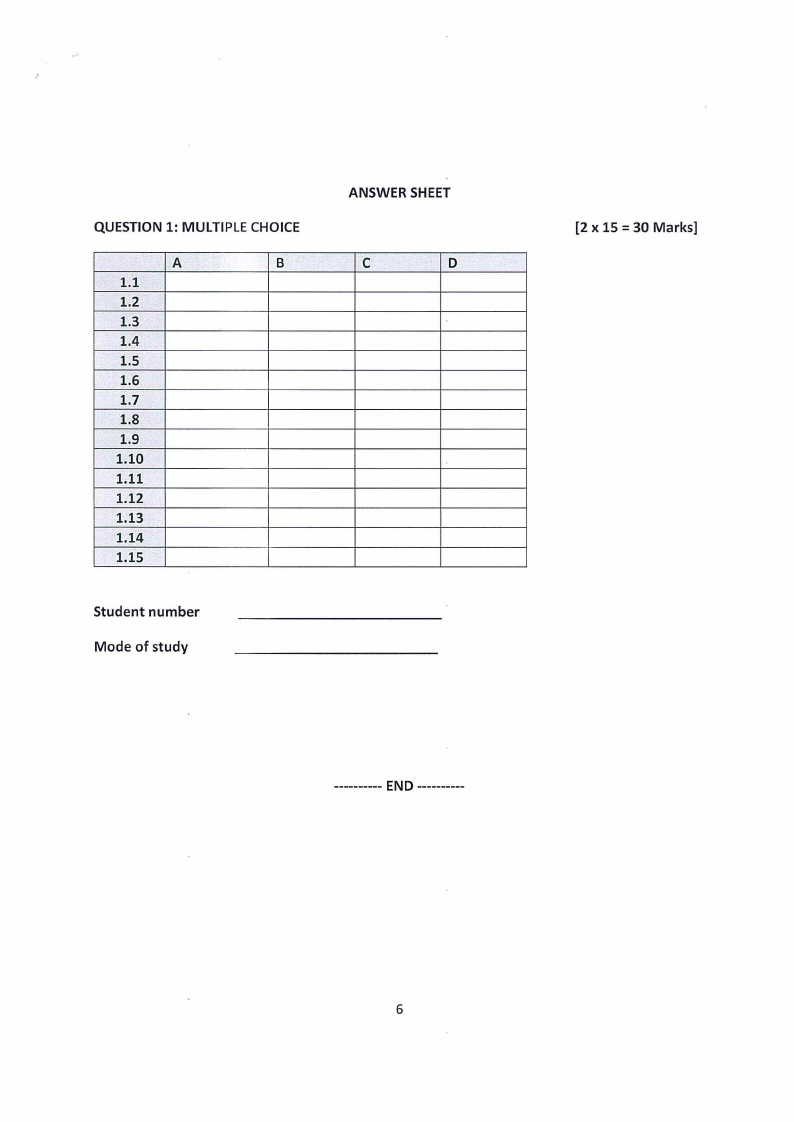
QUESTION 1: MULTIPLE CHOICE
A
B
1.1
1.2
1.3
1.4
1.5
1.6
1.7
1.8
1.9
1.10
1.11
1.12
1.13
1.14
1.15
Student number
Mode of study
ANSWER SHEET
C
D
[2 x 15 = 30 Marks]
---------- END ----------
6