


 |
ILS511S - INTRODUCTION TO LANGUAGE IN SOCIETY - 1ST OPP - JUNE 2025 |
|
|
1 Page 1 |
▲back to top |
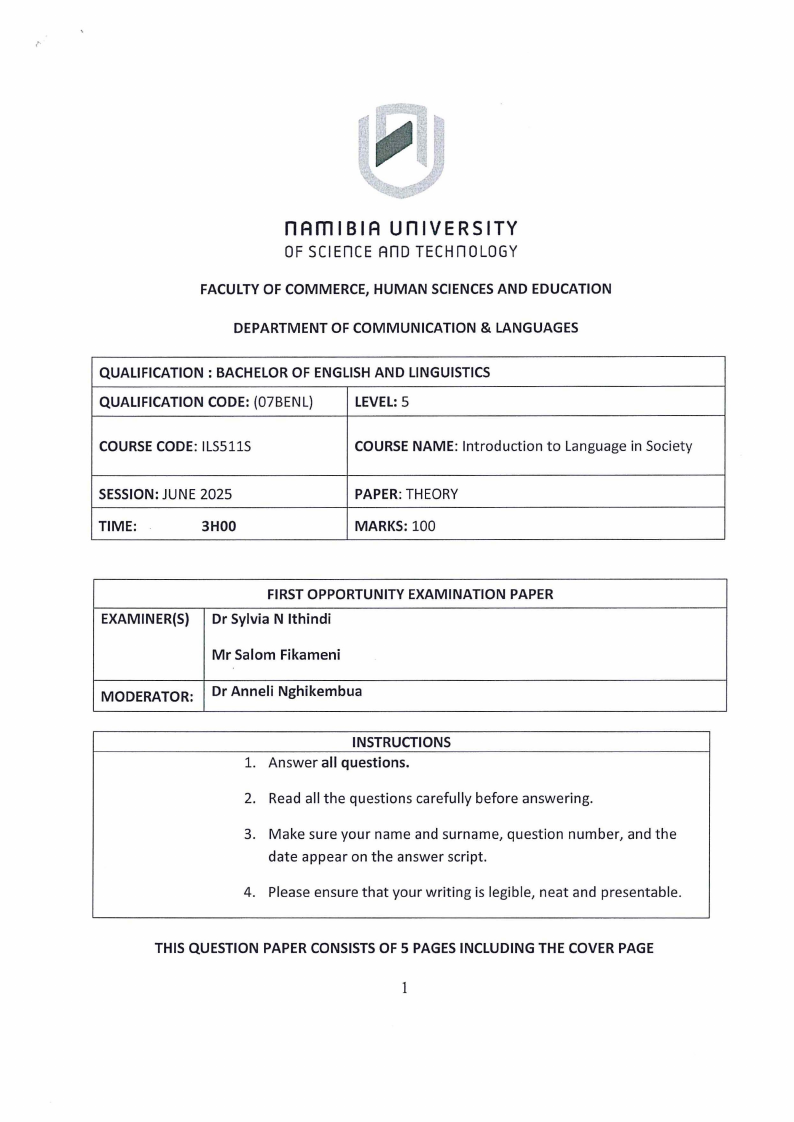
{'
nAmlBIA unlVERSITY
OF SCIEnCE Ano TECHnOLOGY
FACULTY OF COMMERCE, HUMAN SCIENCESAND EDUCATION
DEPARTMENT OF COMMUNICATION & LANGUAGES
QUALIFICATION : BACHELOR OF ENGLISH AND LINGUISTICS
QUALIFICATION CODE: {07BENL)
LEVEL: 5
COURSE CODE: ILSSllS
COURSE NAME: Introduction to Language in Society
SESSION: JUNE 2025
TIME:
3H00
PAPER: THEORY
MARKS: 100
EXAMINER(S)
FIRST OPPORTUNITY EXAMINATION PAPER
Dr Sylvia N lthindi
Mr Salom Fikameni
MODERATOR: Dr Anneli Nghikembua
INSTRUCTIONS
1. Answer all questions.
2. Read all the questions carefully before answering.
3. Make sure your name and surname, question number, and the
date appear on the answer script.
4. Please ensure that your writing is legible, neat and presentable.
THIS QUESTION PAPER CONSISTS OF 5 PAGES INCLUDING THE COVER PAGE
1
|
|
2 Page 2 |
▲back to top |
r-
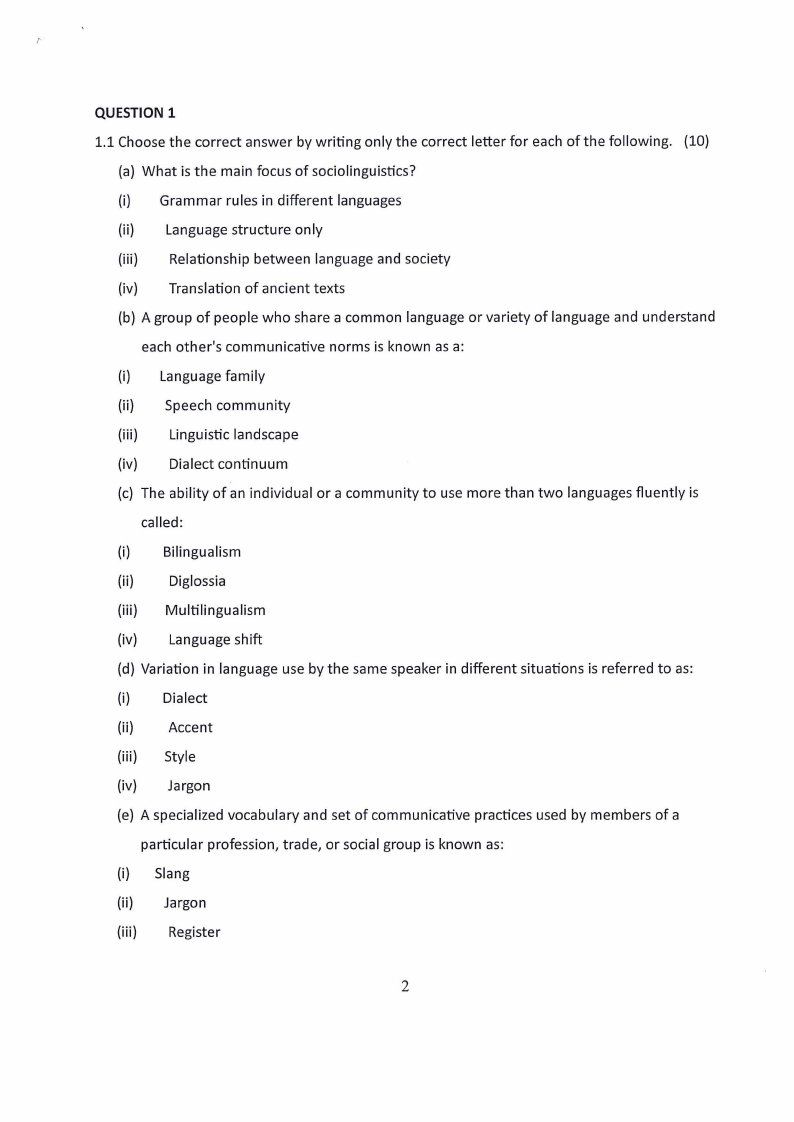
QUESTION 1
1.1 Choose the correct answer by writing only the correct letter for each of the following. {10)
(a) What is the main focus of sociolinguistics?
(i) Grammar rules in different languages
(ii) Language structure only
(iii) Relationship between language and society
(iv) Translation of ancient texts
(b) A group of people who share a common language or variety of language and understand
each other's communicative norms is known as a:
(i) Language family
(ii) Speech community
(iii) Linguistic landscape
(iv) Dialect continuum
(c) The ability of an individual or a community to use more than two languages fluently is
called:
(i) Bilingualism
(ii)
Diglossia
(iii) Multilingualism
(iv) Language shift
(d) Variation in language use by the same speaker in different situations is referred to as:
(i) Dialect
(ii) Accent
(iii) Style
(iv) Jargon
(e) A specialized vocabulary and set of communicative practices used by members of a
particular profession, trade, or social group is known as:
(i) Slang
(ii) Jargon
(iii) Register
2
|
|
3 Page 3 |
▲back to top |
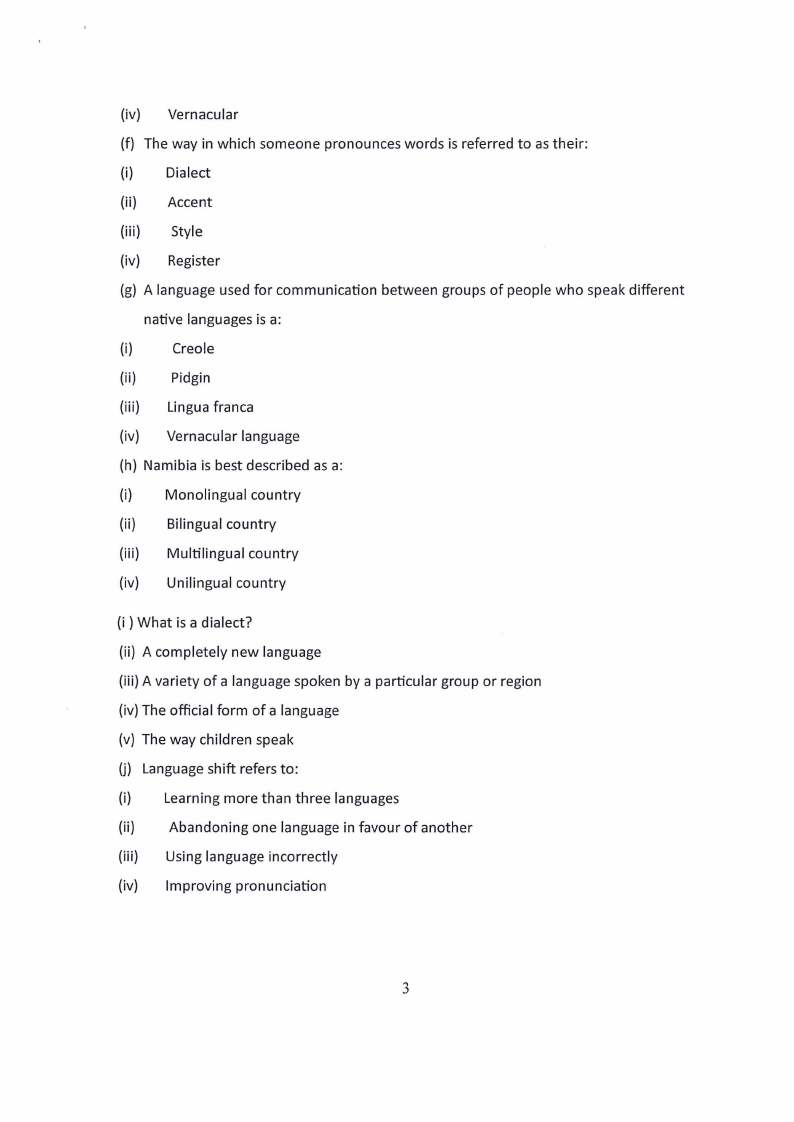
(iv) Vernacular
(f) The way in which someone pronounces words is referred to as their:
(i) Dialect
(ii) Accent
(iii) Style
(iv) Register
(g) A language used for communication between groups of people who speak different
native languages is a:
(i)
Creole
(ii)
Pidgin
(iii) Lingua franca
(iv) Vernacular language
(h) Namibia is best described as a:
(i) Monolingual country
(ii) Bilingual country
(iii) Multilingual country
(iv) Unilingual country
(i ) What is a dialect?
(ii) A completely new language
(iii) A variety of a language spoken by a particular group or region
(iv) The official form of a language
(v) The way children speak
(j) Language shift refers to:
(i) Learning more than three languages
(ii) Abandoning one language in favour of another
(iii) Using language incorrectly
(iv) Improving pronunciation
3
|
|
4 Page 4 |
▲back to top |
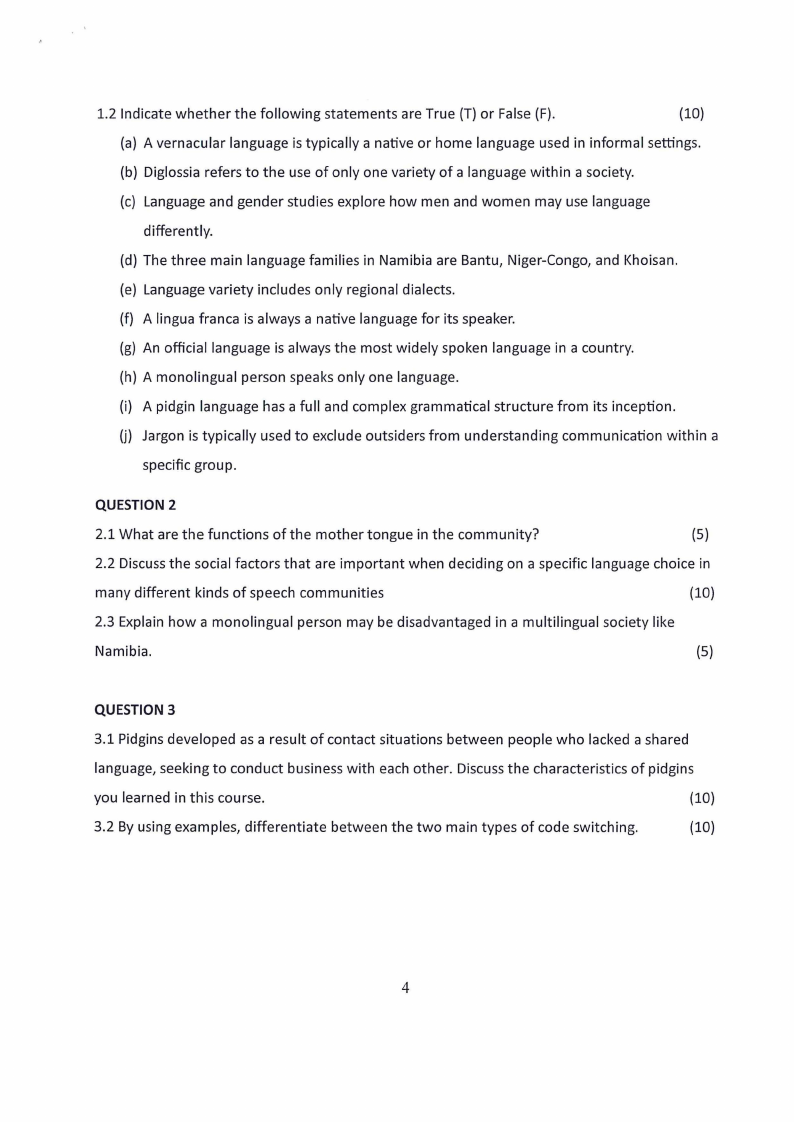
1.2 Indicate whether the following statements are True (T) or False (F).
(10)
(a) A vernacular language is typically a native or home language used in informal settings.
(b) Diglossia refers to the use of only one variety of a language within a society.
(c) Language and gender studies explore how men and women may use language
differently.
(d) The three main language families in Namibia are Bantu, Niger-Congo, and Khoisan.
(e) Language variety includes only regional dialects.
(f) A lingua franca is always a native language for its speaker.
(g) An official language is always the most widely spoken language in a country.
(h) A monolingual person speaks only one language.
(i) A pidgin language has a full and complex grammatical structure from its inception.
(j) Jargon is typically used to exclude outsiders from understanding communication within a
specific group.
QUESTION 2
2.1 What are the functions of the mother tongue in the community?
(5)
2.2 Discussthe social factors that are important when deciding on a specific language choice in
many different kinds of speech communities
(10)
2.3 Explain how a monolingual person may be disadvantaged in a multilingual society like
Namibia.
(5)
QUESTION 3
3.1 Pidgins developed as a result of contact situations between people who lacked a shared
language, seeking to conduct business with each other. Discuss the characteristics of pidgins
you learned in this course.
{10)
3.2 By using examples, differentiate between the two main types of code switching.
(10)
4
|
|
5 Page 5 |
▲back to top |
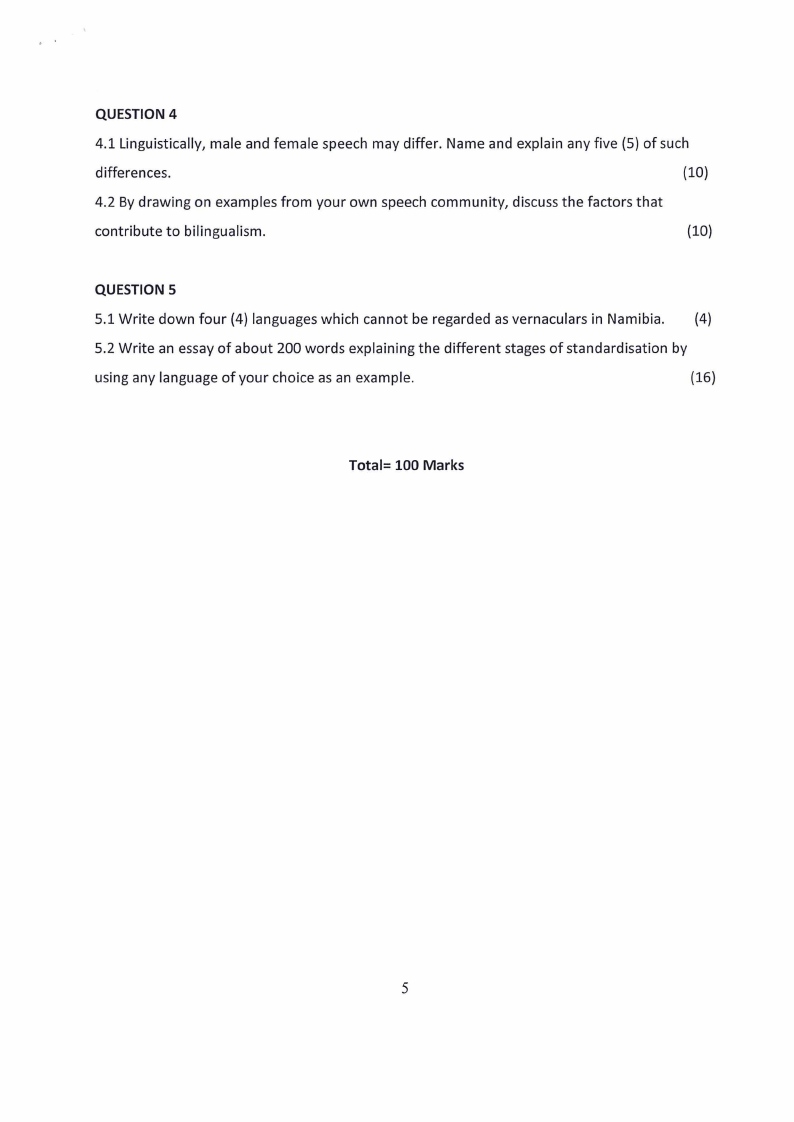
QUESTION 4
4.1 Linguistically, male and female speech may differ. Name and explain any five (5) of such
differences.
(10}
4.2 By drawing on examples from your own speech community, discuss the factors that
contribute to bilingualism.
(10}
QUESTION 5
5.1 Write down four (4) languages which cannot be regarded as vernaculars in Namibia. (4)
5.2 Write an essay of about 200 words explaining the different stages of standardisation by
using any language of your choice as an example.
(16}
Total= 100 Marks
5