


 |
PAI621S - PRINCIPLES AND APPLICATION OF INFORMATICS - 2ND OPP - DEC 2025 |
|
|
1 Page 1 |
▲back to top |
n Am I BI A u n IV ERs ITY
OF SCIEnCE Ano TECHnOLOGY
FACULTY OF COMPUTING AND INFORMATICS
DEPARTMENT OF INFORMATICS
QUALIFICATION: BACHELOR OF INFORMATICS
QUALIFICATION CODE: 07BAIT
LEVEL: 6
COURSE CODE: PAl621S
COURSE: PRINCIPLES AND APPLICATION OF
INFORMATICS
SESSION: DECEMBER 2025
DURATION: 3 HOURS
PAPER: THEORY
MARKS: 70
SECOND OPPORTUNITY/ SUPPLEMENTARY EXAMINATION QUESTION PAPER
EXAMINER(S):
Prof lrja Shaanika
MODERATOR:
Dr Gabriel Nhinda
INSTRUCTIONS FOR THE CANDIDATE
1. Answer ALL the questions on the answer scripts provided.
2. Answer each section on a NEW PAGE.
3. Write clearly and neatly.
4. Be guided by the number of marks allocated when answering the questions.
5. Number your questions clearly.
None
PERMISSIBLE MATERIALS
THIS EXAMINATION PAPER CONSISTS OF 5 PAGES
(INCLUDING THIS FRONT PAGE)
1
|
|
2 Page 2 |
▲back to top |
Section A: Multiple Choice Questions
[10 Marks]
Each question is 1 mark
1. The secondary activity in Porter, dealing with the acquisition of inputs or resources, is
said to be.
A. Procurements
B. Resources management
C. Infrastructure
D. Development
2. In Business Process Modelling Notation, which is true about an association?
A. Data descriptions between two Messages are connected to th e same pool with an
event object as input to or an output from an activity.
B. Information structures exist between two Flow Objects
C. Artifacts are associated with Activities and Control Objects to show that an event
object is either an input to or an output from an activity
D. A directional Association is often used with Data Objects to show that a Data Object
is either an input to or an output from an activity
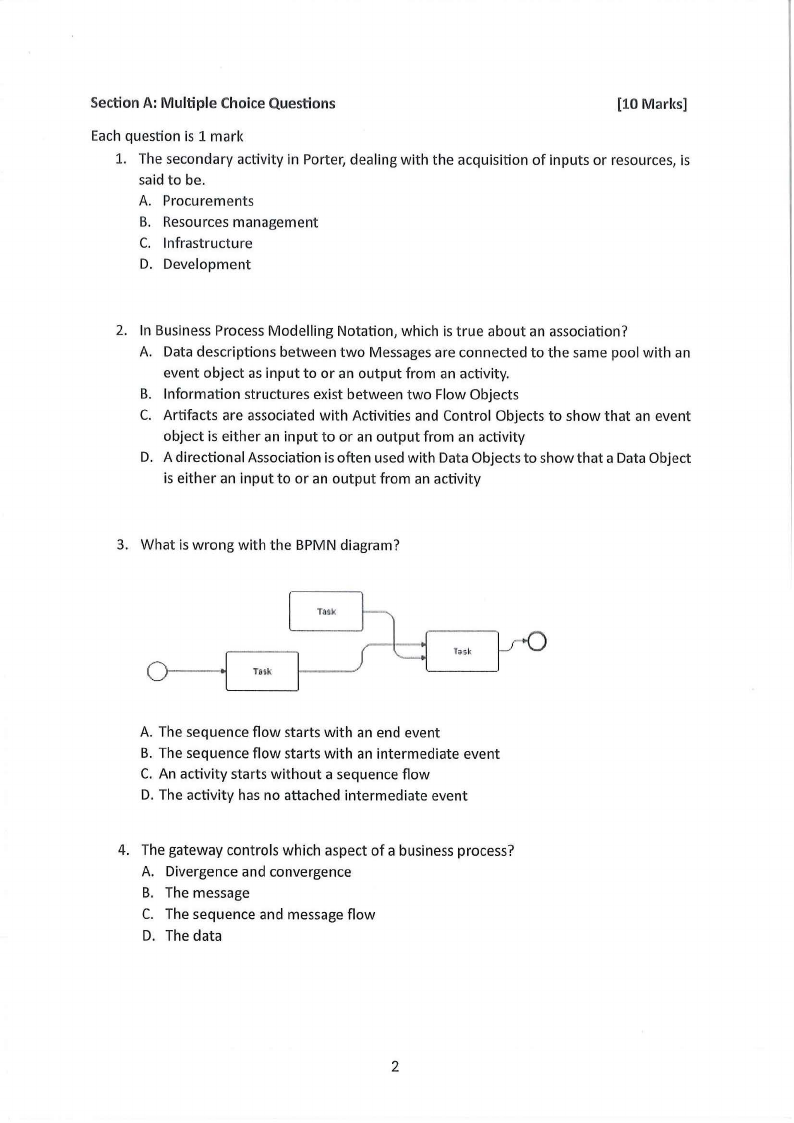
3. What is wrong with the BPMN diagram?
C:J
o- •I 1t-- T&9k
{)
Task
A. The sequence flow starts with an end event
B. The sequence flow starts with an intermediate event
C. An activity starts without a sequence flow
D. The activity has no attached intermediate event
4. The gateway controls which aspect of a business process?
A. Divergence and convergence
B. The message
C. The sequence and message flow
D. The data
2
|
|
3 Page 3 |
▲back to top |
5. How do you indicate that the sub-process is being invoked?
A. Use a collapsed sub-process activity with a thinker border
B. Use expanded sub-process activity with a thinker border
C. Use collapsed and sub-process activity with a thin border
D. Use collapsed and sub-process activity with a thicker border
6. Which stage provides the basis for defining pools and lanes?
A. Identify the process boundaries
B. Identify activities and events
C. Identify resources and their handovers
D. Identify the control flow
7. Why is it important to identify patterns in the information provided by domain
experts?
A. Patterns can be utilised for constructing parts of a process model
B. Models have to look nice to be engaging to a wide audience
C. To progress with the project, it is important to have a short and precise set of
working hypotheses
D. They will be useful when designing resources and handovers
8. The following is a disadvantage of which method: the models resulting from process
mining may not be directly understandable.
A. Observation
B. Automatic process discovery
C. Document analysis
D. Interview based
9. A step that is required due to the regulatory environment of the business is called?
A. Business Value-adding
B. Non-value adding
C. Value-adding
D. Environment value adding
10. To understand the cause of process defects, one needs to do:
A. Root cause analysis
B. Waste elimination analysis
C. Defects analysis
D. Non-value adding analysis
3
|
|
4 Page 4 |
▲back to top |
Section B: True and False Questions
[10 Marks]
Each question is 1 mark.
1. Application-to-approval is a type of process that starts when a customer raises a problem
or issue, such as a complaint related to a defect in a product or an issue encountered when
co nsuming a service.
2. Functional units were created to address the challenge of how to differentiate between the
responsibilities of many managers.
3. Business process re-engineering provides concepts, methods, techniques, and tools that
cover all aspects of managing a process.
4. A side-effect of the ideas of Taylor and his contemporaries was the emergence of an
altogether new class of professionals, that of managers.
5. A key element in Taylor's approach was an extreme form of labour division.
6. A process architecture serves as a framework for defining the priorities and the scope of
process modelling and redesign projects.
7. An intermediate message event signals the receipt of a message, or that a message has
just been sent, during the execution of the process .
8. A procure-to-pay process can be seen as the dual of the quote-to-cash process in the
context of business-to-business interactions.
9. Why-why diagram depicts the relationship between a given negative effect and its causes.
10. One of the reasons for re-designing an existing business process relates to the organic
nature of the organisation.
4
|
|
5 Page 5 |
▲back to top |
Section C: Structured Questions
[30 Marks]
Question 1: Briefly discuss what was transpiring during the prehistoric stage in terms of
humans' focus and capabilities.
[10 marks]
Question 2: As a process manager, discuss three criteria you w ould employ to evaluate
process prioritisation in your organisation.
[10 marks]
Question 3: The fact that modelling knowledge and domain knowledge are often available
to different persons in a modelling project has strong implications. Discuss three challenges
as a result of this.
[10 marks]
Section D: Practical Questions
[20 Marks]
Question 1: Model the Purchase Order Generation process described below using the
business process management notation language.
[ 10 marks]
The goal of this process is to automatically generate purchase orders according to the raw
materials inventory levels and to manage their approva l, record them in the company
accounting system and deliver them to suppliers. The process is organised as follows.
• When the inventory level reaches a reorder point, the process starts, and
immediately, a purchase order is generated and checked for approval or rejection.
• If the order is approved, it will be delivered to the supplier, and its details are sent
to the account system for being recorded. These two last activities can be performed
in any order. Finally, the process completes.
Question 2: The University registration process is viewed by many students to be slow and
ineffective. As an Informatics student, you are requested to carry out a root cause analysis
of the registration process and design a cause- and- effect (fishbone) diagram to identify
and categorise the potential reasons for the ineffectiveness. Use the 6Ms (Man, Method,
Machine, measurement, Millieu, Material) in your categories:
[10 marks]
The End
'I"
5