


 |
PSL521S - PSYCHOLOGY OF LEARNING B - 2ND OPP - DECEMBER 2025 |
|
|
1 Page 1 |
▲back to top |
nAmlBIA unlVERSITY
OF SCIEnCE Ano TECHnOLOGY
FACULTY OF COMMERCE, HUMAN SCIENCE AND EDUCATION
DEPARTMENT OF TECHNICAL AND VOCATIONAL EDUCATION AND TRAINING
QUALIFICATION: DIPLOMA IN TECHNICAL AND VOCATIONAL EDUCATION AND TRAINING: TRAINER
QUALIFICATION CODE: 06DTVT
COURSE CODE: PSL620S
LEVEL: 6
COURSE NAME: PSYCHOLOGY OF LEARNING B
SESSION: DECEMBER 2025
PAPER:2
DURATION: 3 HOURS
MARKS: 100
SECOND OPPORTUNITY/SUPPLEMENTARY EXAMINATION QUESTION PAPER
EXAMINER(S) MS J. EISEB
MODERATOR: DR 0. KACHEPA
INSTRUCTIONS
1. Answer ALL the questions.
2. Read all the questions carefully before answering.
3. Number the answers clearly.
THIS EXAMINATION QUESTION PAPER CONSISTS OF 3 PAGES (Including this front page)
|
|
2 Page 2 |
▲back to top |
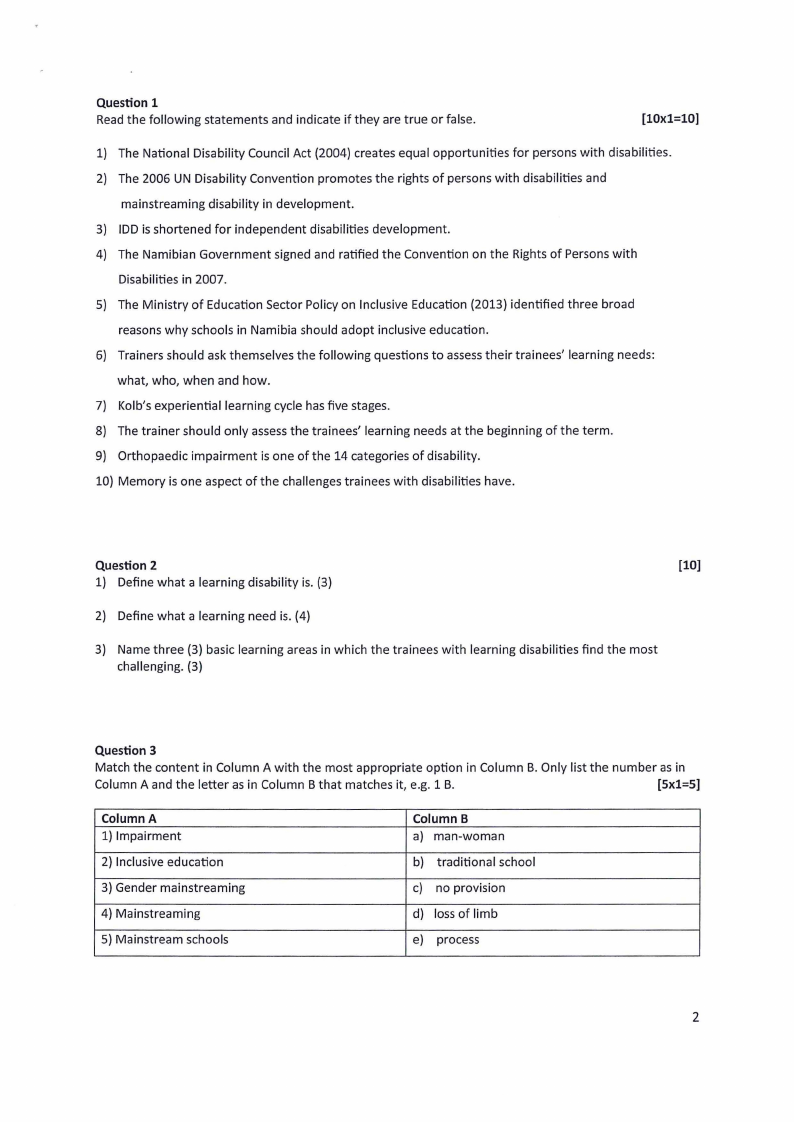
Question 1
Read the following statements and indicate if they are true or false .
[10x1=10]
1) The National Disability Council Act (2004) creates equal opportunities for persons with disabilities.
2) The 2006 UN Disability Convention promotes the rights of persons with disabilities and
mainstreaming disability in development.
3) IDD is shortened for independent disabilities development.
4) The Namibian Government signed and ratified the Convention on the Rights of Persons with
Disabilities in 2007.
5) The Ministry of Education Sector Policy on Inclusive Education (2013) identified three broad
reasons why schools in Namibia should adopt inclusive education .
6) Trainers should ask themselves the following questions to assess their trainees' learning needs:
what, who, when and how.
7) Kolb's experiential learning cycle has five stages.
8) The trainer should only assess the trainees' learning needs at the beginning of the term.
9) Orthopaedic impairment is one of the 14 categories of disability.
10) Memory is one aspect of the challenges tra inees with disabilities have.
Question 2
[10]
1) Define what a learning disability is. (3)
2) Define what a learning need is. (4)
3) Name three (3) basic learning areas in which the trainees with learning disabilities find the most
challenging. (3)
Question 3
Match the content in Column A with the most appropriate option in Column B. Only list the number as in
Column A and the letter as in Column B that matches it, e.g. 1 B.
[Sxl=S]
Column A
1) Impairment
2) Inclusive education
3) Gender mainstreaming
4) Mainstreaming
5) Mainstream schools
Column B
a) man-woman
b) traditional school
c) no provision
d) loss of limb
e) process
2
|
|
3 Page 3 |
▲back to top |
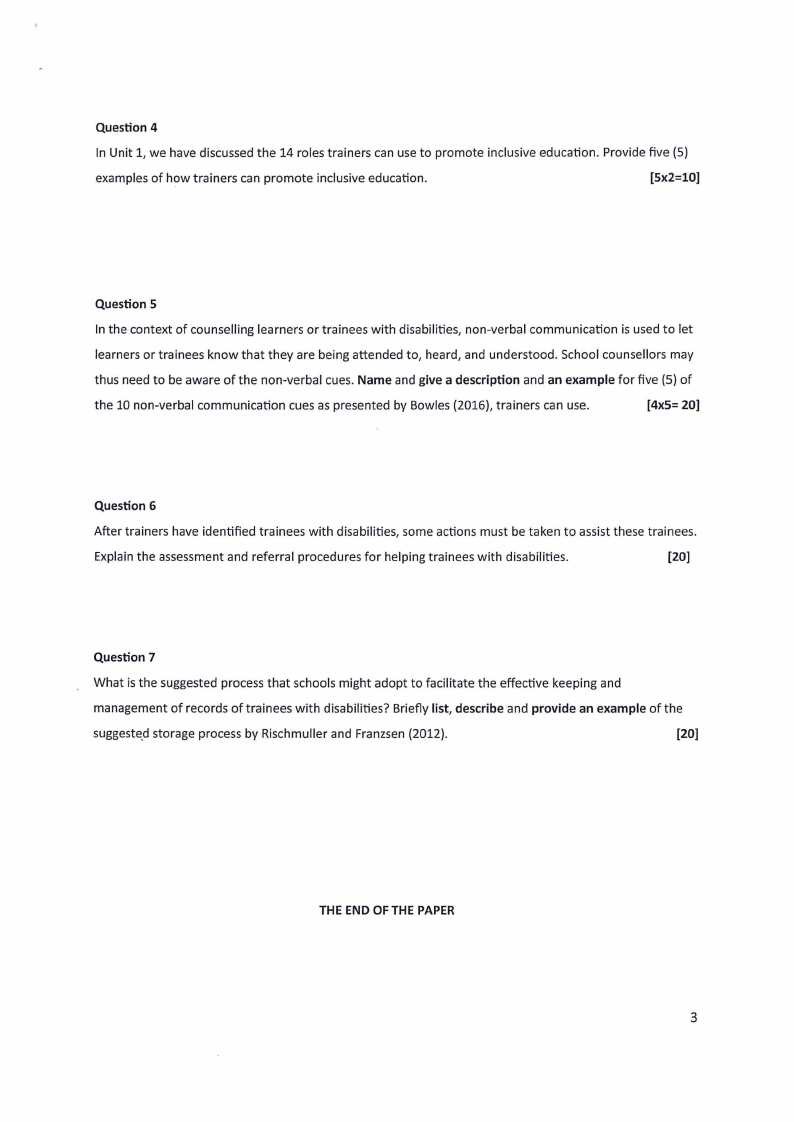
Question 4
In Unit 1, we have discussed the 14 roles trainers can use to promote inclusive education . Provide five (5)
examples of how trainers can promote inclusive education .
[5x2=10]
Question 5
In the context of counselling learners or tra inees with disabilities, non-verbal communication is used to let
learners or trainees know that they are being attended to, heard, and understood . School counsellors may
thus need to be aware of the non-verbal cues. Name and give a description and an example for five (5) of
the 10 non-verbal communication cues as presented by Bowles (2016), trainers can use.
[4x5= 20)
Question 6
After trainers have identified trainees with disabilities, some actions must be taken to assist these trainees.
Explain the assessment and referral procedures for helping trainees with disabilities.
[20)
Question 7
What is the suggested process that schools might adopt to facilitate the effective keeping and
management of records of trainees with disabilities? Briefly list, describe and provide an example of the
suggeste_d storage process by Rischmuller and Franzsen (2012).
[20)
THE END OF THE PAPER
3