


 |
PSL521S - PSYCHOLOGY OF LEARNING B - 1ST OPP - NOVEMBER 2025 |
|
|
1 Page 1 |
▲back to top |
n Am I 8 I A Un IVERS ITY
OF SCIEnCE Ano TECHnOLOGY
FACULTY OF COMMERCE, HUMAN SCIENCE AND EDUCATION
DEPARTMENT OF TECHNICAL AND VOCATIONAL EDUCATION AND TRAINING
QUALIFICATION: DIPLOMA IN TECHNICAL AND VOCATIONAL EDUCATION AND TRAINING: TRAINER
QUALIFICATION CODE: 06DTVT
COURSE CODE: PSL620S
LEVEL: 6
COURSE NAME: PSYCHOLOGY OF LEARNING B
SESSION: NOVEMBER 2025
PAPER: 1
DURATION: 3 HOURS
MARKS: 100
EXAMINER(S)
MODERATOR:
FIRST OPPORTUNITY EXAMINATION QUESTION PAPER
MS J. EISEB
DR 0. KACHEPA
INSTRUCTIONS
1. Answer ALL the questions.
2. Read all the questions carefully before answering.
3. Number the answers clearly.
THIS EXAMINATION QUESTION PAPER CONSISTS OF 5 PAGES (Including this front page)
|
|
2 Page 2 |
▲back to top |
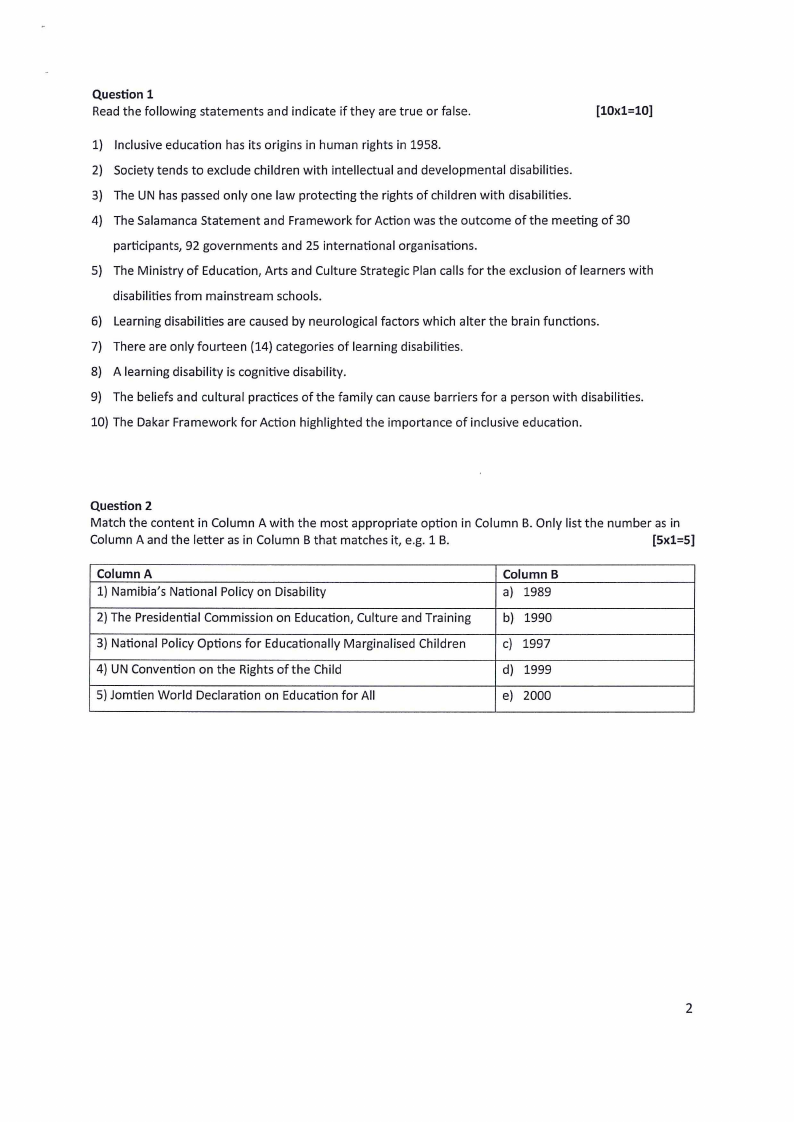
Question 1
Read the following statements and indicate if they are true or false.
[lOxl=lO]
1) Inclusive education has its origins in human rights in 1958.
2) Society tends to exclude children with intellectual and developmental disabilities.
3) The UN has passed only one law protecting the rights of children with disabilities.
4) The Salamanca Statement and Framework for Action was the outcome of the meeting of 30
participants, 92 governments and 25 international organisations.
5) The Ministry of Education, Arts and Culture Strategic Plan calls for the exclusion of learners with
disabilities from mainstream schools.
6) Learning disabilities are caused by neurological factors which alter the bra in functions.
7) There are only fourteen (14) categories of learning disabilities.
8) A learning disability is cognitive disability.
9) The beliefs and cultural practices of the family can cause barriers for a person with disabilities.
10) The Dakar Framework for Action highlighted the importance of inclusive education.
Question 2
Match the content in Column A with the most appropriate option in Column B. Only list the number as in
Column A and the letter as in Column B that matches it, e.g. 1 B.
[Sxl=S]
Column A
1) Namibia's National Policy on Disability
2) The Presidential Commission on Education, Culture and Training
3) National Policy Options for Educationally Marginalised Children
4) UN Convention on the Rights of the Child
5) Jomtien World Declaration on Education for All
Column B
a) 1989
b) 1990
c) 1997
d) 1999
e) 2000
2
|
|
3 Page 3 |
▲back to top |
Question 3
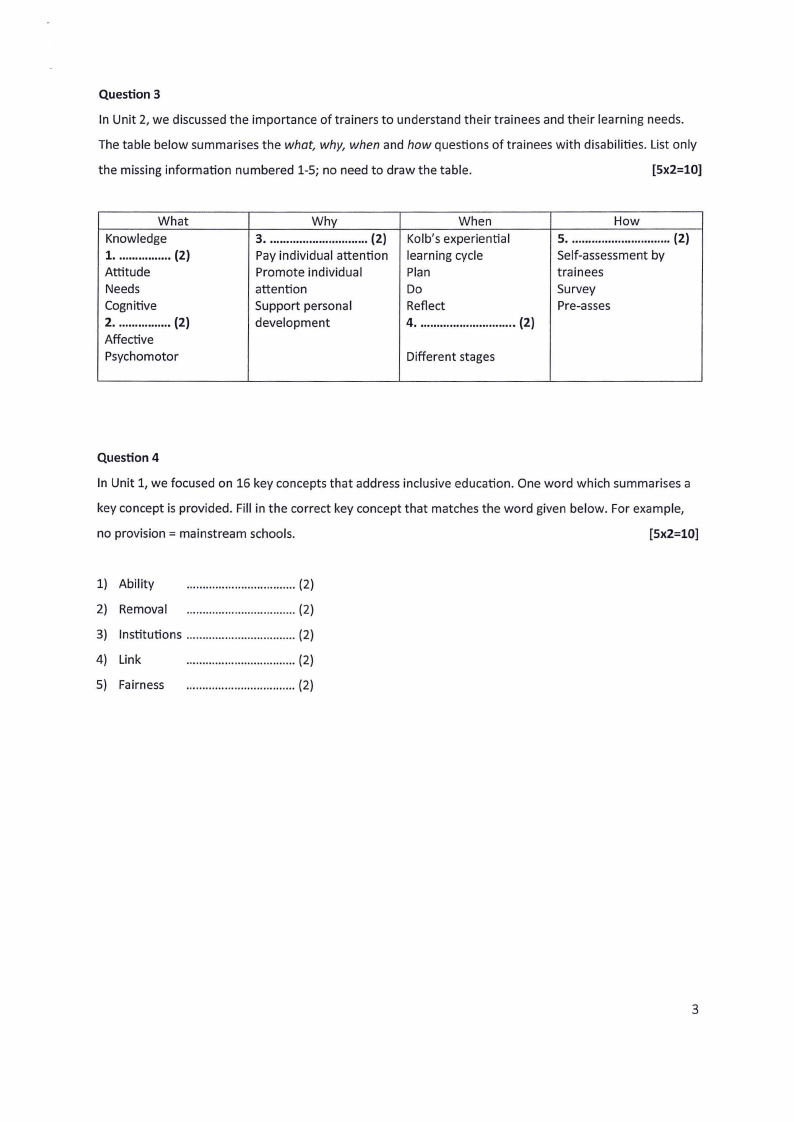
In Unit 2, we discussed the importance of trainers to understand their trainees and their learning needs.
The table below summarises the what, why, when and how questions of trainees with disabilities. List only
the missing information numbered 1-5; no need to draw the table.
[Sx2=10]
What
Knowledge
1. ................ (2)
Attitude
Needs
Cognitive
2. ................ (2)
Affective
Psychomotor
Why
3. .............................. (2)
Pay individual attention
Promote individual
attention
Support personal
development
When
Kolb's experiential
learning cycle
Plan
Do
Reflect
4. ............................. (2)
How
5. .............................. (2)
Self-assessment by
trainees
Survey
Pre-asses
Different stages
Question 4
In Unit 1, we focused on 16 key concepts that address inclusive education. One word which summarises a
key concept is provided. Fill in the correct key concept that matches the word given below. For example,
no provision = mainstream schools.
[Sx2=10]
1) Ability
........................ .......... (2)
2) Removal ... ............................... (2)
3) Institutions ............ ... ................... (2)
4) Link
.................................. (2)
5) Fairness .................................. (2)
3
|
|
4 Page 4 |
▲back to top |
Question 5
There are numerous skills that you, as a counsellor of trainees with disabilities, will need to perform your
counselling responsibilities . Name, briefly describe and provide an example of any four (4) counselling and
communication skills. Ensure the example demonstrates how you will apply the specific skill with a trainee
who has a disability.
[(1 + 2 + 2) X 5 = 25)
Question 6
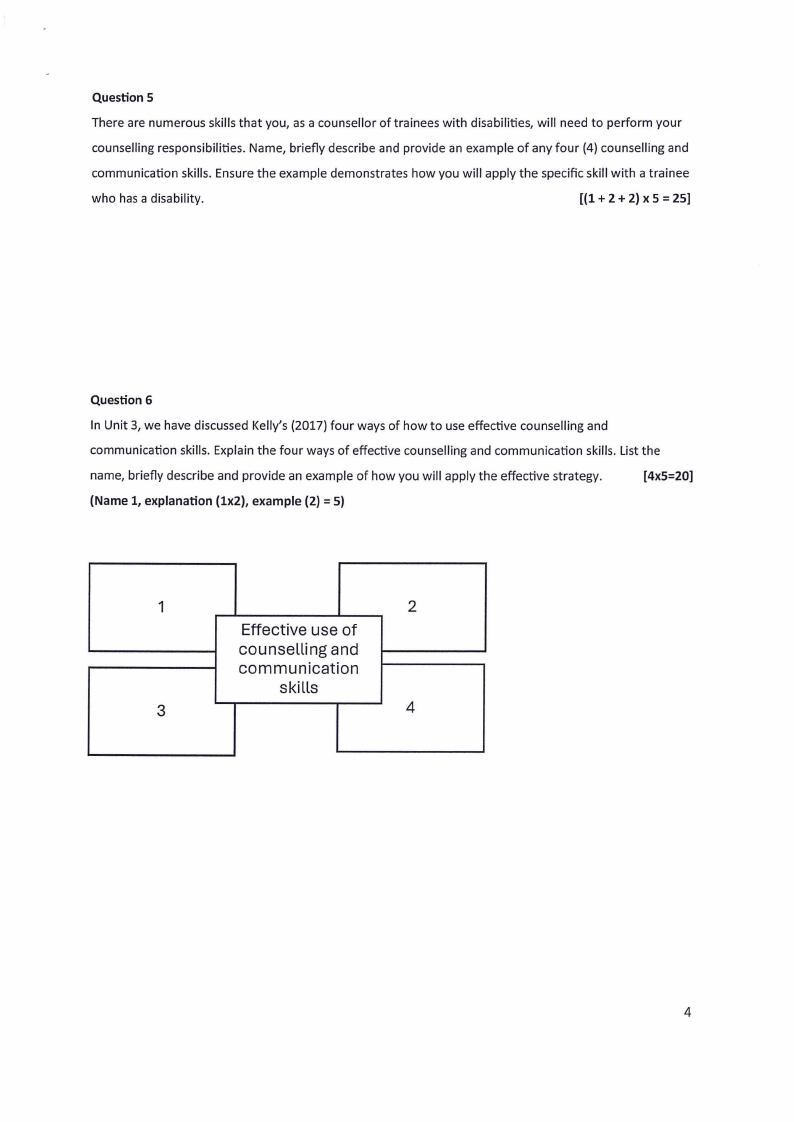
In Unit 3, we have discussed Kelly's (2017) four ways of how to use effective counselling and
communication skills. Explain the four ways of effective counselling and commun ication skills. List the
name, briefly describe and provide an example of how you will apply the effective strategy.
[4x5=20]
(Name 1, explanation (lx2), example (2) = 5)
1
2
Effective use of
counselling and
communication
skills
3
4
4
|
|
5 Page 5 |
▲back to top |
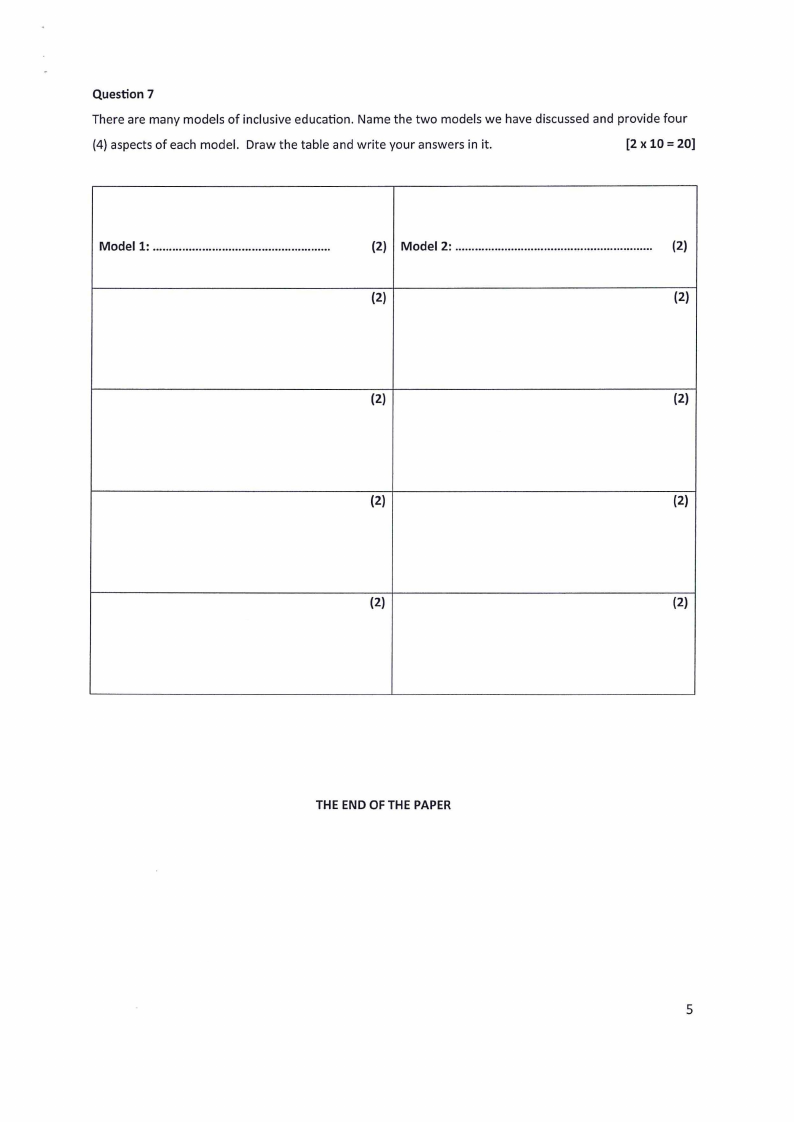
Question 7
There are many models of inclusive education. Name the two models we have discussed and provide four
(4) aspects of each model. Draw the table and write your answers in it.
[2 X 10 = 20]
Model 1: ......................................................
(2) Model 2: ............................................................ (2)
(2)
(2)
(2)
(2)
(2)
(2)
(2)
(2)
THE END OF THE PAPER
5