


 |
ITT611S - INTELLIGENT TRANSPORTATION SYSTEMS - 2ND OPP - JULY 2025 |
|
|
1 Page 1 |
▲back to top |
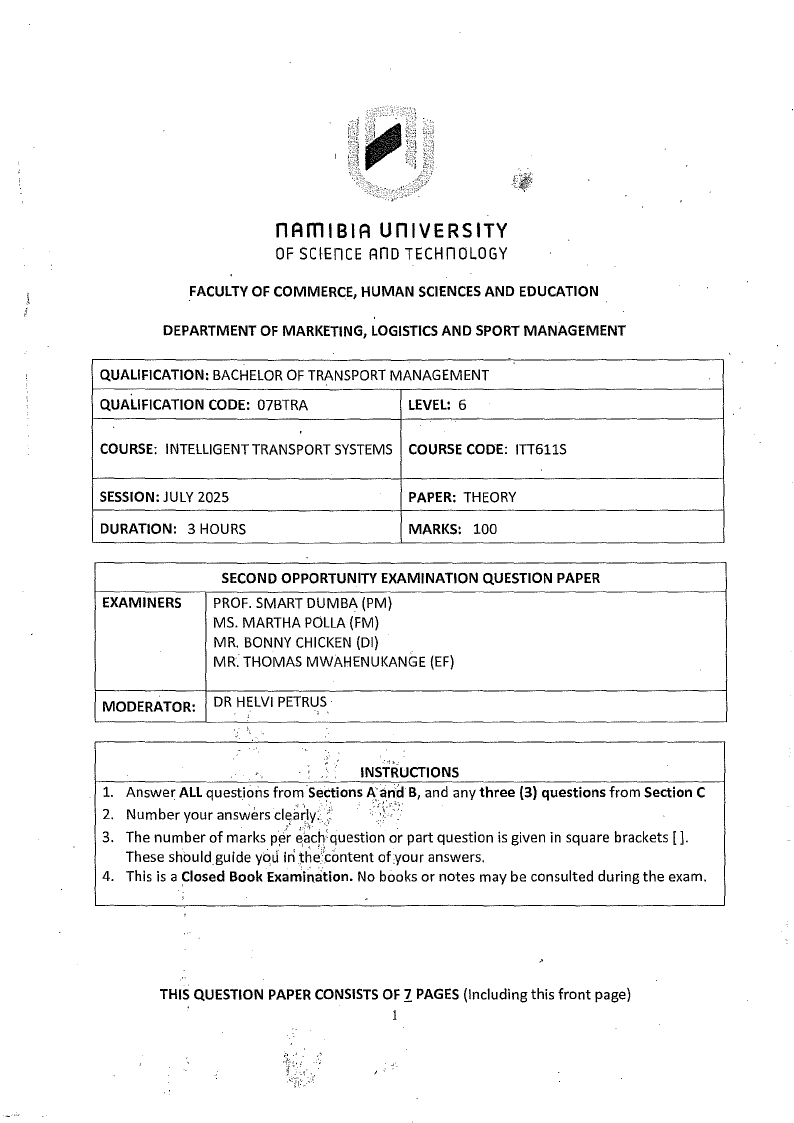
nAmlBIA un1VERSITY
OFSCfEnCEAno TECHnOLOGY
FACULTYOF COMMERCE,HUMAN SCIENCESAND EDUCATION
DEPARTMENTOF MARKETING,LOGISTICSAND SPORTMANAGEMENT
QUALIFICATION:BACHELOROFTRANSPORTMANAGEMENT
QUALIFICATIONCODE: 07BTRA
LEVEL: 6
COURSE:INTELLIGENTTRANSPORTSYSTEMS COURSECODE: ITT611S
SESSION:JULY2025
DURATION: 3 HOURS
PAPER: THEORY
MARKS: 100
EXAMINERS
SECONDOPPORTUNITYEXAMINATION QUESTION PAPER
PROF.SMARTDUMBA (PM)
MS. MARTHA POLLA(FM}
MR. BONNYCHICKEN(DI}
MR. THOMAS MWAHENUKANGE(EF}
MODERATOR: DR HELVIPETRU' S. ·
. .....
INSTRUCTIONS
1. Answer ALLquestions from SectionsAanit B, and any three {3) questions from Section C
2. Number your answers cle~;ly:i
·,,>::
. / 1·(·i· : ';'
·. ·
3. The number of marks per each'question or part question is given in square brackets [ ].
These should guide yot.\\ in Jh~''content of your answers.
4. This is a Closed Book Exarnination. No books or notes may be consulted during the exam.
THIS QUESTION PAPERCONSISTSOF I PAGES{Including this front page)
1
I;.
|
|
2 Page 2 |
▲back to top |
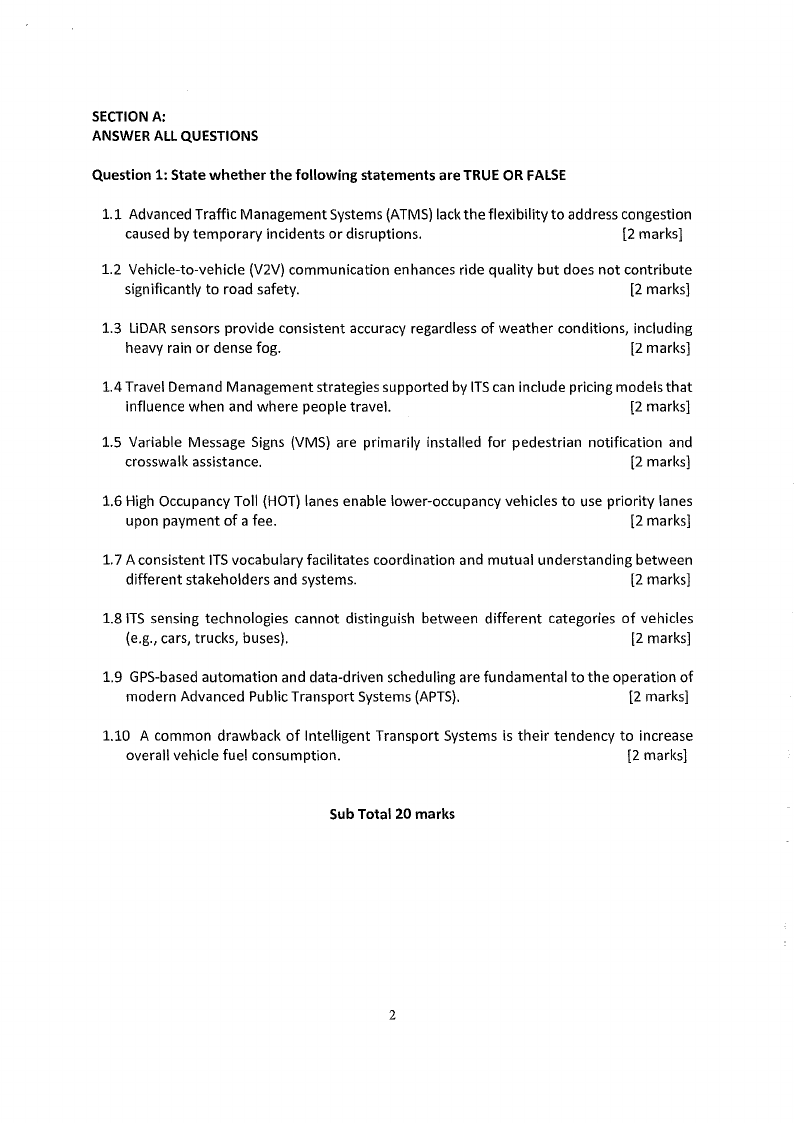
SECTION A:
ANSWER ALL QUESTIONS
Question 1: State whether the following statements are TRUE OR FALSE
1.1 Advanced Traffic Management Systems (ATMS)lack the flexibility to address congestion
caused by temporary incidents or disruptions.
[2 marks]
1.2 Vehicle-to-vehicle (V2V)communication enhances ride quality but does not contribute
significantly to road safety.
[2 marks]
1.3 LiDARsensors provide consistent accuracy regardless of weather conditions, including
heavy rain or dense fog.
[2 marks]
1.4 Travel Demand Management strategies supported by ITScan include pricing models that
influence when and where people travel.
[2 marks]
1.5 Variable Message Signs (VMS) are primarily installed for pedestrian notification and
crosswalk assistance.
[2 marks]
1.6 High Occupancy Toll (HOT) lanes enable lower-occupancy vehicles to use priority lanes
upon payment of a fee.
[2 marks]
1.7 A consistent ITSvocabulary facilitates coordination and mutual understanding between
different stakeholders and systems.
[2 marks]
1.8 ITS sensing technologies cannot distinguish between different categories of vehicles
(e.g., cars, trucks, buses).
[2 marks]
1.9 GPS-based automation and data-driven scheduling are fundamental to the operation of
modern Advanced Public Transport Systems (APTS).
[2 marks]
1.10 A common drawback of Intelligent Transport Systems is their tendency to increase
overall vehicle fuel consumption.
[2 marks]
Sub Total 20 marks
2
|
|
3 Page 3 |
▲back to top |
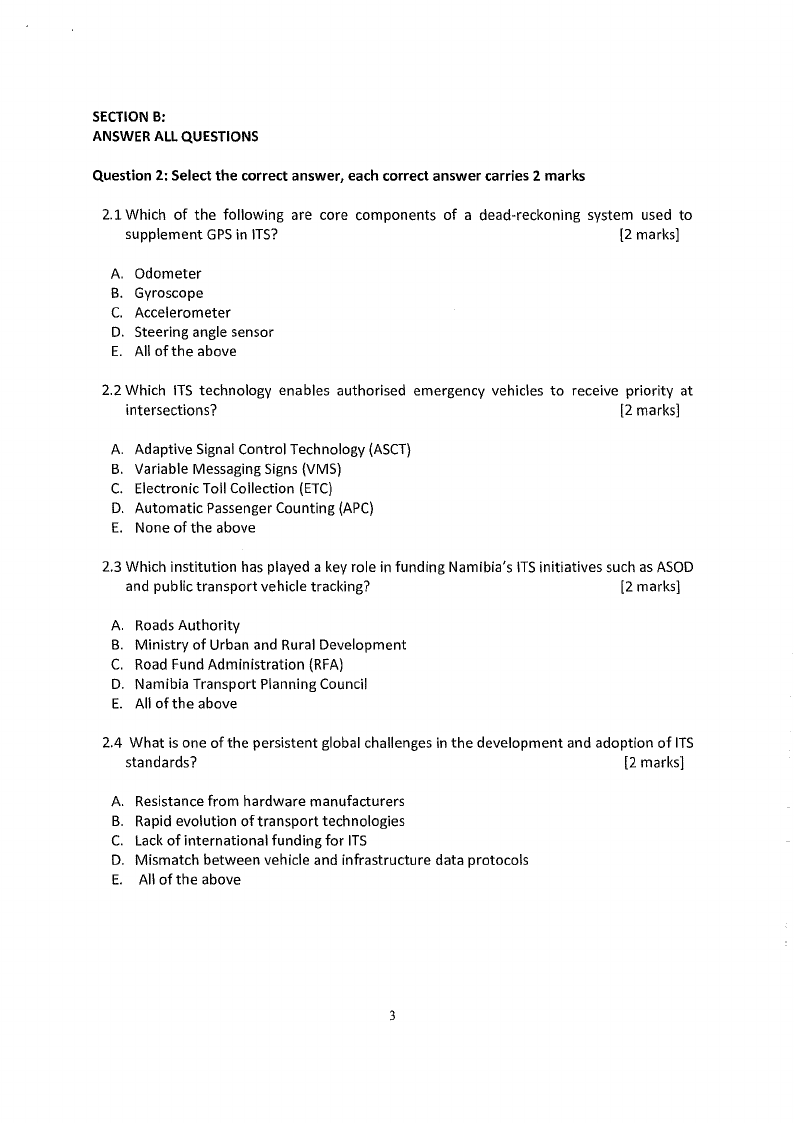
SECTIONB:
ANSWERALLQUESTIONS
Question2: Selectthe correctanswer, eachcorrectanswer carries2 marks
2.1 Which of the following are core components of a dead-reckoning system used to
supplement GPSin ITS?
[2 marks]
A. Odometer
B. Gyroscope
C. Accelerometer
D. Steering angle sensor
E. All of the above
2.2 Which ITS technology enables authorised emergency vehicles to receive priority at
intersections?
[2 marks]
A. Adaptive Signal Control Technology (ASCT)
B. Variable Messaging Signs (VMS)
C. Electronic Toll Collection (ETC)
D. Automatic PassengerCounting (APC}
E. None of the above
2.3 Which institution has played a key role in funding Namibia's ITSinitiatives such as ASOD
and public transport vehicle tracking?
[2 marks]
A. Roads Authority
B. Ministry of Urban and Rural Development
C. Road Fund Administration (RFA)
D. Namibia Transport Planning Council
E. All of the above
2.4 What is one of the persistent global challenges in the development and adoption of ITS
standards?
[2 marks]
A. Resistancefrom hardware manufacturers
B. Rapid evolution of transport technologies
C. Lack of international funding for ITS
D. Mismatch between vehicle and infrastructure data protocols
E. All of the above
3
|
|
4 Page 4 |
▲back to top |
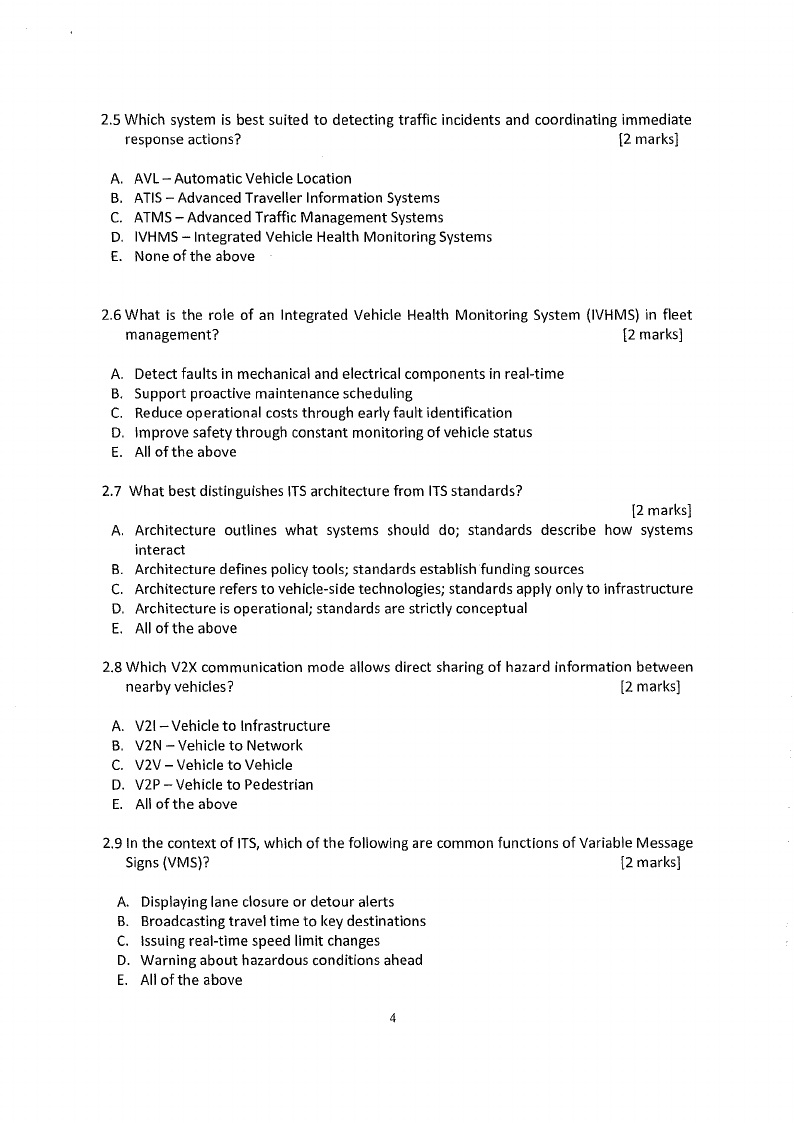
2.5 Which system is best suited to detecting traffic incidents and coordinating immediate
response actions?
[2 marks]
A. AVL- Automatic Vehicle Location
B. ATIS-Advanced Traveller Information Systems
C. ATMS-Advanced Traffic Management Systems
D. IVHMS- Integrated Vehicle Health Monitoring Systems
E. None of the above
2.6 What is the role of an Integrated Vehicle Health Monitoring System {IVHMS)in fleet
management?
[2 marks]
A. Detect faults in mechanical and electrical components in real-time
B. Support proactive maintenance scheduling
C. Reduce operational costs through early fault identification
D. Improve safety through constant monitoring of vehicle status
E. All of the above
2.7 What best distinguishes ITSarchitecture from ITSstandards?
[2 marks]
A. Architecture outlines what systems should do; standards describe how systems
interact
8. Architecture defines policy tools; standards establish funding sources
C. Architecture refers to vehicle-side technologies; standards apply only to infrastructure
D. Architecture is operational; standards are strictly conceptual
E. All of the above
2.8 Which V2X communication mode allows direct sharing of hazard information between
nearby vehicles?
[2 marks]
A. V21-Vehicle to Infrastructure
B. V2N - Vehicle to Network
C. V2V - Vehicle to Vehicle
D. V2P -Vehicle to Pedestrian
E. All of the above
2.9 In the context of ITS,which of the following are common functions of Variable Message
Signs (VMS)?
[2 marks]
A. Displaying lane closure or detour alerts
B. Broadcasting travel time to key destinations
C. Issuing real-time speed limit changes
D. Warning about hazardous conditions ahead
E. All of the above
4
|
|
5 Page 5 |
▲back to top |
2.10 Which technologies are typically integrated into an Advanced Public Transport System
(APTS)to support real-time fleet monitoring and service optimisation?
[2 marks]
A. Automatic Vehicle Location (AVL)
B. Global Positioning System (GPS)
C. Onboard Communication Modules
D. Control Centre Dashboards
E. All of the above
Sub Total 20 marks
5
|
|
6 Page 6 |
▲back to top |
SECTION C:
ANSWER ANY THREE (3) QUESTIONS, EACH QUESTION CARRIES20 MARKS
Question 3
Recent advancements in Intelligent Transport Systems (ITS) have significantly transformed
urban mobility across various African cities. For instance, in February 2025, Lagos State
partnered with Huawei Technologies to deploy four new ITSsites aimed at enhancing traffic
management and road safety. These sites utilize advanced monitoring and Al-powered traffic
solutions, including Automatic Number Plate Recognition (ANPR) cameras and Traffic
Management Solution (TMS) devices, to streamline traffic flow and reduce congestion.
Analyse the benefits and challenges associated with implementing Intelligent Transport
System (ITS) solutions in African cities, using Lagosas a case study.
[20 marks]
Question 4
Advanced Traveller Information Systems (ATIS) support users throughout the travel
experience by providing timely and relevant information.
Analyse the types of information provided at each stage of a trip and explain how this
information enhances traveller decision-making.
[20 marks)
Question S
Discusshow GPSand gyroscope-based dead-reckoning systems work together to improve
accuracy and reliability in Advanced Public Transport Systems (APTS).
[ 20 marks]
Question 6
The architecture of Intelligent Transport Systems (ITS) is built upon multiple interrelated
layers that ensure seamless functionality and integration across technical and institutional
domains.
I. Describe the purpose and key functions of the Transportation Layer in ITS. [8 marks]
II. Discuss the role of the Communication Layer and how it facilitates data exchange
within ITSenvironments.
[6 marks]
Ill. Explain the significance of the Institutional Layer in the planning, implementation, and
coordination of ITSinitiatives.
[6 marks)
6
|
|
7 Page 7 |
▲back to top |
Question 7
Assessthe effectiveness of the Average Speed Over Distance (ASOD)system as a policy tool
for improving compliance with speed regulations and influencing road user behaviour in
Namibia.
[20 marks]
Sub Total 60 marks
TOTAL 100 MARKS
END OF QUESTION PAPER
7