LAL112S - Labour Law 1B - 2nd Opp - Nov 2025


LAL112S - Labour Law 1B - 2nd Opp - Nov 2025


1 Page 1

▲back to top


nAmlBIA UnlVERSITY
OF SCIEnCE Ano TECHnOLOGY
FACULTY OF HUMAN SCIENCES
DEPARTMENT OF SOCIAL SCIENCES
QUALIFICATIONS: BACHELOR OF HUMAN RESOURCES; BACHELOR OF HUMAN RESOURCES
MANAGEMENT; BACHELOR OF BUSINESS AND INFORMATION ADMINISTRATION
QUALIFICATION CODES: 21BHUR;
07BHRM; 07BBIA
LEVEL: S
COURSE CODE : LAL 112 S
COURSE NAME : LABOUR LAW 1B
SESSION: DECEMBER 2025
PAPER: THEORY
DURATION: 2 HOURS
MARKS: 100
SECOND OPPORTUNITY EXAMINATION QUESTION PAPER
EXAMINER(S) Ms K Claasen
MODERATOR: Mrs E Wabomba
INSTRUCTIONS
1. This paper consists of 8 (eight) questions.
2. All questions are compulsory.
3. All questions must be answered in your Examination Book
4. Read all questions carefully before answering.
5. Incorrect spelling and illegible handwriting may prevent mark allocation.
PERMISSIBLE MATERIALS
1. Calculator
THIS QUESTION PAPER CONSISTS OF 9 (NINE) PAGES {Including this front page}

2 Page 2

▲back to top


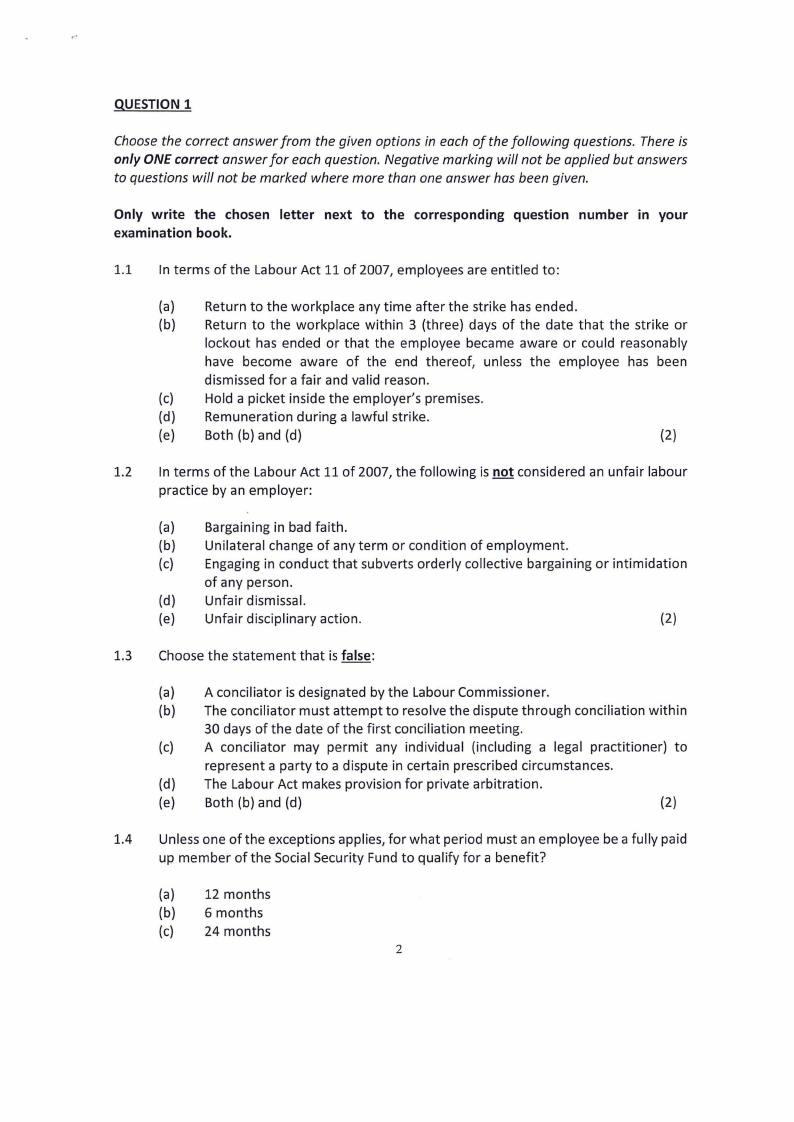
QUESTION 1
Choose the correct answer from the given options in each of the following questions. There is
only ONE correct answer for each question. Negative marking will not be applied but answers
to questions will not be marked where more than one answer has been given.
Only write the chosen letter next to the corresponding question number in your
examination book.
1.1 In terms of the Labour Act 11 of 2007, employees are entitled to:
(a) Return to the workplace any time after the strike has ended.
(b) Return to the workplace within 3 (three) days of the date that the strike or
lockout has ended or that the employee became aware or could reasonably
have become aware of the end thereof, unless the employee has been
dismissed for a fair and valid reason.
(c) Hold a picket inside the employer's premises.
(d) Remuneration during a lawful strike .
(e) Both (b) and (d)
(2)
1.2 In terms of the Labour Act 11 of 2007, the following is not considered an unfair labour
practice by an employer:
(a) Bargaining in bad faith.
(b) Unilateral change of any term or condition of employment.
(c) Engaging in conduct that subverts orderly collective bargaining or intimidation
of any person.
(d) Unfair dismissal.
(e) Unfair disciplinary action.
(2)
1.3 Choose the statement that is false:
(a) A conciliator is designated by the Labour Commissioner.
(b) The conciliator must attempt to resolve the dispute through conciliation within
30 days of the date of the first conciliation meeting.
(c) A conciliator may permit any individual (including a legal practitioner) to
represent a party to a dispute in certain prescribed circumstances.
(d) The Labour Act makes provision for private arbitration.
(e) Both (b) and (d)
(2)
1.4 Unless one of the exceptions applies, for what period must an employee be a fully paid
up member of the Social Security Fund to qualify for a benefit?
(a) 12 months
(b) 6 months
(c) 24 months
2

3 Page 3

▲back to top


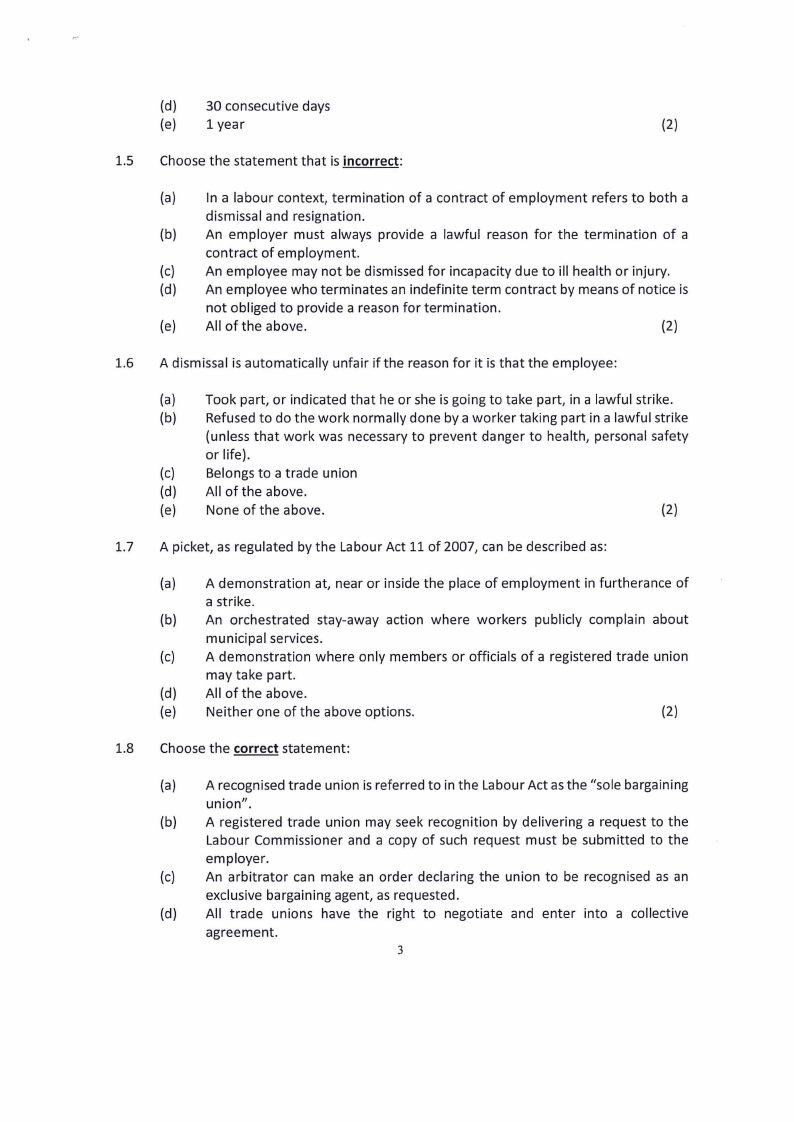
(d) 30 consecutive days
(e) 1 year
(2)
1.5 Choose the statement that is incorrect:
(a) In a labour context, termination of a contract of employment refers to both a
dismissal and resignation .
(b) An employer must always provide a lawful reason for the termination of a
contract of employment.
(c) An employee may not be dismissed for incapacity due to ill health or injury.
(d) An employee who terminates an indefinite term contract by means of notice is
not obliged to provide a reason for termination.
(e) All of the above.
(2)
1.6 A dismissal is automatically unfair if the reason for it is that the employee:
(a) Took part, or indicated that he or she is going to take part, in a lawful strike.
(b) Refused to do the work normally done by a worker taking part in a lawful strike
(unless that work was necessary to prevent danger to health, personal safety
or life).
(c) Belongs to a trade union
(d) All of the above.
(e) None of the above.
(2)
1.7 A picket, as regulated by the Labour Act 11 of 2007, can be described as:
(a) A demonstration at, near or inside the place of employment in furtherance of
a strike.
(b) An orchestrated stay-away action where workers publicly complain about
municipal services.
(c) A demonstration where only members or officials of a registered trade union
may take part.
(d) All of the above.
(e) Neither one of the above options.
(2)
1.8 Choose the correct statement:
(a) A recognised trade union is referred to in the Labour Act as the "sole bargaining
union".
(b) A registered trade union may seek recognition by delivering a request to the
Labour Commissioner and a copy of such request must be submitted to the
employer.
(c) An arbitrator can make an order declaring the union to be recognised as an
exclusive bargaining agent, as requested.
(d) All trade unions have the right to negotiate and enter into a collective
agreement.
3

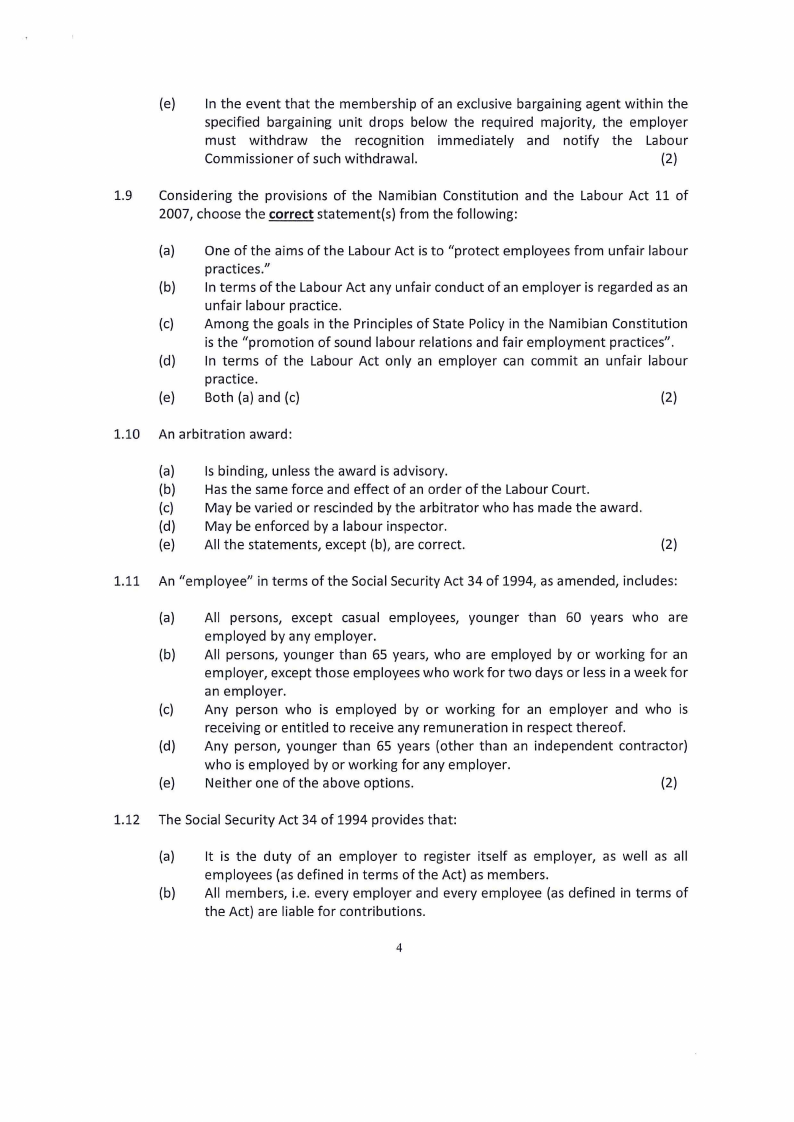
4 Page 4

▲back to top


(e) In the event that the membership of an exclusive bargaining agent within the
specified bargaining unit drops below the required majority, the employer
must withdraw the recognition immediately and notify the Labour
Commissioner of such withdrawal.
(2)
1.9 Considering the provisions of the Namibian Constitution and the Labour Act 11 of
2007, choose the correct statement(s) from the following:
(a) One of the aims of the Labour Act is to "protect employees from unfair labour
practices."
(b) In terms of the Labour Act any unfair conduct of an employer is regarded as an
unfair labour practice.
(c) Among the goals in the Principles of State Policy in the Namibian Constitution
is the "promotion of sound labour relations and fair employment practices".
(d) In terms of the Labour Act only an employer can commit an unfair labour
practice.
(e) Both (a) and (c)
(2)
1.10 An arbitration award:
(a) Is binding, unless the award is advisory.
(b) Has the same force and effect of an order of the Labour Court.
(c) May be varied or rescinded by the arbitrator who has made the award.
(d) May be enforced by a labour inspector.
(e) All the statements, except (b), are correct.
(2)
1.11 An "employee" in terms of the Social Security Act 34 of 1994, as amended, includes:
(a) All persons, except casual employees, younger than 60 years who are
employed by any employer.
(b) All persons, younger than 65 years, who are employed by or working for an
employer, except those employees who work for two days or less in a week for
an employer.
(c) Any person who is employed by or working for an employer and who is
receiving or entitled to receive any remuneration in respect thereof.
(d) Any person, younger than 65 years (other than an independent contractor)
who is employed by or working for any employer.
(e) Neither one of the above options.
(2)
1.12 The Social Security Act 34 of 1994 provides that:
(a) It is the duty of an employer to register itself as employer, as well as all
employees (as defined in terms of the Act) as members.
(b) All members, i.e. every employer and every employee (as defined in terms of
the Act) are liable for contributions.
4

5 Page 5

▲back to top


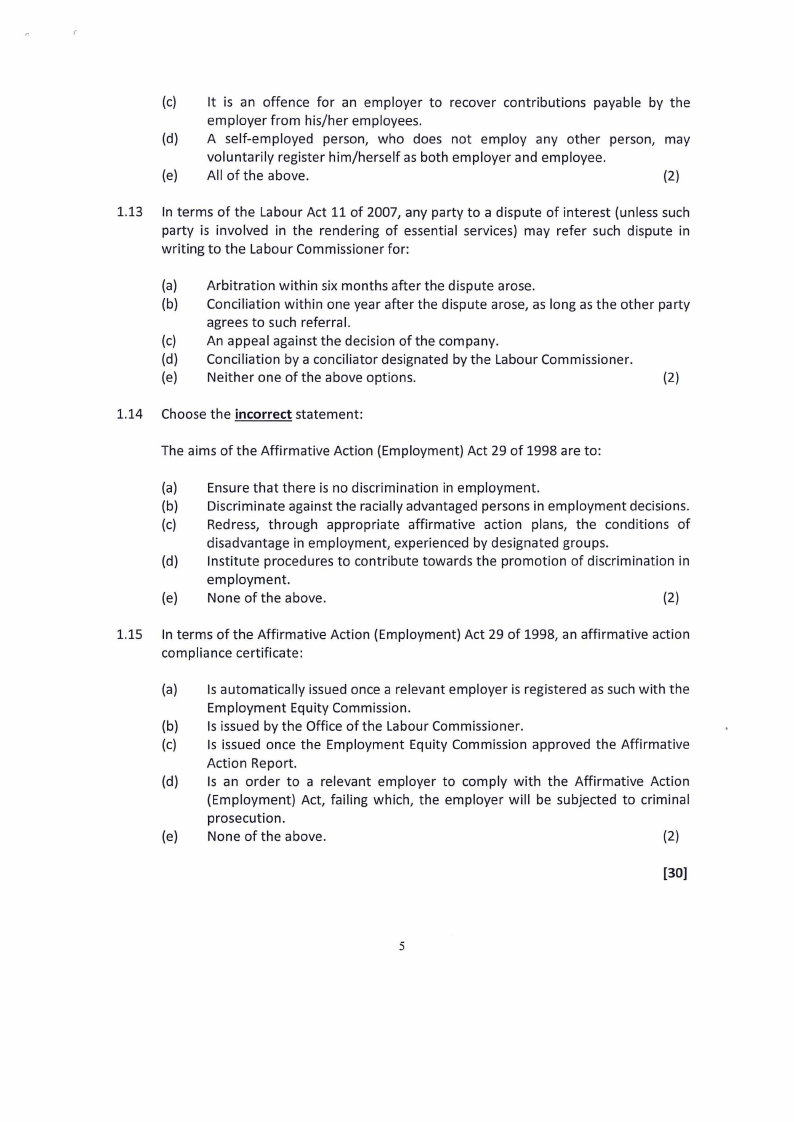
(c) It is an offence for an employer to recover contributions payable by the
employer from his/her employees.
(d) A self-employed person, who does not employ any other person, may
voluntarily register him/herself as both employer and employee.
(e) All of the above.
(2)
1.13 In terms of the Labour Act 11 of 2007, any party to a dispute of interest (unless such
party is involved in the rendering of essential services) may refer such dispute in
writing to the Labour Commissioner for:
(a) Arbitration within six months after the dispute arose.
(b) Conciliation within one year after the dispute arose, as long as the other party
agrees to such referral.
(c) An appeal against the decision of the company.
(d) Conciliation by a conciliator designated by the Labour Commissioner.
(e) Neither one of the above options.
(2)
1.14 Choose the incorrect statement:
The aims of the Affirmative Action (Employment) Act 29 of 1998 are to:
(a) Ensure that there is no discrimination in employment.
(b) Discriminate against the racially advantaged persons in employment decisions.
(c) Redress, through appropriate affirmative action plans, the conditions of
disadvantage in employment, experienced by designated groups.
(d) Institute procedures to contribute towards the promotion of discrimination in
employment.
(e) None of the above.
(2)
1.15 In terms of the Affirmative Action (Employment) Act 29 of 1998, an affirmative action
compliance certificate:
(a) Is automatically issued once a relevant employer is registered as such with the
Employment Equity Commission.
(b) Is issued by the Office of the Labour Commissioner.
(c) Is issued once the Employment Equity Commission approved the Affirmative
Action Report.
(d) Is an order to a relevant employer to comply with the Affirmative Action
(Employment) Act, failing which, the employer will be subjected to criminal
prosecution.
(e) None of the above.
(2)
[30]
5

6 Page 6

▲back to top


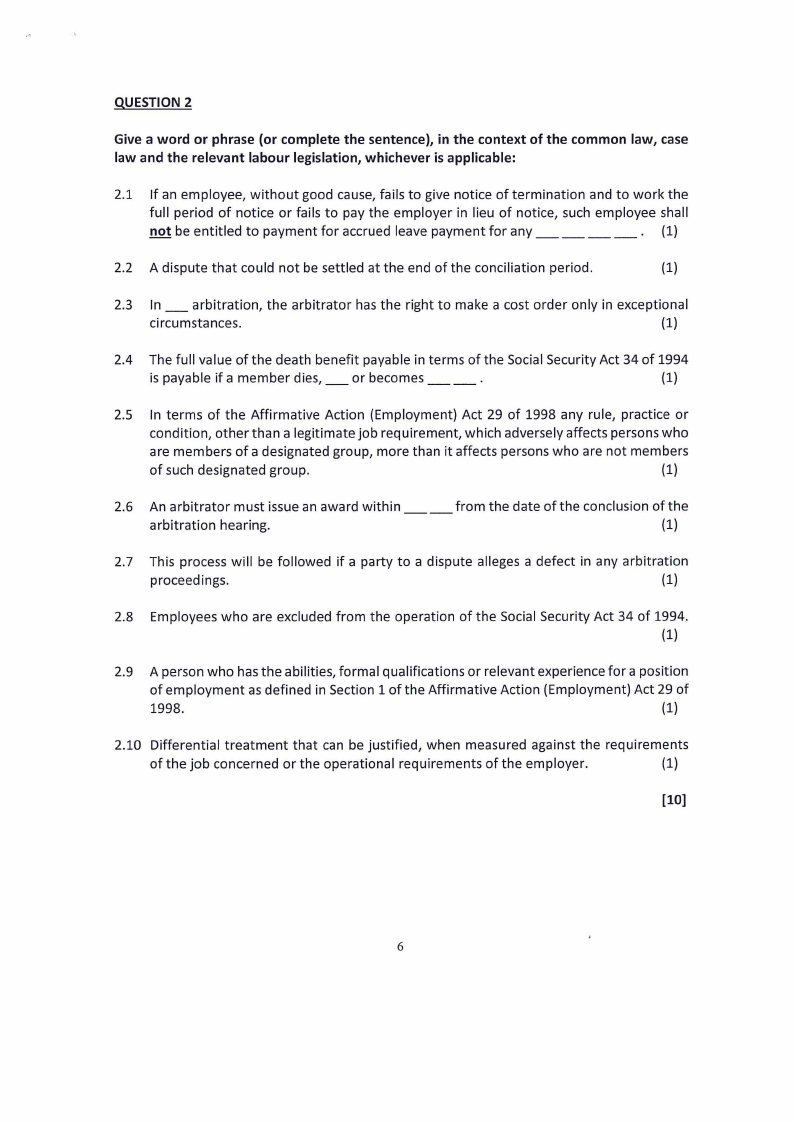
QUESTION 2
Give a word or phrase {or complete the sentence), in the context of the common law, case
law and the relevant labour legislation, whichever is applicable:
2.1 If an employee, w ithout good cause, fails to give notice of termination and to work the
full period of notice or fails to pay the employer in lieu of notice, such employee shall
not be entitled to payment for accrued leave payment for any _ _ _ _ . (1)
2.2 A dispute that could not be settled at the end of the conciliation period.
(1)
2.3 In _ arbitration, the arbitrator has the right to make a cost order only in exceptional
circumstances.
(1)
2.4 The full value of the death benefit payable in terms of the Social Security Act 34 of 1994
is payable if a member dies,_ or becomes _ _ .
(1)
2.5 In terms of the Affirmative Action (Employment) Act 29 of 1998 any rule, practice or
condition, other than a legitimate job requirement, which adversely affects persons who
are members of a designated group, more than it affects persons who are not members
of such designated group.
(1)
2.6 An arbitrator must issue an award within - - from the date of the conclusion of the
arbitration hearing.
(1)
2.7 This process will be followed if a party to a dispute alleges a defect in any arbitration
proceedings.
(1)
2.8 Employees who are excluded from the operation of the Social Security Act 34 of 1994.
(1)
2.9 A person who has the abilities, formal qualifications or relevant experience for a position
of employment as defined in Section 1 of the Affirmative Action (Employment) Act 29 of
1998.
(1)
2.10 Differential treatment that can be justified, when measured against the requirements
of the job concerned or the operational requirements of the employer.
(1)
[10]
6

7 Page 7

▲back to top


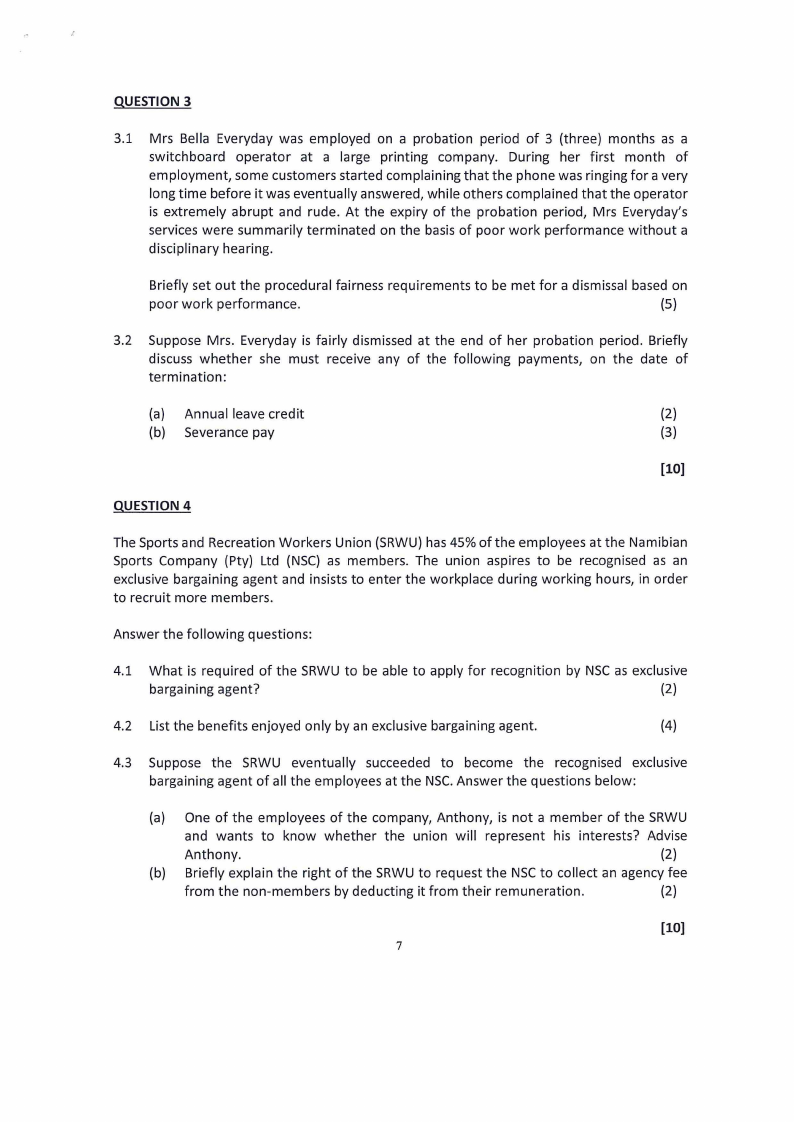
QUESTION 3
3.1 Mrs Bella Everyday was employed on a probation period of 3 (three) months as a
switchboard operator at a large printing company. During her first month of
employment, some customers started complaining that the phone was ringing for a very
long time before it was eventually answered, while others complained that the operator
is extremely abrupt and rude . At the expiry of the probation period, Mrs Everyday's
services were summarily terminated on the basis of poor work performance without a
disciplinary hearing.
Briefly set out the procedural fairness requirements to be met for a dismissal based on
poor work performance.
(5)
3.2 Suppose Mrs. Everyday is fairly dismissed at the end of her probation period. Briefly
discuss whether she must receive any of the following payments, on the date of
termination:
(a) Annual leave credit
(2)
(b) Severance pay
(3)
[10]
QUESTION 4
The Sports and Recreation Workers Union (SRWU) has 45% of the employees at the Namibian
Sports Company (Pty) Ltd (NSC) as members. The union aspires to be recognised as an
exclusive bargaining agent and insists to enter the workplace during working hours, in order
to recruit more members.
Answer the following questions:
4.1 What is required of the SRWU to be able to apply for recognition by NSC as exclusive
bargaining agent?
(2)
4.2 List the benefits enjoyed only by an exclusive bargaining agent.
(4)
4.3 Suppose the SRWU eventually succeeded to become the recognised exclusive
bargaining agent of all the employees at the NSC. Answer the questions below:
(a) One of the employees of the company, Anthony, is not a member of the SRWU
and wants to know whether the union will represent his interests? Advise
Anthony.
(2)
(b) Briefly explain the right of the SRWU to request the NSC to collect an agency fee
from the non-members by deducting it from their remuneration.
(2)
[10]
7

8 Page 8

▲back to top


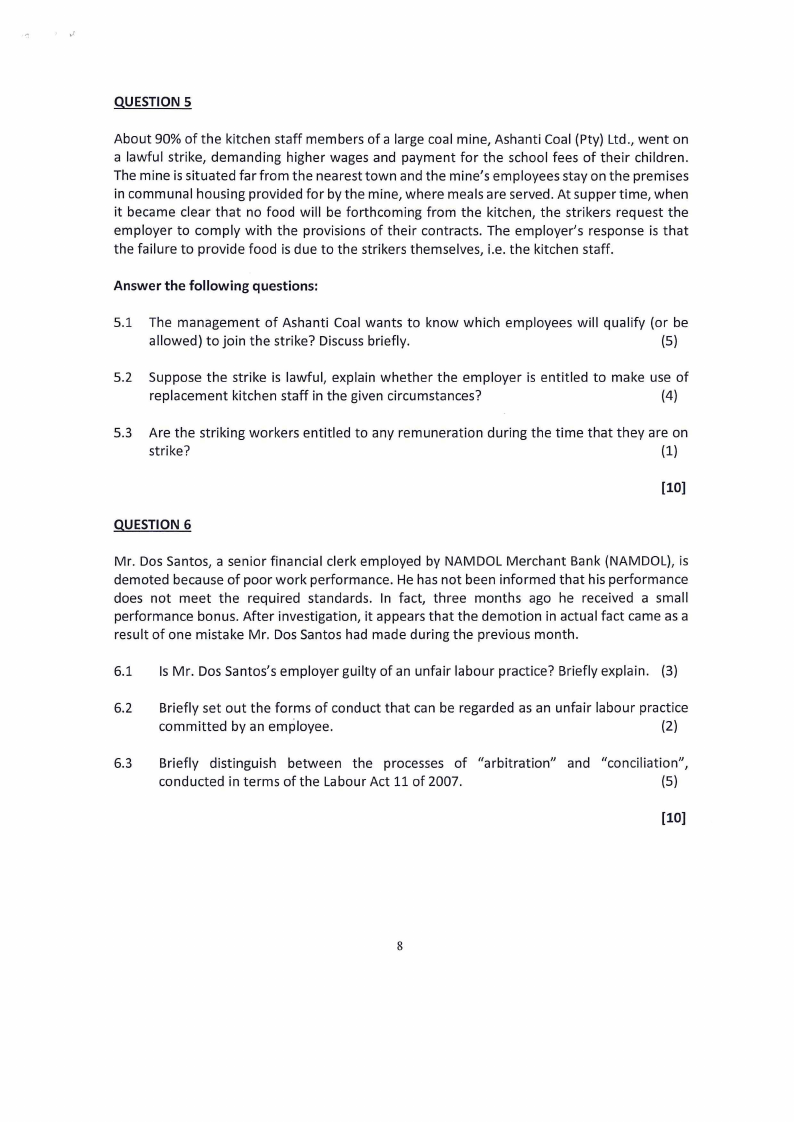
QUESTION 5
About 90% of the kitchen staff members of a large coal mine, Ashanti Coal (Pty) Ltd., went on
a lawful strike, demanding higher wages and payment for the school fees of their children.
The mine is situated far from the nearest town and the mine's employees stay on the premises
in communal housing provided for by the mine, where meals are served . At supper time, when
it became clear that no food will be forthcoming from the kitchen, the strikers request the
employer to comply with the provisions of their contracts. The employer's response is that
the failure to provide food is due to the strikers themselves, i.e. the kitchen staff.
Answer the following questions:
5.1 The management of Ashanti Coal wants to know which employees will qualify (or be
allowed) to join the strike? Discuss briefly.
(5)
5.2 Suppose the strike is lawful, explain whether the employer is entitled to make use of
replacement kitchen staff in the given circumstances?
(4)
5.3 Are the striking workers entitled to any remuneration during the time that they are on
strike?
(1)
[10)
QUESTION 6
Mr. Dos Santos, a senior financial clerk employed by NAMDOL Merchant Bank (NAMDOL}, is
demoted because of poor work performance. He has not been informed that his performance
does not meet the required standards. In fact, three months ago he received a small
performance bonus. After investigation, it appears that the demotion in actual fact came as a
result of one mistake Mr. Dos Santos had made during the previous month.
6.1 Is Mr. Dos Santos's employer guilty of an unfair labour practice? Briefly explain. (3)
6.2 Briefly set out the forms of conduct that can be regarded as an unfair labour practice
committed by an employee .
(2)
6.3 Briefly distinguish between the processes of "arbitration" and "conciliation",
conducted in terms of the Labour Act 11 of 2007.
(5)
[10)
8

9 Page 9

▲back to top


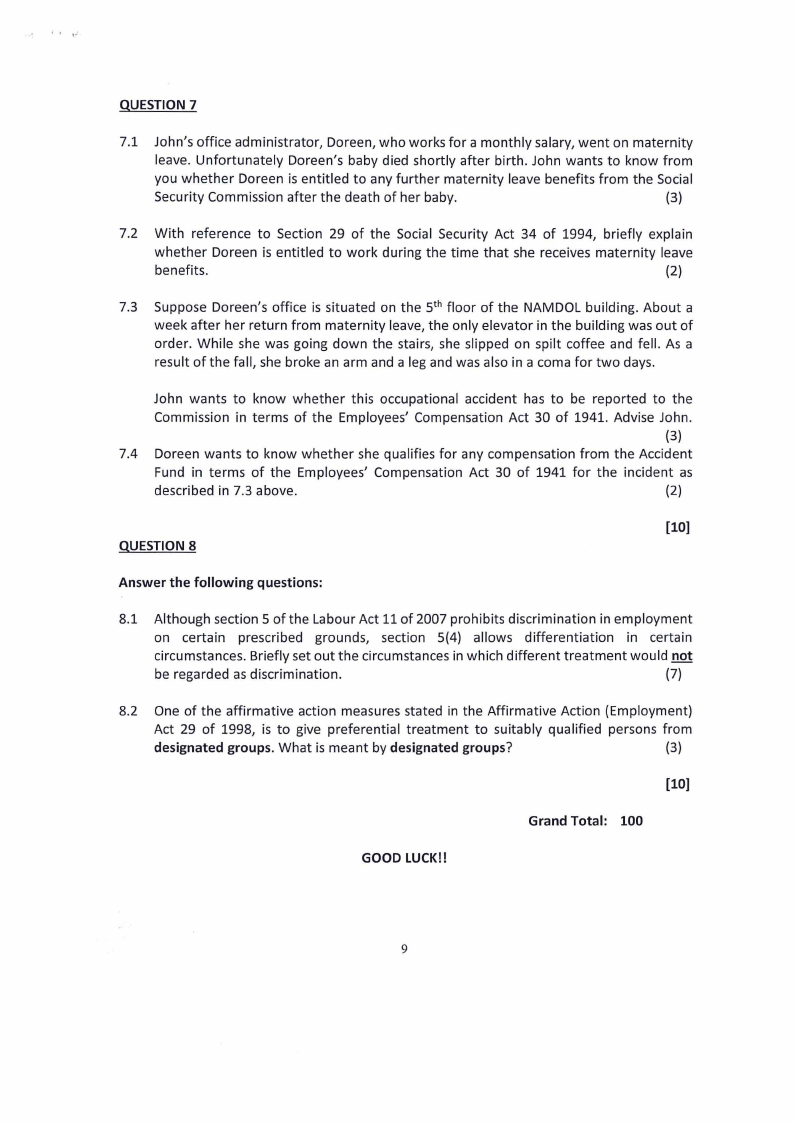
QUESTION 7
7.1 John's office administrator, Doreen, who works for a monthly salary, went on maternity
leave. Unfortunately Doreen's baby died shortly after birth. John wants to know from
you whether Doreen is entitled to any further maternity leave benefits from the Social
Security Commission after the death of her baby.
{3)
7.2 With reference to Section 29 of the Social Security Act 34 of 1994, briefly explain
whether Doreen is entitled to work during the time that she receives maternity leave
benefits.
{2)
7.3 Suppose Doreen's office is situated on the 5th floor of the NAMDOL building. About a
week after her return from maternity leave, the only elevator in the building was out of
order. While she was going down the stairs, she slipped on spilt coffee and fell. As a
result of the fall, she broke an arm and a leg and was also in a coma for two days.
John wants to know whether this occupational accident has to be reported to the
Commission in terms of the Employees' Compensation Act 30 of 1941. Advise John.
(3)
7.4 Doreen wants to know whether she qualifies for any compensation from the Accident
Fund in terms of the Employees' Compensation Act 30 of 1941 for the incident as
described in 7.3 above.
{2)
[10]
QUESTION 8
Answer the following questions:
8.1 Although section 5 of the Labour Act 11 of 2007 prohibits discrimination in employment
on certain prescribed grounds, section 5(4) allows differentiation in certain
circumstances. Briefly set out the circumstances in which different treatment would not
be regarded as discrimination .
(7)
8.2 One of the affirmative action measures stated in the Affirmative Action {Employment)
Act 29 of 1998, is to give preferential treatment to suitably qualified persons from
designated groups. What is meant by designated groups?
(3)
[10]
Grand Total: 100
GOOD LUCK!!
9