


 |
SDM812S - Strategic Digital Marketing - 1st Opp - Nov 2025 |
|
|
1 Page 1 |
▲back to top |
nAmlBIA UnlVERSITY
OF SCIEnCE An □ TECHn □ LOGY
FACULTY OF COMMERCE, HUMAN SCIENCES AND EDUCATION
DEPARTMENT OF MARKETING, LOGISTICS, AND SPORT MANAGEMENT
QUALIFICATION: BACHELOR OF MARKETING HONOURS
QUALIFICATION CODE: 08MAR
LEVEL: NQF LEVEL 8
COURSE CODE: SDM812S
COURSE NAME: STRATEGIC DIGITAL MARKETING
SESSION: NOVEMBER 2025
PAPER: THEORY
DURATION: 3 HOURS
MARKS: 100
1st OPPORTUNITY EXAMINATION QUESTION PAPER
EXAMINER(S) MS. L. HEELU (FT, PM)
MODERATOR DR. EVANS SIMATAA
INSTRUCTIONS
READ THE INSTRUCTIONS CAREFULLY
1. Answer ALL questions on your ANSWER SHEET.
2. Read all the questions carefully before answering
3. This paper consists of 5 questions
4. Write your Name, Student Number, Lecturer's name, and Mode of
study on your answer sheet.
THIS QUESTION PAPER CONSISTS OF _6_ PAGES (Including this front page)
ALL THE BEST!
1
|
|
2 Page 2 |
▲back to top |
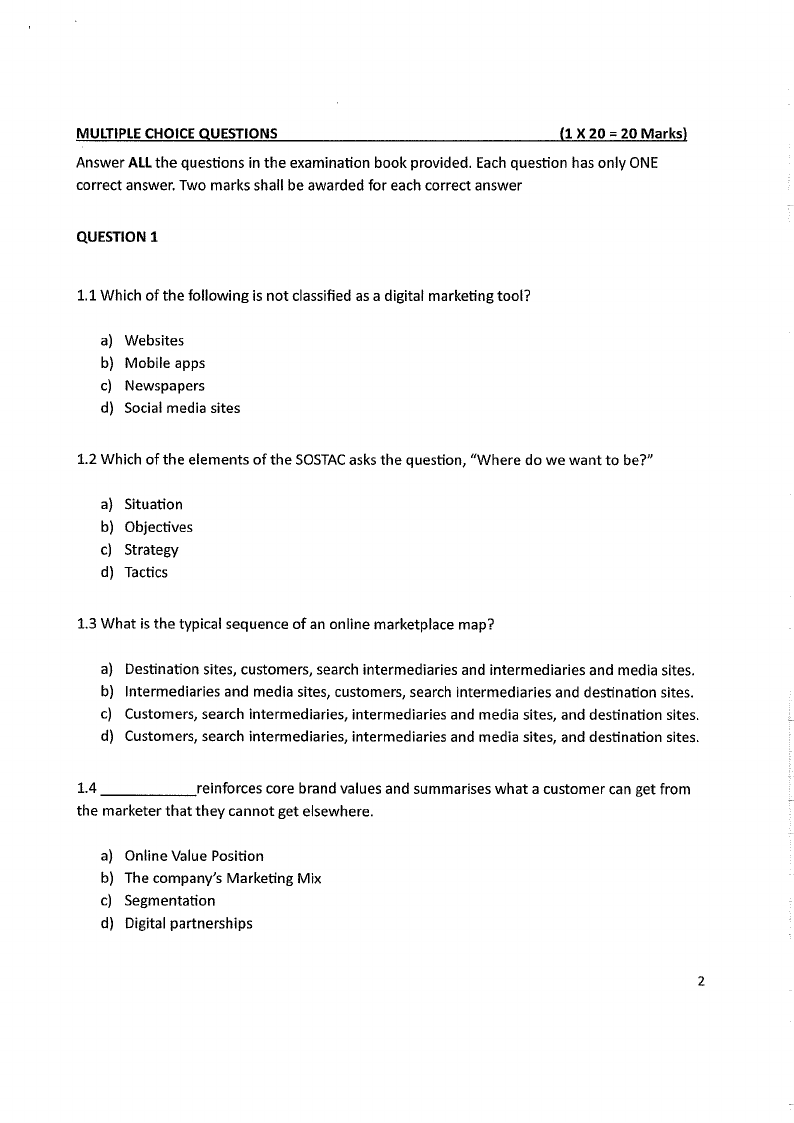
MULTIPLE CHOICE QUESTIONS
11 X 20 = 20 Marks)
Answer ALL the questions in the examination book provided. Each question has only ONE
correct answer. Two marks shall be awarded for each correct answer
QUESTION 1
1.1 Which of the following is not classified as a digital marketing tool?
a) Websites
b) Mobile apps
c) Newspapers
d) Social media sites
1.2 Which of the elements of the SOSTAC asks the question, "Where do we want to be?"
a) Situation
b) Objectives
c) Strategy
d) Tactics
1.3 What is the typical sequence of an online marketplace map?
a) Destination sites, customers, search intermediaries and intermediaries and media sites.
b) Intermediaries and media sites, customers, search intermediaries and destination sites.
c) Customers, search intermediaries, intermediaries and media sites, and destination sites.
d) Customers, search intermediaries, intermediaries and media sites, and destination sites.
1.4 ______reinforces core brand values and summarises what a customer can get from
the marketer that they cannot get elsewhere.
a) Online Value Position
b) The company's Marketing Mix
c) Segmentation
d) Digital partnerships
2
|
|
3 Page 3 |
▲back to top |
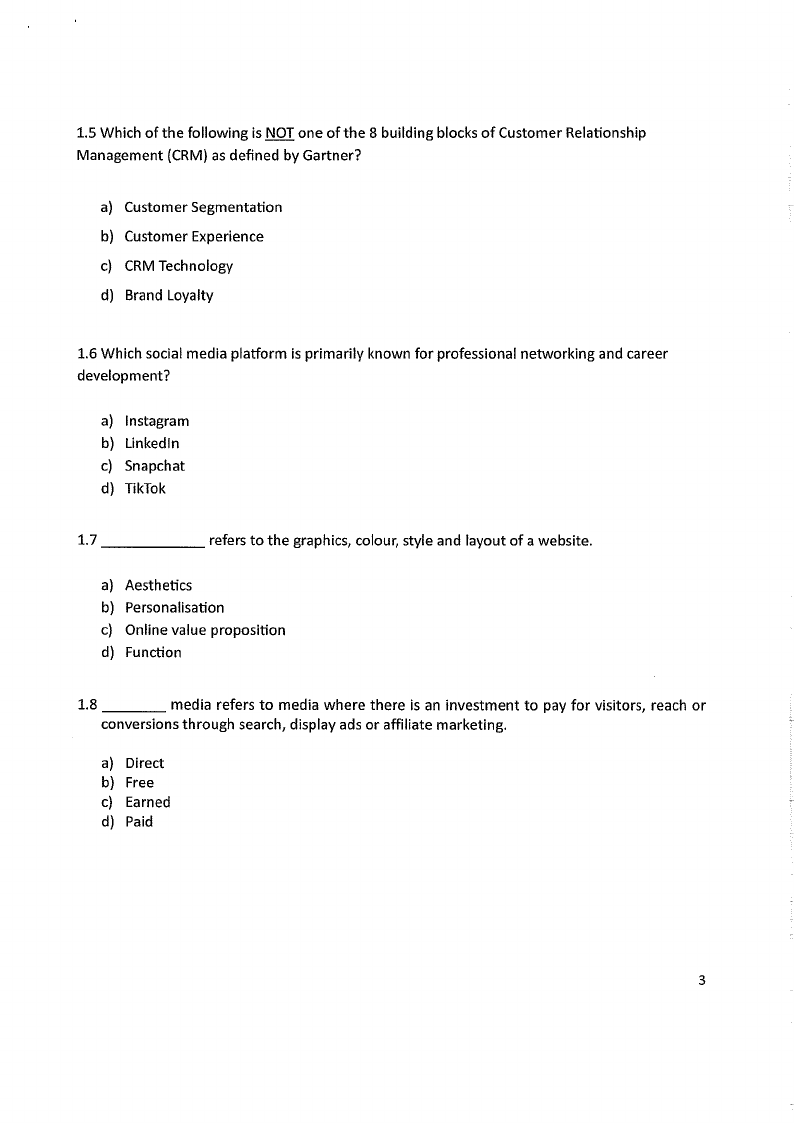
1.5 Which of the following is NOT one of the 8 building blocks of Customer Relationship
Management (CRM) as defined by Gartner?
a) Customer Segmentation
b) Customer Experience
c) CRM Technology
d) Brand Loyalty
1.6 Which social media platform is primarily known for professional networking and career
development?
a) lnstagram
b) Linkedln
c) Snapchat
d) TikTok
1.7 ______ refers to the graphics, colour, style and layout of a website.
a) Aesthetics
b) Personalisation
c) Online value proposition
d) Function
1.8 ____ media refers to media where there is an investment to pay for visitors, reach or
conversions through search, display ads or affiliate marketing.
a) Direct
b) Free
c) Earned
d) Paid
3
|
|
4 Page 4 |
▲back to top |
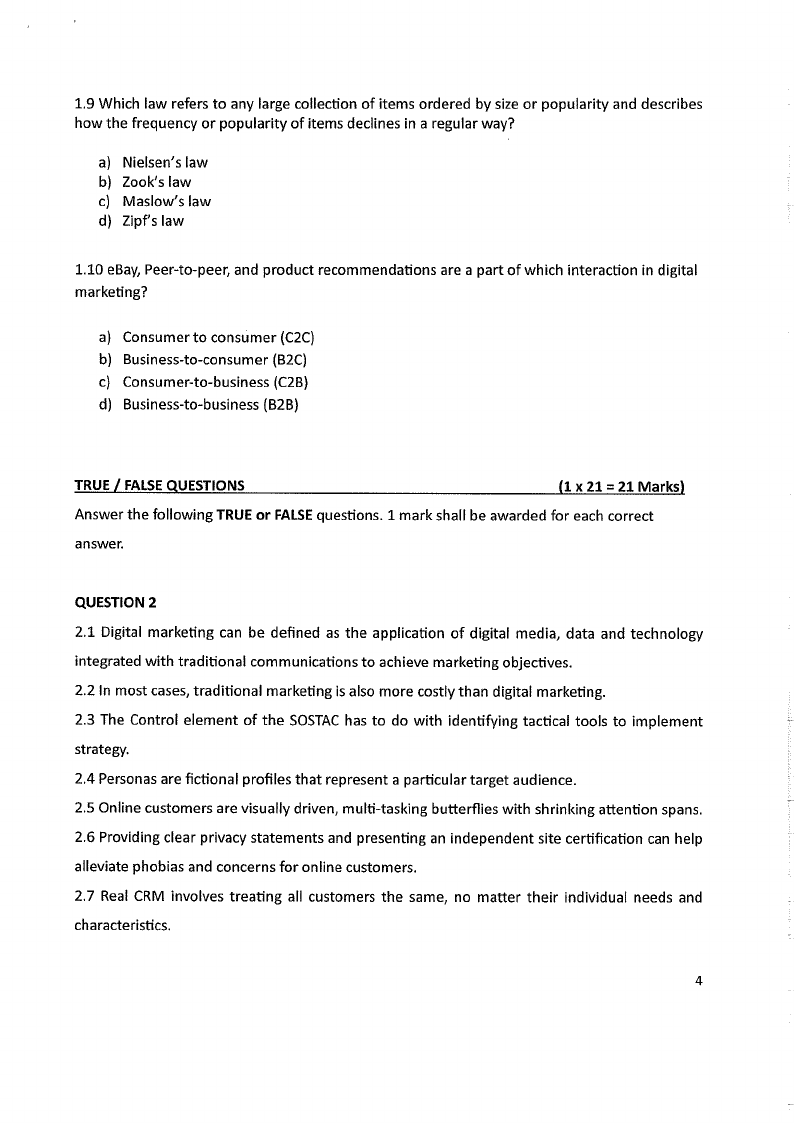
1.9 Which law refers to any large collection of items ordered by size or popularity and describes
how the frequency or popularity of items declines in a regular way?
a) Nielsen's law
b) Zook's law
c) Maslow's law
d) Zipf's law
1.10 eBay, Peer-to-peer, and product recommendations are a part of which interaction in digital
marketing?
a) Consumer to consumer (C2C)
b) Business-to-consumer (B2C)
c) Consumer-to-business (C2B)
d) Business-to-business (B2B)
TRUE/ FALSE QUESTIONS
(1 x 21 = 21 Marks)
Answer the following TRUE or FALSE questions. 1 mark shall be awarded for each correct
answer.
QUESTION2
2.1 Digital marketing can be defined as the application of digital media, data and technology
integrated with traditional communications to achieve marketing objectives.
2.2 In most cases, traditional marketing is also more costly than digital marketing.
2.3 The Control element of the SOSTAC has to do with identifying tactical tools to implement
strategy.
2.4 Person as are fictional profiles that represent a particular target audience.
2.5 Online customers are visually driven, multi-tasking butterflies with shrinking attention spans.
2.6 Providing clear privacy statements and presenting an independent site certification can help
alleviate phobias and concerns for on line customers.
2. 7 Real CRM involves treating all customers the same, no matter their individual needs and
characteristics.
4
|
|
5 Page 5 |
▲back to top |
2.8 Business-to-employee (B2E) involves processes and applications that help sell to and service
customers.
2.9 The 3Ms resources of digital marketing planning are Men, Money, and Minutes.
2.10 In digital marketing planning and management, Tactics refer to short-term and flexible
planning, while Strategy refers to long-term and enduring planning.
2.11 On-time delivery is the first step in the Ladder of Loyalty.
2.12 Safety concerns such as security, protection, order and stability are only applicable to
traditional marketing.
2.13 E-CRM enables digital marketers to create a multi-channel marketing process of reacting
with appropriate messages, either online or offline.
2.14 A potential disadvantage of affiliate marketing is that the cost of acquisition can be controlled
well.
2.15 Due to the growth in social media, the use of company websites to access the company
information via desktop, smartphone and tablet devices, is now regarded as outdated.
2.16 Permission marketing involves obtaining consent from consumers before sending them
promotional messages.
2.17 The SOSTAC model involves six stages: Situation Analysis, Objectives, Search, Tactics, Action,
and Control.
2.18 Technological advancements, economic conditions, and cultural shifts are examples of
macro-environmental factors influencing digital marketing.
2.19 Legal and regulatory constraints do not play a significant role in shaping the digital marketing
environment.
2.20 Website accessibility and inclusive design practices are not critical considerations in web
design.
2.21 Search Engine Marketing encompasses paid search advertising, where businesses bid on
keywords to have their ads displayed in search engine results.
5
|
|
6 Page 6 |
▲back to top |
STRUCTURED QUESTIONS: ANSWER ALL QUESTIONS
[59 Marks)
QUESTION3
{20 marks)
The '55' framework, developed by Dave Chaffey, outlines key objectives or benefits that
organisations should aim for in their digital marketing strategies. Identify each of the five
elements of the 55 framework, explain the specific benefits that each element provides to a
business and discuss how these benefits are delivered or achieved in practice.
QUESTION4
(15 Marks)
Identify the different elements of an organisation's macro-environment and discuss how each
force impacts an organisation's digital marketing strategy.
QUESTION 5
{24 marks)
Understanding the stages that buyers go through when making an online purchase enables
marketers to create and deliver targeted content at each step of the journey. Identify the stages
of the high-involvement online buying process and, using NUST as an example, describe the
actions that a marketer can take at each stage to help move the customer through the process.
** END OF QUESTION PAPER**
6