SOT612S - Sales And Operations Management - 1st Opp - Nov 2025


SOT612S - Sales And Operations Management - 1st Opp - Nov 2025


1 Pages 1-10

▲back to top


1.1 Page 1

▲back to top


nAmlBIA unlVERSITY
OF SCIEnCE Ano TECHnOLOGY
FACULTY OF COMMERCE, HUMAN SCIENCE AND EDUCATION
DEPARTMENT OF MARKETING, LOGISTICS AND SPORT MANAGEMENT
QUALIFICATION: BACHELOR OF MARKETING
QUALIFICATION CODE: 07BMAK
LEVEL: 6
COURSE CODE: SOT612S
COURSE NAME: SALES AND OPERATIONS
MANAGEMENT
SESSION: OCTOBER 2025
PAPER:THEORY
DURATION: 3 HOURS
MARKS: 100
FIRST OPPORTUNITY EXAMINATION QUESTION PAPER
EXAMINER(S) MR. C. KAZONDOVI
MODERATOR: PROF. M. CHUFAMA
INSTRUCTIONS
1. Answer ALL the questions.
2. Write clearly and neatly.
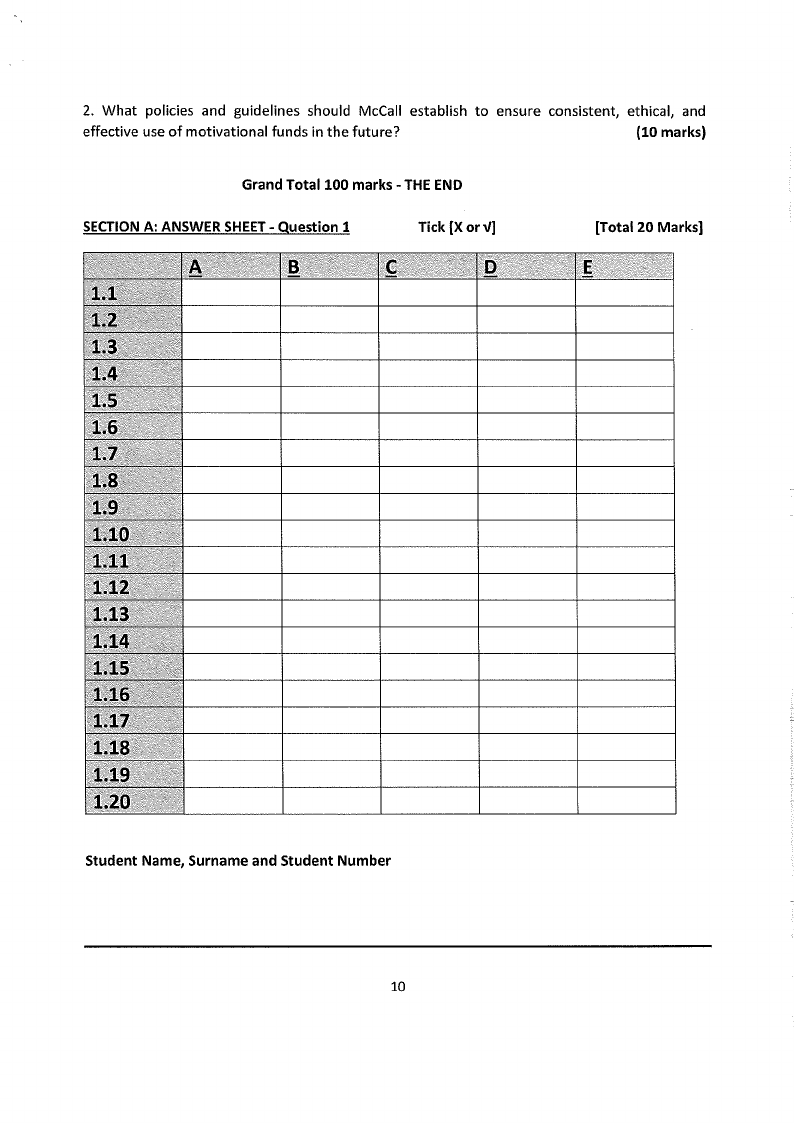
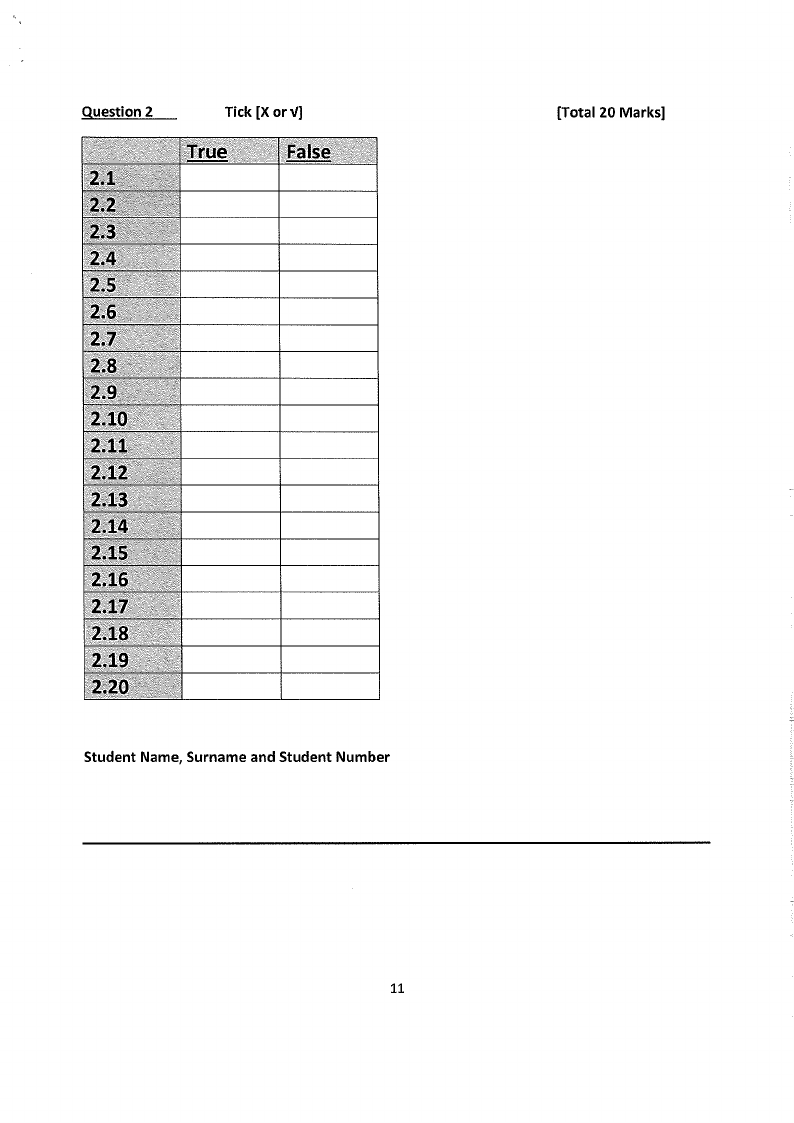
3. Use the tables provided on [page 10 & 11] to answer Section A,
Question One (1) AND Question Two (2) respectively: Detach and insert
it into your answer booklet.
THIS QUESTION PAPER CONSISTS OF 11 PAGES {Including this front page)
1

1.2 Page 2

▲back to top


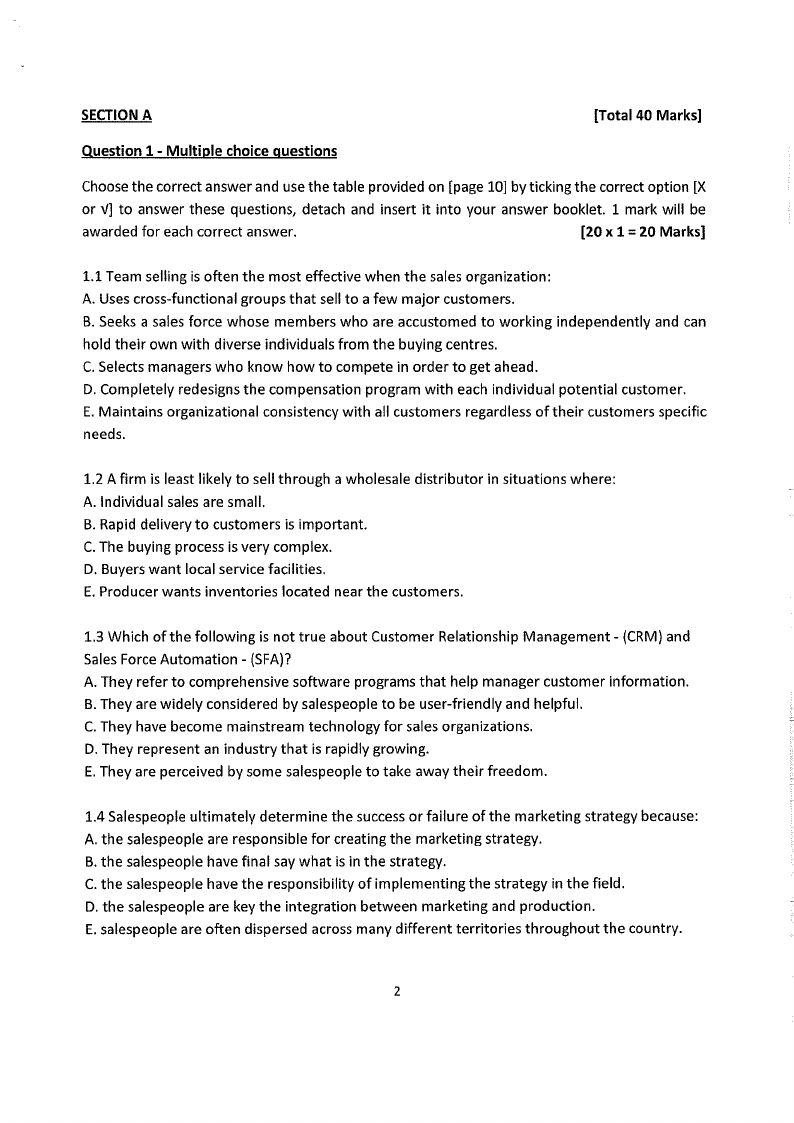
SECTION A
[Total 40 Marks]
Question 1 - Multiple choice questions
Choose the correct answer and use the table provided on [page 10] by ticking the correct option [X
or v] to answer these questions, detach and insert it into your answer booklet. 1 mark will be
awarded for each correct answer.
[20 x 1 = 20 Marks]
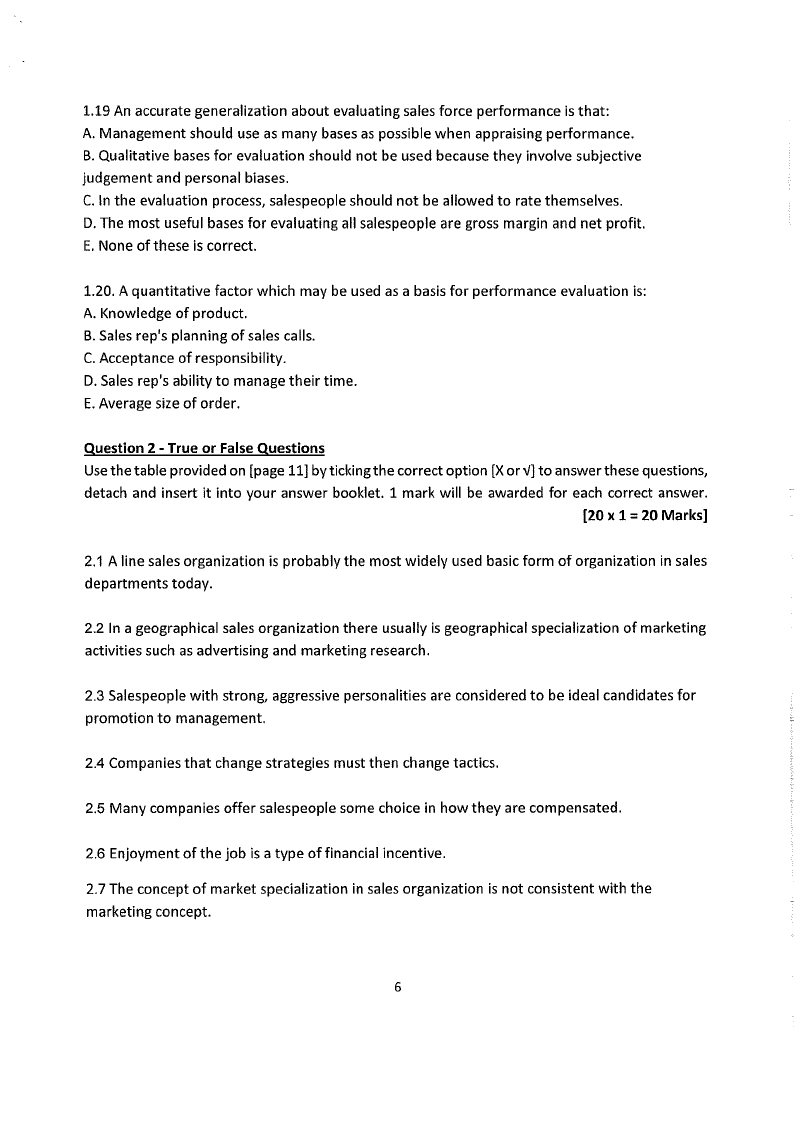
1.1 Team selling is often the most effective when the sales organization:
A. Uses cross-functional groups that sell to a few major customers.
B. Seeks a sales force whose members who are accustomed to working independently and can
hold their own with diverse individuals from the buying centres.
C. Selects managers who know how to compete in order to get ahead.
D. Completely redesigns the compensation program with each individual potential customer.
E. Maintains organizational consistency with all customers regardless of their customers specific
needs.
1.2 A firm is least likely to sell through a wholesale distributor in situations where:
A. Individual sales are small.
B. Rapid delivery to customers is important.
C. The buying process is very complex.
D. Buyers want local service facilities.
E. Producer wants inventories located near the customers.
1.3 Which of the following is not true about Customer Relationship Management - (CRM) and
Sales Force Automation - (SFA)?
A. They refer to comprehensive software programs that help manager customer information.
B. They are widely considered by salespeople to be user-friendly and helpful.
C. They have become mainstream technology for sales organizations.
D. They represent an industry that is rapidly growing.
E. They are perceived by some salespeople to take away their freedom.
1.4 Salespeople ultimately determine the success or failure of the marketing strategy because:
A. the salespeople are responsible for creating the marketing strategy.
B. the salespeople have final say what is in the strategy.
C. the salespeople have the responsibility of implementing the strategy in the field.
D. the salespeople are key the integration between marketing and production.
E. salespeople are often dispersed across many different territories throughout the country.
2

1.3 Page 3

▲back to top


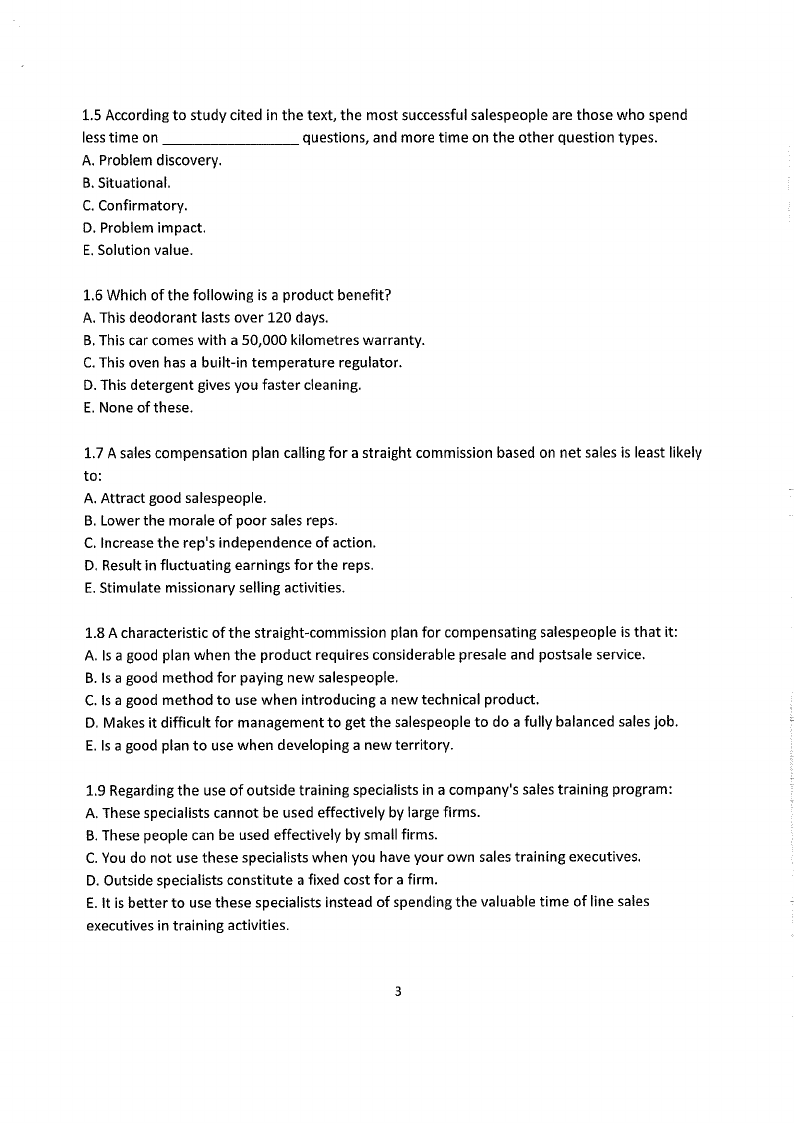
1.5 According to study cited in the text, the most successful salespeople are those who spend
less time on ________ questions, and more time on the other question types.
A. Problem discovery.
B. Situational.
C. Confirmatory.
D. Problem impact.
E. Solution value.
1.6 Which of the following is a product benefit?
A. This deodorant lasts over 120 days.
B. This car comes with a 50,000 kilometres warranty.
C. This oven has a built-in temperature regulator.
D. This detergent gives you faster cleaning.
E. None of these.
1.7 A sales compensation plan calling for a straight commission based on net sales is least likely
to:
A. Attract good salespeople.
B. Lower the morale of poor sales reps.
C. Increase the rep's independence of action.
D. Result in fluctuating earnings for the reps.
E. Stimulate missionary selling activities.
1.8 A characteristic of the straight-commission plan for compensating salespeople is that it:
A. Is a good plan when the product requires considerable presale and postsale service.
B. Is a good method for paying new salespeople.
C. Is a good method to use when introducing a new technical product.
D. Makes it difficult for management to get the salespeople to do a fully balanced sales job.
E. Is a good plan to use when developing a new territory.
1.9 Regarding the use of outside training specialists in a company's sales training program:
A. These specialists cannot be used effectively by large firms.
B. These people can be used effectively by small firms.
C. You do not use these specialists when you have your own sales training executives.
D. Outside specialists constitute a fixed cost for a firm.
E. It is better to use these specialists instead of spending the valuable time of line sales
executives in training activities.
3

1.4 Page 4

▲back to top


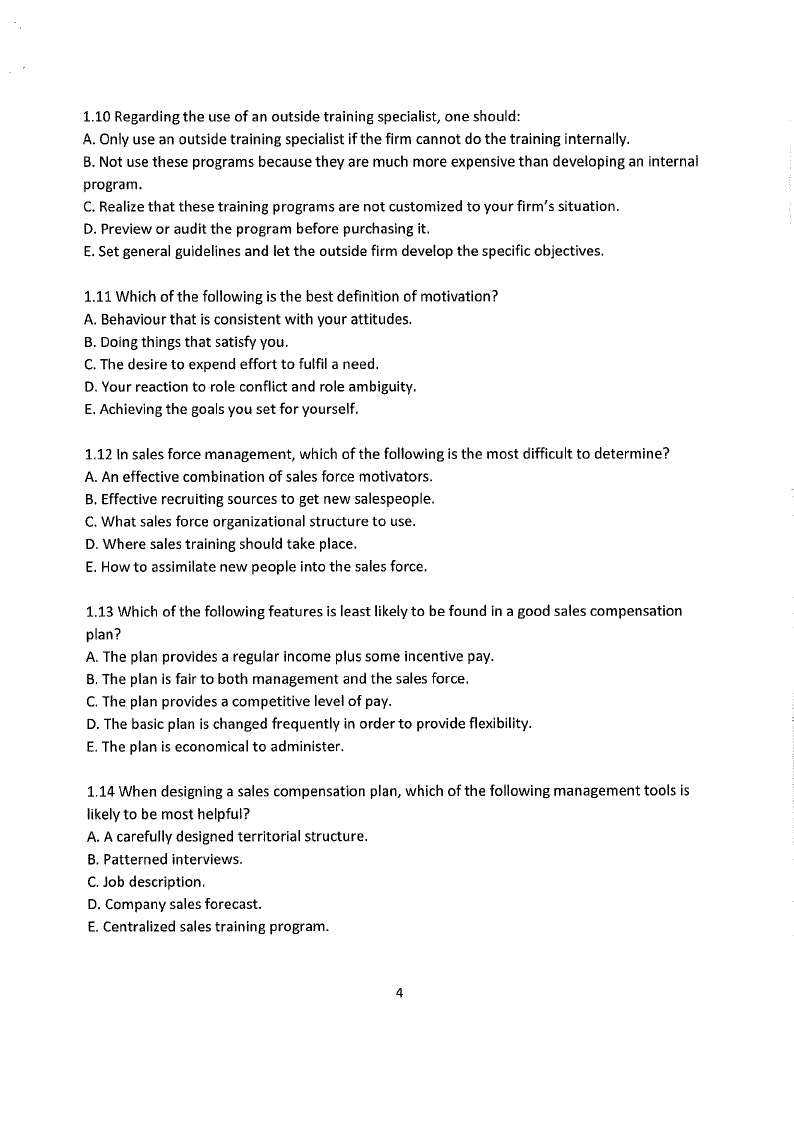
1.10 Regarding the use of an outside training specialist, one should:
A. Only use an outside training specialist if the firm cannot do the training internally.
B. Not use these programs because they are much more expensive than developing an internal
program.
C. Realize that these training programs are not customized to your firm's situation.
D. Preview or audit the program before purchasing it.
E. Set general guidelines and let the outside firm develop the specific objectives.
1.11 Which ofthe following is the best definition of motivation?
A. Behaviour that is consistent with your attitudes.
B. Doing things that satisfy you.
C. The desire to expend effort to fulfil a need.
D. Your reaction to role conflict and role ambiguity.
E. Achieving the goals you set for yourself.
1.12 In sales force management, which ofthe following is the most difficult to determine?
A. An effective combination of sales force motivators.
B. Effective recruiting sources to get new salespeople.
C. What sales force organizational structure to use.
D. Where sales training should take place.
E. How to assimilate new people into the sales force.
1.13 Which of the following features is least likely to be found in a good sales compensation
plan?
A. The plan provides a regular income plus some incentive pay.
B. The plan is fair to both management and the sales force.
C. The plan provides a competitive level of pay.
D. The basic plan is changed frequently in order to provide flexibility.
E. The plan is economical to administer.
1.14 When designing a sales compensation plan, which of the following management tools is
likely to be most helpful?
A. A carefully designed territorial structure.
B. Patterned interviews.
C. Job description.
D. Company sales forecast.
E. Centralized sales training program.
4

1.5 Page 5

▲back to top


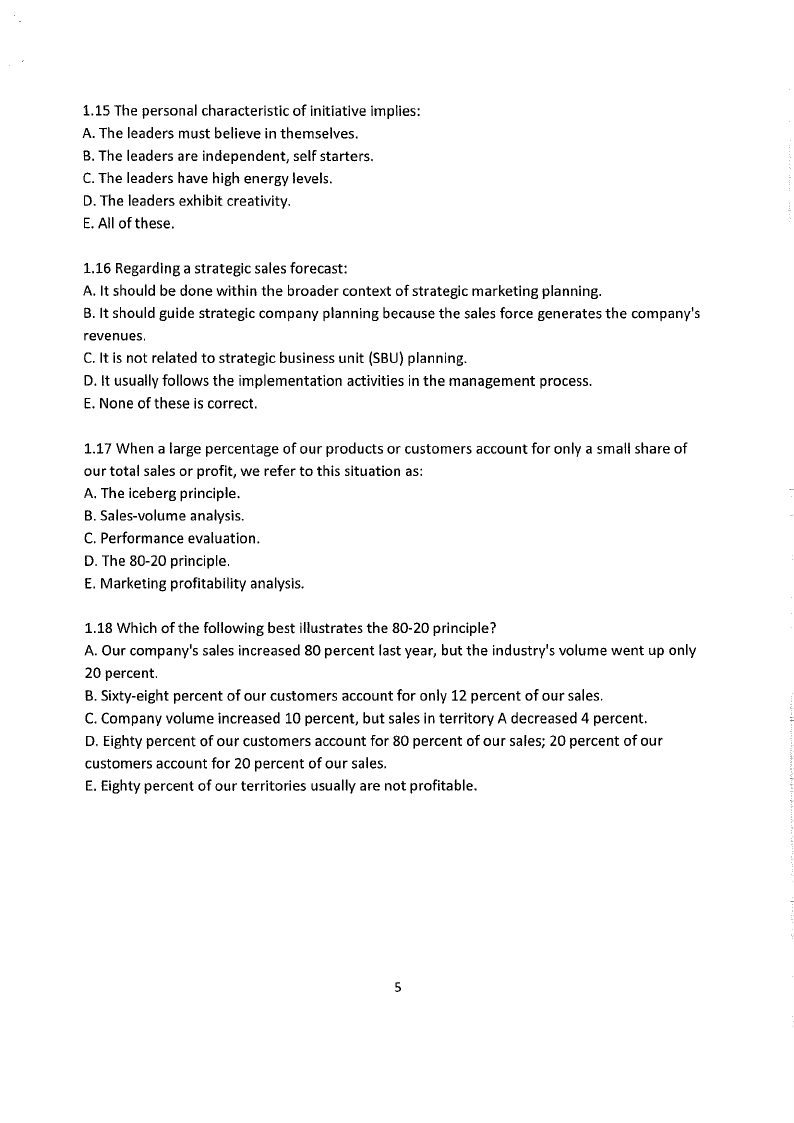
1.15 The personal characteristic of initiative implies:
A. The leaders must believe in themselves.
B. The leaders are independent, self starters.
C. The leaders have high energy levels.
D. The leaders exhibit creativity.
E. All of these.
1.16 Regarding a strategic sales forecast:
A. It should be done within the broader context of strategic marketing planning.
B. It should guide strategic company planning because the sales force generates the company's
revenues.
C. It is not related to strategic business unit (SBU) planning.
D. It usually follows the implementation activities in the management process.
E. None of these is correct.
1.17 When a large percentage of our products or customers account for only a small share of
our total sales or profit, we refer to this situation as:
A. The iceberg principle.
B. Sales-volume analysis.
C. Performance evaluation.
D. The 80-20 principle.
E. Marketing profitability analysis.
1.18 Which of the following best illustrates the 80-20 principle?
A. Our company's sales increased 80 percent last year, but the industry's volume went up only
20 percent.
B. Sixty-eight percent of our customers account for only 12 percent of our sales.
C. Company volume increased 10 percent, but sales in territory A decreased 4 percent.
D. Eighty percent of our customers account for 80 percent of our sales; 20 percent of our
customers account for 20 percent of our sales.
E. Eighty percent of our territories usually are not profitable.
5

1.6 Page 6

▲back to top


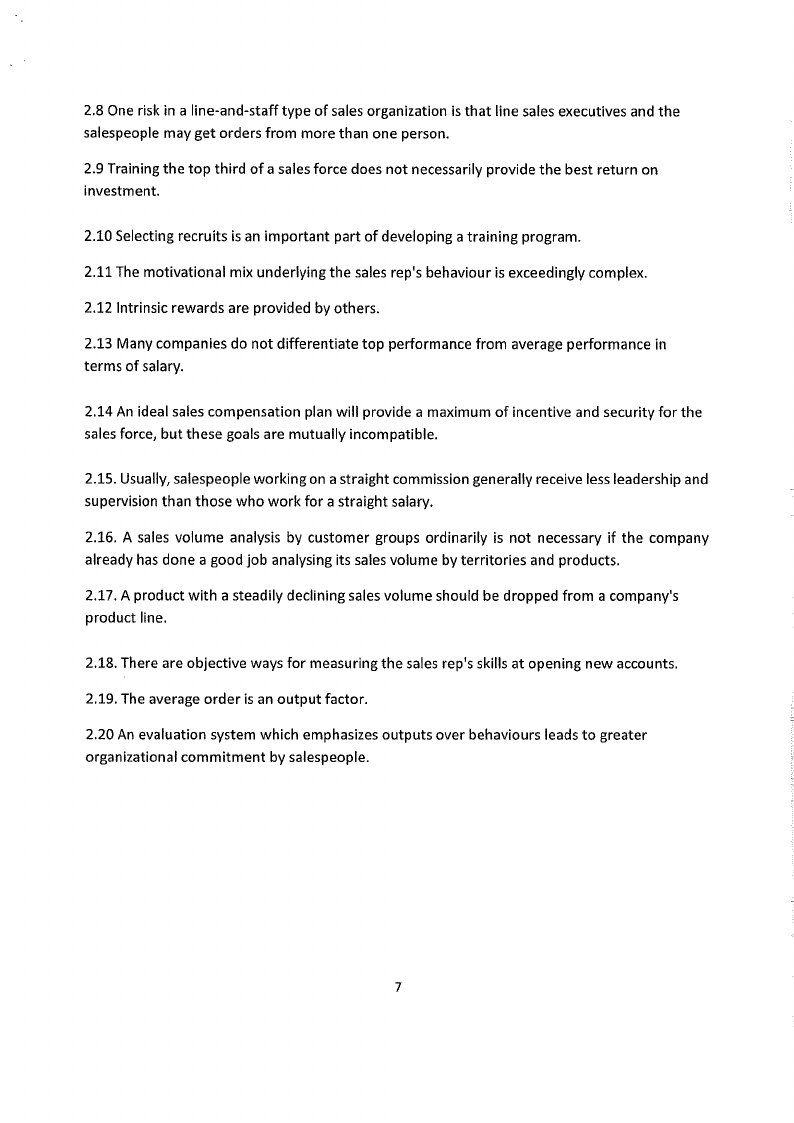
1.19 An accurate generalization about evaluating sales force performance is that:
A. Management should use as many bases as possible when appraising performance.
B. Qualitative bases for evaluation should not be used because they involve subjective
judgement and personal biases.
C. In the evaluation process, salespeople should not be allowed to rate themselves.
D. The most useful bases for evaluating all salespeople are gross margin and net profit.
E. None of these is correct.
1.20. A quantitative factor which may be used as a basis for performance evaluation is:
A. Knowledge of product.
B. Sales rep's planning of sales calls.
C. Acceptance of responsibility.
D. Sales rep's ability to manage their time.
E. Average size of order.
Question 2 - True or False Questions
Use the table provided on [page 11] by ticking the correct option [X or v] to answer these questions,
detach and insert it into your answer booklet. 1 mark will be awarded for each correct answer.
[20 x 1 = 20 Marks]
2.1 A line sales organization is probably the most widely used basic form of organization in sales
departments today.
2.2 In a geographical sales organization there usually is geographical specialization of marketing
activities such as advertising and marketing research.
2.3 Salespeople with strong, aggressive personalities are considered to be ideal candidates for
promotion to management.
2.4 Companies that change strategies must then change tactics.
2.5 Many companies offer salespeople some choice in how they are compensated.
2.6 Enjoyment of the job is a type of financial incentive.
2. 7 The concept of market specialization in sales organization is not consistent with the
marketing concept.
6

1.7 Page 7

▲back to top


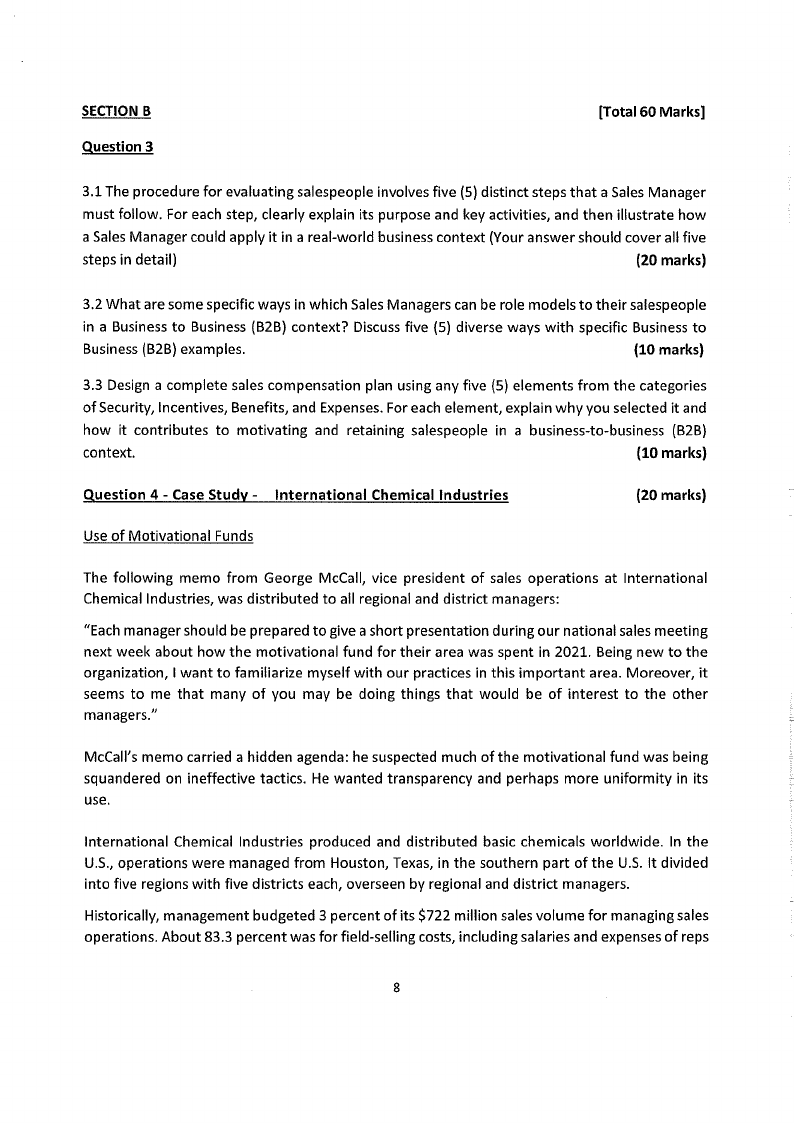
2.8 One risk in a line-and-staff type of sales organization is that line sales executives and the
salespeople may get orders from more than one person.
2.9 Training the top third of a sales force does not necessarily provide the best return on
investment.
2.10 Selecting recruits is an important part of developing a training program.
2.11 The motivational mix underlying the sales rep's behaviour is exceedingly complex.
2.12 Intrinsic rewards are provided by others.
2.13 Many companies do not differentiate top performance from average performance in
terms of salary.
2.14 An ideal sales compensation plan will provide a maximum of incentive and security for the
sales force, but these goals are mutually incompatible.
2.15. Usually, salespeople working on a straight commission generally receive less leadership and
supervision than those who work for a straight salary.
2.16. A sales volume analysis by customer groups ordinarily is not necessary if the company
already has done a good job analysing its sales volume by territories and products.
2.17. A product with a steadily declining sales volume should be dropped from a company's
product line.
2.18. There are objective ways for measuring the sales rep's skills at opening new accounts.
2.19. The average order is an output factor.
2.20 An evaluation system which emphasizes outputs over behaviours leads to greater
organizational commitment by salespeople.
7

1.8 Page 8

▲back to top


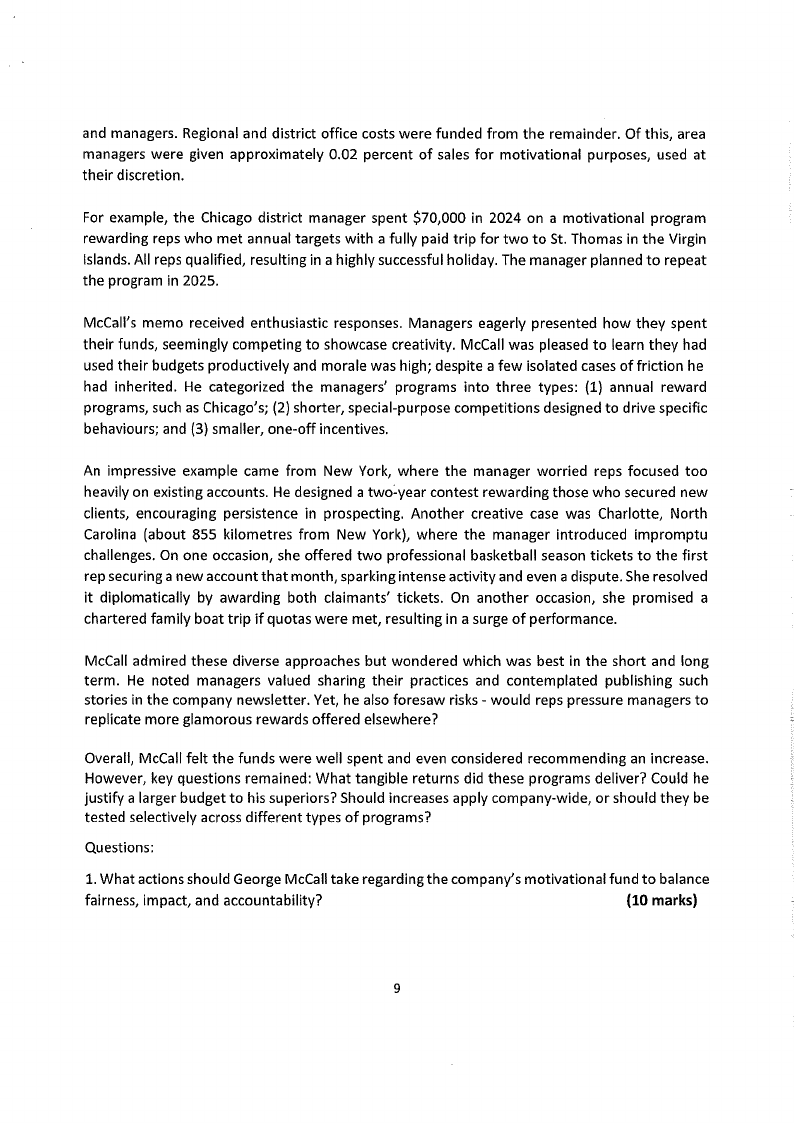
SECTION B
Question 3
[Total 60 Marks]
3.1 The procedure for evaluating salespeople involves five (5) distinct steps that a Sales Manager
must follow. For each step, clearly explain its purpose and key activities, and then illustrate how
a Sales Manager could apply it in a real-world business context (Your answer should cover all five
steps in detail)
(20 marks)
3.2 What are some specific ways in which Sales Managers can be role models to their salespeople
in a Business to Business (B2B) context? Discuss five (5) diverse ways with specific Business to
Business (B2B) examples.
(10 marks)
3.3 Design a complete sales compensation plan using any five (5) elements from the categories
of Security, Incentives, Benefits, and Expenses. For each element, explain why you selected it and
how it contributes to motivating and retaining salespeople in a business-to-business (B2B)
context.
(10 marks)
Question 4 - Case Study - International Chemical Industries
(20 marks)
Use of Motivational Funds
The following memo from George McCall, vice president of sales operations at International
Chemical Industries, was distributed to all regional and district managers:
"Each manager should be prepared to give a short presentation during our national sales meeting
next week about how the motivational fund for their area was spent in 2021. Being new to the
organization, I want to familiarize myself with our practices in this important area. Moreover, it
seems to me that many of you may be doing things that would be of interest to the other
managers."
McCall's memo carried a hidden agenda: he suspected much ofthe motivational fund was being
squandered on ineffective tactics. He wanted transparency and perhaps more uniformity in its
use.
International Chemical Industries produced and distributed basic chemicals worldwide. In the
U.S., operations were managed from Houston, Texas, in the southern part of the U.S. It divided
into five regions with five districts each, overseen by regional and district managers.
Historically, management budgeted 3 percent of its $722 million sales volume for managing sales
operations. About 83.3 percent was for field-selling costs, including salaries and expenses of reps
8

1.9 Page 9

▲back to top


and managers. Regional and district office costs were funded from the remainder. Of this, area
managers were given approximately 0.02 percent of sales for motivational purposes, used at
their discretion.
For example, the Chicago district manager spent $70,000 in 2024 on a motivational program
rewarding reps who met annual targets with a fully paid trip for two to St. Thomas in the Virgin
Islands. All reps qualified, resulting in a highly successful holiday. The manager planned to repeat
the program in 2025.
McCall's memo received enthusiastic responses. Managers eagerly presented how they spent
their funds, seemingly competing to showcase creativity. McCall was pleased to learn they had
used their budgets productively and morale was high; despite a few isolated cases of friction he
had inherited. He categorized the managers' programs into three types: (1) annual reward
programs, such as Chicago's; (2) shorter, special-purpose competitions designed to drive specific
behaviours; and (3) smaller, one-off incentives.
An impressive example came from New York, where the manager worried reps focused too
heavily on existing accounts. He designed a two'.year contest rewarding those who secured new
clients, encouraging persistence in prospecting. Another creative case was Charlotte, North
Carolina (about 855 kilometres from New York), where the manager introduced impromptu
challenges. On one occasion, she offered two professional basketball season tickets to the first
rep securing a new account that month, sparking intense activity and even a dispute. She resolved
it diplomatically by awarding both claimants' tickets. On another occasion, she promised a
chartered family boat trip if quotas were met, resulting in a surge of performance.
McCall admired these diverse approaches but wondered which was best in the short and long
term. He noted managers valued sharing their practices and contemplated publishing such
stories in the company newsletter. Yet, he also foresaw risks - would reps pressure managers to
replicate more glamorous rewards offered elsewhere?
Overall, McCall felt the funds were well spent and even considered recommending an increase.
However, key questions remained: What tangible returns did these programs deliver? Could he
justify a larger budget to his superiors? Should increases apply company-wide, or should they be
tested selectively across different types of programs?
Questions:
1. What actions should George McCall take regarding the company's motivational fund to balance
fairness, impact, and accountability?
(10 marks)
9

1.10 Page 10

▲back to top


2. What policies and guidelines should McCall establish to ensure consistent, ethical, and
effective use of motivational funds in the future?
(10 marks)
Grand Total 100 marks - THE END
SECTION A: ANSWER SHEET - Question 1
Tick [X ori/]
[Total 20 Marks]
Student Name, Surname and Student Number
10

2 Pages 11-20

▲back to top


2.1 Page 11

▲back to top


Question 2
Tick [X orv]
1~I:1rsezi,i:(,0
[Total 20 Marks]
Student Name, Surname and Student Number
11