BAC611C-BUSINESS ACCOUNTING 2A-1ST OPP-NOV 2025


BAC611C-BUSINESS ACCOUNTING 2A-1ST OPP-NOV 2025


1 Page 1

▲back to top


nAmlBIA
UnlVERSITY
OF SCIEnCE Ano
TECHn0L0GY
HP-65B
HAROLD PUPKEWITZ
Graduate School of Busine ss
FACULTY OF COMMERCE, HUMAN SCIENCES AND EDUCATION
HAROLD PUPKEWITZ GRADUATE SCHOOL OF BUSINESS
QUALIFICATION: DIPLOMA IN BUSINESS PROCESS MANAGEMENT
QUALIFICATION CODE: 06DBPM LEVEL: 6
COURSE CODE: BAC611C
COURSE NAME: BUSINESS ACCOUNTING 2A
SESSION: OCTOBER 2025
PAPER: THEORY AND CALCULATIONS {PAPER 1)
DURATION: 3 HOURS
MARKS: 100
EXAMINER
FIRST OPPORTUNITY EXAMINATION QUESTION PAPER
Lameck Odada
MODERATOR Gerhardt Sheehama
INSTRUCTIONS
1. This question paper comprises four (4) questions.
2. Answer ALL the questions in blue or black ink only. NO pencil
3. Start each question on a new page in your answer booklet and show all workings.
4. Round off only final answers to two (2) decimal places unless otherwise stated.
5. Work with whole numbers in all your calculations unless otherwise stated.
6. Questions relating to this examination may be raised in the initial 30 minutes after the
start of the paper. Thereafter, candidates must use their initiative to deal with any
perceived error or ambiguity. Any assumption made by the candidate should be clearly
stated .
PERMISSIBLE MATERIALS
Silent, non-programmable calculators
THIS QUESTION PAPER CONSISTS OF 9 PAGES (including this front page)

2 Page 2

▲back to top


QUESTION 1
[30 MARKS]
For questions 1.1 - 1.15, write the answer only (the correct letter chosen) in your answer
book and not on the question paper.
1.1 The purpose of the Conceptual Framework is:
a) To assist the International Accounting Standards Board in developing IFRS
Standards.
b) To assist preparers of IFRS financial statements in developing consistent
accounting policies when no IFRS Standard applies to a particular transaction or
other event, or when a Standard allows a choice of accounting policy.
c) To assist all parties in understanding and interpreting IFRS Standards.
d) All of the above
1.2 The objective of general-purpose financial reporting , as described in the Conceptual
Framework, is to:
a) Provide information to regulators.
b) Support the entity's tax return.
c) Meet the information needs of an entity's stakeholders.
d) Provide financial information about the reporting entity that is useful to existing and
potential investors, lenders, and other creditors in making decisions relating to
providing resources to the entity.
1.3 Which of the following does the Conceptual Framework identify as the primary users of
general-purpose financial reports?
a) Employees, investors, and trade union representatives.
b) Existing and potential investors, lenders, and other creditors.
c) Lenders and other creditors and customers.
d) Existing and potential investors, government agencies, and the general public
1.4 The fundamental qualitative characteristics of useful financial information are:
a) Comparability and relevance
b) Relevance and reliability
c) Relevance, reliability, and comparability
d) Relevance and faithful representation
1.5 For information to be relevant, it has to possess:
a) Only predictive value
b) Only confirmative value
c) Both predictive and confirmatory value
1

3 Page 3

▲back to top


d) Either predictive or confirmatory value, or both
1.6 Consolidated financial statements provide information about the assets, liabilities, equity,
income, and expenses of both the parent and its subsidiaries as:
a) Separate reporting entities
b) A partnership
c) A single reporting entity
d) A legal entity
1.7 The Conceptual Framework defines a liability as:
a) A present obligation of the entity to transfer an economic resource as a result of
past events.
b) A present obligation of the entity arising from past events, the settlement of which
is expected to result in an outflow from the entity of resources embodying
economic benefits.
c) An amount the entity may have to pay after the end of the reporting period
d) None of the above
1.8 In explaining the meaning of the term 'obligation' in the definition of a liability,
the Conceptual Framework states:
a) That an obligation is a duty or responsibility that an entity has no practical ability
to avoid
b) That an obligation can arise from a duty or responsibility conditional on a future
action that the entity itself may take if the entity has no practical ability to avoid
taking that action.
c) That an obligation can arise from an entity's customary practices, published
policies or specific statements, if the entity has no practical ability to avoid those
practices, policies or statements.
d) All of the above
1.9 Recognition is the process of:
a) Capturing, for inclusion in the statement offinancial position or the statement(s) of
financial performance, an item that meets the definition of one of the elements of
the financial statements-an asset, a liability, equity, income, or expenses.
b) Determining where an item should be presented in the financial statements.
c) Sorting assets, liabilities, equity, income, or expenses based on shared
characteristics
2

4 Page 4

▲back to top


1.10
1.11
1.12
1.13
d) Adding together of assets, liabilities, equity, income, or expenses that have shared
characteristics .
What does the Conceptual Framework state about derecognition?
a) For an asset, derecognition normally occurs when the entity loses control of all or
part of the recognised asset.
b) For a liability, derecognition normally occurs when the entity no longer has a
present obligation for all or part of the recognised liability.
c) Derecognition removes all or part of a recognised asset or liability from an entity's
statement of financial position.
d) All of the above
The Conceptual Framework describes prudence as:
a) The exercise of caution when making judgments under conditions of uncertainty
b) A bias towards understating assets or income and towards overstating liabilities or
expenses
c) A preference towards the earlier recognition of expenses and liabilities than of
income and assets
d) A mechanism for smoothing profits over time (understate profits in good years and
overstate profits in bad years)
e) A form of accounting conservatism
Which statement is included in the Conceptual Framework?
a) Relevance is a fundamental qualitative characteristic of useful financial
information.
b) Financial information without both relevance and faithful representation is not
useful.
c) Enhancing qualitative characteristics cannot make information useful if that
information is irrelevant or does not provide a faithful representation of what it
purports to represent.
d) All of the above
e) None of the above
The Conceptual Framework defines an asset as:
a) A resource controlled by the entity due to past events and from which future
economic benefits are expected to flow to the entity.
b) A present economic resource controlled by the entity due to past events.
c) A right to receive income or reduce expenses in the future.
3

5 Page 5

▲back to top


d) None of the above
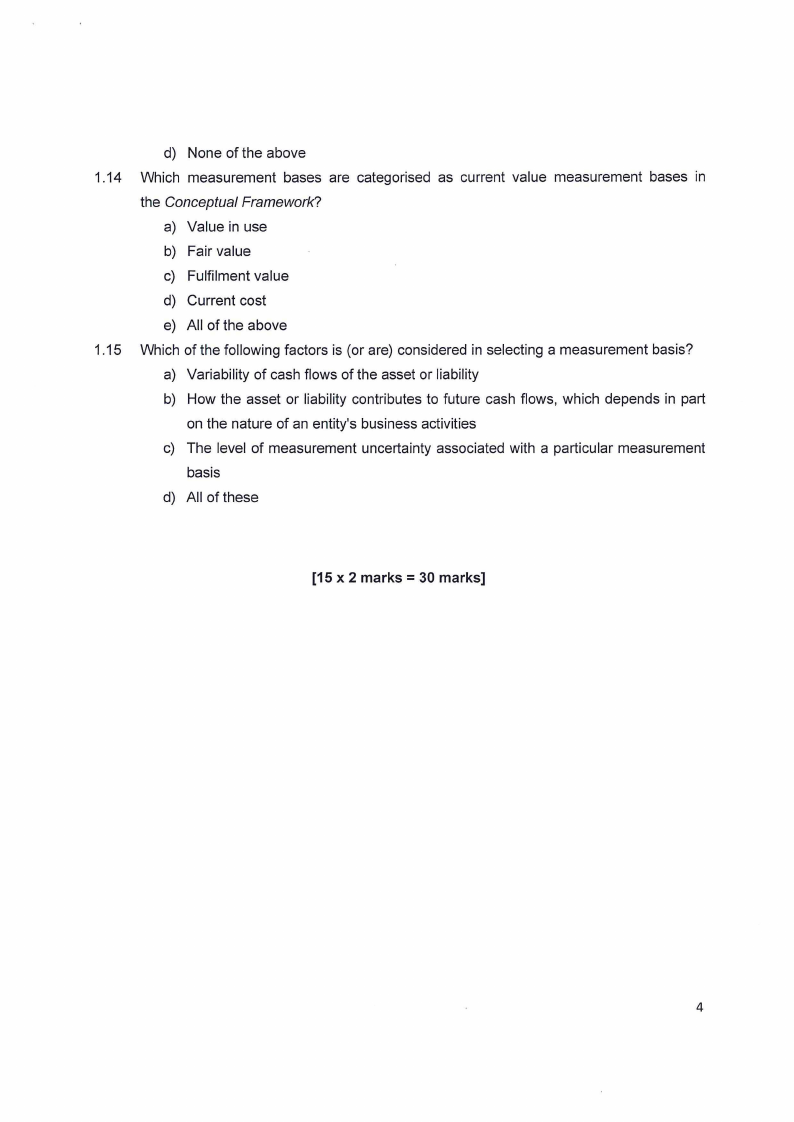
1.14 Which measurement bases are categorised as current value measurement bases in
the Conceptual Framework?
a) Value in use
b) Fair value
c) Fulfilment value
d) Current cost
e) All of the above
1.15 Which of the following factors is (or are) considered in selecting a measurement basis?
a) Variability of cash flows of the asset or liability
b) How the asset or liability contributes to future cash flows, which depends in part
on the nature of an entity's business activities
c) The level of measurement uncertainty associated with a particular measurement
basis
d) All of these
[15 x 2 marks = 30 marks]
4

6 Page 6

▲back to top


QUESTION 2
[25 MARKS]
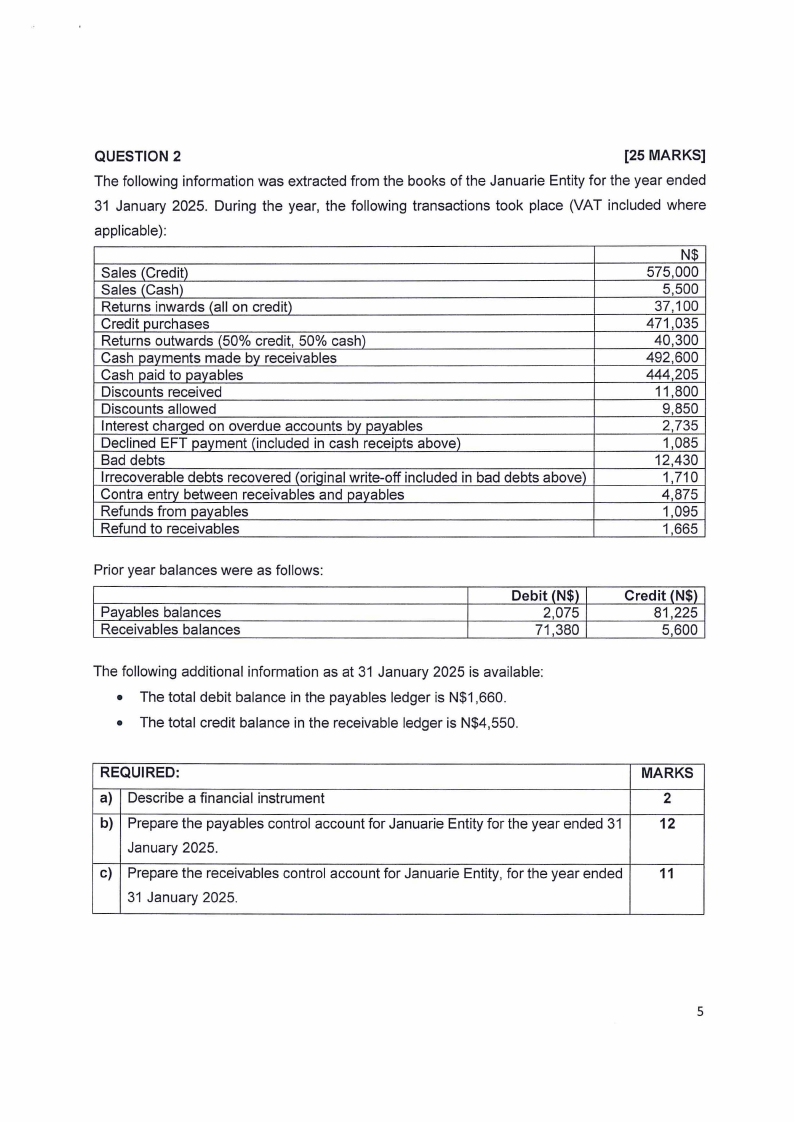
The following information was extracted from the books of the Januarie Entity for the year ended
31 January 2025. During the year, the following transactions took place (VAT included where
applicable):
Sales (Credit)
Sales (Cash)
Returns inwards (all on credit)
Credit purchases
Returns outwards (50% credit, 50% cash)
Cash payments made by receivables
Cash paid to payables
Discounts received
Discounts allowed
Interest charged on overdue accounts by payables
Declined EFT payment (included in cash receipts above)
Bad debts
Irrecoverable debts recovered (original write-off included in bad debts above)
Contra entrv between receivables and payables
Refunds from payables
Refund to receivables
N$
575 ,000
5,500
37 ,100
471,035
40,300
492,600
444,205
11,800
9,850
2,735
1,085
12,430
1,710
4,875
1,095
1,665
Prior year balances were as follows:
Payables balances
Receivables balances
Debit (N$)
2,075
71,380
Credit (N$)
81,225
5,600
The following additional information as at 31 January 2025 is available:
• The total debit balance in the payables ledger is N$1,660.
• The total credit balance in the receivable ledger is N$4,550.
REQUIRED:
a) Describe a financial instrument
b) Prepare the payables control account for Januarie Entity for the year ended 31
January 2025.
c) Prepare the receivables control account for Januarie Entity, for the year ended
31 January 2025.
MARKS
2
12
11
5

7 Page 7

▲back to top


QUESTION 3
[20 MARKS]
Financial analysis examines a company's performance in the context of its industry and economic
environment to arrive at a decision or recommendation. Overall , a central focus of financial
analysis is evaluating the company's ability to earn a return on its capital that is at least equal to
the cost of that capital, to profitably grow its operations, and to generate enough cash to meet
obligations and pursue opportunities.
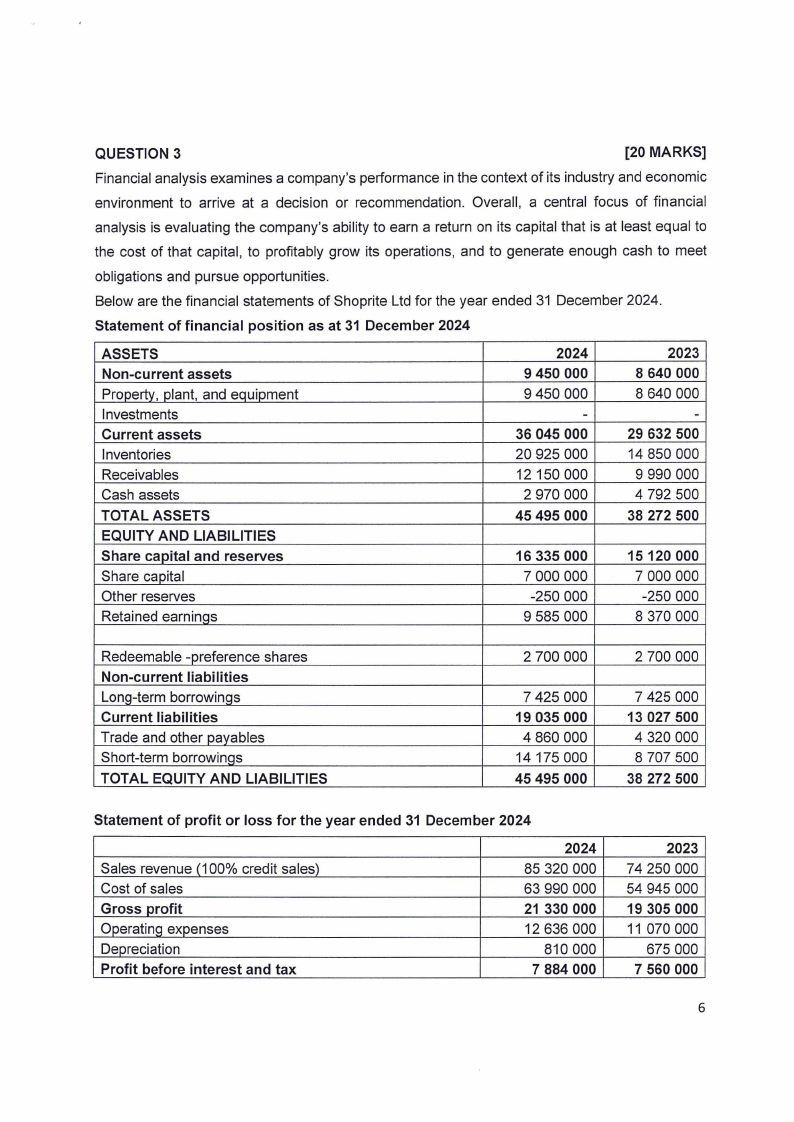
Below are the financial statements of Shoprite Ltd for the year ended 31 December 2024.
Statement of financial position as at 31 December 2024
ASSETS
Non-current assets
Property, plant, and eauipment
Investments
Current assets
Inventories
Receivables
Cash assets
TOTAL ASSETS
EQUITY AND LIABILITIES
Share capital and reserves
Share capital
Other reserves
Retained earninqs
2024
9 450 000
9 450 000
-
36 045 000
20 925 000
12 150 000
2 970 000
45 495 000
16 335 000
7 000 000
-250 000
9 585 000
2023
8 640 000
8 640 000
-
29 632 500
14 850 000
9 990 000
4 792 500
38 272 500
15 120 000
7 000 000
-250 000
8 370 000
Redeemable -preference shares
Non-current liabilities
Long-term borrowinqs
Current liabilities
Trade and other payables
Short-term borrowinqs
TOTAL EQUITY AND LIABILITIES
2 700 000
7 425 000
19 035 000
4 860 000
14 175 000
45 495 000
2 700 000
7 425 000
13 027 500
4 320 000
8 707 500
38 272 500
Statement of profit or loss for the year ended 31 December 2024
Sales revenue (100% credit sales)
Cost of sales
Gross profit
Operating expenses
Depreciation
Profit before interest and tax
2024
85 320 000
63 990 000
21 330 000
12 636 000
810 000
7 884 000
2023
74 250 000
54 945 000
19 305 000
11 070 000
675 000
7 560 000
6

8 Page 8

▲back to top


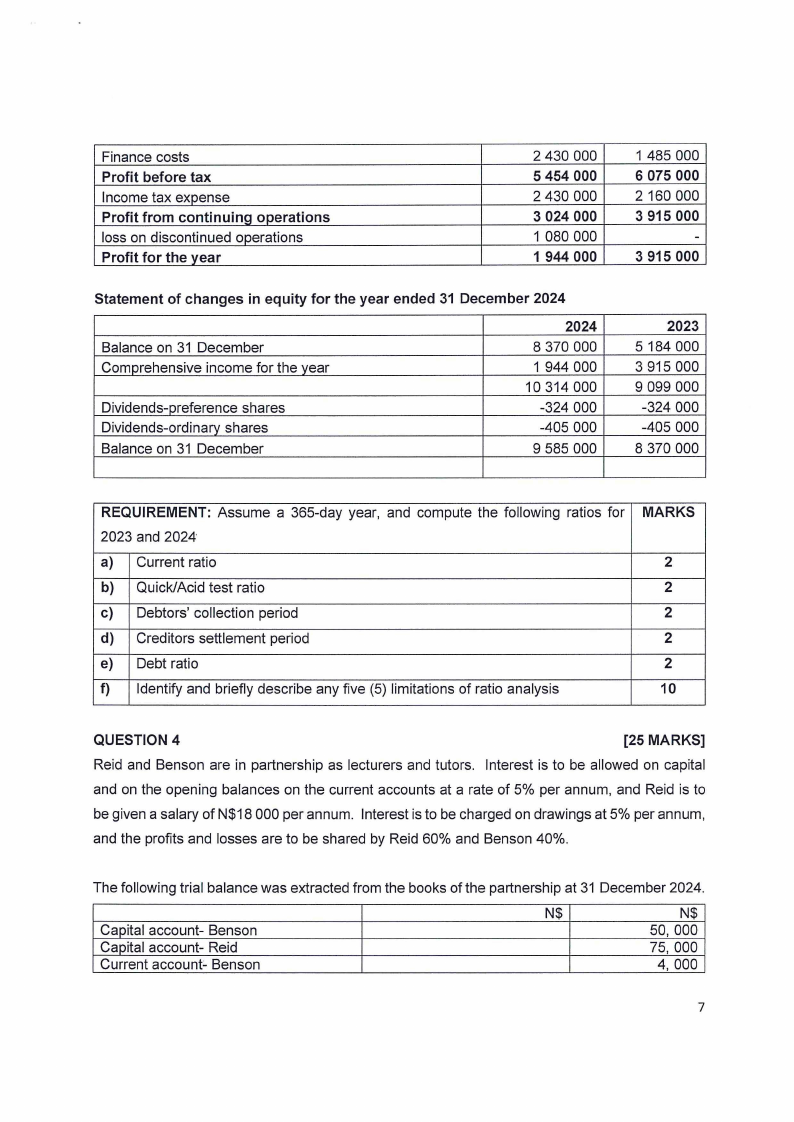
Finance costs
Profit before tax
Income tax expense
Profit from continuina operations
loss on discontinued operations
Profit for the year
2 430 000
5 454 000
2 430 000
3 024 000
1 080 000
1 944 000
Statement of changes in equity for the year ended 31 December 2024
Balance on 31 December
Comprehensive income for the year
Dividends-preference shares
Dividends-ordinary shares
Balance on 31 December
2024
8 370 000
1 944 000
10 314 000
-324 000
-405 000
9 585 000
1 485 000
6 075 000
2 160 000
3 915 000
-
3 915 000
2023
5 184 000
3915000
9 099 000
-324 000
-405 000
8 370 000
REQUIREMENT: Assume a 365-day year, and compute the following ratios for
2023 and 2024
a) Current ratio
b) Quick/Acid test ratio
c) Debtors' collection period
d) Creditors settlement period
e) Debt ratio
f) Identify and briefly describe any five (5) limitations of ratio analysis
MARKS
2
2
2
2
2
10
QUESTION 4
[25 MARKS]
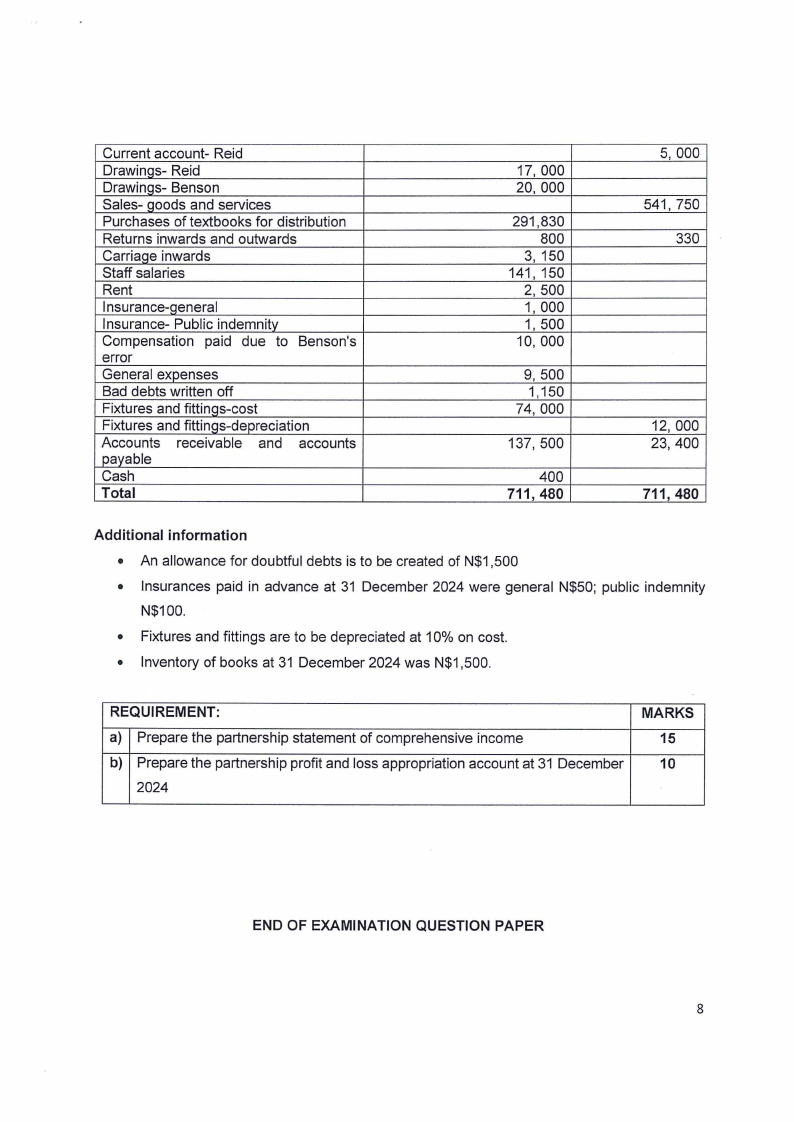
Reid and Benson are in partnership as lecturers and tutors. Interest is to be allowed on capital
and on the opening balances on the current accounts at a rate of 5% per annum, and Reid is to
be given a salary of N$18 000 per annum. Interest is to be charged on drawings at 5% per annum,
and the profits and losses are to be shared by Reid 60% and Benson 40%.
The following trial balance was extracted from the books of the partnership at 31 December 2024.
Capital account- Benson
Capital account- Reid
Current account~ Benson
N$
N$
50,000
75,000
4, 000
7

9 Page 9

▲back to top


Current account- Reid
Drawings- Reid
Drawings- Benson
Sales- qoods and services
Purchases of textbooks for distribution
Returns inwards and outwards
Carriaqe inwards
Staff salaries
Rent
I nsurance-qeneral
Insurance- Public indemnity
Compensation paid due to Benson's
error
General expenses
Bad debts written off
Fixtures and fittinqs-cost
Fixtures and fittings-depreciation
Accounts receivable and accounts
payable
Cash
Total
17,000
20,000
291,830
800
3,150
141, 150
2,500
1, 000
1, 500
10,000
9,500
1,150
74,000
137,500
400
711,480
5,000
541,750
330
12,000
23,400
711,480
Additional information
• An allowance for doubtful debts is to be created of N$1,500
• Insurances paid in advance at 31 December 2024 were general N$50; public indemnity
N$100.
• Fixtures and fittings are to be depreciated at 10% on cost.
• Inventory of books at 31 December 2024 was N$1,500.
REQUIREMENT:
a) Prepare the partnership statement of comprehensive income
b) Prepare the partnership profit and loss appropriation account at 31 December
2024
MARKS
15
10
END OF EXAMINATION QUESTION PAPER
8