


 |
ICS620S - INTRODUCTION TO CURRICULUM STUDIES - 2ND OPP - DECEMBER 2025 |
|
|
1 Page 1 |
▲back to top |
nAmlBIA UnlVERS I TY
OF SCIEnCE Ano TECH no.LOGY
FACULTY OF HUMAN SCIENCES
DEPARTMENT OF TECHNICAL AND VOCATIONAL EDUCATION AND TRAINING
QUALIFICATION: DIPLOMA IN TECHNICAL AND VOCATIONAL EDUCATION AND TRAINING:
TRAINER
QUALIFICATION CODE: 06DTVT
LEVEL: 6
COURSE CODE : ICS620S
SESSION: DECEMBER 2025
DURATION: 3 HOURS
COURSE NAME: INTRODUCTION TO CURRICULUM
STUDIES
PAPER 2
MARKS: 100
EXAMINER(S)
SECOND OPPORTUNITY EXAMINATION PAPER
Dr Oksana Kachepa
MODERATORS: Ms Claudia Maritshane
INSTRUCTIONS
1. This question paper consists of Sections A and 8.
2. Answer all the questions carefully.
3. Number the answers clearly.
THIS QUESTION PAPER CONSISTS OF 8 PAGES (INCLUDING THIS COVER PAGE)
|
|
2 Page 2 |
▲back to top |
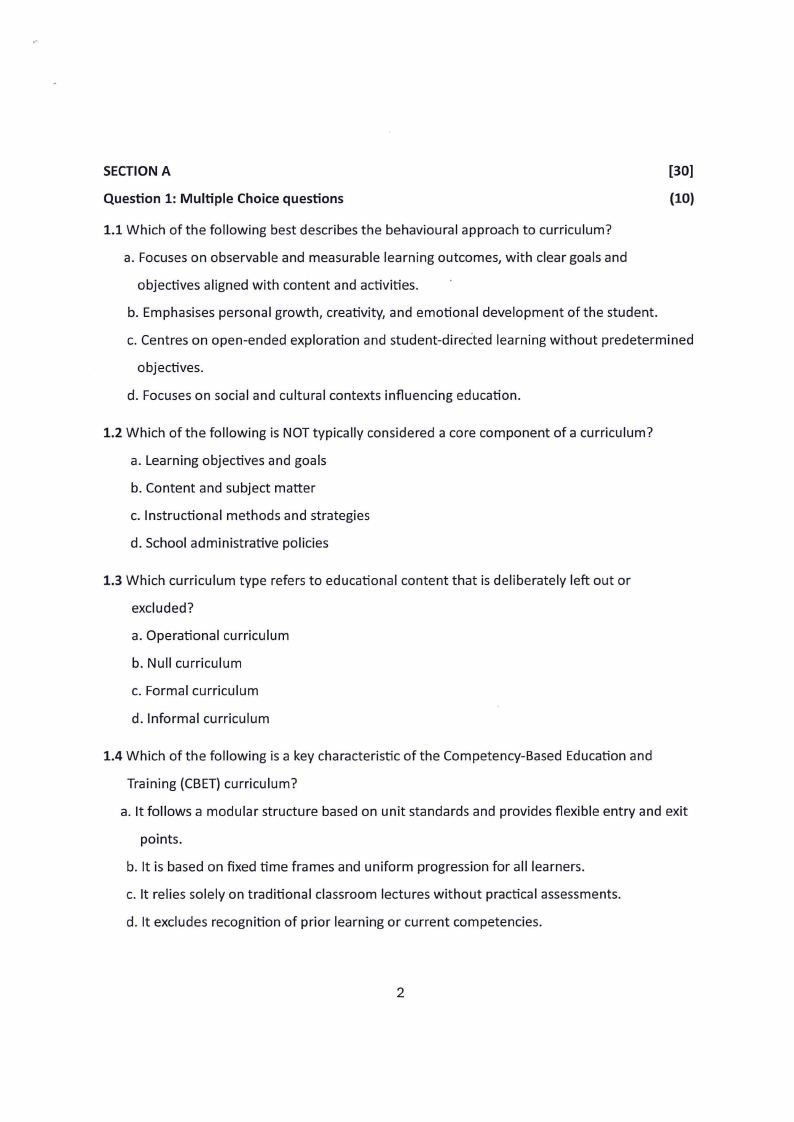
SECTION A
[30]
Question 1: Multiple Choice questions
(10)
1.1 Which of the following best describes the behavioural approach to curriculum?
a. Focuses on observable and measurable learning outcomes, with clear goals and
objectives aligned with content and activities.
b. Emphasises personal growth, creativity, and emotional development of the student.
c. Centres on open-ended exploration and student-directed learning without predetermined
objectives.
d. Focuses on social and cultural contexts influencing education.
1.2 Which of the following is NOT typically considered a core component of a curriculum?
a. Learning objectives and goals
b. Content and subject matter
c. Instructional methods and strategies
d. School administrative policies
1.3 Which curriculum type refers to educational content that is deliberately left out or
excluded?
a. Operational curriculum
b. Null curriculum
c. Formal curriculum
d. Informal curriculum
1.4 Which of the following is a key characteristic of the Competency-Based Education and
Training (CBET) curriculum?
a. It follows a modular structure based on unit standards and provides flexible entry and exit
points.
b. It is based on fixed time frames and uniform progression for all learners.
c. It relies solely on traditional classroom lectures without practical assessments.
d. It excludes recognition of prior learning or current competencies.
2
|
|
3 Page 3 |
▲back to top |
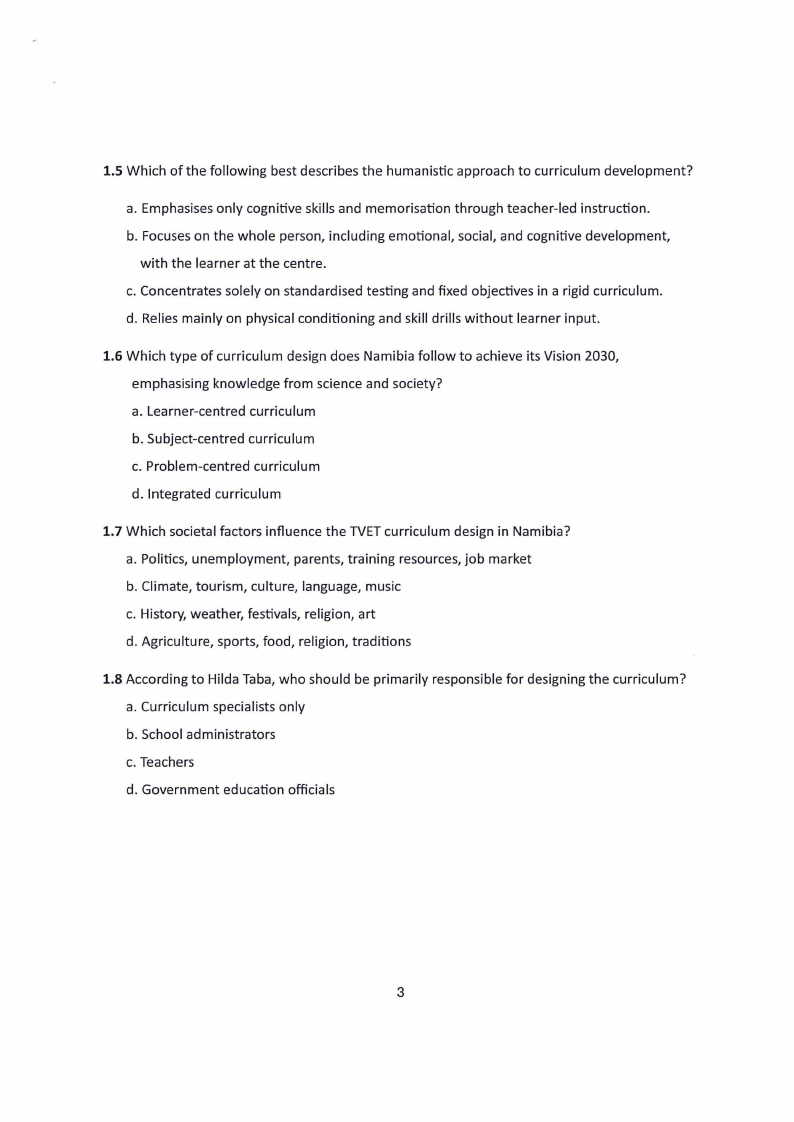
1.5 Which of the following best describes the humanistic approach to curriculum development?
a. Emphasises only cognitive skills and memorisation through teacher-led instruction.
b. Focuses on the whole person, including emotional, social, and cognitive development,
with the learner at the centre.
c. Concentrates solely on standardised testing and fixed objectives in a rigid curriculum.
d. Relies mainly on physical conditioning and skill drills without learner input.
1.6 Which type of curriculum design does Namibia follow to achieve its Vision 2030,
emphasising knowledge from science and society?
a. Learner-centred curriculum
b. Subject-centred curriculum
c. Problem-centred curriculum
d. Integrated curriculum
1.7 Which societal factors influence the TVET curriculum design in Namibia?
a. Politics, unemployment, parents, training resources, job market
b. Climate, tourism, culture, language, music
c. History, weather, festivals, religion, art
d. Agriculture, sports, food, religion, traditions
1.8 According to Hilda Taba, who should be primarily responsible for designing the curriculum?
a. Curriculum specialists only
b. School administrators
c. Teachers
d. Government education officials
3
|
|
4 Page 4 |
▲back to top |
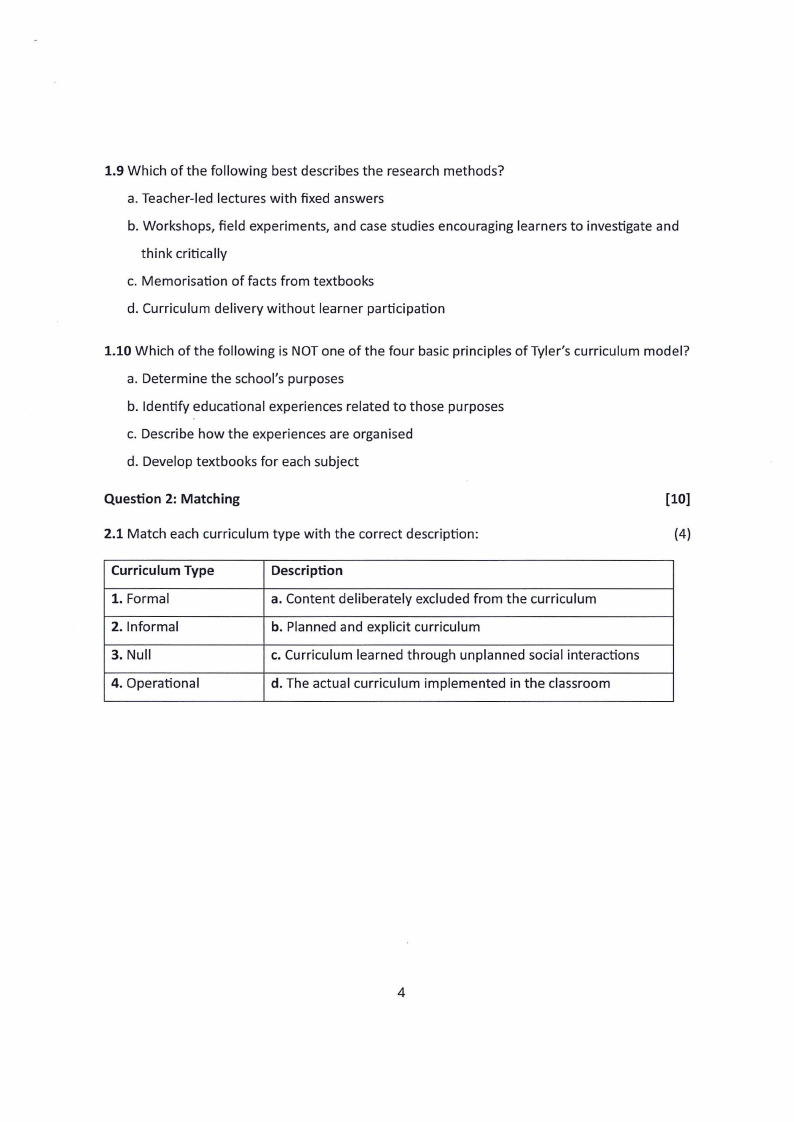
1.9 Which of the following best describes the research methods?
a. Teacher-led lectures with fixed answers
b. Workshops, field experiments, and case studies encouraging learners to investigate and
think critically
c. Memorisation of facts from textbooks
d. Curriculum delivery without learner participation
1.10 Which of the following is NOT one of the four basic principles of Tyler's curriculum model?
a. Determine the school's purposes
b. Identify educational experiences related to those purposes
c. Describe how the experiences are organised
d. Develop textbooks for each subject
Question 2: Matching
[10]
2.1 Match each curriculum type with the correct description:
(4)
Curriculum Type
1. Formal
2. Informal
3. Null
4. Operational
Description
a. Content deliberately excluded from the curriculum
b. Planned and explicit curriculum
c. Curriculum learned through unplanned social interactions
d. The actual curriculum implemented in the classroom
4
|
|
5 Page 5 |
▲back to top |
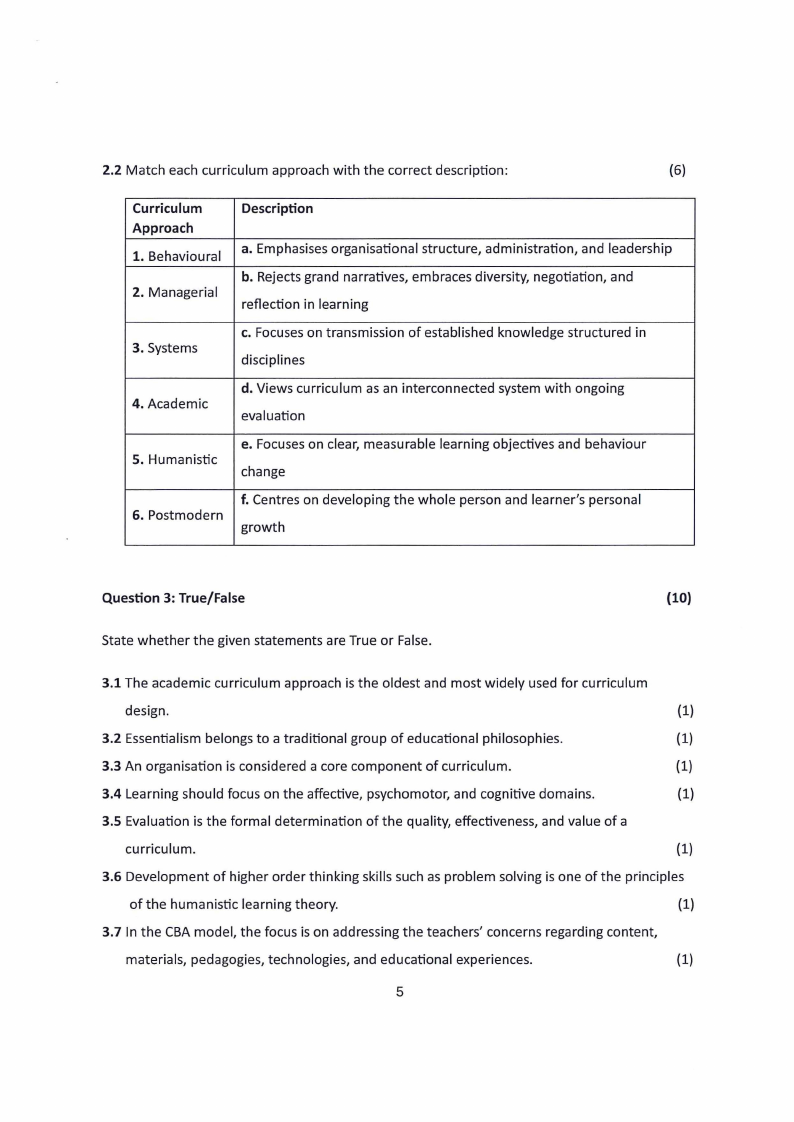
2.2 Match each curriculum approach with the correct description:
(6)
Curriculum
Approach
1. Behavioural
2. Managerial
Description
a. Emphasises organisational structure, administration, and leadership
b. Rejects grand narratives, embraces diversity, negotiation, and
reflection in learning
3. Systems
c. Focuses on transmission of established knowledge structured in
disciplines
4. Academic
d. Views curriculum as an interconnected system with ongoing
evaluation
5. Humanistic
e. Focuses on clear, measurable learning objectives and behaviour
change
f. Centres on developing the whole person and learner's personal
6. Postmodern
growth
Question 3: True/False
(10)
State whether the given statements are True or False.
3.1 The academic curriculum approach is the oldest and most widely used for curriculum
design.
(1)
3.2 Essentialism belongs to a traditional group of educational philosophies.
(1)
3.3 An organisation is considered a core component of curriculum.
(1)
3.4 Learning should focus on the affective, psychomotor, and cognitive domains.
(1)
3.5 Evaluation is the formal determination of the quality, effectiveness, and value of a
curriculum.
(1)
3.6 Development of higher order thinking skills such as problem solving is one of the principles
of the humanistic learning theory.
(1)
3.7 In the CBA model, the focus is on addressing the teachers' concerns regarding content,
materials, pedagogies, technologies, and educational experiences.
(1)
5
|
|
6 Page 6 |
▲back to top |
3.8 Application is a core component of the curriculum.
(1)
3.9 Curriculum is defined as an unplanned set of random educational experiences without a
specific structure or goals.
(1)
3.10 An experience-centred curriculum bases learning on the learner's interests, needs, and
real-life experiences rather than predefined content.
(1)
SECTION B
[70)
QUESTION 4
[12)
William Doll proposed the 4 R's as criteria to determine the success of a curriculum . Name and
explain these criteria.
QUESTION 5
[12)
Distinguish between the three (3) main curriculum designs based on the learning theories of
behaviourism, cognitivism, and humanism. In your answer, clearly describe the principles of
each learning theory as they relate to curriculum design.
QUESTION 6
[15)
6.1 Describe two (2) types of subject-centred curriculum designs: subject design and broad-
fields design. For each type, explain its characteristics and provide examples to illustrate
how content is organised and integrated.
(12)
6.2 Name three (3) key sources that influence Namibia's curriculum design in alignment with
Vision 2030.
(3)
6
|
|
7 Page 7 |
▲back to top |
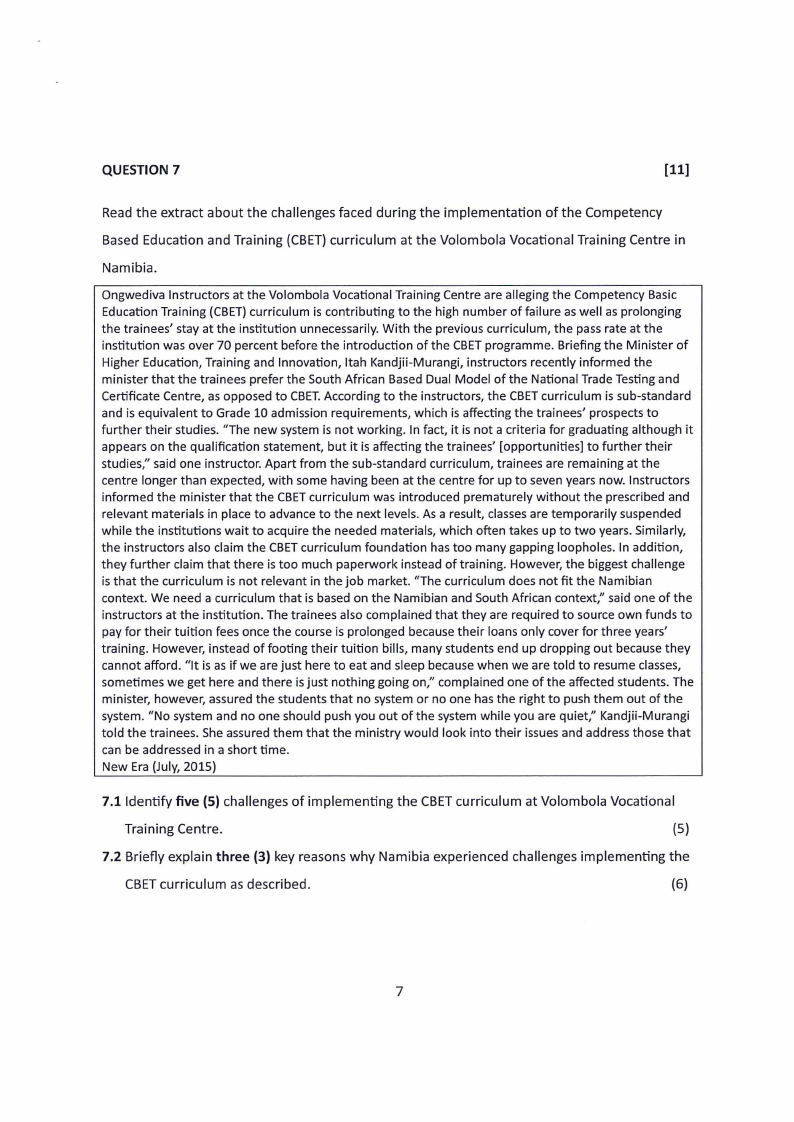
QUESTION 7
[11]
Read the extract about the challenges faced during the implementation of the Competency
Based Education and Training (CBET) curriculum at the Volombola Vocational Training Centre in
Namibia.
Ongwediva Instructors at the Volombola Vocational Training Centre are alleging the Competency Basic
Education Training (CBET) curriculum is contributing to the high number of failure as well as prolonging
the trainees' stay at the institution unnecessarily. With the previous curriculum, the pass rate at the
institution was over 70 percent before the introduction of the CBET programme. Briefing the Minister of
Higher Education, Training and Innovation, ltah Kandjii-Murangi, instructors recently informed the
minister that the trainees prefer the South African Based Dual Model of the National Trade Testing and
Certificate Centre, as opposed to CBET. According to the instructors, the CBET curriculum is sub-standard
and is equivalent to Grade 10 admission requirements, which is affecting the trainees' prospects to
further their studies. "The new system is not working. In fact, it is not a criteria for graduating although it
appears on the qualification statement, but it is affecting the trainees' [opportunities] to further their
studies," said one instructor. Apart from the sub-standard curriculum, trainees are remaining at the
centre longer than expected, with some having been at the centre for up to seven years now. Instructors
informed the minister that the CBET curriculum was introduced prematurely without the prescribed and
relevant materials in place to advance to the next levels. As a result, classes are temporarily suspended
while the institutions wait to acquire the needed materials, which often takes up to two years. Similarly,
the instructors also claim the CBET curriculum foundation has too many gapping loopholes. In addition,
they further claim that there is too much paperwork instead of training. However, the biggest challenge
is that the curriculum is not relevant in the job market. "The curriculum does not fit the Namibian
context. We need a curriculum that is based on the Namibian and South African context," said one of the
instructors at the institution. The trainees also complained that they are required to source own funds to
pay for their tuition fees once the course is prolonged because their loans only cover for three years'
training. However, instead of footing their tuition bills, many students end up dropping out because they
cannot afford. "It is as if we are just here to eat and sleep because when we are told to resume classes,
sometimes we get here and there is just nothing going on," complained one of the affected students. The
minister, however, assured the students that no system or no one has the right to push them out of the
system. "No system and no one should push you out of the system while you are quiet," Kandjii-Murangi
told the trainees. She assured them that the ministry would look into their issues and address those that
can be addressed in a short time.
New Era (July, 2015)
7.1 Identify five (5) challenges of implementing the CBET curriculum at Volombola Vocational
Training Centre.
(5)
7.2 Briefly explain three (3) key reasons why Namibia experienced challenges implementing the
CBET curriculum as described.
(6)
7
|
|
8 Page 8 |
▲back to top |
QUESTION 8
(20]
Ornstein and Hunkins (2018) state that the success of the Overcoming-Resistance-to-Change
(ORC) model hinges on leaders' ability to overcome staff resistance during curriculum
implementation.
8.1 Describe four (4) strategies recommended by Ornstein and Hunkins (2018) that can help the
staff overcome resistance and feel committed to new curriculum implementation.
(8)
8.2 Outline and explain the four (4) stages of concerns that individuals may experience in the
ORC model when facing curriculum change .
(12)
[END OF PAPER]
8