


 |
ICS620S - INTRODUCTION TO CURRICULUM STUDIES - 1ST OPP - NOVEMBER 2025 |
|
|
1 Page 1 |
▲back to top |
nAmlBIA UnlVERSITY
OF SCI En CE Ano TECH n OLOGY
FACULTY OF HUMAN SCIENCES
DEPARTMENT OF TECHNICAL AND VOCATIONAL EDUCATION AND TRAINING
QUALIFICATION: DIPLOMA IN TECHNICAL AND VOCATIONAL EDUCATION AND TRAINING:
TRAINER
QUALIFICATION CODE: 06DTVT
LEVEL: 6
COURSE CODE: ICS620S
SESSION: NOVEMBER 2025
DURATION: 3 HOURS
COURSE NAME: INTRODUCTION TO CURRICULUM
STUDIES
PAPER 1
MARKS: 100
EXAMINER(S)
FIRST OPPORTUNITY EXAMINATION QUESTION PAPER
Dr Oksana Kachepa
MODERATORS: Ms Claudia Maritshane
INSTRUCTIONS
1. This question paper consists of Sections A and B.
2. Answer all the questions carefully.
3. Number the answers clearly.
THIS QUESTION PAPER CONSISTS OF 7 PAGES (INCLUDING THIS COVER PAGE)
|
|
2 Page 2 |
▲back to top |
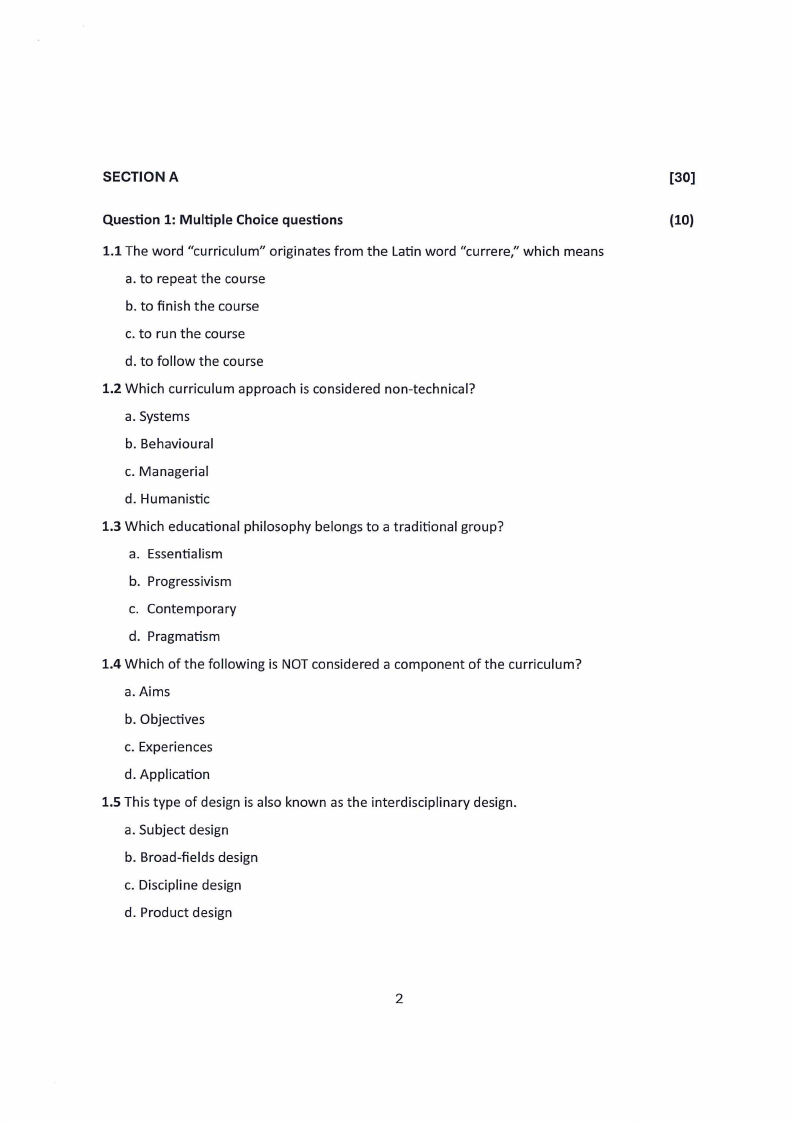
SECTION A
[30]
Question 1: Multiple Choice questions
(10)
1.1 The word "curriculum" originates from the Latin word "currere," which means
a. to repeat the course
b. to finish the course
c. to run the course
d. to follow the course
1.2 Which curriculum approach is considered non-technical?
a. Systems
b. Behavioural
c. Managerial
d. Humanistic
1.3 Which educational philosophy belongs to a traditional group?
a. Essentialism
b. Progressivism
c. Contemporary
d. Pragmatism
1.4 Which of the following is NOT considered a component of the curriculum?
a. Aims
b. Objectives
c. Experiences
d. Application
1.5 This type of design is also known as the interdisciplinary design.
a. Subject design
b. Broad-fields design
c. Discipline design
d. Product design
2
|
|
3 Page 3 |
▲back to top |
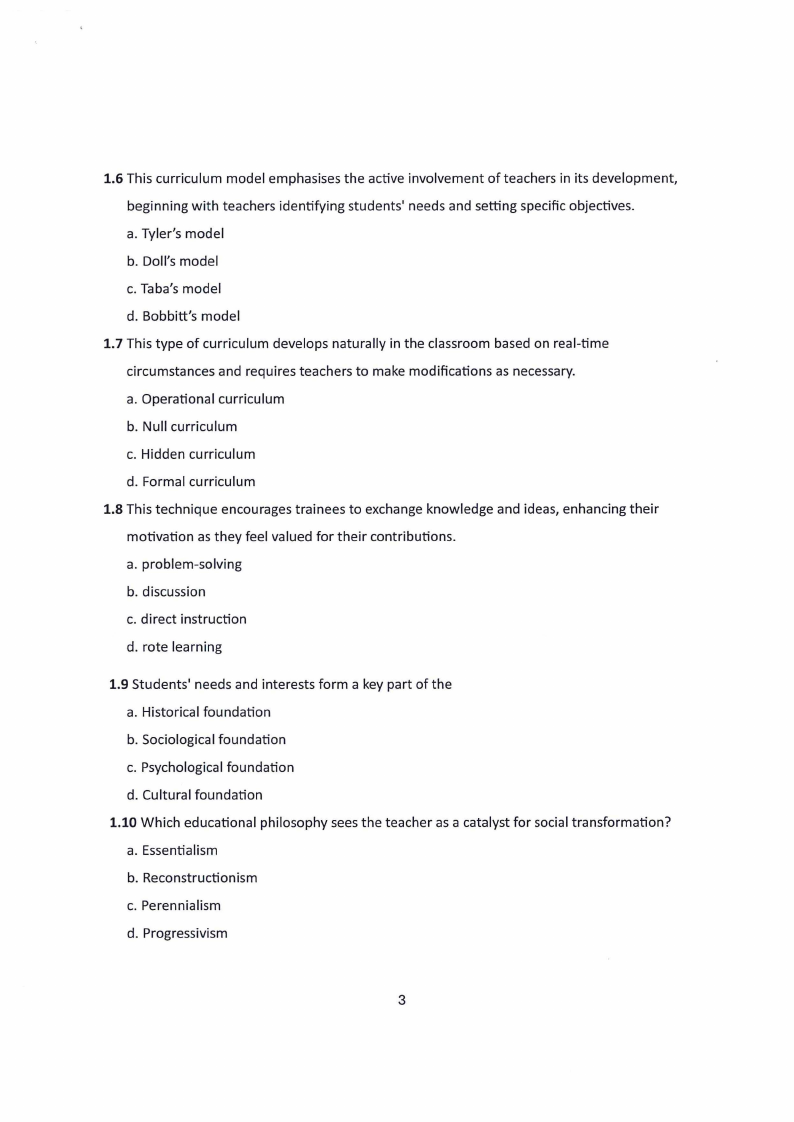
1.6 This curriculum model emphasises the active involvement of teachers in its development,
beginning with teachers identifying students' needs and setting specific objectives.
a. Tyler's model
b. Doll's model
c. Taba's model
d. Bobbitt's model
1.7 This type of curriculum develops naturally in the classroom based on real-time
circumstances and requires teachers to make modifications as necessary.
a. Operational curriculum
b. Null curriculum
c. Hidden curriculum
d. Formal curriculum
1.8 This technique encourages trainees to exchange knowledge and ideas, enhancing their
motivation as they feel valued for their contributions.
a. problem-solving
b. discussion
c. direct instruction
d. rote learning
1.9 Students' needs and interests form a key part of the
a. Historical foundation
b. Sociological foundation
c. Psychological foundation
d. Cultural foundation
1.10 Which educational philosophy sees the teacher as a catalyst for social transformation?
a. Essentialism
b. Reconstructionism
c. Perennialism
d. Progressivism
3
|
|
4 Page 4 |
▲back to top |
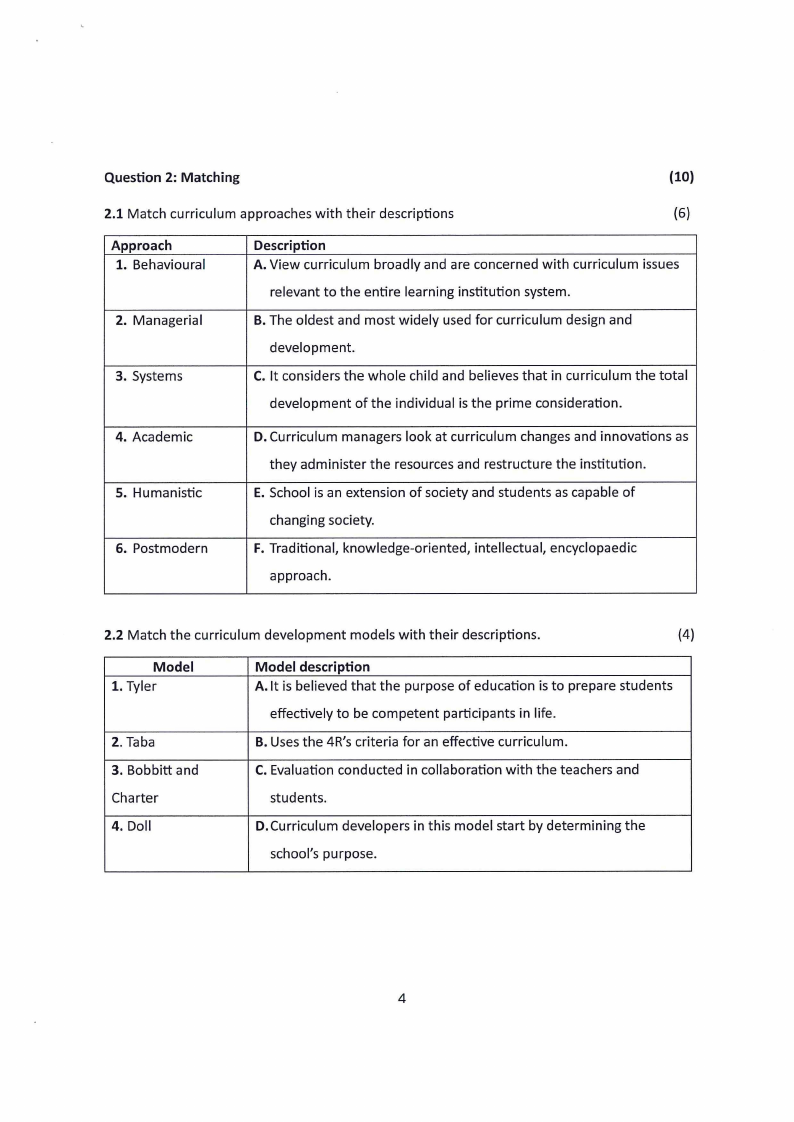
Question 2: Matching
(10)
2.1 Match curriculum approaches with their descriptions
(6)
Approach
1. Behavioural
2. Managerial
3. Systems
Description
A. View curriculum broadly and are concerned with curriculum issues
relevant to the entire learning institution system.
B. The oldest and most widely used for curriculum design and
development.
C. It considers the whole child and believes that in curriculum the total
development of the individual is the prime consideration.
4. Academic
5. Humanistic
6. Postmodern
D. Curriculum managers look at curriculum changes and innovations as
they administer the resources and restructure the institution.
E. School is an extension of society and students as capable of
changing society.
F. Traditional, knowledge-oriented, intellectual, encyclopaedic
approach.
2.2 Match the curriculum development models with their descriptions.
(4)
Model
1. Tyler
2. Taba
3. Bobbitt and
Charter
4. Doll
Model description
A. It is believed that the purpose of education is to prepare students
effectively to be competent participants in life.
B. Uses the 4R's criteria for an effective curriculum.
C. Evaluation conducted in collaboration with the teachers and
students.
D.Curriculum developers in this model start by determining the
school's purpose.
4
|
|
5 Page 5 |
▲back to top |
Question 3: True/False
(10)
State whether the given statements are True or False.
3.1 Curriculum is just a fixed set of textbooks and exercises with no consideration for teaching
methods or student needs.
3.2 A curriculum approach defines the roles of students, teachers, and curriculum specialists,
and sets the curriculum goals.
3.3 Behavioural, humanistic and managerial approaches fall under the technical/scientific
approaches.
3.4 ORC model rests in the assumption that the success or failure of planned change basically
depends on the leaders' ability to overcome staff resistance to change.
3.5 Namibia's curriculum falls under the non-technical/non-scientific category.
3.6 Curriculum cannot exist without an underlying educational philosophy.
3.7 Namibia's TVET curriculum is grounded in essentialist educational philosophy.
3.8 Teachers can easily create effective curriculum materials without professional training in
curriculum design.
3.9 Tyler's curriculum model emphasises setting clear educational objectives and assessing
learning outcomes.
3.10 The subject-centred curriculum model focuses primarily on student interests and individual
learning styles.
5
|
|
6 Page 6 |
▲back to top |
SECTION B
[70)
QUESTION 4
[15)
4.1 Explain how humanistic principles can be applied in a TVET classroom. Provide five (5) key
points.
(10)
4.2 Describe an example from your teaching experience that illustrates the use of humanistic
principles in your classroom .
(5)
QUESTION 5
[10)
Identify and explain at least five (5) societal factors that have influenced the design of the TVET
curriculum in Namibia. Provide detailed points for each factor.
QUESTION 6
[18)
The Bank of Namibia's 19th Annual Symposium report highlighted certain challenges that affect
the quality and relevance of the TVET system in Namibia. Read the report and respond to the
questions that follow the report.
The current TVET system is characterised by a number of issues, ranging from inadequate
capacity for new intake, to lack of adequate resources at centres. The TVET system is
characterized by several issues, such as lack of adequate capacity to increase intake,
relevance, and responsiveness of training programmes as well as an average
pass/competency rate which currently stands at 52 percent. There is a lack of adequate
resources at centres which hampers the quality of training outcomes and trainees thus
struggle to find jobs as their skills do not match the industry demand. TVET in Namibia does
not adequately respond to the demand for skills expressed by formal firms. Trainees face
challenges in finding job placement, while industries complain that TVET does not respond to
their demand for skills. The lack of adequate workshop facilities, tools, machinery, and
equipment (including learning resources) continues to compromise the quality of training
outcomes. Many TVET institutions report enormous difficulties in recruiting qualified and
competent instructors. The current trainer-trainee ratio which stands at 1 to 20 for technical. ..
6
|
|
7 Page 7 |
▲back to top |
6.1 Identify at least five (5) challenges stated in the report.
(10)
6.2 As a potential TVET trainer, come up with suggestions on how you would address any
four (4) challenges you identified in 6.1.
(8)
QUESTION 7
[14)
7.1 Who are the key players in the TVET curriculum implementation? List at least five (5) key
players.
(5)
7.2 The focus of the Concerns-based (CBA) model is on addressing the teachers' concerns
regarding content, materials, pedagogies, technologies, and educational experiences. Explain
t he following concerns : concern for self, concern for teachers and concern for students. (6)
7.3 How does the CBA model differ from the Overcoming Resistance to Change (ORC) and
Organisational Development (OD) models?
(3)
QUESTION 8
[13)
8.1 The principles and training approaches in CBET are based on the behaviourist learning
theory. How do behaviourists define curriculum?
(2)
8.2 Explain the importance of philosophical foundations in the development of curriculum
theory.
(2)
8.3 Which educational philosophies inform the TVET curriculum in Namibia?
(2)
8.4 Describe the key characteristics of one philosophy mentioned in question 8.2.
(3)
8.5 State four (4) basic principles of Tyler's curriculum model.
(4)
[END OF PAPER]
7