


 |
SAD621S - SYSTEMS ANALYSIS AND DESIGN - 2ND OPP - DEC 2025 |
|
|
1 Page 1 |
▲back to top |
nAmlBIA unlVERSITY
OF SCIEnCE Ano TECHnOLOGY
Faculty of Computing & Informatics
DEPARTMENT OF INFORMATICS
QUALIFICATION : BACHELOR OF COMPUTER SCIENCE
QUALIFICATION CODE: 07BAIF
COURSE CODE: SAD621S
LEVEL: 6
COURSE: SYSTEMS ANALYSISAND DESIGN
DATE: DECEMBER 2025
DURATION: 2 HOURS
PAPER: THEORY
MARKS: 100
SECOND OPPORTUNITY/ SUPPLEMENTARY EXAMINATION QUESTION PAPER
EXAMINERS
Dr Gabriel Nhinda
Mr. Freddy Embashu
Prof. Suama Hamunyela
MODERATOR: Prof. Samuel Akinsola
THIS QUESTION PAPER CONSISTS OF 4 PAGES
(INCLUDING THIS FRONT PAGE)
INSTRUCTIONS FOR THE CANDIDATE
1. Answer ALL questions.
2. When writing take the following into account: The style should inform than impress, it
should be formal, in third person, paragraphs set out according to ideas or issues and the
paragraphs flowing in a logical order.
3. Information should be brief and accurate.
4. Please ensure that your writing is legible, neat and presentable.
|
|
2 Page 2 |
▲back to top |
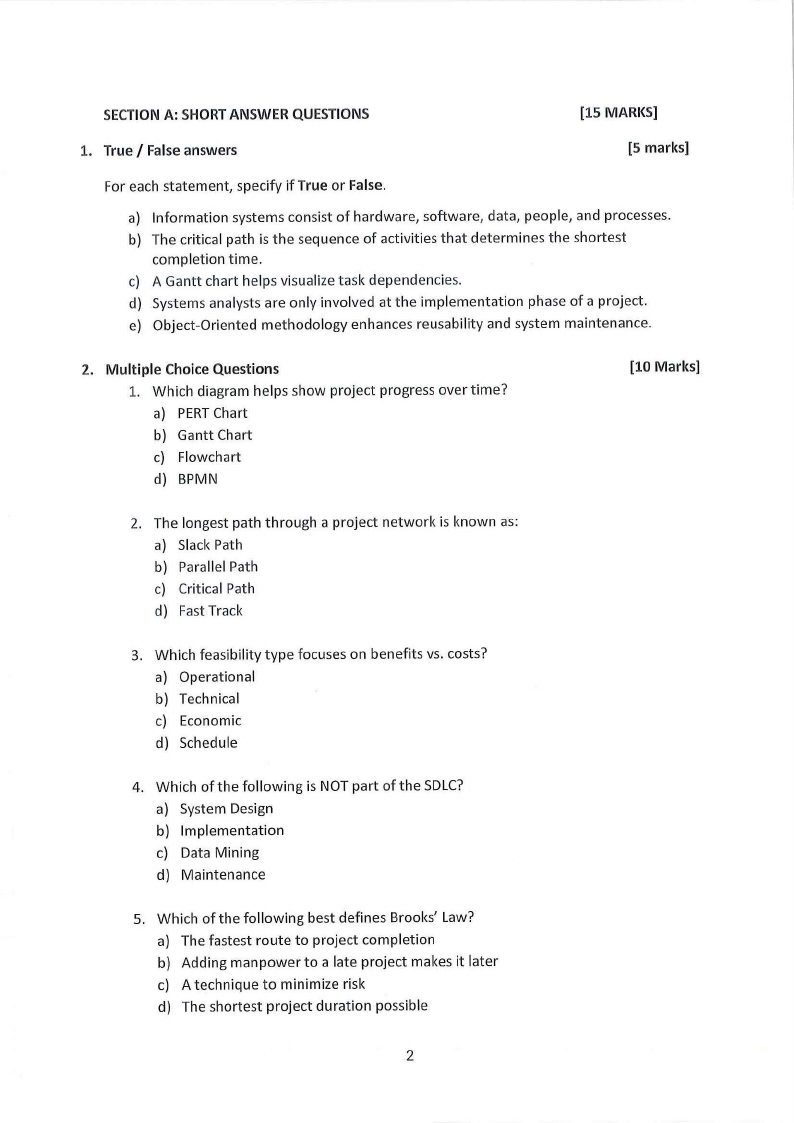
SECTION A: SHORT ANSWER QUESTIONS
[15 MARKS]
1. True / False answers
[5 marks]
For each statement, specify if True or False.
a) Information systems consist of hardware, softwa re, data, people, and processes.
b) The critical path is the sequence of activities that determines the shortest
completion time.
c) A Gantt chart helps visualize task dependencies.
d) Systems analysts are only involved at the implementation phase of a project.
e) Object-Oriented methodology enhances reusability and system maintenance.
2. Multiple Choice Questions
1. Which diagram helps show project progress over time?
a) PERT Chart
b) Gantt Chart
c) Flowchart
d) BPMN
[10 Marks]
2. The longest path through a project network is known as:
a) Slack Path
b) Parallel Path
c) Critical Path
d) Fast Track
3. Which feasibility type focuses on benefits vs. costs?
a) Operational
b) Technical
c) Economic
d) Schedule
4. Which of the following is NOT part of the SDLC?
a) System Design
b) Implementation
c) Data Mining
d) Maintenance
5. Which of the following best defines Brooks' Law?
a) The fastest route to project completion
b) Adding manpower to a late project makes it later
c) A t echnique to minimize risk
d) The shortest project duration possible
2
|
|
3 Page 3 |
▲back to top |
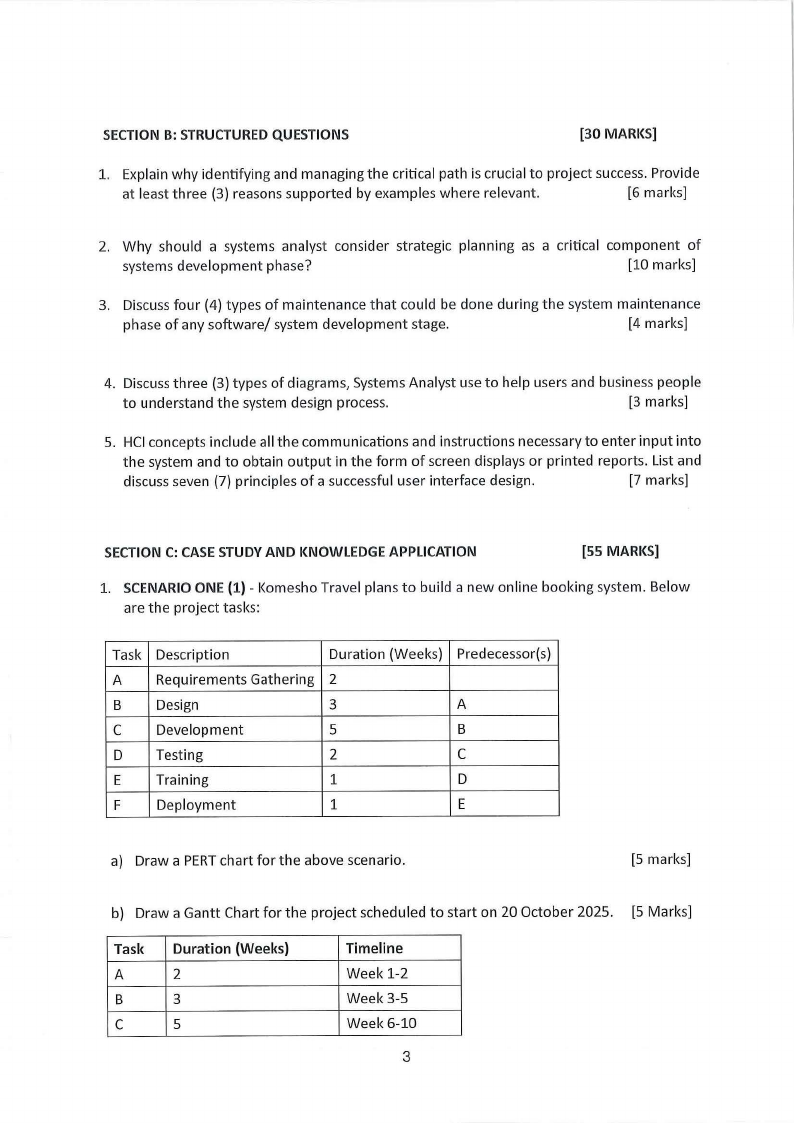
SECTION B: STRUCTURED QUESTIONS
[30 MARKS]
1. Explain why identifying and managing the critical path is crucial to project success. Provide
at least three {3) reasons supported by examples where relevant.
[6 marks]
2. Why should a systems analyst consider strategic planning as a critical component of
systems development phase?
[10 marks]
3. Discuss four (4) types of maintenance that cou ld be done during the system maintenance
phase of any software/ system development stage.
[4 marks]
4. Discuss three (3) types of diagrams, Systems Analyst use to help users and business people
to understand the system design process.
[3 marks]
5. HCI concepts include all the communications and instructions necessary to enter input into
the system and to obtain output in the form of screen displays or printed reports. List and
discuss seven (7) principles of a successful user interface design.
[7 marks]
SECTION C: CASE STUDY AND KNOWLEDGE APPLICATION
[55 MARKS]
1. SCENARIO ONE (1) - Komesho Travel plans to build a new online booking system. Below
are the project tasks:
Task Description
Duration (Weeks) Predecessor(s)
A Requirements Gathering 2
B Design
3
A
C Development
5
B
D Testing
2
C
E Training
1
D
F Deployment
1
E
a) Draw a PERT chart for the above scenario.
[5 marks]
b) Draw a Gantt Chart for the project schedu led to start on 20 October 2025. [5 Marks]
Task
A
B
C
Duration (Weeks)
2
3
5
Timeline
Week 1-2
Week 3-5
Week 6-10
3
|
|
4 Page 4 |
▲back to top |
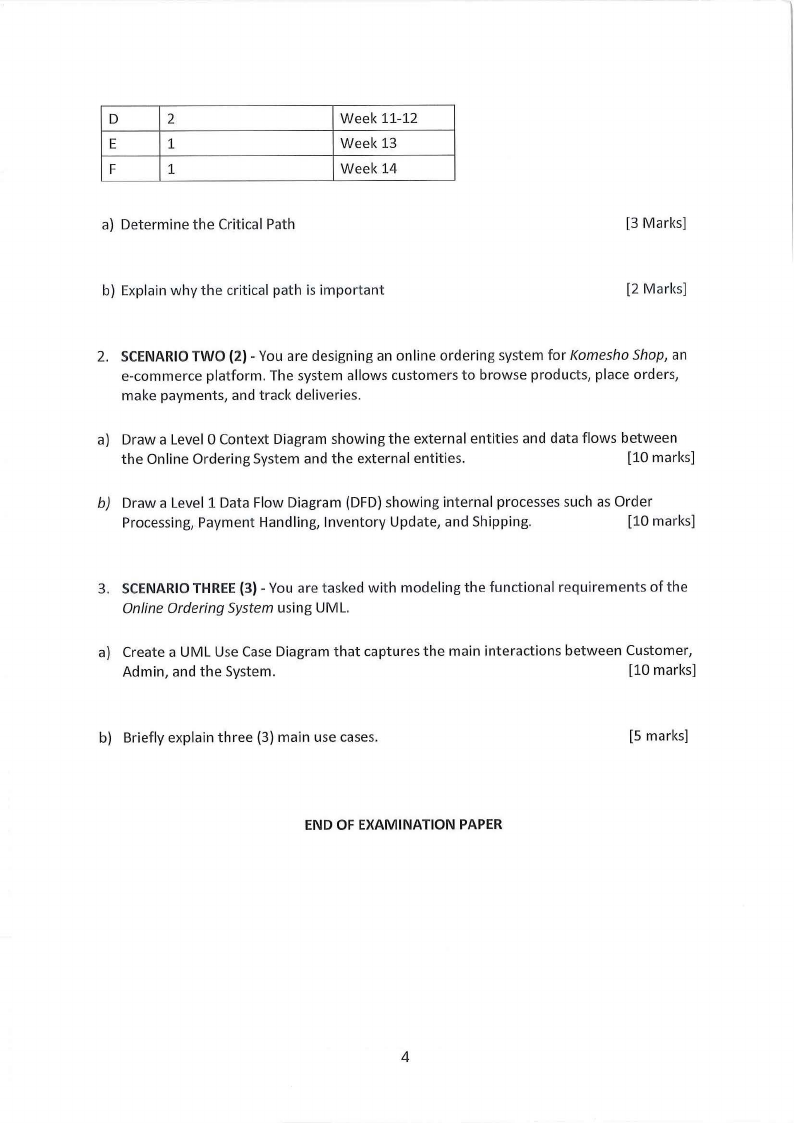
D
2
E
1
F
1
Week 11-12
Week 13
Week 14
a} Determine the Critical Path
[3 Marks]
b) Explain why the critical path is important
[2 Marks]
2. SCENARIO TWO (2) - You are designing an on line ordering system for J<omesho Shop, an
e-commerce platform. The system allows customers to browse products, place orders,
make payments, and track deliveries.
a) Draw a Level OContext Diagram showing the external entities and data flows between
the Online Ordering System and the external entities.
[10 marks]
b) Draw a Level 1 Data Flow Diagram (DFD) showing internal processes such as Order
Processing, Payment Handling, Inventory Update, and Shipping.
[10 marks]
3. SCENARIO THREE {3) - You are tasked with modeling the functional requirements of the
Online Ordering System using UML.
a} Create a UML Use Case Diagram that captures the main interactions between Customer,
Admin, and the System.
[10 marks]
b} Briefly explain three (3) main use cases.
[5 marks]
END OF EXAMINATION PAPER
4