ANP621S - ANATOMICAL PATHOLOGY 2B - 1ST OPP - NOV 2025


ANP621S - ANATOMICAL PATHOLOGY 2B - 1ST OPP - NOV 2025


1 Pages 1-10

▲back to top


1.1 Page 1

▲back to top


ANATOMICAL PATHOLOGY 2B (ANP621S) i st OPPORTUNITY EXAMINATION PAPER - 2025
nAmlBIA unlVERSITY
OF SCIEnCE Ano TECHnOLOGY
FACULTY OF HEALTH, NATURAL RESOURCES AND APPLIED SCIENCES
DEPARTMENT OF CLINICAL HEALTH SCIENCES
QUALIFICATION: BACHELOR OF MEDICAL LABORATORY SCIENCES
QUALIFICATION CODE: 08BMLS
LEVEL: 6
COURSE CODE: ANP621S
COURSE NAME: ANATOMICAL PATHOLOGY 28
SESSION: OCTOBER 2025
DURATION: 3 HOURS
PAPER: THEORY
MARKS: 100
FIRST OPPORTUNITY EXAMINATION QUESTION PAPER
EXAMINER(S)
MS BELINDA ROSELIN TSAUSES
MODERATOR:
MS NDESHIPEWA HAMATWI-VALOMBOLA
INSTRUCTIONS TO CANDIDATES
1. Answer ALL questions in your answer booklet.
2. This examination paper consists of THREE sections:
o Section A: 40 marks (Multiple Choice and True/False questions)
o Section B: 30 marks (Short answer questions)
o Section C: 30 marks (Case studies with image interpretation)
3. Write legibly and use black or blue ink only. Pencil may only be used for diagrams.
4. No reference materials, textbooks, or notes are permitted.
THIS QUESTION PAPER CONSISTS OF 12 PAGES (including this front page).
Page 1 of 12

1.2 Page 2

▲back to top


ANATOMICAL PATHOLOGY 2B {ANP621S) i5t OPPORTUNITY EXAMINATION PAPER - 2025
Section A (40 marks)
Question 1
(30)
Evaluate the statements in each numbered section and select the most appropriate
answer. Write correct letter next to the corresponding number.
1.1 A 42-year-old woman presents with a cervical smear showing atypical glandular
cells. The cells are arranged in three-dimensional clusters with nuclear crowding,
occasional rosette formation, and feathering at the periphery. Nuclear enlargement
is 3x normal with irregular chromatin. Which Bethesda System category is MOST
appropriate?
(1)
A. NILM with reactive endocervical cells.
B. Atypical Glandular Cells (AGC) - favor neoplastic.
C. Endocervical Adenocarcinoma in situ (AIS}.
D. Atypical Glandular Cells - Not Otherwise Specified (AGC-NOS).
1.2 The hallmark nuclear feature of superficial squamous cells is:
(1)
A. Vesicular ~s µm
B. Pyknotic ~s µm
C. Irregular hyperchromatic
D. Macronucleolus
1.3 A cervical smear from a 28-year-old asymptomatic woman shows numerous
mature squamous cells with perinuclear halos and slightly enlarged nuclei with
smooth membranes. However, the cytop lasm is glycogen-rich without peripheral
condensation, and nuclei show uniform fine chromatin. Colposcopy shows no
acetowhite changes. What is the MOST likely interpretation?
(1)
A. LSIL (Low-grade squamous intraepith elial lesion).
B. ASC-US (Atypical squamous cells of undetermined significance).
C. NILM - glycogenated intermediate cells mimicking koilocytes.
D. ASC-H (Atypical squamous cells - cannot exclude HSIL} .
Page 2 of 12

1.3 Page 3

▲back to top


ANATOMICAL PATHOLOGY 2B (ANP621S) 1st OPPORTUNITY EXAMINATION PAPER - 2025
1.4 A lactational/gestational pattern is characterized by predominance of:
(1)
A. Superficial cells
B. Parabasal cells
C. Navicular (glycogenated intermediate) cells
D. Anucleate squames
1.5 Trichomonas vaginalis on Pap smear is best recognized by:
(1)
A. Flagella always visible
B. Pear-shaped body, eccentric nucleus, cytoplasmic granules
C. Pseudohyphae
D. Viral inclusions
1.6 Cervical smear shows numerous squamous cells with obscured cellular detail
and a background of mixed bacterial flora including curved rods, cocci, and
absence of lactobacilli. Many squamous cells have adherent coccobacilli
completely coating the cell membrane, giving a granular "ground glass"
appearance. Which add itional finding would MOST strongly support the
diagnosis?
(1)
A. Perinuclear halo formation.
B. Loss of sharp cytoplasmic borders and "smudged" cell edges.
C. lntracytoplasmic vacuoles with organisms.
D. Nuclear enlargement with hyperchromasia.
1.7 A key clue for typical repa ir is:
(1)
A. Loss of polarity
B. Streaming nuclear polarity in flat monolayer sheet s
C. M arked hyperchromasia
D. Enucleation
Page 3 of 12

1.4 Page 4

▲back to top


ANATOMICAL PATHOLOGY 2B (ANP621S) 1st OPPORTUNITY EXAMINATION PAPER - 2025
1.8 The nucleus of an intermediate cell is approximately the size of a:
(1)
A. Parabasal nucleus
B. Superficial nucleus
C. Endometrial cell nucleus
D. HSIL nucleus
1.9 Cytolysis is primarily due to:
(1)
A. HSV
8. Lactobacilli acting on glycogenated cells.
C. Radiation
D. Atrophy alone
1.10 ASC-H implies:
(1)
A. Cannot exclude HSIL
8. Definite HSIL
C. NILM with HPV CPE
D. LSIL only
1.11 A maturation index compatible with estrogenic peak (mid-cycle) is most
likely:
(1)
A. 80:20:0
8. 0:80:20
C. 0:20:80
D. 60:40:0
1.12 Dyskeratosis commonly accompanies:
(1)
A. Plat condyloma
8. Typical repair
C. NILM postpartum
D. Endometrial shedding
Page 4 of 12

1.5 Page 5

▲back to top


ANATOMICAL PATHOLOGY 2B (ANP621S) 1st OPPORTUNITY EXAMINATION PAPER - 2025
1.13 Endocervical cells classically show:
(1)
A. Top-hat clusters
B. Honeycomb sheets/palisades
C. Cobblestone
D. Pearls
1.14 Blue blobs are most associated with:
(1)
A. Severe atrophy
B. Candida
C. Trichomonas
D. Actinomyces
1.15 CIN grading correlates cytologically most with:
(1)
A. Cytoplasmic hue alone
B. Progressive nuclear atypia & N/C ratio
C. Goblet cells
D. Barr bodies
1.16 Reserve cell hyperplasia is the precursor for:
(1)
A. Glandular only
B. Squamous only
C. Squamous, adeno- and adenosquamous lesions
D.None
1.17 Which of the following best describes metaplastic cells in cervical cytology?
(1)
A. Cells that arise from the transformation of columnar epithelium to
squamous epithelium, usually appearing as small polygonal cells with dense
cytoplasm and distinct borders.
B. Cells derived from the endometrium during menstruation.
C. Koilocytotic cells with perinuclear clearing and nuclear atypia.
D. Cells showing malignant features with coarse chromatin and irregular
membranes.
Page 5 of 12

1.6 Page 6

▲back to top


ANATOMICAL PATHOLOGY 2B {ANP621S) 1st OPPORTUNITY EXAMINATION PAPER - 2025
1.18 "Two-toned" polychromasia and kite cells are minor features sometimes
seen with:
(1)
A. Candida
B.BV
C. HPV infection
D. Actinomyces
1.19 What does the term "atypical squamous epithelial cell" mean in cervical
cytology?
(1)
A. Cells that are definitely malignant.
B. Squamous ce lls that show changes beyond reactive alterations but are
insufficient for a definitive intraepithelial lesion diagnosis.
C. Cells that are infected with HPV.
D. Normal squamous cells seen in the transformation zone.
1.20 Transformation Zone adequate sampling when smear contains at least:
(1)
A. 5 superficial
B. ~10 well-preserved endocervical or metaplastic cells.
C. 50 parabasal
D. Navicular cells
1.21 Parakeratosis is defined cytologica lly by:
(1)
A. Anucleate squames
B. Miniature superficial-like cells with pyknotic nuclei.
C. Balloon cells
D. Cornflake artifact
Page 6 of 12

1.7 Page 7

▲back to top


ANATOMICAL PATHOLOGY 2B {ANP621S) 1st OPPORTUNITY EXAMINATION PAPER - 2025
1.22 In atrophic smears, a pitfall is confusion of parabasal clusters with:
(1)
A. Endometrial cells
8. Endocervical cells
C. HSIL
D. Candida
1.23 Which of the following best describes the correct fixation procedure for
conventional cervical cytology smears?
(1)
A. Air-dry the smear for 10 minutes before applying fixative.
8. Fix the smear immediately in 95% ethanol or spray fixative while still wet to
preserve cellular detail.
C. Allow the smear to dry partially before immersion in alcohol.
D. Fix the smear after staining to improve cytoplasmic clarity.
1.24 The cellular index widely used in hormonal cytology is:
(1)
A. KP I
8. Eosinophilic index
C. Maturation Index
D. Crowding index
1.25 NILM smear with many navicular cells is most consistent with:
(1)
A. Early pregnancy/luteal
8. HSIL
C. Acute cervicitis only
D. Atrophy
1.26 Actinomyces-like organisms are classically associated with:
(1)
A. IUCD use
8. Menopause
C. HSV
D. Candida
Page 7 of 12

1.8 Page 8

▲back to top


ANATOMICAL PATHOLOGY 2B (ANP621S) 1st OPPORTUNITY EXAMINATION PAPER - 2025
1.27 Why is it important to consider the phase of the menstrual cycle when
interpreting cervical cytology?
(1)
A. Because the menstrual cycle determines the likelihood of malignancy.
B. Because hormonal variations during the cycle influence the type and
maturation of exfoliated epithelial cells seen on cytology.
C. Because the menstrual cycle affects the staining properties of the cells
only.
D. Because cytology can only be performed during menstruation.
1.28 Which of the following best describes degenerative changes in
gynaecological cytology?
(1)
A. Cytoplasmic keratinization with associated koilocytosis.
B. Features associated with active hormonal stimulation of squamous cells.
C. Cellular alterations such as karyorrhexis, karyolysis, and cytoplasmic changes
(e.g., pseudo-eosinophilia, hyalinization) due to cell breakdown.
D. Proliferative changes in response to viral infection.
1.29 A 52-year-old perimenopausal woman has irregular cycles. Her day 21
progesterone level is low. A cervical smear shows a maturation index of 10:85:5
(parabasal:intermediate:superficial). Which hormonal pattern is MOST consistent
with these findings?
(1)
A. Adequate luteal phase with normal progesterone effect.
B. Hyperestrogenic state with LH surge.
C. Anovulatory cycle with insufficient progesterone.
D. Normal ovulatory cycle at mid-luteal phase.
1.30 "Clue cel ls+ diffuse coccobacilli, absent lactobacilli" su pports:
(1)
A. Normal flora
B. Bacterial vaginosis
C. Candidiasis
D. Trichomoniasis
Page 8 of 12

1.9 Page 9

▲back to top


ANATOMICAL PATHOLOGY 2B (ANP621S) 1st OPPORTUNITY EXAMINATION PAPER - 2025
Question 2
[10)
Evaluate the statements in each numbered section and select the most appropriate
answer. Write "True" or "False" next to the corresponding number.
2.1 The nucleus of a superficia l cell is "'8 µm and vesicular.
(1)
2.2 Inflammation typically causes nuclear enlargement <2x the ICN with smooth
membranes.
(1)
2.3 Cell growth and cell division should always occur together.
(1)
2.4 Parabasal cell predominance is compatible with atrophic smears.
(1)
2.5 The principle of the cytospin is to separate cells based on their density using
centrifugal buoyancy, similar to differential centrifugation.
(1)
2.6 "Blue blobs" are degenerative parabasal material commonly seen in severe atrophy. (1)
2.7 Reserve cell hyperplasia originates from endometrial stroma.
(1)
2.8 Typical repair shows streaming polarity in monolayer sheets.
(1)
2.9 Actinomyces-like organisms are obligate pathogens and always require treatment. (1)
2.10 ASC-H means atypical squamous cells where HSIL cannot be excluded.
(1)
Section B (30 marks)
Question 3
[19)
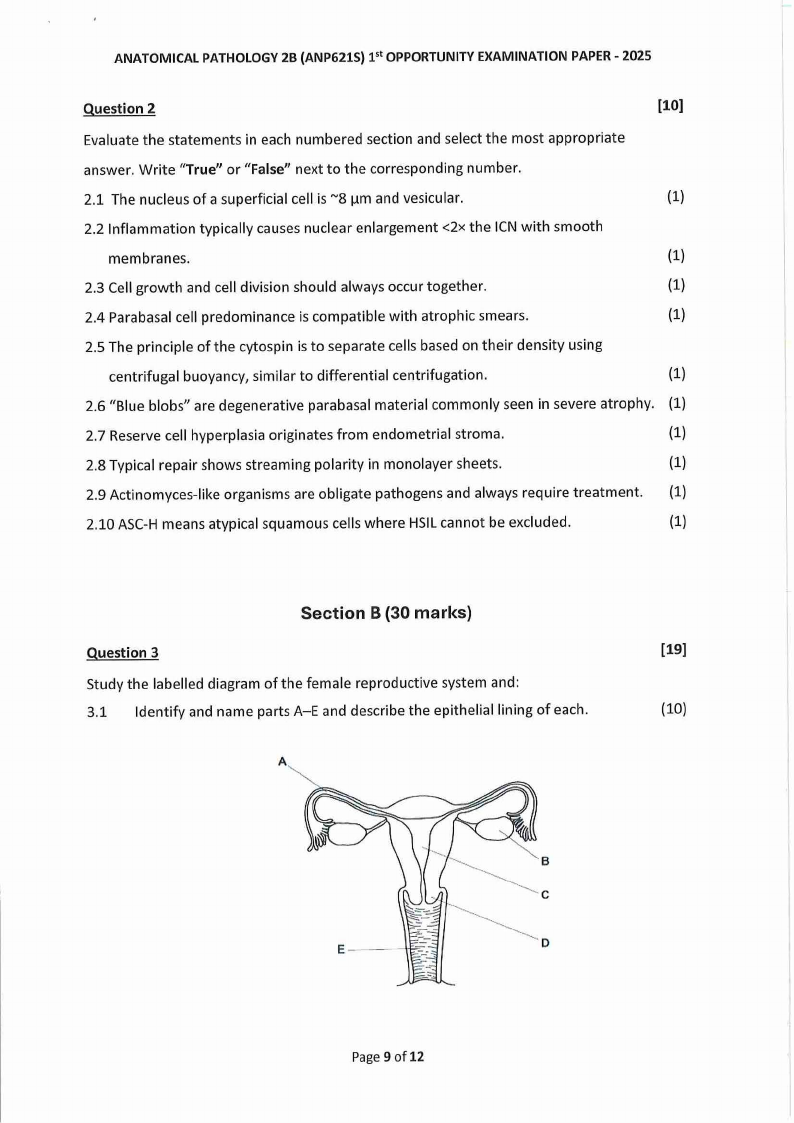
Study the labelled diagram of the female reproductive system and :
3.1 Identify and name parts A-E and describe the epithelial lining of each.
(10)
A
B
·--........._ c
Page 9 of 12

1.10 Page 10

▲back to top


ANATOMICAL PATHOLOGY 28 (ANP621S) 1st OPPORTUNITY EXAMINATION PAPER - 2025
3.2 Demonstrate your understanding of the distinct anatomical regions of the cervix
and its cytological sign ificance in the diagnosis of cervical cancer based on the
following criteria:
3.2.1 Ectocervix
(2)
3.2.2 Endocervical Canal/Endocervix
(2)
3.2.3 Squamocolumnar Junction
(2)
3.2.4 Transformation Zone
(2)
3.3 Why do you think that the integrated knowledge under question 2 is important in
cervical cancer diagnosis?
(1)
Question 4
4.1 Both endocervical and endometrial cells are glandular epithelial cells of the
female genital tract. Distinguish between endocervical and endometrial cells
by tabulating their cytologic differences based on the following criteria : nuclei,
cytoplasm, arrangement, and clinical correlation.
(8)
4.2 Differentiate between liquid-based cytology (LBC) and conventional Smears in
cervical cytology by giving three key differences. Copy and complete the table in
your answer book.
(3)
Page 10 of 12

2 Pages 11-20

▲back to top


2.1 Page 11

▲back to top


ANATOMICAL PATHOLOGY 2B (ANP621S) 1st OPPORTUNITY EXAMINATION PAPER - 2025
Section C (30 marks)
Question 5
[20]
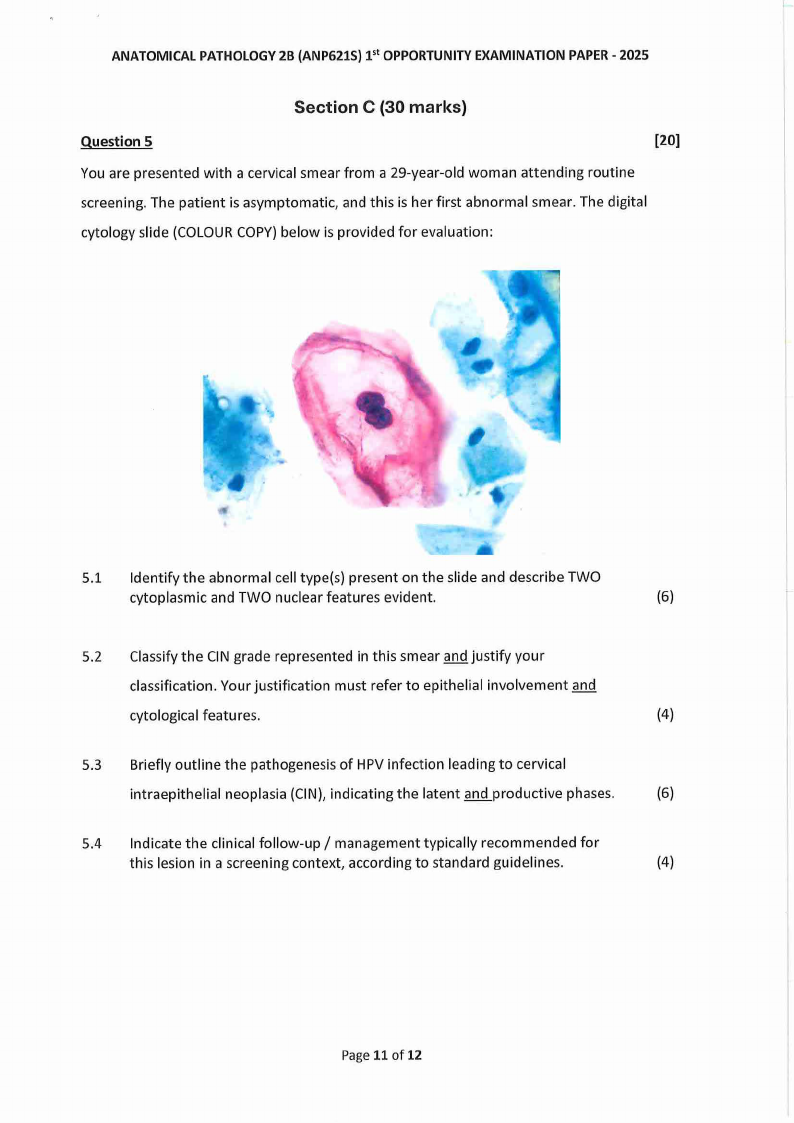
You are presented with a cervical smear from a 29-year-old woman attending routine
screening. The patient is asymptomatic, and this is her first abnormal smear. The digital
cytology slide (COLOUR COPY) below is provided for evaluation:
5.1 Identify the abnormal cell type(s) present on the slide and describe TWO
cytoplasmic and TWO nuclear features evident.
(6)
5.2 Classify the CIN grade represented in this smear and justify your
classification. Your justification must refer to epithelial involvement and
cytological features.
(4)
5.3 Briefly outline the pathogenesis of HPV infection leading to cervical
intraepithelial neoplasia (CIN), indicating the latent and productive phases.
(6)
5.4 Indicate the clinical follow-up/ management typically recommended for
this lesion in a screening context, accord ing to standard guidelines.
(4)
Page 11 of 12

2.2 Page 12

▲back to top


ANATOMICAL PATHOLOGY 28 (ANP621S) 1st OPPORTUNITY EXAMINATION PAPER -2025
Question 6
[10]
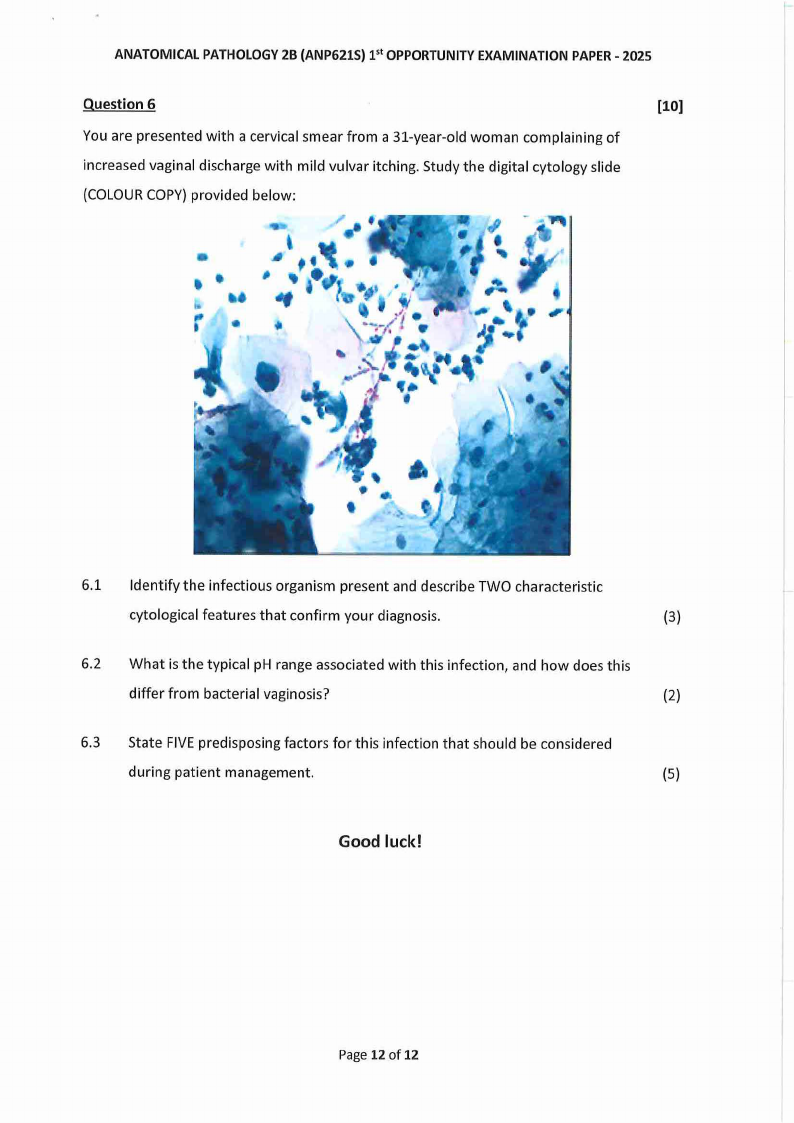
You are presented with a cervical smear from a 31-year-old woman complaining of
increased vaginal discharge with mild vu Ivar itching. Study the digital cytology slide
(COLOUR COPY) provided below:
.. /
- All f .,• t
• • w - "'~ ,• 1
6.1 Identify the infectious organism present and describe TWO characteristic
cytological features that confirm your diagnosis.
(3)
6.2 What is the typical pH range associated with this infection, and how does this
differ from bacterial vaginosis?
(2)
6.3 State FIVE predisposing factors for this infection that should be considered
during patient management.
(5)
Good luck!
Page 12 of 12