


 |
GDC611S - GROUP DYNAMICS AND COMMUNICATION - 1ST OPP - JUNE 2025 |
|
|
1 Page 1 |
▲back to top |

n Aim I BI A u n I VE RS ITV
OF SCIEnCE Ano TECHnOLOGY
FACULTY OF COMMERCE, HUMAN SCIENCEAND EDUCATION
DEPARTMENT OF COMMUNICATION AND LANGUAGES
QUALIFICATION: BACHELOR OF COMMUNICATION
QUALIFICATION CODE: 07BCMM
LEVEL: 7
COURSE CODE: GDC 611S
SESSION: JUNE, 2025
DURATION: THREE HOURS
COURSE: GROUP DYNAMICS AND
COMMUNICATION
PAPER: (THEORY)
MARKS: 100
EXAMINER
FIRST OPPORTUNITY EXAMINATION QUESTION PAPER
DR C PEEL
MODERATOR MRS. A. TJIRAMANGA
INSTRUCTIONS
1.Answer ONE question from Section A, and TWO QUESTIONS from Section 8.
2.Read all the questions carefully before answering them.
3. Indicate whether you are a FT, PT, or DE student.
4. Please write legibly.
THIS EXAMINATION QUESTION PAPER CONSISTS OF _3_PAGES (Including this front page)
1
|
|
2 Page 2 |
▲back to top |
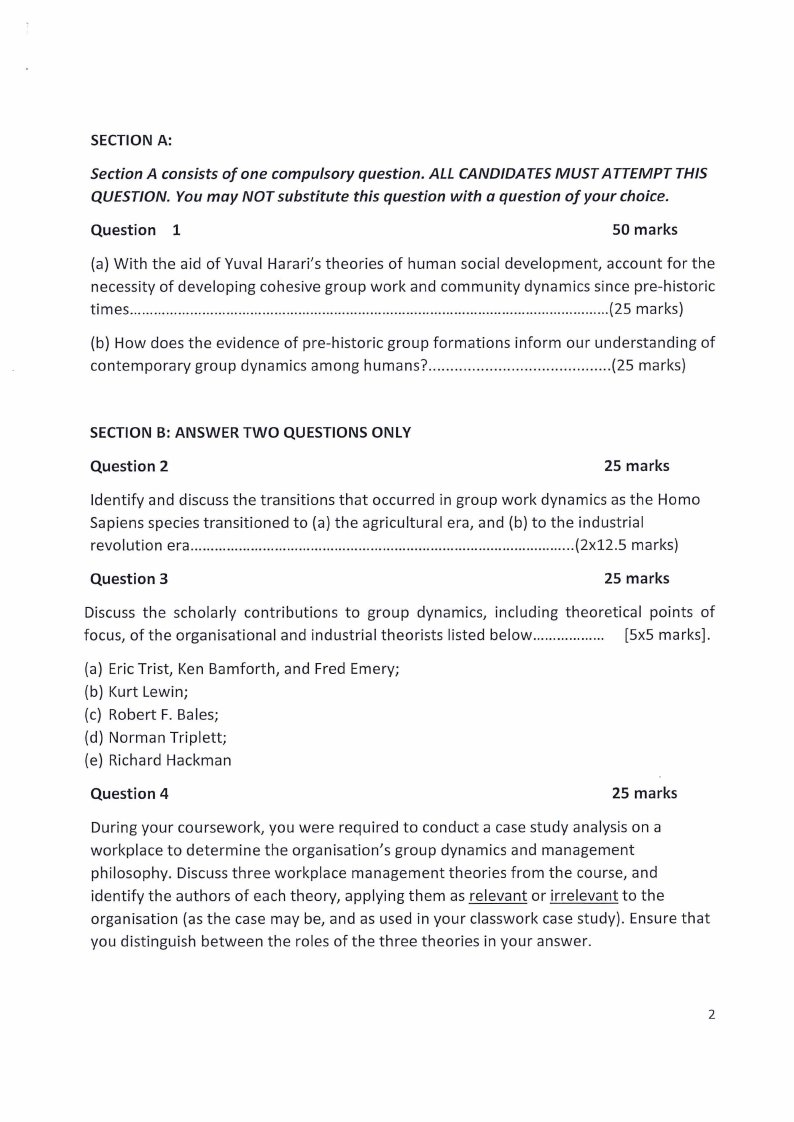
SECTION A:
Section A consists of one compulsory question. ALL CANDIDATES MUST ATTEMPT THIS
QUESTION. You may NOT substitute this question with a question of your choice.
Question 1
50 marks
(a) With the aid of Yuval Harari's theories of human social development, account for the
necessity of developing cohesive group work and community dynamics since pre-historic
times .....................................................................................................................(.2..5 marks)
(b) How does the evidence of pre-historic group formations inform our understanding of
contemporary group dynamics among humans? .......................................... (25 marks)
SECTION B: ANSWER TWO QUESTIONS ONLY
Question 2
25 marks
Identify and discuss the transitions that occurred in group work dynamics as the Homo
Sapiens species transitioned to (a) the agricultural era, and (b) to the industrial
revolution era ..............................................................................................(.2. x12.5 marks)
Question 3
25 marks
Discuss the scholarly contributions to group dynamics, including theoretical points of
focus, of the organisational and industrial theorists listed below.................. [SxS marks].
(a) Eric Trist, Ken Bamforth, and Fred Emery;
(b) Kurt Lewin;
(c) Robert F. Bales;
(d) Norman Triplett;
(e) Richard Hackman
Question 4
25 marks
During your coursework, you were required to conduct a case study analysis on a
workplace to determine the organisation's group dynamics and management
philosophy. Discuss three workplace management theories from the course, and
identify the authors of each theory, applying them as relevant or irrelevant to the
organisation (as the case may be, and as used in your classwork case study). Ensure that
you distinguish between the roles of the three theories in your answer.
2
|
|
3 Page 3 |
▲back to top |
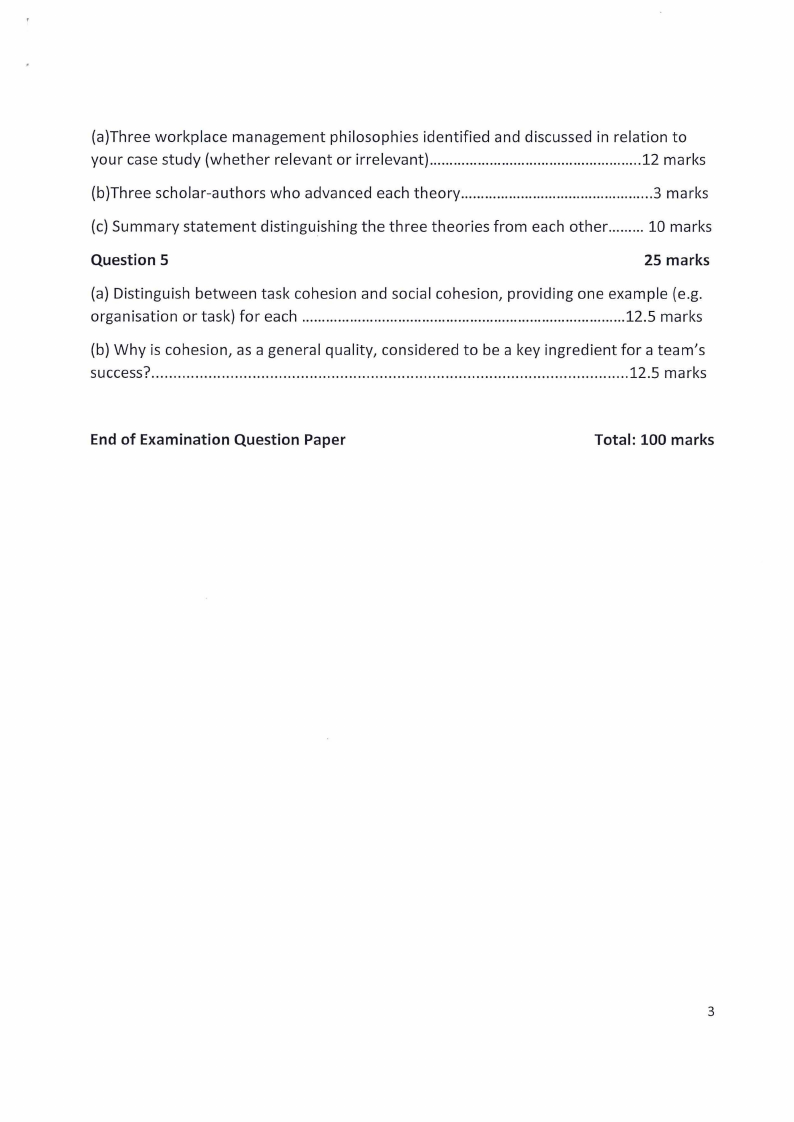
(a}Three workplace management philosophies identified and discussed in relation to
your case study (whether relevant or irrelevant) ....................................................1. 2 marks
(b)Three scholar-authors who advanced each theory ...............................................3. marks
(c) Summary statement distinguishing the three theories from each other ......... 10 marks
Question 5
25 marks
(a) Distinguish between task cohesion and social cohesion, providing one example (e.g.
organisation or task) for each ...............................................................................1..2.5 marks
(b) Why is cohesion, as a general quality, considered to be a key ingredient for a team's
success?............................................................................................................. 12.5 marks
End of Examination Question Paper
Total: 100 marks
3