


 |
GDC611S - GROUP DYNAMICS AND COMMUNICATION - 2ND OPP - JULY 2025 |
|
|
1 Page 1 |
▲back to top |
n Aim I BI A un I V!E RS ITY
OF SCIEnCE AflD TECHnOLOGY
FACULTY OF COMMERCE, HUMAN SCIENCEAND EDUCATION
DEPARTMENT OF COMMUNICATION AND LANGUAGES
QUALIFICATION: BACHELOR OF COMMUNICATION
QUALIFICATION CODE: 06BCMM
LEVEL: 6
COURSE CODE: GDC 611S
COURSE: GROUP DYNAMICS IN COMMUNICATION
SESSION: JUNE/JULY, 2025
DURATION: THREE HOURS
PAPER: (THEORY)
MARKS: 100
SUPPLEMENTARY/SECOND OPPORTUNITY EXAMINATION QUESTION PAPER
EXAMINER
DR C PEEL
MODERATOR MS. A. TJIRAMANGA
INSTRUCTIONS
1.Answer ONE question from Section A, and TWO QUESTIONS from Section B.
2.Read all the questions carefully before answering them.
3. Indicate whether you are a FT, PT, or DE student.
4. Please write legibly.
THIS EXAMINATION QUESTION PAPER CONSISTS OF _3_PAGES (Including this front page)
1
|
|
2 Page 2 |
▲back to top |
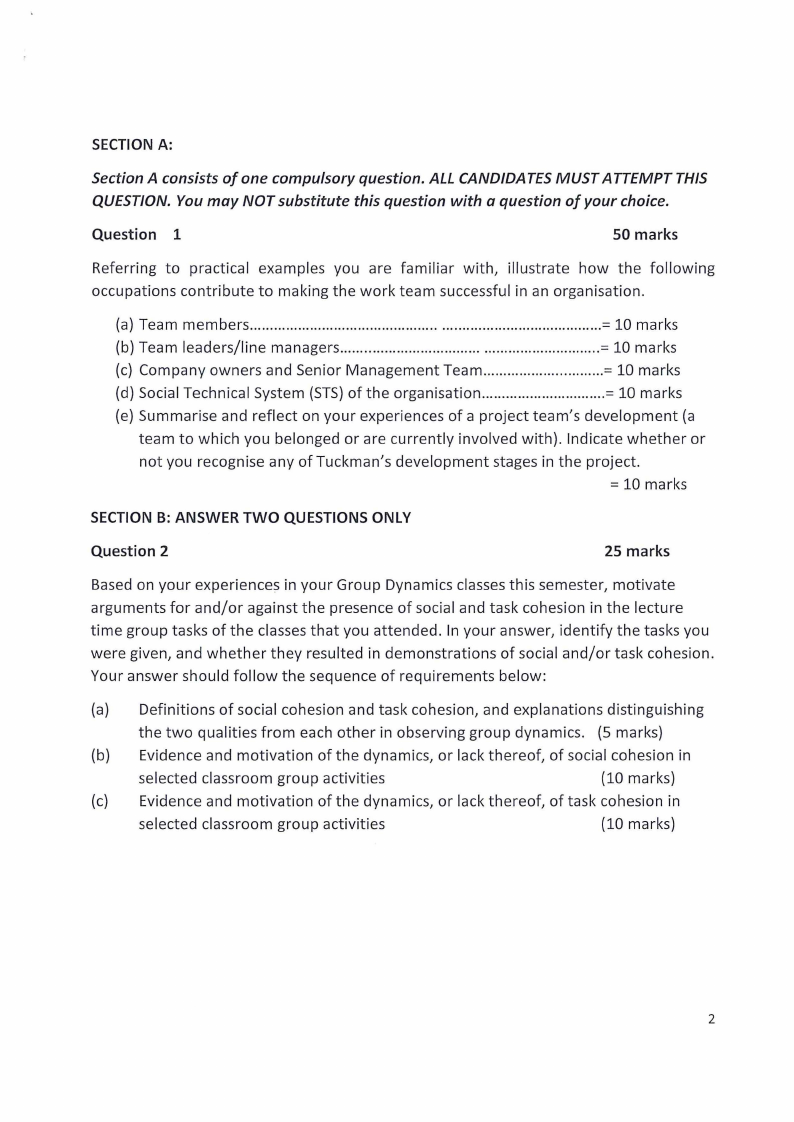
SECTION A:
Section A consists of one compulsory question. ALL CANDIDATES MUST ATTEMPT THIS
QUESTION. You may NOT substitute this question with a question of your choice.
Question 1
50 marks
Referring to practical examples you are familiar with, illustrate how the following
occupations contribute to making the work team successful in an organisation.
{a) Team members ....................................................................................... = 10 marks
{b) Team leaders/line managers ................................................................ = 10 marks
{c) Company owners and Senior Management Team .............................. = 10 marks
{d) Social Technical System {STS) of the organisation ...............................= 10 marks
{e) Summarise and reflect on your experiences of a project team's development {a
team to which you belonged or are currently involved with). Indicate whether or
not you recognise any of Tuckman's development stages in the project.
= 10 marks
SECTION B: ANSWER TWO QUESTIONS ONLY
Question 2
25 marks
Based on your experiences in your Group Dynamics classes this semester, motivate
arguments for and/or against the presence of social and task cohesion in the lecture
time group tasks of the classes that you attended. In your answer, identify the tasks you
were given, and whether they resulted in demonstrations of social and/or task cohesion.
Your answer should follow the sequence of requirements below:
{a) Definitions of social cohesion and task cohesion, and explanations distinguishing
the two qualities from each other in observing group dynamics. {5 marks)
{b) Evidence and motivation of the dynamics, or lack thereof, of social cohesion in
selected classroom group activities
{10 marks)
{c) Evidence and motivation of the dynamics, or lack thereof, of task cohesion in
selected classroom group activities
{10 marks)
2
|
|
3 Page 3 |
▲back to top |
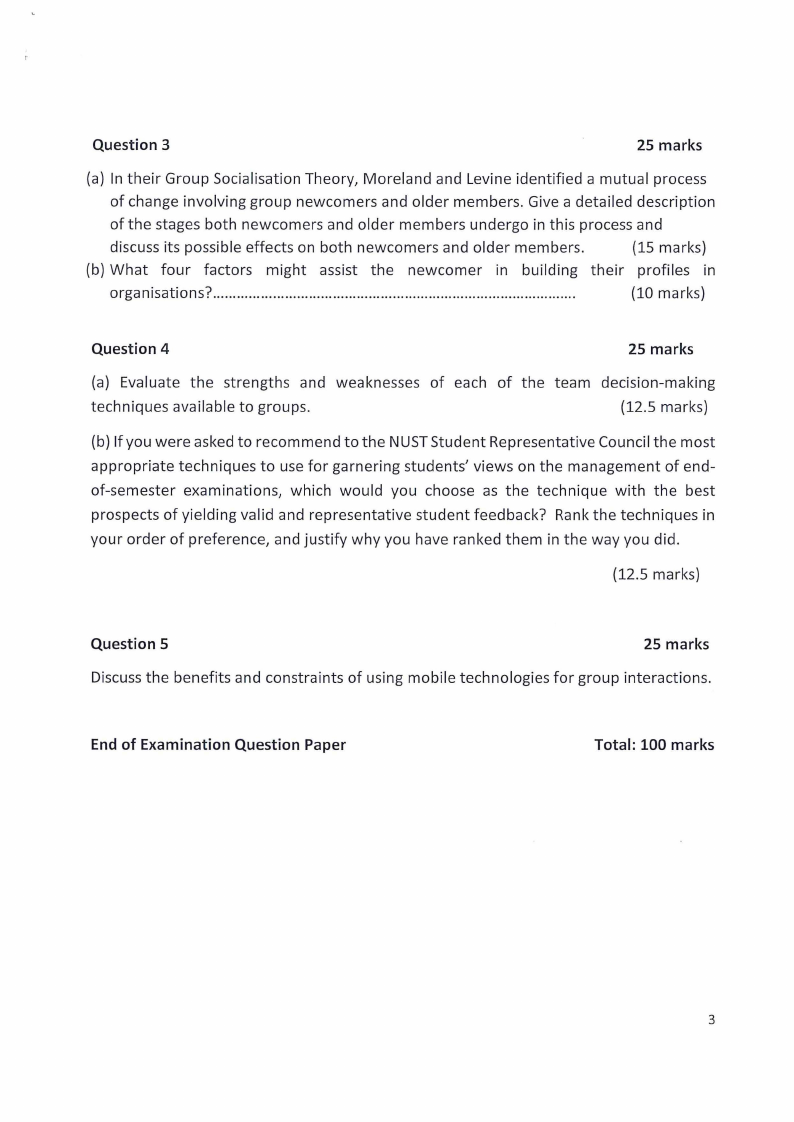
Question 3
25 marks
(a) In their Group Socialisation Theory, Moreland and Levine identified a mutual process
of change involving group newcomers and older members. Give a detailed description
of the stages both newcomers and older members undergo in this process and
discuss its possible effects on both newcomers and older members.
(15 marks)
(b) What four factors might assist the newcomer in building their profiles in
organisations?...........................................................................................
(10 marks)
Question 4
25 marks
(a) Evaluate the strengths and weaknesses of each of the team decision-making
techniques available to groups.
(12.5 marks)
(b) If you were asked to recommend to the NUSTStudent Representative Council the most
appropriate techniques to use for garnering students' views on the management of end-
of-semester examinations, which would you choose as the technique with the best
prospects of yielding valid and representative student feedback? Rank the techniques in
your order of preference, and justify why you have ranked them in the way you did.
(12.5 marks)
Question 5
25 marks
Discuss the benefits and constraints of using mobile technologies for group interactions.
End of Examination Question Paper
Total: 100 marks
3