


 |
PPO7011S - PUBLIC POLICY - 2ND OPP - JULY 2025 |
|
|
1 Page 1 |
▲back to top |
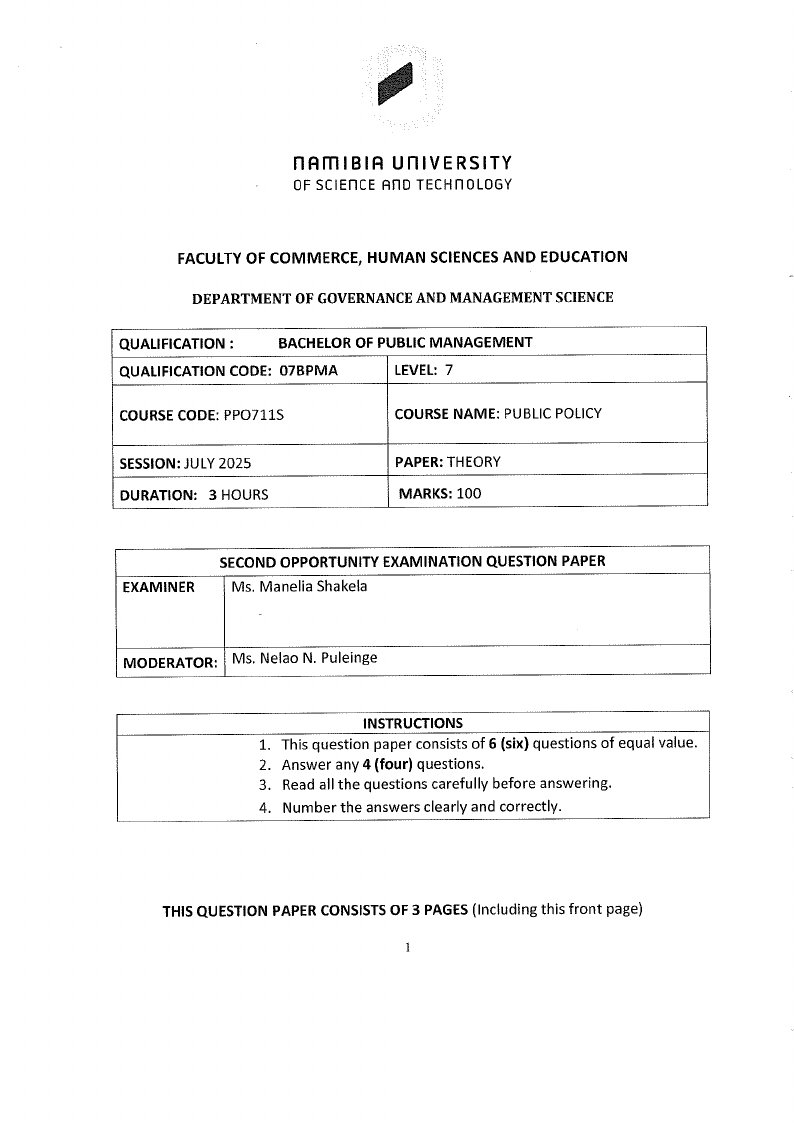
nAmlBIA unlVERSITY
OF SCIEnCE Ano TECHn0L0GY
FACULTYOFCOMMERCEH, UMANSCIENCESAND EDUCATION
DEPARTMENTOF GOVERNANCEAND MANAGEMENTSCIENCE
QUALIFICATION:
BACHELOROF PUBLICMANAGEMENT
QUALIFICATIONCODE: 07BPMA
LEVEL:7
COURSECODE:PPO711S
COURSENAME: PUBLICPOLICY
SESSION:JULY2025
DURATION: 3 HOURS
PAPER:THEORY
MARKS: 100
SECONDOPPORTUNITYEXAMINATION QUESTIONPAPER
EXAMINER Ms. Manelia Shakela
MODERATOR: Ms. Nelao N. Puleinge
INSTRUCTIONS
1. This question paper consists of 6 (six) questions of equal value.
2. Answer any 4 (four) questions.
3. Read all the questions carefully before answering.
4. Number the answers clearly and correctly.
THIS QUESTIONPAPERCONSISTSOF 3 PAGES(Including this front page)
|
|
2 Page 2 |
▲back to top |
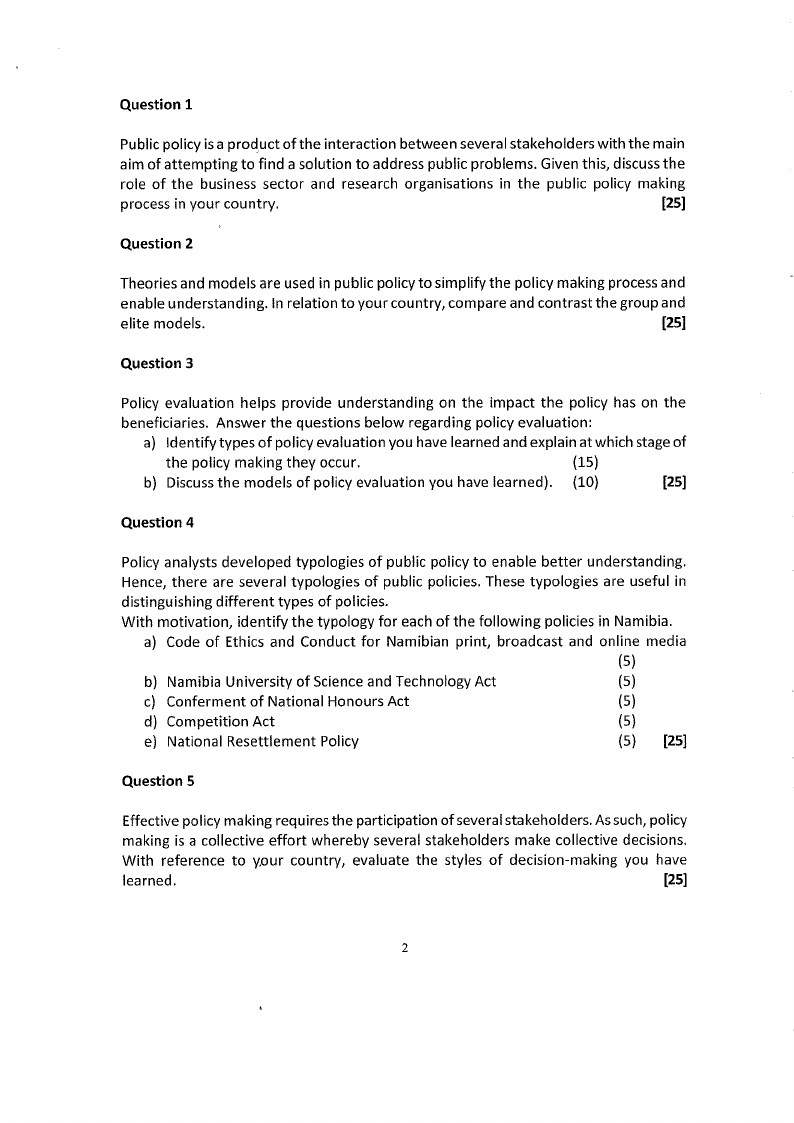
Question 1
Public policy is a prod"uct of the interaction between several stakeholders with the main
aim of attempting to find a solution to address public problems. Given this, discussthe
role of the business sector and research organisations in the public policy making
process in your country.
[ZS)
Question Z
Theories and models are used in public policy to simplify the policy making process and
enable understanding. In relation to your country, compare and contrast the group and
elite models.
[ZS)
Question 3
Policy evaluation helps provide understanding on the impact the policy has on the
beneficiaries. Answer the questions below regarding policy evaluation:
a) Identify types of policy evaluation you have learned and explain at which stage of
the policy making they occur.
{15)
b) Discussthe models of policy evaluation you have learned). {10)
[ZS)
Question 4
Policy analysts developed typologies of public policy to enable better understanding.
Hence, there are several typologies of public policies. These typologies are useful in
distinguishing different types of policies.
With motivation, identify the typology for each of the following policies in Namibia.
a) Code of Ethics and Conduct for Namibian print, broadcast and online media
(5)
b) Namibia University of Science and Technology Act
(5)
c) Conferment of National Honours Act
(5)
d) Competition Act
(5)
e) National Resettlement Policy
(5) [ZS)
Question S
Effective policy making requires the participation of several stakeholders. As such, policy
making is a collective effort whereby several stakeholders make collective decisions.
With reference to y.our country, evaluate the styles of decision-making you have
learned.
[ZS)
2
|
|
3 Page 3 |
▲back to top |
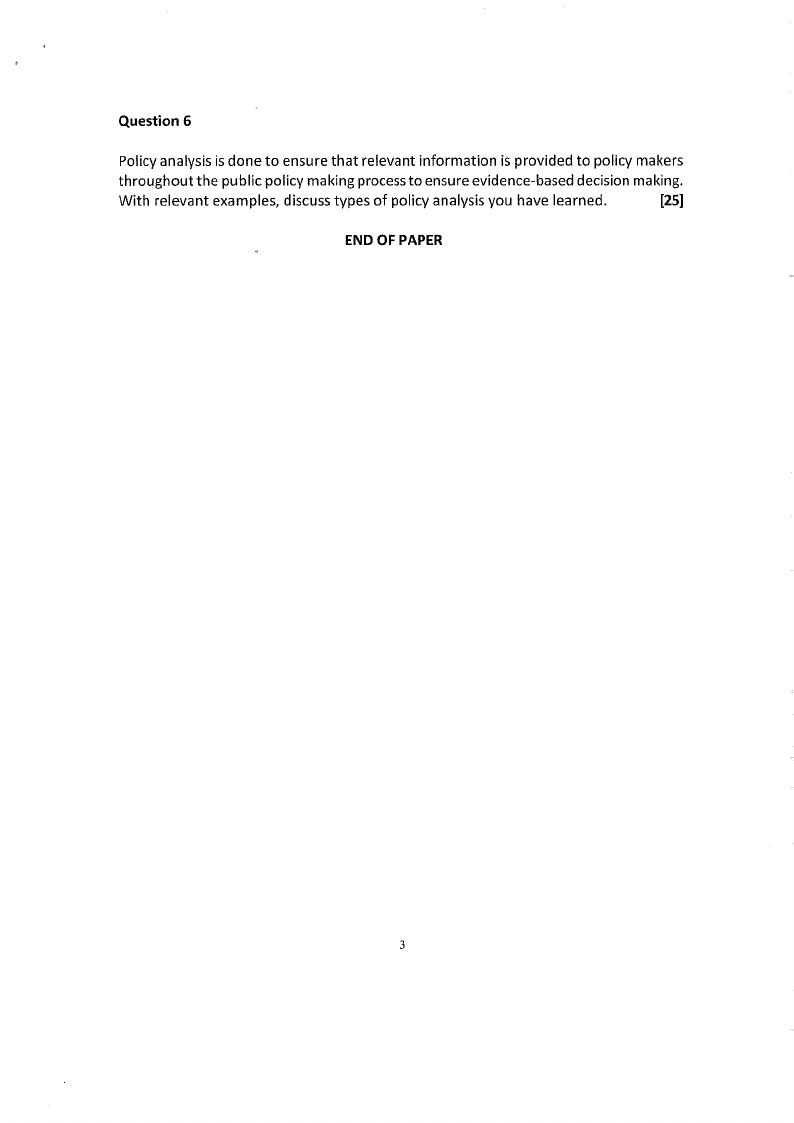
Question 6
Policy analysis is done to ensure that relevant information is provided to policy makers
throughout the public policy making processto ensure evidence-based decision making.
With relevant examples, discuss types of policy analysis you have learned.
[25)
END OF PAPER
3