


 |
BBE612C-BUSINESS ETHICS-2ND OPP-JULY 2025 |
|
|
1 Page 1 |
▲back to top |
nAmlBIA unlVERSITY
OF SCIEnCE Ano TECHnOLOGY
FACULTYOF COMMERCEH, UMANSCIENCESAND EDUCATION
HAROLD PUPKEWITZ GRADUATE SCHOOL OF BUSINESS
QUALIFICATION CODE:06DBPM
COURSE CODE BBE612C
LEVEL:6
COURSE NAME: BUSINESSETHICS
DATE: JUNE 2025
MODE: PM
DURATION: 3 HOURS
MARKS: 100
EXAMINER(S)
MODERATOR:
SECOND OPPORTUNITY EXAMINATION PAPER
Ms O.N Kangandjo
Ms J Hambabi
INSTRUCTIONS
1. Answer ALL the questions.
2. Write clearly and neatly.
3. Number the answers clearly.
PERMISSIBLE MATERIALS
1. Examination paper
2. Examination script
THIS QUESTION PAPER MEMO CONSISTS OF 7 PAGES (INCLUDING THIS FRONT PAGE)
|
|
2 Page 2 |
▲back to top |
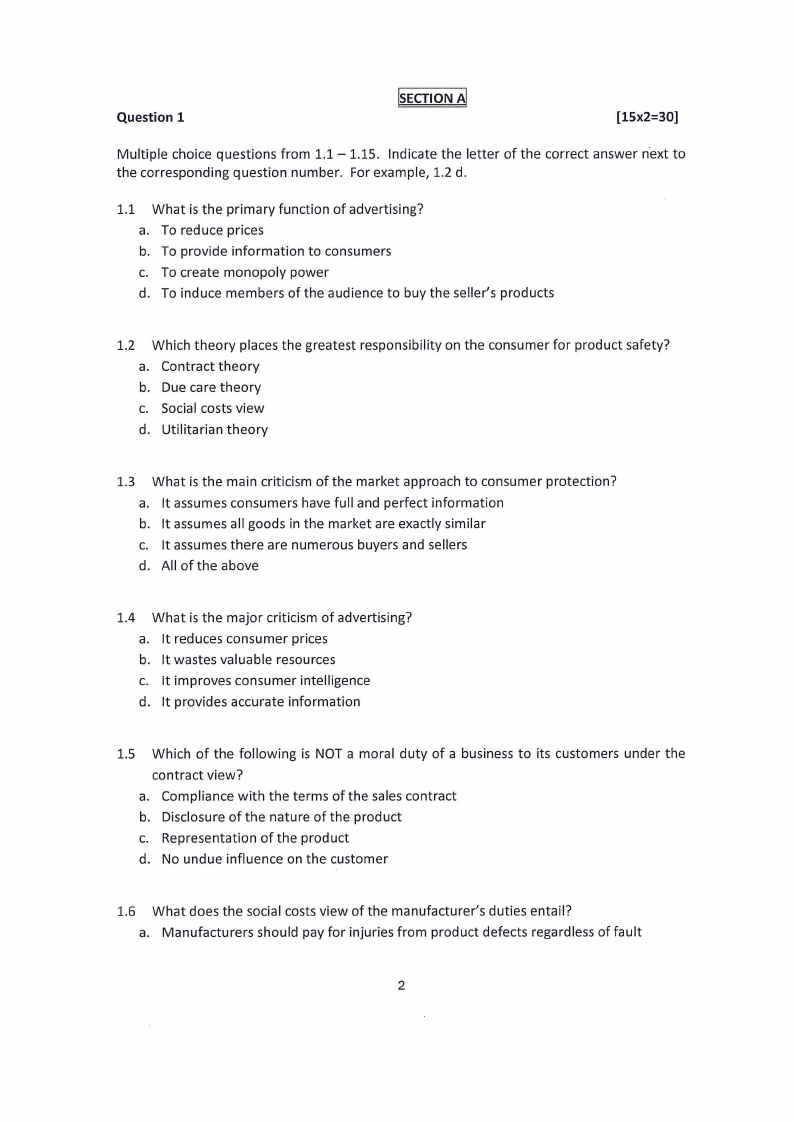
Question 1
!SECTION~
[15x2=30]
Multiple choice questions from 1.1 - 1.15. Indicate the letter of the correct answer next to
the corresponding question number. For example, 1.2 d.
1.1 What is the primary function of advertising?
a. To reduce prices
b. To provide information to consumers
c. To create monopoly power
d. To induce members of the audience to buy the seller's products
1.2 Which theory places the greatest responsibility on the consumer for product safety?
a. Contract theory
b. Due care theory
C. Social costs view
d. Utilitarian theory
1.3 What is the main criticism of the market approach to consumer protection?
a. It assumes consumers have full and perfect information
b. It assumes all goods in the market are exactly similar
c. It assumes there are numerous buyers and sellers
d. All of the above
1.4 What is the major criticism of advertising?
a. It reduces consumer prices
b. It wastes valuable resources
c. It improves consumer intelligence
d. It provides accurate information
1.5 Which of the following is NOT a moral duty of a business to its customers under the
contract view?
a. Compliance with the terms of the sales contract
b. Disclosure of the nature of the product
c. Representation of the product
d. No undue influence on the customer
1.6 What does the social costs view of the manufacturer's duties entail?
a. Manufacturers should pay for injuries from product defects regardless of fault
2
|
|
3 Page 3 |
▲back to top |
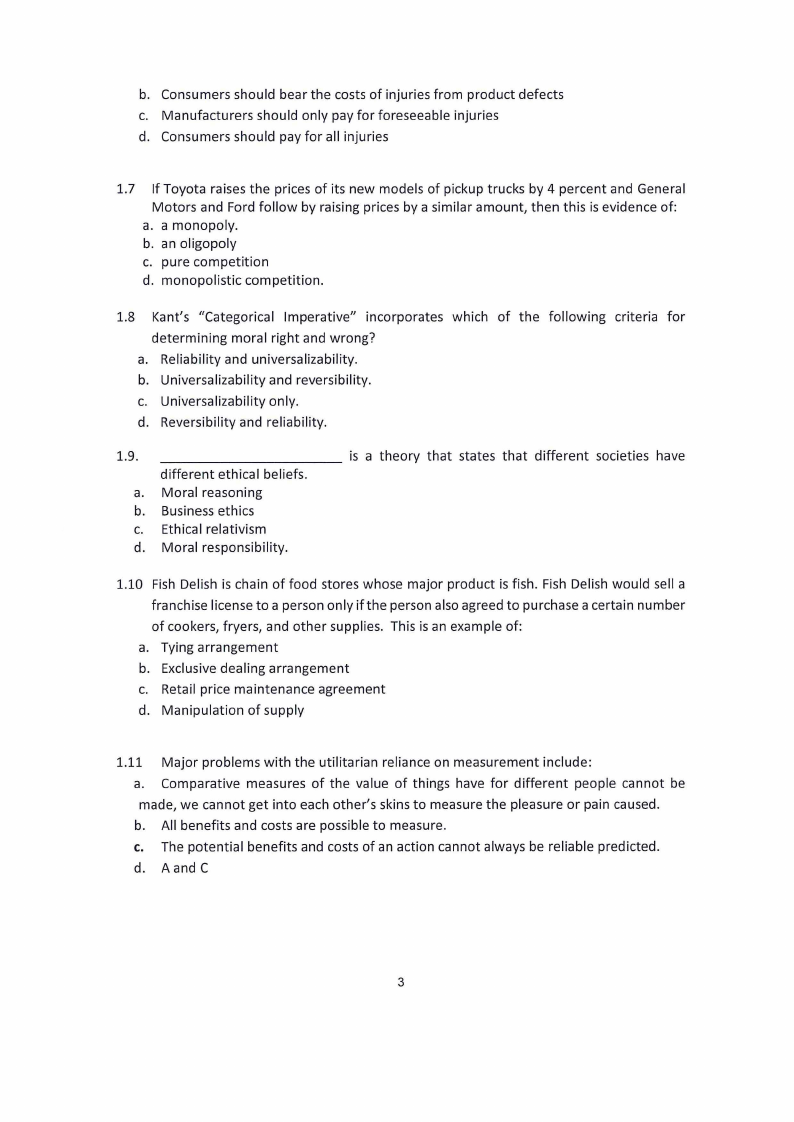
b. Consumers should bear the costs of injuries from product defects
c. Manufacturers should only pay for foreseeable injuries
d. Consumers should pay for all injuries
1.7 If Toyota raises the prices of its new models of pickup trucks by 4 percent and General
Motors and Ford follow by raising prices by a similar amount, then this is evidence of:
a. a monopoly.
b. an oligopoly
c. pure competition
d. monopolistic competition.
1.8 Kant's "Categorical Imperative" incorporates
determining moral right and wrong?
a. Reliability and universalizability.
b. Universalizability and reversibility.
c. Universalizability only.
d. Reversibility and reliability.
which of the following
criteria for
1.9.
a.
b.
c.
d.
different ethical beliefs.
Moral reasoning
Business ethics
Ethical relativism
Moral responsibility.
is a theory that states that different societies have
1.10 Fish Delish is chain of food stores whose major product is fish. Fish Delish would sell a
franchise license to a person only if the person also agreed to purchase a certain number
of cookers, fryers, and other supplies. This is an example of:
a. Tying arrangement
b. Exclusive dealing arrangement
c. Retail price maintenance agreement
d. Manipulation of supply
1.11 Major problems with the utilitarian reliance on measurement include:
a. Comparative measures of the value of things have for different people cannot be
made, we cannot get into each other's skins to measure the pleasure or pain caused.
b. All benefits and costs are possible to measure.
c. The potential benefits and costs of an action cannot always be reliable predicted.
d. A and C
3
|
|
4 Page 4 |
▲back to top |
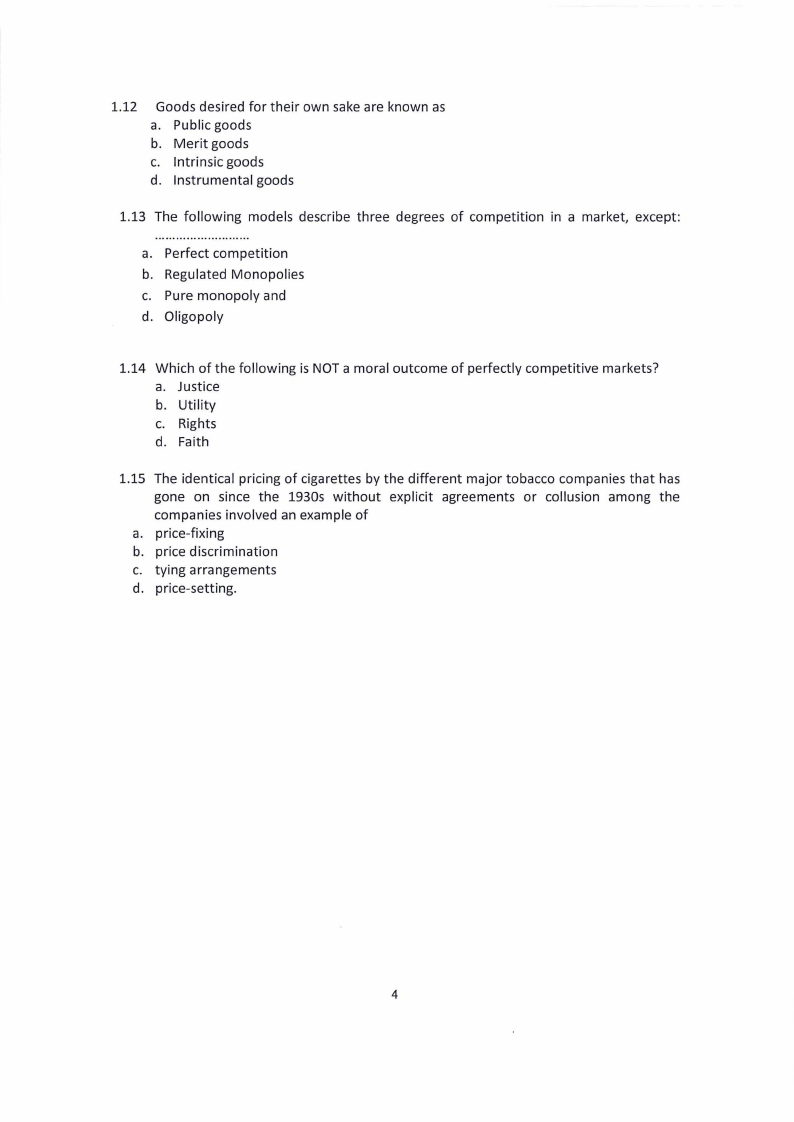
1.12 Goods desired for their own sake are known as
a. Public goods
b. Merit goods
c. Intrinsic goods
d. Instrumental goods
1.13 The following models describe three degrees of competition in a market, except:
a. Perfect competition
b. Regulated Monopolies
c. Pure monopoly and
d. Oligopoly
1.14 Which of the following is NOT a moral outcome of perfectly competitive markets?
a. Justice
b. Utility
C. Rights
d. Faith
1.15 The identical pricing of cigarettes by the different major tobacco companies that has
gone on since the 1930s without explicit agreements or collusion among the
companies involved an example of
a. price-fixing
b. price discrimination
c. tying arrangements
d. price-setting.
4
|
|
5 Page 5 |
▲back to top |
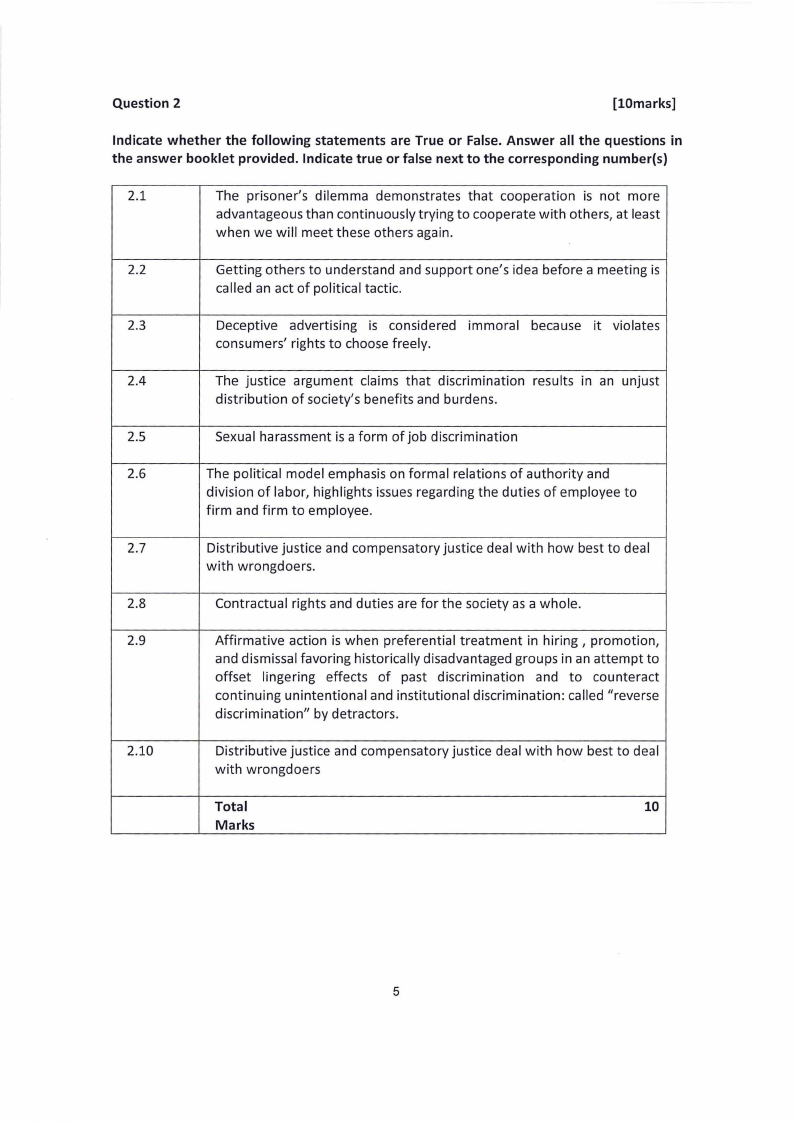
Question 2
[lOmarks]
Indicate whether the following statements are True or False. Answer all the questions in
the answer booklet provided. Indicate true or false next to the corresponding number(s)
2.1
The prisoner's dilemma demonstrates that cooperation is not more
advantageous than continuously trying to cooperate with others, at least
when we will meet these others again.
2.2
Getting others to understand and support one's idea before a meeting is
called an act of political tactic.
2.3
Deceptive advertising is considered immoral because it violates
consumers' rights to choose freely.
2.4
The justice argument claims that discrimination results in an unjust
distribution of society's benefits and burdens.
2.5
Sexual harassment is a form of job discrimination
2.6
The political model emphasis on formal relations of authority and
division of labor, highlights issues regarding the duties of employee to
firm and firm to employee.
2.7
Distributive justice and compensatory justice deal with how best to deal
with wrongdoers.
2.8
Contractual rights and duties are for the society as a whole.
2.9
Affirmative action is when preferential treatment in hiring , promotion,
and dismissal favoring historically disadvantaged groups in an attempt to
offset lingering effects of past discrimination and to counteract
continuing unintentional and institutional discrimination: called "reverse
discrimination" by detractors.
2.10
Distributive justice and compensatory justice deal with how best to deal
with wrongdoers
Total
10
Marks
5
|
|
6 Page 6 |
▲back to top |
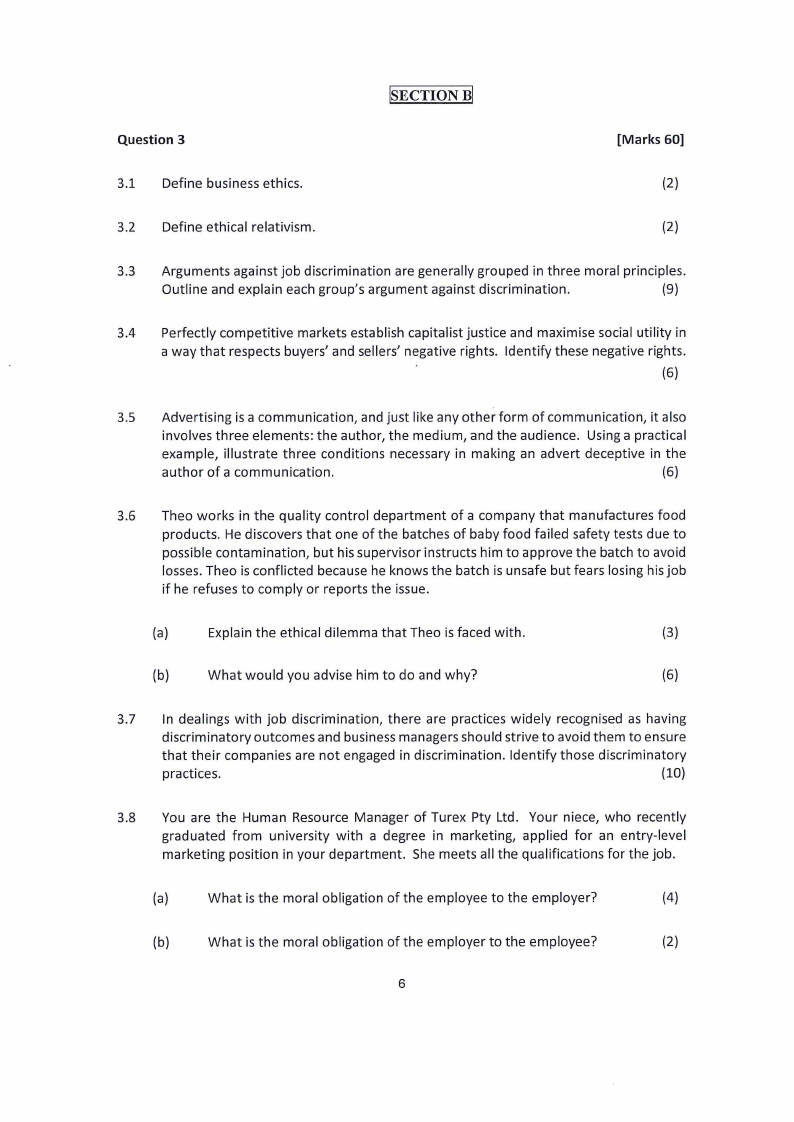
ISECTIONBI
Question 3
[Marks 60)
3.1 Define business ethics.
(2)
3.2 Define ethical relativism.
(2)
3.3 Arguments against job discrimination are generally grouped in three moral principles.
Outline and explain each group's argument against discrimination.
(9)
3.4 Perfectly competitive markets establish capitalist justice and maximise social utility in
a way that respects buyers' and sellers' negative rights. Identify these negative rights.
(6)
3.5 Advertising is a communication, and just like any other form of communication, it also
involves three elements: the author, the medium, and the audience. Using a practical
example, illustrate three conditions necessary in making an advert deceptive in the
author of a communication.
(6)
3.6 Theo works in the quality control department of a company that manufactures food
products. He discovers that one of the batches of baby food failed safety tests due to
possible contamination, but his supervisor instructs him to approve the batch to avoid
losses. Theo is conflicted because he knows the batch is unsafe but fears losing his job
if he refuses to comply or reports the issue.
(a)
Explain the ethical dilemma that Theo is faced with.
(3)
(b)
What would you advise him to do and why?
(6)
3.7 In dealings with job discrimination, there are practices widely recognised as having
discriminatory outcomes and business managers should strive to avoid them to ensure
that their companies are not engaged in discrimination. Identify those discriminatory
practices.
(10)
3.8 You are the Human Resource Manager of Turex Pty Ltd. Your niece, who recently
graduated from university with a degree in marketing, applied for an entry-level
marketing position in your department. She meets all the qualifications for the job.
(a)
What is the moral obligation of the employee to the employer?
(4)
(b)
What is the moral obligation of the employer to the employee?
(2)
6
|
|
7 Page 7 |
▲back to top |
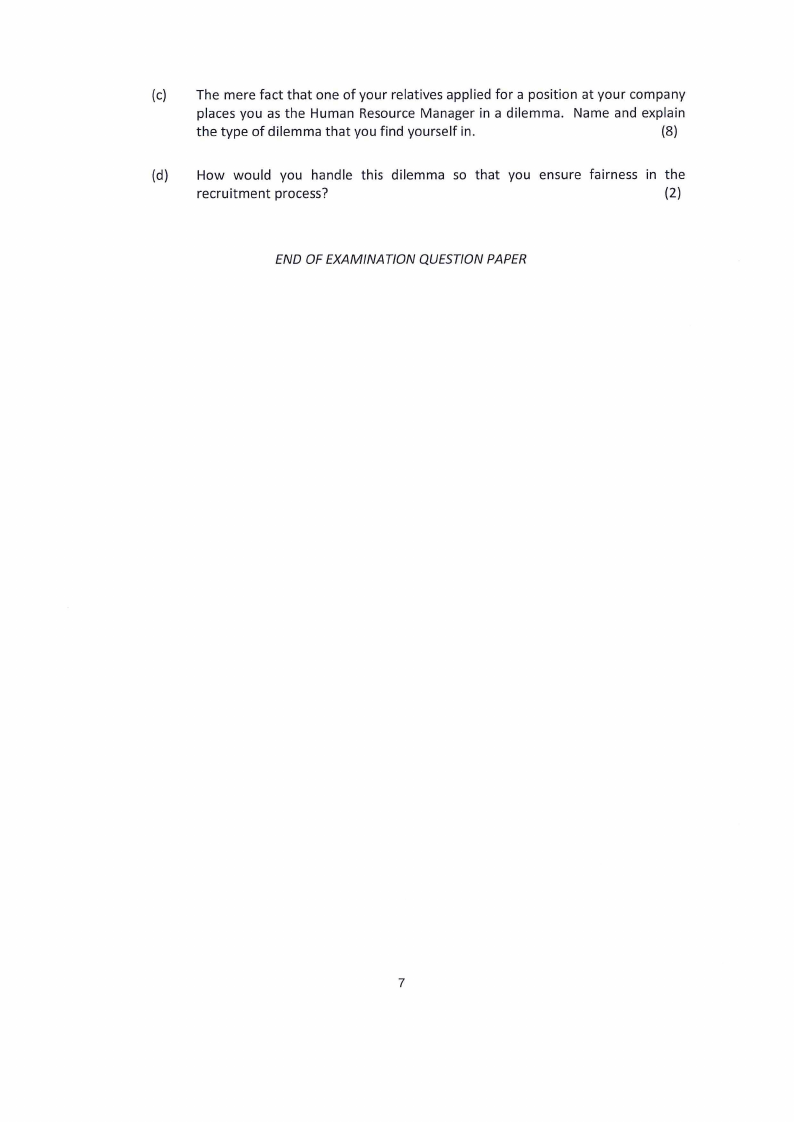
(c) The mere fact that one of your relatives applied for a position at your company
places you as the Human Resource Manager in a dilemma. Name and explain
the type of dilemma that you find yourself in.
(8)
(d) How would you handle this dilemma so that you ensure fairness in the
recruitment process?
(2)
END OF EXAMINATION QUESTIONPAPER
7