


 |
PNH610S - PLANNING FOR HOUSING - 1ST OPP - JUNE 2025 |
|
|
1 Page 1 |
▲back to top |
nAmtBIA untVERSITY
OF SCIEnCE AnD TECHnOLOGY
FACULTYOF ENGINEERINGAND THE BUILTENVIRONMENT
DEPARTMENTOF ARCHITECTUREP, LANNINGAND CONSTRUCTION
QUALIFICATION:BACHELOR OF TOWN AND REGIONAL PLANNING
QUALIFICATIONCODE:07BTAR
NQF LEVEL:6
COURSECODE: PNH610S
COURSENAME: PLANNING FOR HOUSING
DATE: JUNE 2025
PAPER: THEORY
DURATION: 3 HOURS
MARKS: 100
FIRSTOPPORTUNITYEXAMINATION QUESTIONPAPER
EXAMINER(S) Ms. GB van Rooi
MODERATOR Mr. J. Korrubel
NOTES:
1. Answer ALLthe questions.
2. Answer your questions in legible handwriting.
3. Number the answers clearly.
THIS QUESTIONPAPERCONSISTSOF 5 PAGES(includingthis front page).
PERMISSABLEMATERIAL:Black Ink Pen
|
|
2 Page 2 |
▲back to top |
Planning for Housing
PNH610S
Question 1
The Flexible Land Tenure System (FLTS)was introduced to improve land security for low-income
residents in urban areas. You are appointed as an urban planner at a Local Authority and must
integrate the Flexible Land Tenure Act, (Act No. 4 of 2012) (FLTS)into an informal settlement
upgrading project.
(a) Provide advice to the Local Authority wherein you clearly convey an understanding of the
Starter and Land Hold Titles.
(10)
A guest lecturer presented an overview of the implementation of the Flexible Land Tenure System
(FLTS)in Mariental.
(b) Recall the challenges experienced during the implementation the FLTSin Mariental.
(5)
[15]
Question 2
(a) Interpret the following statement: "Housing is both a noun and a verb".
(5)
(b) Provide a brief overview of the Modernist principles that informed Le Corbusier's "Ville de
Radieuse" concept.
(5)
[10]
Question 3
(a) Prepare a briefing document wherein you highlight the guiding principles of the National Housing
Policy as revised in 2023.
(7)
The 2009 National Housing Policy contains several strategies, relating to the provision of housing.
Although this policy has been revised in 2023, some of the older strategies are still relevant and
some have been assimilated in the latest policy.
(b) Can you identify at least three strategies that are still relevant and which have been assimilated
in to the National Housing Policy of 2023?
(3)
[10]
First Opportunity Question Paper
Page 2 of 5
June 2025
|
|
3 Page 3 |
▲back to top |
Planning for Housing
PNH610S
Question 4
The continued presence and growth of informal settlements with little or no accessto services and
infrastructure is a common feature in Namibia. There are an estimated 228,423 shacks in 308
informal settlements throughout the country. The latest statistics indicated that approximately
126,812 shack units are in the Khomas Region, and the majority thereof are found in Windhoek.
The City of Windhoek favours upgrading informal settlements In-Situ.
(a) Detail the processesthe urban planners followed to upgrade the Onyika Informal Settlement. (5)
(b) Provide a critical reflection of In-Situ informal settlement upgrading. Ensure you detail what it
entails as well as an overview of the advantages and challenges inherent in such an approach.
Refer to the upgrading of Ongulumbashe as discussed in class.
(5)
In conjunction with In-Situ upgrading, a Participatory Informal Settlement Upgrading approach to
upgrading informal settlements is generally favoured.
(c) Predict the outcome of an upgrading project that did not follow the Participatory Informal
Settlement Upgrading Approach.
(5)
[15)
Question 5
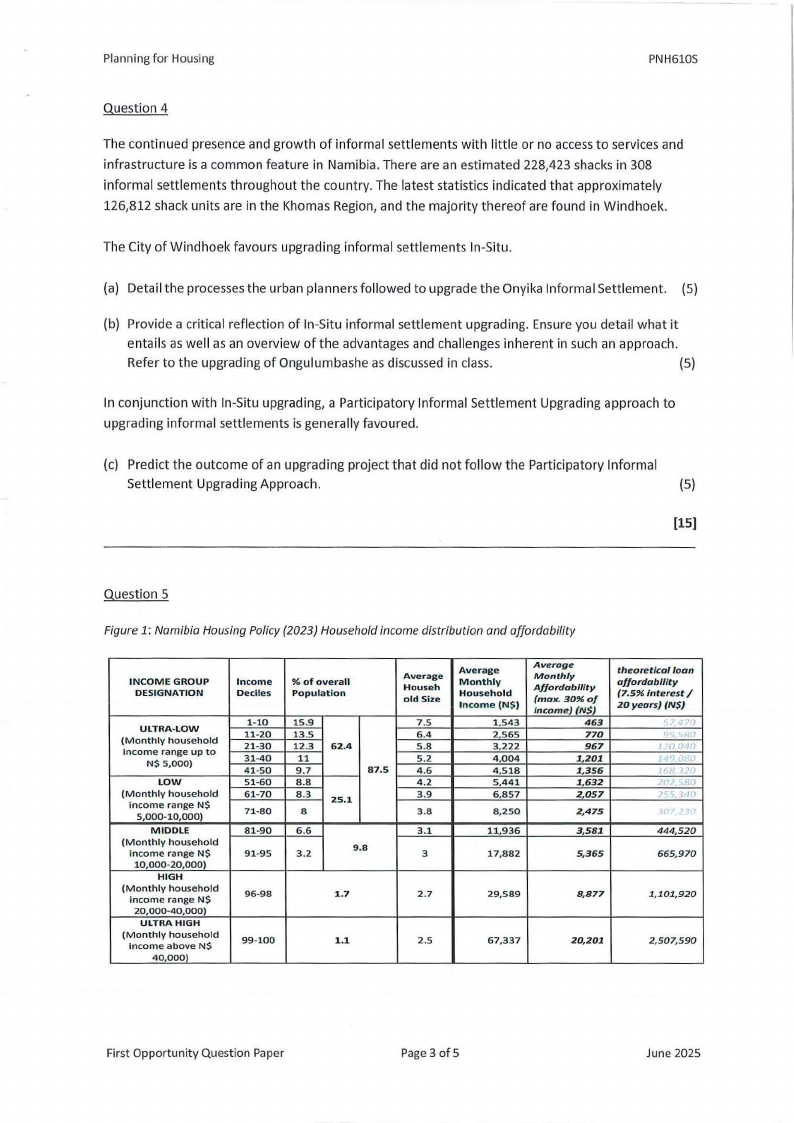
Figure 1: Namibia Housing Policy (2023) Household income distribution and affordability
INCOME GROUP
DESIGNATION
ULTRA-LOW
(Monthly household
Income range up to
NS 5,000)
LOW
(Monthly household
income range N$
5,000-10,000)
MIDDLE
(Monthly household
Income range N$
10,000-20,000)
HIGH
(Monthly household
income range N$
20,000-40,000)
ULTRAHIGH
(Monthly household
income above N$
40,000)
Income
Deciles
1-10
11-20
21-30
31-40
41-50
51-60
61-70
71-80
81-90
91-95
96-98
99-100
% of overall
Population
15.9
13.5
12.3 62.4
11
9.7
87.5
8.8
8.3
25.1
8
6.6
3.2
9.8
Average
Househ
old Size
7.5
6.4
5.8
5.2
4.6
4.2
3.9
3.8
3.1
3
Average
Monthly
Household
Income (N$)
1,543
2,565
3,222
4,004
4,518
5,441
6,857
8,250
11,936
17,882
Average
Monthly
A/fordabllity
(max. 30%of
Income) (N$}
463
770
967
1,201
1,356
1,632
2,057
2,475
3,581
5,365
theoretical loan
o/fordabll/ty
(7.5% Interest/
20 years) {N$}
~,-,
o<;'
).C(J (),l()
14'1 (>
1611 >
..l(J/ '1.~
,:.>r;, /1
444,520
665,970
1.7
2.7
29,589
8,877
1,101,920
1.1
2.5
67,337
20,201
2,507,590
First Opportunity Question Paper
Page 3 of 5
June 2025
|
|
4 Page 4 |
▲back to top |
Planning for Housing
PNH610S
(a) Evaluate the figures & statistics presented in Figure 1 and discuss which housing programme
would best suit the Ultra Low-Income group.
(5)
The main goal of the Mass Housing Programme is to cause the construction of 185 000 housing units
by the year 2030 underpinned by three objectives:
• provide access to affordable housing to the Namibian people;
• economic empowerment through ownership of a tradable asset (a house) that can be used
as security for further wealth and asset generation at household's level; and
• creating jobs and stimulating economic growth
(b) Provide a brief discussion wherein you indicate to what extent the abovementioned objectives
have been met.
(3)
The Single Quarter Transformation Programme is a subprogram me that falls under the broad
umbrella of the Built Together Programme.
(c) What advice would you as an urban planner render that could ensure the successful
transformation of these blighted units?
(2)
(10)
Question 6
The National Housing Policy (2023) requires compliance to the United Nations "Right to Adequate
Housing "principles.
(a) What are the aspects that ought to be reflected within any housing policy and programme to
ensure the output of such a programme delivers adequate housing?
(7)
The UN Committee on Economic, Social and Cultural Rights (CESCR),states that forced evictions are
"primafacie incompatible" with the right to adequate housing and other provisions in the Covenant.
It can thus be deduced that evictions are not totally ruled out.
(b) How should evictions thus be undertaken?
(3)
(10)
Question 7
Principle Thirteen of the Charter for New Urbanism states: "Within neighbourhoods, a broad range
of housing types and price levels can bring people of diverse ages, races, and incomes into daily
interaction, strengthening the personal and civic bonds essential to an authentic community".
(a) How would you adapt township layout designs to ensure this principle informs design?
(3)
First Opportunity Question Paper
Page 4 of 5
June 2025
|
|
5 Page 5 |
▲back to top |
Planning for Housing
PNH610S
One of the guiding principles of the National Housing Policy as revised in 2023 speaks of
Differentiated Housing Options and this compliments Principle Thirteen of the Charter for New
Urbanism.
(b) What are the main features of the concept.
(2)
Incremental or gentle densification of cities can significantly aide in alleviating the housing backlog.
(c) How can the Cape Town Densification Strategy be applied within Windhoek to ensure
incremental densification?
(5)
[10)
Question 8
It has been stated that there is a clear relationship between the formulation of a housing
programme for a Local Authority and its Structure Plan.
(a) Explain to a layman why that is so.
(3)
(b) What facts can you compile to support the importance of the Zoning Scheme within any
housing provision programme or projects?
(5)
(c) Provide an overview of the concepts of "high" and "low" density housing.
(2)
[10)
Question 9
It was reported that the City of Windhoek approved 1,941 building plans worth N$2.22 billion over
the 12 months ending March 2025, marking a 4.6% year-on-year increase in the number of plans and
a 21.3% rise in value. During the same period, informal settlements continued to grow and it has
been reported that there are now approximately 126,812 shack units in the Khomas Region, and the
majority thereof are found in Windhoek.
It can be thus be deduced that housing provision that led to the positive growth as reported, did not
occur in the ultra-low-income areas. This then also mean that there is a mismatch between housing
demand and provision.
(a) How can this mismatch between housing demand and supply be explained?
(5)
(b) Discusshow you as an urban planner could take the demographic profile of Windhoek into
account to determine the housing demand within the city.
(5)
First Opportunity Question Paper
TOTAL= 100
Page 5 of 5
[10)
June 2025