


 |
PNH610S - PLANNING FOR HOUSING - 2ND OPP - JULY 2025 |
|
|
1 Page 1 |
▲back to top |
nAmlBIA unlVERSITY
OF SCIEnCE Ano TECHnOLOGY
FACULTYOF ENGINEERINGAND THE BUILTENVIRONMENT
DEPARTMENTOFARCHITECTUREP, LANNINGAND CONSTRUCTION
QUALIFICATION:BACHELOR OF TOWN AND REGIONAL PLANNING
QUALIFICATIONCODE:07BTAR
NQF LEVEL:6
COURSECODE:PNH610S
COURSENAME: PLANNING FOR HOUSING
DATE: JULY 2025
PAPER: THEORY
DURATION: 3 HOURS
MARKS: 100
SECONDOPPORTUNITY/ SUPPLEMENTARYEXAMINATION QUESTION PAPER
EXAMINER(S} Ms. GB van Rooi
MODERATOR Mr. J. Korrubel
NOTES:
1. Answer ALLthe questions.
2. Answer your questions in legible handwriting.
3. Number the answers clearly.
THIS QUESTION PAPERCONSISTSOF 5 PAGES(including this front page).
PERMISSABLEMATERIAL:Black Ink Pen
|
|
2 Page 2 |
▲back to top |
Planning for Housing
PNH610S
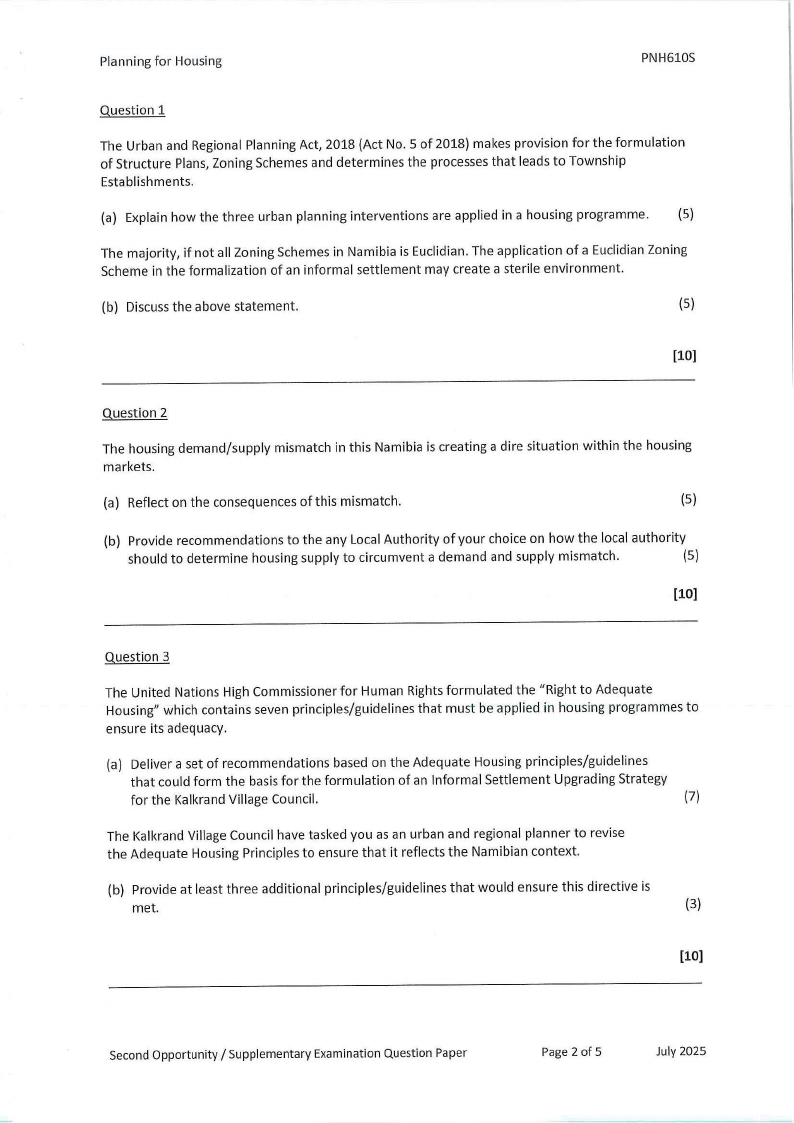
Question 1
The Urban and Regional Planning Act, 2018 (Act No. 5 of 2018) makes provision for the formulation
of Structure Plans,Zoning Schemes and determines the processes that leads to Township
Establishments.
(a) Explain how the three urban planning interventions are applied in a housing programme. (5)
The majority, if not all Zoning Schemes in Namibia is Euclidian. The application of a Euclidian Zoning
Scheme in the formalization of an informal settlement may create a sterile environment.
(b) Discussthe above statement.
(5)
[10]
Question 2
The housing demand/supply mismatch in this Namibia is creating a dire situation within the housing
markets.
(a) Reflect on the consequences of this mismatch.
(5)
(b) Provide recommendations to the any Local Authority of your choice on how the local authority
should to determine housing supply to circumvent a demand and supply mismatch.
(5)
[10]
Question 3
The United Nations High Commissioner for Human Rights formulated the "Right to Adequate
Housing" which contains seven principles/guidelines that must be applied in housing programmes to
ensure its adequacy.
(a) Deliver a set of recommendations based on the Adequate Housing principles/guidelines
that could form the basis for the formulation of an Informal Settlement Upgrading Strategy
for the Kalkrand Village Council.
(7)
The Kalkrand Village Council have tasked you as an urban and regional planner to revise
the Adequate Housing Principles to ensure that it reflects the Namibian context.
(b) Provide at least three additional principles/guidelines that would ensure this directive is
met.
(3)
[10]
Second Opportunity/ Supplementary Examination Question Paper
Page 2 of 5
July 2025
|
|
3 Page 3 |
▲back to top |
Planning for Housing
PNH610S
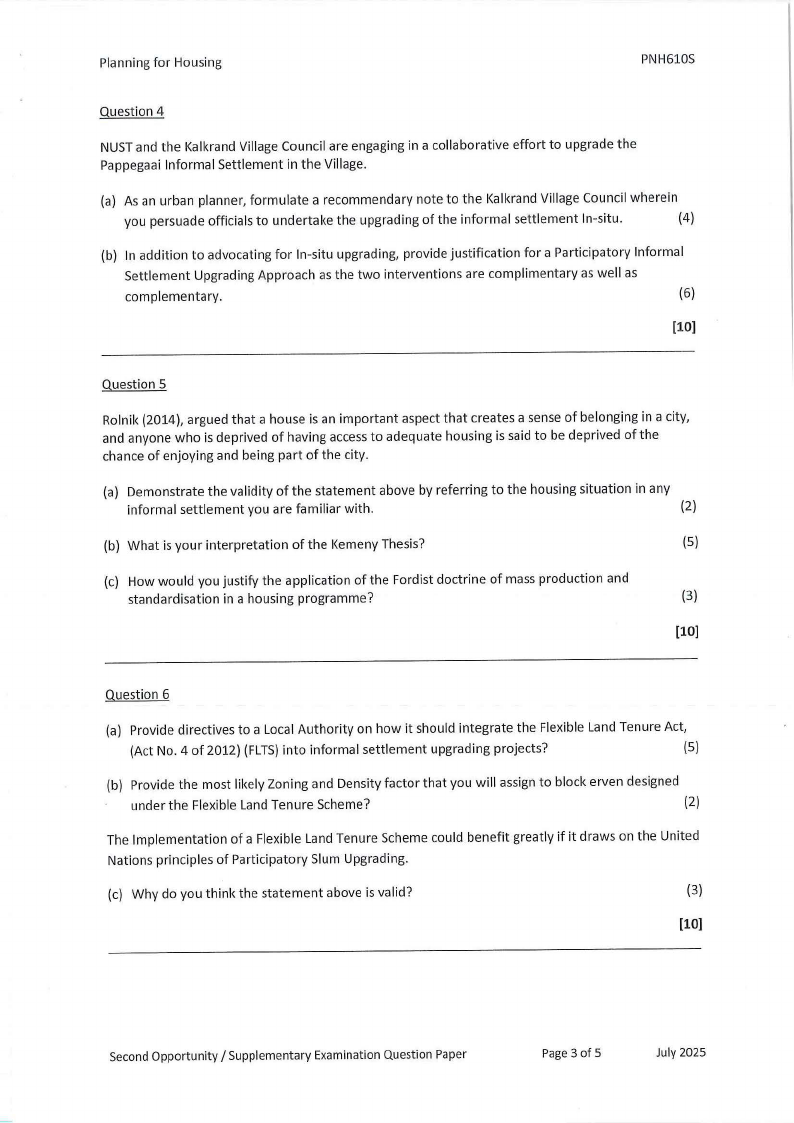
Question 4
NUSTand the Kalkrand Village Council are engaging in a collaborative effort to upgrade the
Pappegaai Informal Settlement in the Village.
(a) As an urban planner, formulate a recommendary note to the Kalkrand Village Council wherein
you persuade officials to undertake the upgrading of the informal settlement In-situ.
(4)
(b) In addition to advocating for In-situ upgrading, provide justification for a Participatory Informal
Settlement Upgrading Approach as the two interventions are complimentary as well as
complementary.
(6)
(10)
Question 5
Rolnik (2014), argued that a house is an important aspect that creates a sense of belonging in a city,
and anyone who is deprived of having accessto adequate housing is said to be deprived of the
chance of enjoying and being part of the city.
(a) Demonstrate the validity of the statement above by referring to the housing situation in any
informal settlement you are familiar with.
(2)
(b) What is your interpretation of the Kemeny Thesis?
(5)
(c) How would you justify the application of the Fordist doctrine of mass production and
standardisation in a housing programme?
(3)
(10)
Question 6
(a) Provide directives to a Local Authority on how it should integrate the Flexible Land Tenure Act,
(Act No. 4 of 2012) (FLTS)into informal settlement upgrading projects?
(5)
(b) Provide the most likely Zoning and Density factor that you will assign to block erven designed
under the Flexible LandTenure Scheme?
(2)
The Implementation of a Flexible Land Tenure Scheme could benefit greatly if it draws on the United
Nations principles of Participatory Slum Upgrading.
(c) Why do you think the statement above is valid?
(3)
(10)
Second Opportunity/ Supplementary Examination Question Paper
Page 3 of 5
July 2025
|
|
4 Page 4 |
▲back to top |
Planning for Housing
PNH610S
Question 7
Principle thirteen of the Charter for New Urbanism states: "Within neighbourhoods, a broad
range of housing types and price levels can bring people of diverse ages, races, and incomes
into daily interaction, strengthening the personal and civic bonds essential to an authentic
community."
(a) How do you think would most Namibians perceive a neighbourhood that demonstrates diversity
with respect to housing types, price levels, diverse ages, cultures, and incomes?
(2)
New Urbanist design principles have been observed in Private Townships Establishments as its
proponents aims to create "liveable communities".
(b) To what extent is social and land use diversity achieved in private township developments? (3)
(c) How would you as urban planner justify the approval of Private Townships development despite
the fact that it may contribute to sprawl and further the socio-economic divide in already
fragmented Namibian urban centres.
(5)
[10]
Question 8
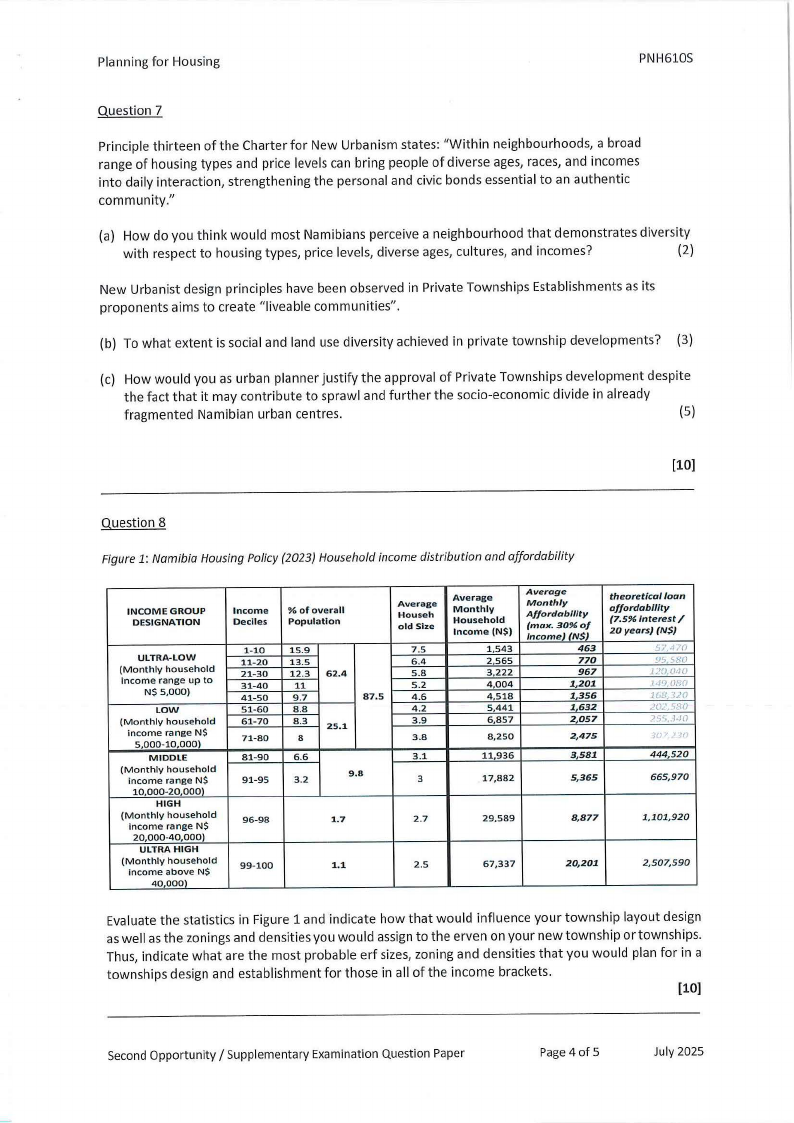
Figure 1: Namibia Housing Policy (2023} Household income distribution and affordability
INCOME GROUP
DESIGNATION
ULTRA-LOW
(Monthly household
Income range up to
N$ 5,000)
LOW
(Monthly household
income range N$
5,000-10,000)
MIDDLE
(Monthly household
income range N$
10,000-20,000)
HIGH
(Monthly household
income range N$
20,000-40,000)
ULTRA HIGH
(Monthly household
Income above N$
40,000)
Income
Deciles
1-10
11-20
21-30
31-40
41-50
51-60
61-70
71-80
81-90
91-95
96-98
99-100
% of overall
Population
15.9
13.5
12.3 62.4
11
9.7
87.S
8.8
8.3
2S.1
8
6.6
3.2
9.8
Average
Househ
old Size
7.5
6.4
5.8
5.2
4.6
4.2
3.9
3.8
3.1
3
Average
Monthly
Household
Income (N$)
1,543
2,565
3,222
4,004
4,518
5,441
6,857
8,250
11,936
17,882
Average
Monthly
Affordability
(mox. 30%of
Income) {N$)
463
770
967
1,201
1,356
1,632
2,057
2,475
3,581
5,365
theoretlc:al loan
affordability
{7.5% Interest/
20 years) {N$)
:.·l .J ·,n
YS SNU
1; 1/1,U,IV
l.S 1 1,0\\•,()
1(;8 320
.?( -·'.r.;•~(
?5~.J..,I()
)1)
'(
444,520
665,970
1.7
2.7
29,589
8,877
1,101,920
1.1
2.5
67,337
20,201
2,507,590
Evaluate the statistics in Figure 1 and indicate how that would influence your township layout design
as well as the zonings and densities you would assign to the erven on your new township or townships.
Thus, indicate what are the most probable erf sizes, zoning and densities that you would plan for in a
townships design and establishment for those in all of the income brackets.
[10]
Second Opportunity/ Supplementary Examination Question Paper
Page 4 of 5
July 2025
|
|
5 Page 5 |
▲back to top |

Planning for Housing
PNH610S
Question 9
The guiding principles of the National Housing Policy as revised in 2023 deals amongst others with
the following: Inclusive and Sustainable Urbanisation; Incremental Approaches & Differentiated
Housing Options.
(a) Deliver commentary on the policy intentions of each one of these principles.
(5)
(b) Break down the rationale/purpose of the National Housing Policy as revised in 2023.
(5)
[10]
Question 10
Buildings account for nearly 40% of energy-related CO2 emissions worldwide, making them a primary
target for reducing greenhouse gas emissions (UNEP,2022). The Namibian Building Regulations thus
need to be amended to ensure decarbonization of buildings takes place.
(a) What measures would you recommend for implementation to ensure decarbonisation of
buildings?
(3)
By 2050, Africa will be home to 1.1 billion more people than it is today. That's nearly 75% of the
world's projected population growth of 1.5 billion more people. This means a huge demand for
buildings, with 80 percent of those that will exist in 2050 yet to be built. To ensure sustainability in
African cities the Africa Manifesto for Sustainable Cities and the Built Environment was formulated.
This manifesto is not well known in Namibia.
Urban Planners and Environmentalists must thus ensure capacity building exercises are rolled out
throughout Namibia to educate those in the Built Environment as well as the public on this
manifesto. You are assigned this duty in your first task as an emerging urban planner at a Local
Authority.
(b) Deliver a set of the most important aspects contained within the manifesto that you would
convey to the political office bearers at your Council.
(7)
[10]
TOTAL= 100
Second Opportunity/ Supplementary Examination Question Paper
Page 5 of 5
July 2025