


 |
RGE811S-RANGELAND ECOLOGY-2ND OPP-JULY 2025 |
|
|
1 Page 1 |
▲back to top |
nAmI BI AunIVE RSITY
OF SCIEn CE Ano TECH n OLOGY
FACULTY OF HEALTH, NATURAL RESOURCES AND APPLIED SCIENCES
DEPARTMENT OF NATURAL RESOURCE SCIENCES
QUALIFICATION: BACHELOR of NATURAL RESOURCE MANAGEMENT HONOURS
QUALIFICATION CODE: 08BNRH
LEVEL: 8
COURSE CODE: RGE811S
COURSE NAME: RANGELANDECOLOGY
SESSION: JULY 2025
DURATION: 3 HOURS
PAPER: THEORY
MARKS: 100
SECOND OPPORTUNITY EXAMINATION QUESTION PAPER
EXAMINER(S) Prof. Ben Strohbach
MODERATOR: Dr Absalom Kahumba
INSTRUCTIONS
1. Answer ALL questions.
2. Candidates must correctly number their responses on the
ANSWER sheet.
3. Candidates are allowed to use calculators.
THIS QUESTION PAPER CONSISTS OF 3 PAGES {Including this front page)
|
|
2 Page 2 |
▲back to top |
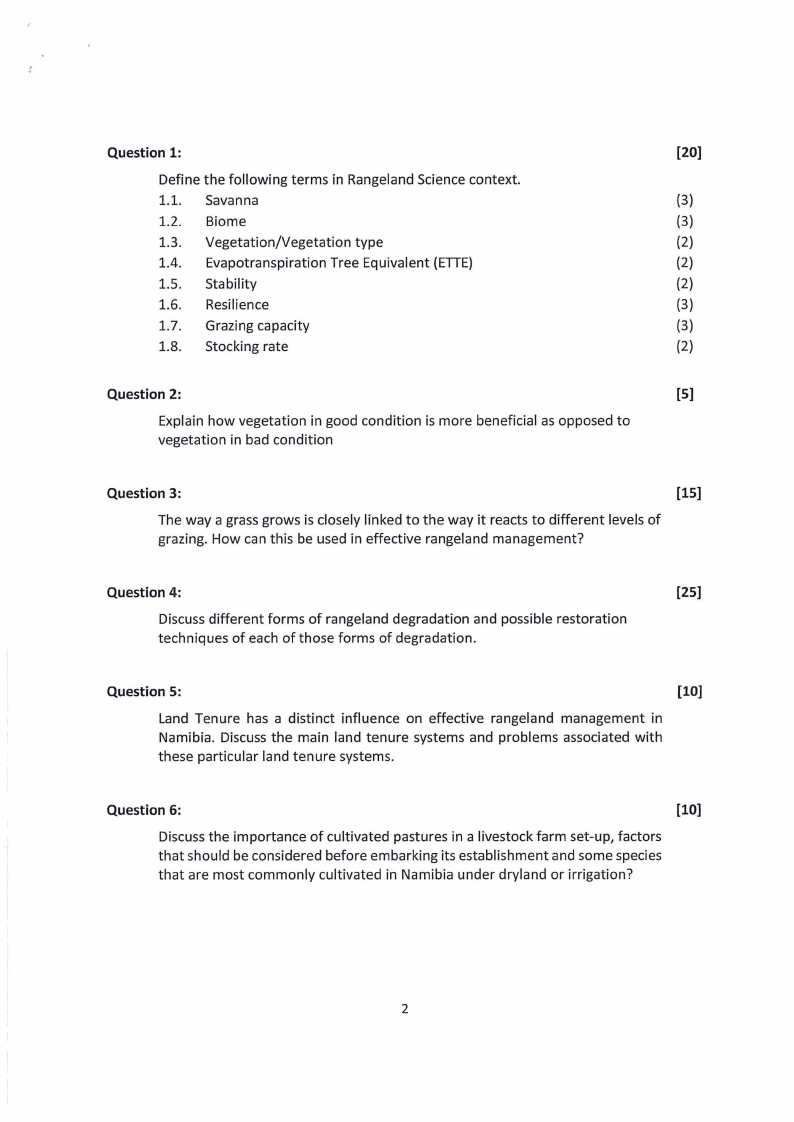
Question 1:
[20]
Define the following terms in Rangeland Science context.
1.1. Savanna
(3)
1.2. Biome
(3)
1.3. Vegetation/Vegetation type
(2)
1.4. Evapotranspiration Tree Equivalent (ETTE)
(2)
1.5. Stability
(2)
1.6. Resilience
(3)
1.7. Grazing capacity
(3)
1.8. Stocking rate
(2)
Question 2:
[5]
Explain how vegetation in good condition is more beneficial as opposed to
vegetation in bad condition
Question 3:
[15]
The way a grass grows is closely linked to the way it reacts to different levels of
grazing. How can this be used in effective rangeland management?
Question 4:
[25]
Discuss different forms of rangeland degradation and possible restoration
techniques of each of those forms of degradation.
Question 5:
[10]
Land Tenure has a distinct influence on effective rangeland management in
Namibia. Discuss the main land tenure systems and problems associated with
these particular land tenure systems.
Question 6:
[10]
Discussthe importance of cultivated pastures in a livestock farm set-up, factors
that should be considered before embarking its establishment and some species
that are most commonly cultivated in Namibia under dryland or irrigation?
2
|
|
3 Page 3 |
▲back to top |
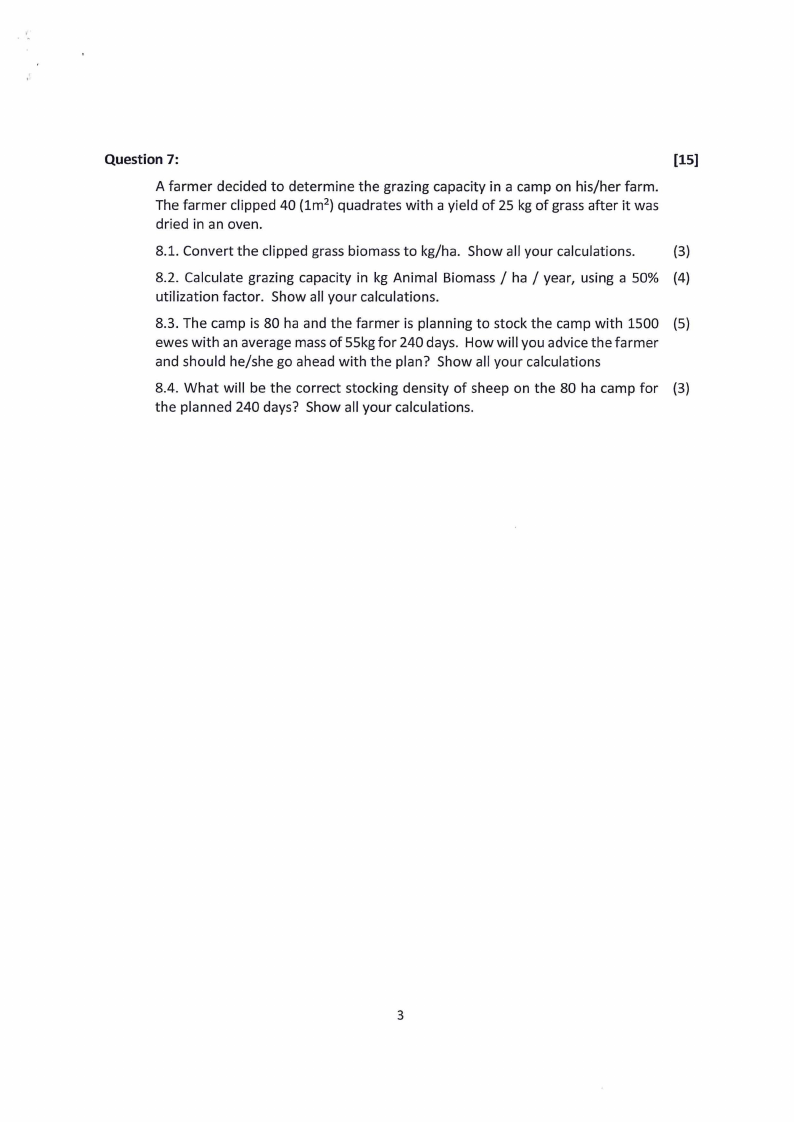
Question 7:
[15)
A farmer decided to determine the grazing capacity in a camp on his/her farm.
The farmer clipped 40 (1m2) quadrates with a yield of 25 kg of grass after it was
dried in an oven.
8.1. Convert the clipped grass biomass to kg/ha. Show all your calculations.
(3)
8.2. Calculate grazing capacity in kg Animal Biomass / ha / year, using a 50% (4)
utilization factor. Show all your calculations.
8.3. The camp is 80 ha and the farmer is planning to stock the camp with 1500 (5)
ewes with an average mass of 55kg for 240 days. How will you advice the farmer
and should he/she go ahead with the plan? Show all your calculations
8.4. What will be the correct stocking density of sheep on the 80 ha camp for (3)
the planned 240 days? Show all your calculations.
3