


 |
HEC802S-HEALTH ECONOMICS-2ND OPP-JULY 2025 |
|
|
1 Page 1 |
▲back to top |

nAmlBIA unlVERSITY
OF SCIEnCE Ano TECHnOLOGY
FACULTY OF MANAGEMENT SCIENCES
DEPARTMENT OF ECONOMICS, ACCOUNTING AND FINANCE
QUALIFICATION: BACHELOR OF ECONOMICS HONORS
QUALIFICATION CODE: 08HECO
LEVEL: 8
COURSE CODE: HEC802S
COURSE NAME: HEALTH ECONOMICS
SESSION: JULY 2025
DURATION: 3 HOURS
PAPER: THEORY
MARKS: 100
SECOND OPPORTUNITY EXAMINATION QUESTION PAPER
EXAMINER(S) MR IMMANUEL NASHIVELA
MODERATOR: MS. OLIVIA SHUULUKA
INSTRUCTIONS
1. This paper consists of 5 questions
2. Answer ALL questions
3. Number your answers in accordance with the question paper.
4. Start each question answer on a new page
5. Write clearly and legibly
PERMISSIBLE MATERIALS
1. Pen
2. Ruler
3. Calculator
THIS QUESTION PAPER CONSISTS OF Z PAGES (Including
this front
page)
|
|
2 Page 2 |
▲back to top |
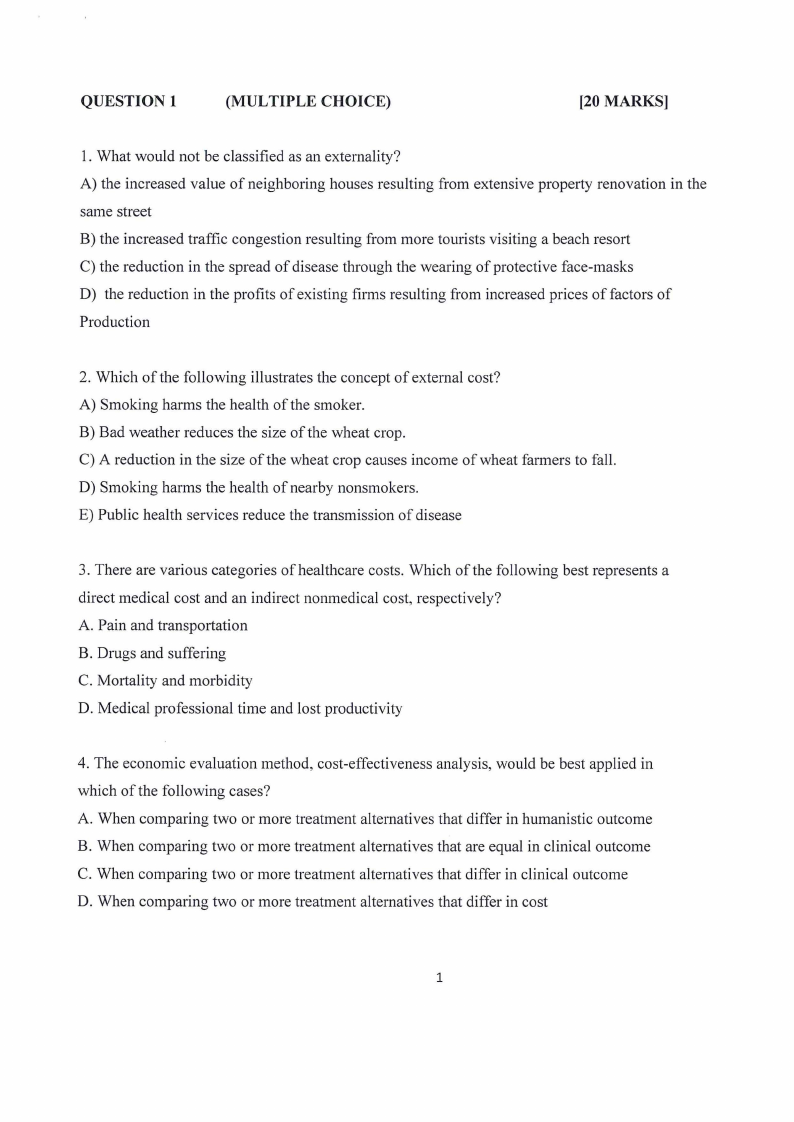
QUESTION 1
(MULTIPLE CHOICE)
[20 MARKS]
1. What would not be classified as an externality?
A) the increased value of neighboring houses resulting from extensive property renovation in the
same street
B) the increased traffic congestion resulting from more tourists visiting a beach resort
C) the reduction in the spread of disease through the wearing of protective face-masks
D) the reduction in the profits of existing firms resulting from increased prices of factors of
Production
2. Which of the following illustrates the concept of external cost?
A) Smoking harms the health of the smoker.
B) Bad weather reduces the size of the wheat crop.
C) A reduction in the size of the wheat crop causes income of wheat farmers to fall.
D) Smoking harms the health of nearby nonsmokers.
E) Public health services reduce the transmission of disease
3. There are various categories of healthcare costs. Which of the following best represents a
direct medical cost and an indirect nomnedical cost, respectively?
A. Pain and transportation
B. Drugs and suffering
C. Mo11ality and morbidity
D. Medical professional time and lost productivity
4. The economic evaluation method, cost-effectiveness analysis, would be best applied in
which of the following cases?
A. When comparing two or more treatment alternatives that differ in humanistic outcome
B. When comparing two or more treatment alternatives that are equal in clinical outcome
C. When comparing two or more treatment alternatives that differ in clinical outcome
D. When comparing two or more treatment alternatives that differ in cost
1
|
|
3 Page 3 |
▲back to top |
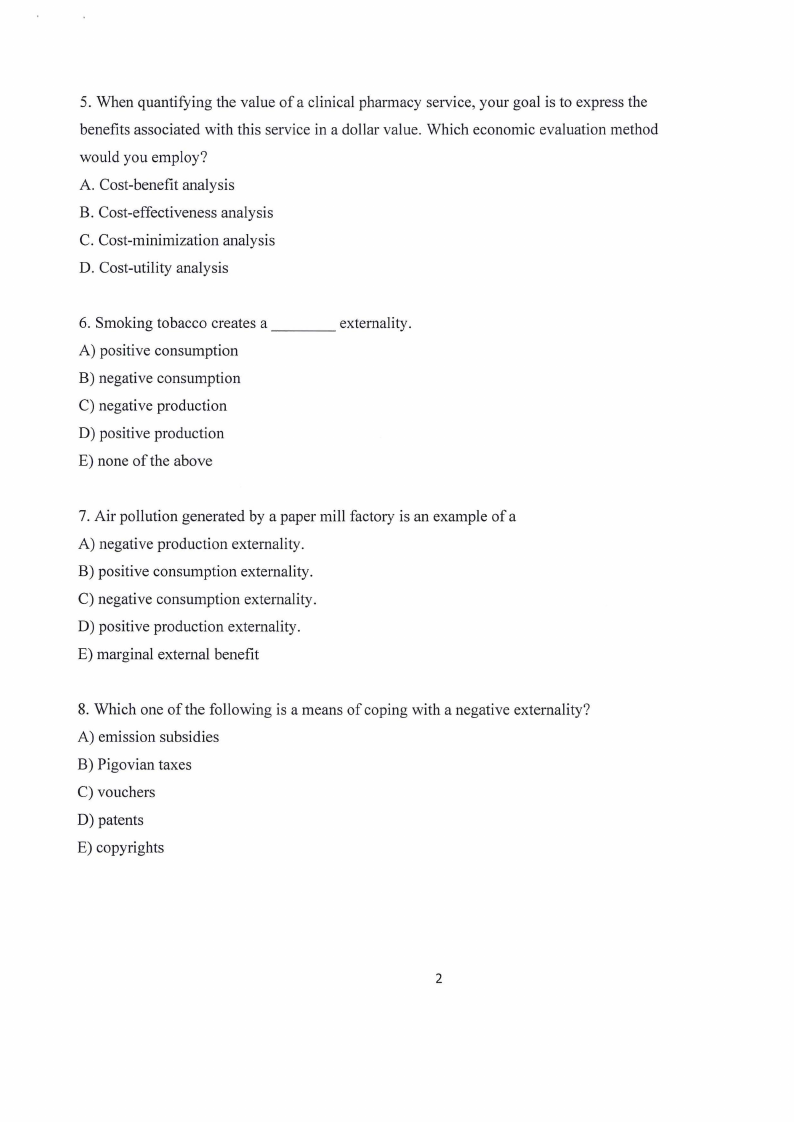
5. When quantifying the value of a clinical pharmacy service, your goal is to express the
benefits associated with this service in a dollar value. Which economic evaluation method
would you employ?
A. Cost-benefit analysis
B. Cost-effectiveness analysis
C. Cost-minimization analysis
D. Cost-utility analysis
6. Smoking tobacco creates a ____
A) positive consumption
B) negative consumption
C) negative production
D) positive production
E) none of the above
externality.
7. Air pollution generated by a paper mill factory is an example of a
A) negative production extemality.
B) positive consumption extemality.
C) negative consumption extemality.
D) positive production extemality.
E) marginal external benefit
8. Which one of the following is a means of coping with a negative extemality?
A) emission subsidies
B) Pigovian taxes
C) vouchers
D) patents
E) copyrights
2
|
|
4 Page 4 |
▲back to top |
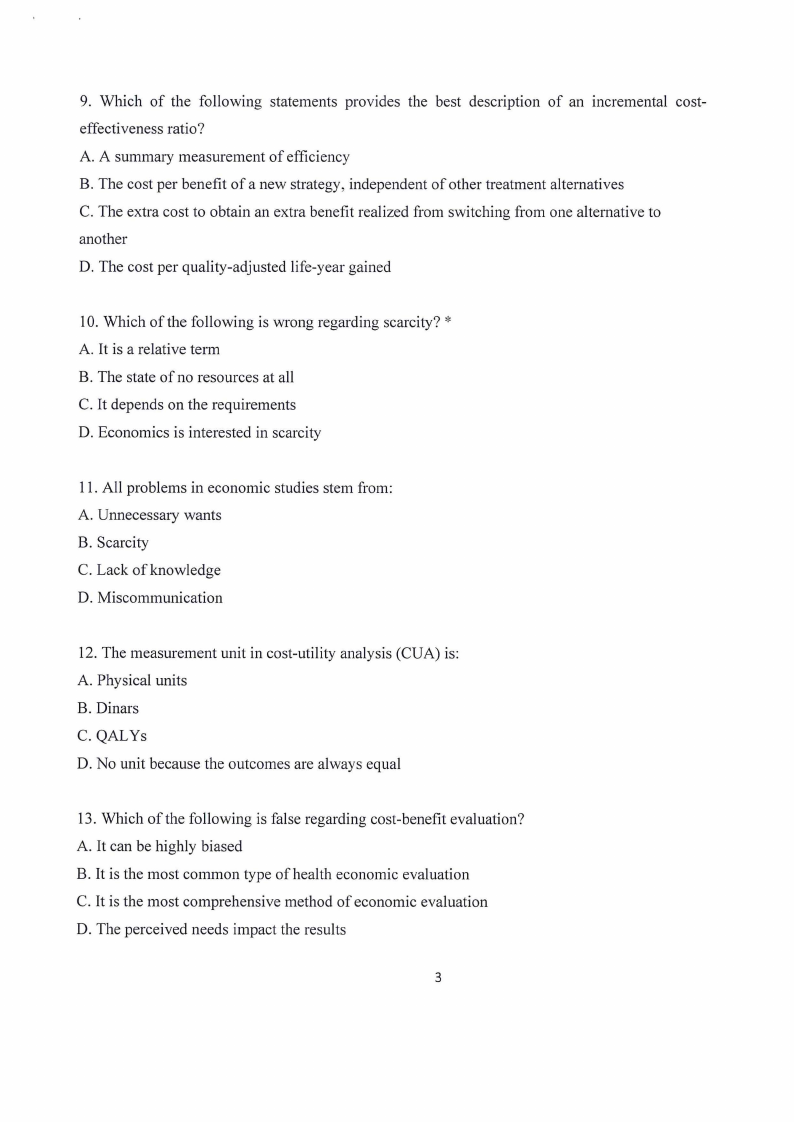
9. Which of the following statements provides the best description of an incremental cost-
effectiveness ratio?
A. A summary measurement of efficiency
B. The cost per benefit of a new strategy, independent of other treatment alternatives
C. The extra cost to obtain an extra benefit realized from switching from one alternative to
another
D. The cost per quality-adjusted life-year gained
10. Which of the following is wrong regarding scarcity?*
A. It is a relative term
B. The state of no resources at all
C. It depends on the requirements
D. Economics is interested in scarcity
11. All problems in economic studies stem from:
A. Unnecessary wants
B. Scarcity
C. Lack of knowledge
D. Miscommunication
12. The measurement unit in cost-utility analysis (CUA) is:
A. Physical units
B. Dinars
C. QALYs
D. No unit because the outcomes are always equal
13. Which of the following is false regarding cost-benefit evaluation?
A. It can be highly biased
B. It is the most common type of health economic evaluation
C. It is the most comprehensive method of economic evaluation
D. The perceived needs impact the results
3
|
|
5 Page 5 |
▲back to top |
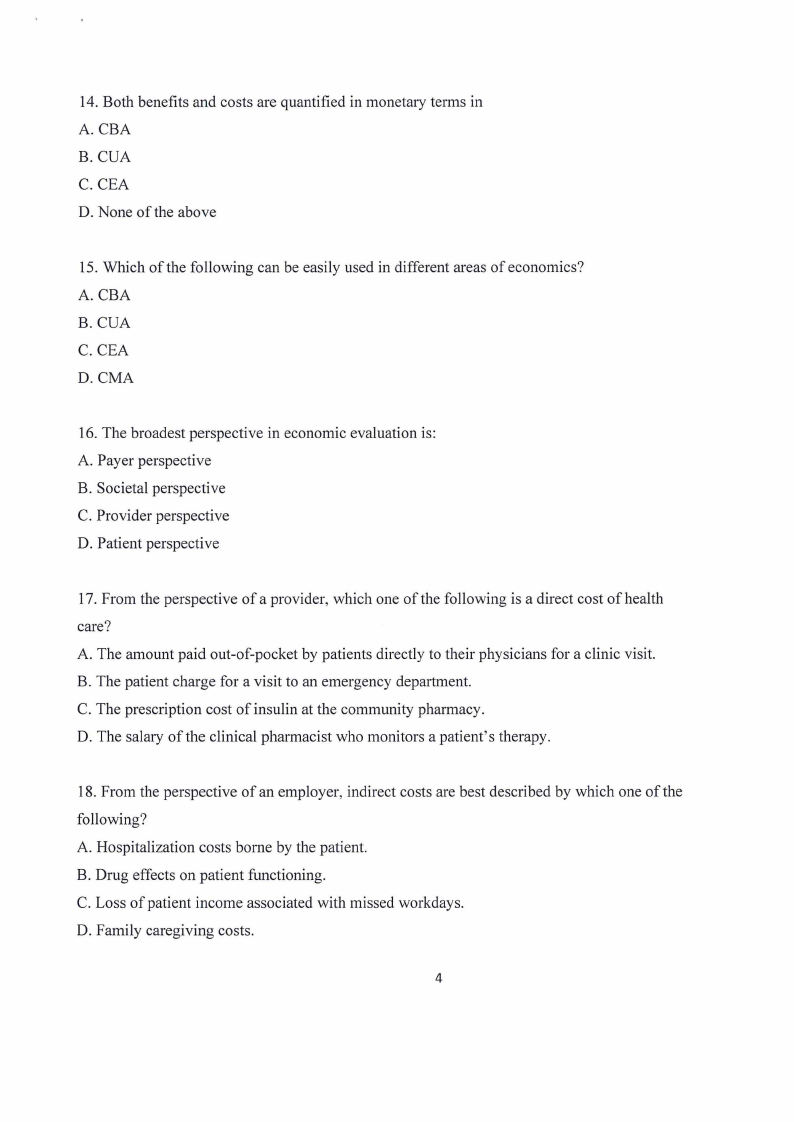
14. Both benefits and costs are quantified in monetary terms in
A.CBA
B.CUA
C.CEA
D. None of the above
15. Which of the following can be easily used in different areas of economics?
A. CBA
B.CUA
C.CEA
D.CMA
16. The broadest perspective in economic evaluation is:
A. Payer perspective
B. Societal perspective
C. Provider perspective
D. Patient perspective
17. From the perspective of a provider, which one of the following is a direct cost of health
care?
A. The amount paid out-of-pocket by patients directly to their physicians for a clinic visit.
B. The patient charge for a visit to an emergency depai1ment.
C. The prescription cost of insulin at the community pharmacy.
D. The salary of the clinical pharmacist who monitors a patient's therapy.
18. From the perspective of an employer, indirect costs are best described by which one of the
following?
A. Hospitalization costs borne by the patient.
B. Drug effects on patient functioning.
C. Loss of patient income associated with missed workdays.
D. Family caregiving costs.
4
|
|
6 Page 6 |
▲back to top |
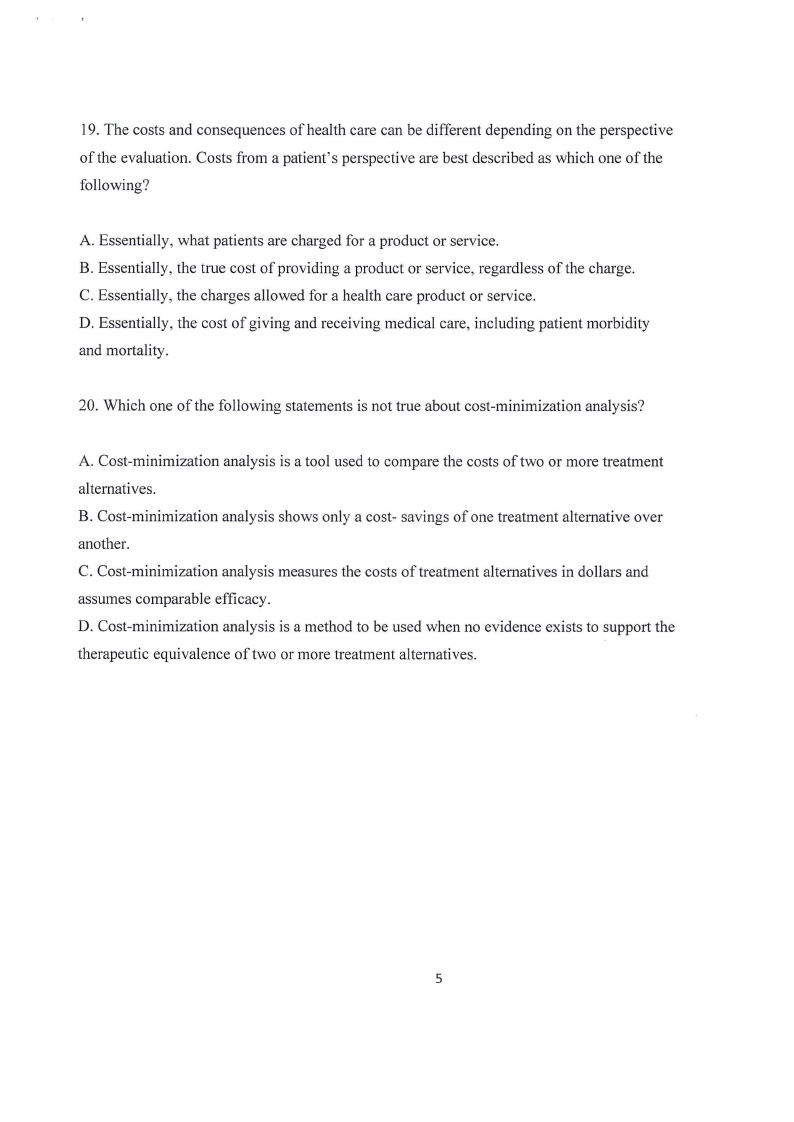
19. The costs and consequences of health care can be different depending on the perspective
of the evaluation. Costs from a patient's perspective are best described as which one of the
following?
A. Essentially, what patients are charged for a product or service.
B. Essentially, the true cost of providing a product or service, regardless ofthe charge.
C. Essentially, the charges allowed for a health care product or service.
D. Essentially, the cost of giving and receiving medical care, including patient morbidity
and mortality.
20. Which one of the following statements is not true about cost-minimization analysis?
A. Cost-minimization analysis is a tool used to compare the costs of two or more treatment
alternatives.
B. Cost-minimization analysis shows only a cost- savings of one treatment alternative over
another.
C. Cost-minimization analysis measures the costs of treatment alternatives in dollars and
assumes comparable efficacy.
D. Cost-minimization analysis is a method to be used when no evidence exists to support the
therapeutic equivalence of two or more treatment alternatives.
5
|
|
7 Page 7 |
▲back to top |
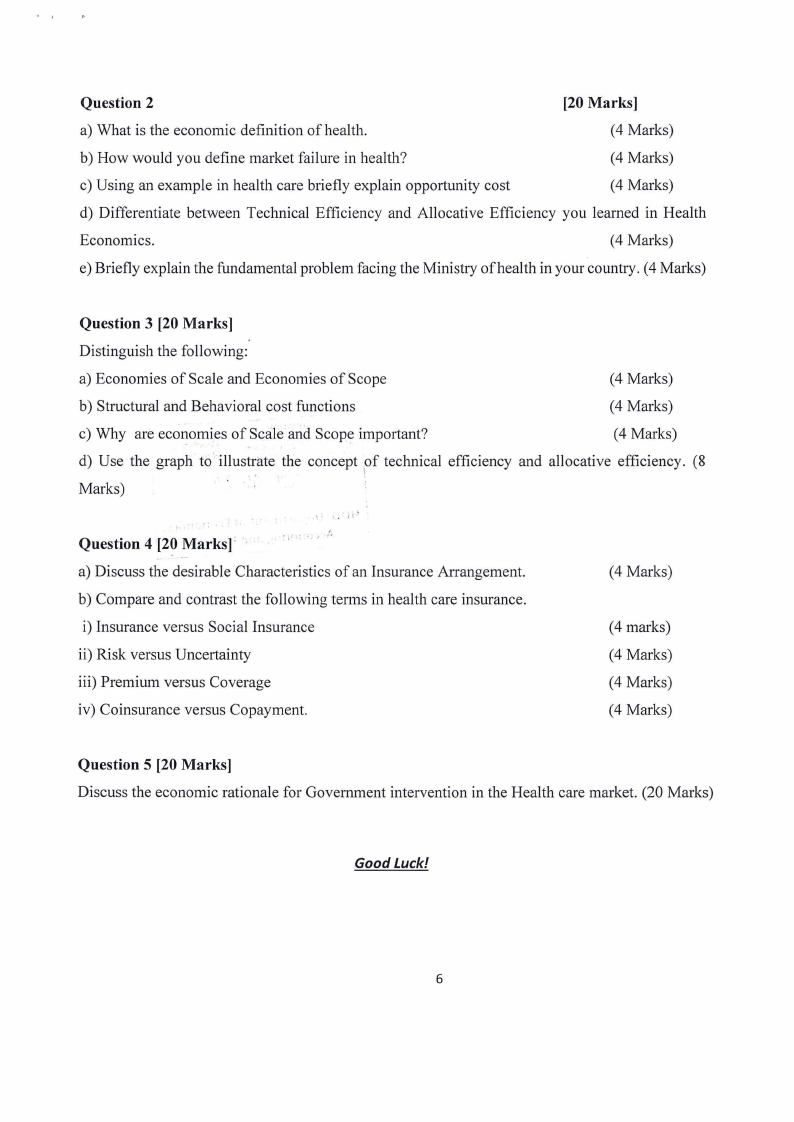
Question 2
[20 Marks]
a) What is the economic definition of health.
(4 Marks)
b) How would you define market failure in health?
(4 Marks)
c) Using an example in health care briefly explain opportunity cost
(4 Marks)
d) Differentiate between Technical Efficiency and Allocative Efficiency you learned in Health
Economics.
(4 Marks)
e) Briefly explain the fundamental problem facing the Ministry of health in your country. (4 Marks)
Question 3 [20 Marks]
Distinguish the following:
a) Economies of Scale and Economies of Scope
(4 Marks)
b) Structural and Behavioral cost functions
(4 Marks)
c) Why are economies of Scale and Scope impo1iant?
(4 Marks)
d) Use the graph to illustrate the concept _oftechnical efficiency and allocative efficiency. (8
'
I
Marks)
Question 4 [20 Marks];
•,r •.
••
,1
', ••
a) Discuss the desirable Characteristics of an Insurance Arrangement.
b) Compare and contrast the following terms in health care insurance.
i) Insurance versus Social Insurance
ii) Risk versus Unce1iainty
iii) Premium versus Coverage
iv) Coinsurance versus Copayment.
(4 Marks)
(4 marks)
(4 Marks)
(4 Marks)
(4 Marks)
Question 5 [20 Marks]
Discuss the economic rationale for Government intervention in the Health care market. (20 Marks)
Good Luck!
6