


 |
PLF621S - Policies And Legal Frameworks For Public Procurement Management - 2nd Opp - Nov 2025 |
|
|
1 Page 1 |
▲back to top |
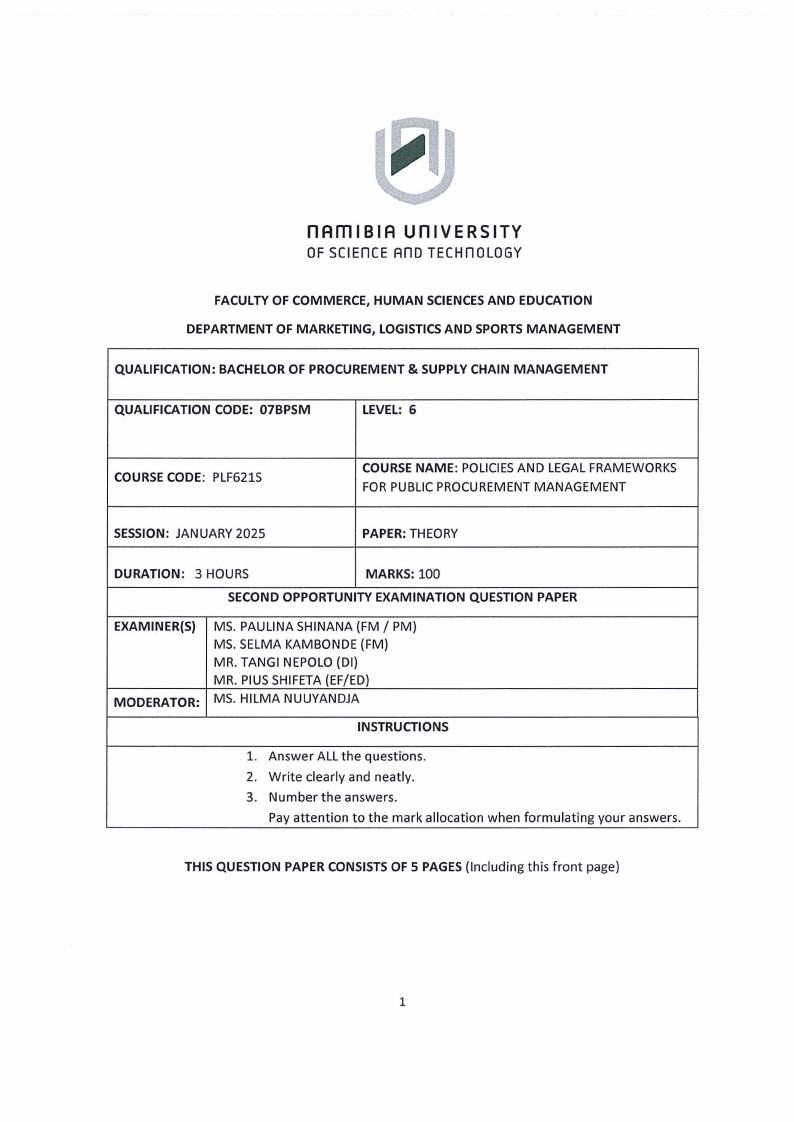
nAm I BI AunIVER sITY
OF SCIEnCE Ano TECHnOLOGY
FACULTY OF COMMERCE, HUMAN SCIENCES AND EDUCATION
DEPARTMENT OF MARKETING, LOGISTICS AND SPORTS MANAGEMENT
QUALIFICATION: BACHELOR OF PROCUREMENT & SUPPLY CHAIN MANAGEMENT
QUALIFICATION CODE: 07BPSM
LEVEL: 6
COURSE CODE : PLF621S
COURSE NAME: POLICIES AND LEGAL FRAMEWORKS
FOR PUBLIC PROCUREMENT MANAGEMENT
SESSION: JANUARY 2025
PAPER: THEORY
DURATION: 3 HOURS
MARKS: 100
SECOND OPPORTUNITY EXAMINATION QUESTION PAPER
EXAMINER(S)
MODERATOR:
MS . PAULINA SHINANA (FM/ PM)
MS. SELMA KAMBONDE (FM)
MR. TANG! NEPOLO (DI)
MR. PIUS SHIFETA (EF/ED)
MS. HILMA NUUYANDJA
INSTRUCTIONS
1. Answer ALL the questions.
2. Write clearly and neatly.
3. Number the answers .
Pay attention to the mark allocation when formulating your answers.
THIS QUESTION PAPER CONSISTS OF 5 PAGES (Including this front page)
1
|
|
2 Page 2 |
▲back to top |
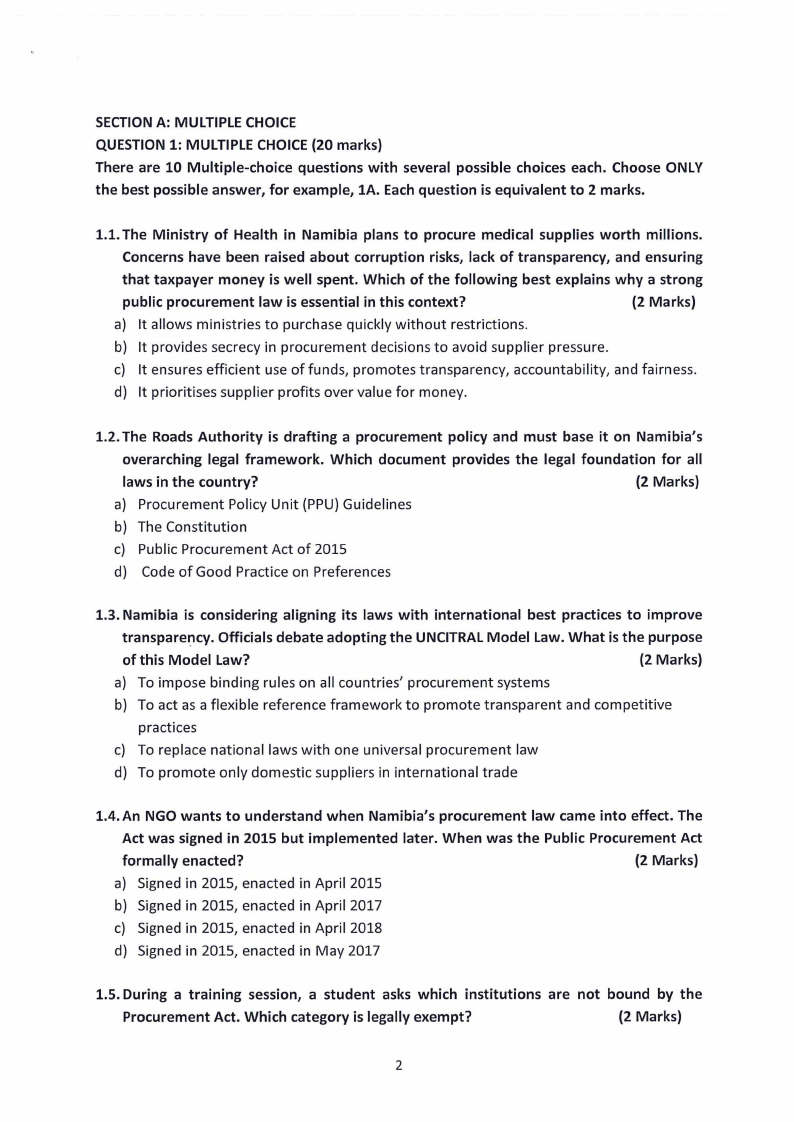
SECTION A: MULTIPLE CHOICE
QUESTION 1: MULTIPLE CHOICE (20 marks)
There are 10 Multiple-choice questions with several possible choices each. Choose ONLY
the best possible answer, for example, lA. Each question is equivalent to 2 marks.
1.1. The Ministry of Health in Namibia plans to procure medical supplies worth millions.
Concerns have been raised about corruption risks, lack of transparency, and ensuring
that taxpayer money is well spent. Which of the following best explains why a strong
public procurement law is essential in this context?
(2 Marks)
a) It allows ministries to purchase quickly without restrictions.
b) It provides secrecy in procurement decisions to avoid supplier pressure.
c) It ensures efficient use of funds, promotes transparency, accountability, and fairness .
d) It prioritises supplier profits over value for money.
1.2. The Roads Authority is drafting a procurement policy and must base it on Namibia's
overarching legal framework. Which document provides the legal foundation for all
laws in the country?
(2 Marks)
a) Procurement Policy Unit (PPU) Guidelines
b) The Constitution
c) Public Procurement Act of 2015
d) Code of Good Practice on Preferences
1.3. Namibia is considering aligning its laws with international best practices to improve
transparer:icy. Officials debate adopting the UNCITRAL Model Law. What is the purpose
of this Model Law?
(2 Marks)
a) To impose binding rules on all countries' procurement systems
b) To act as a flexible reference framework to promote transparent and competitive
practices
c) To replace national laws with one universal procurement law
d) To promote only domestic suppliers in international trade
1.4. An NGO wants to understand when Namibia's procurement law came into effect. The
Act was signed in 2015 but implemented later. When was the Public Procurement Act
formally enacted?
(2 Marks)
a) Signed in 2015, enacted in April 2015
b) Signed in 2015, enacted in April 2017
c) Signed in 2015, enacted in April 2018
d) Signed in 2015, enacted in May 2017
1.5. During a training session, a student asks which institutions are not bound by the
Procurement Act. Which category is legally exempt?
(2 Marks)
2
|
|
3 Page 3 |
▲back to top |
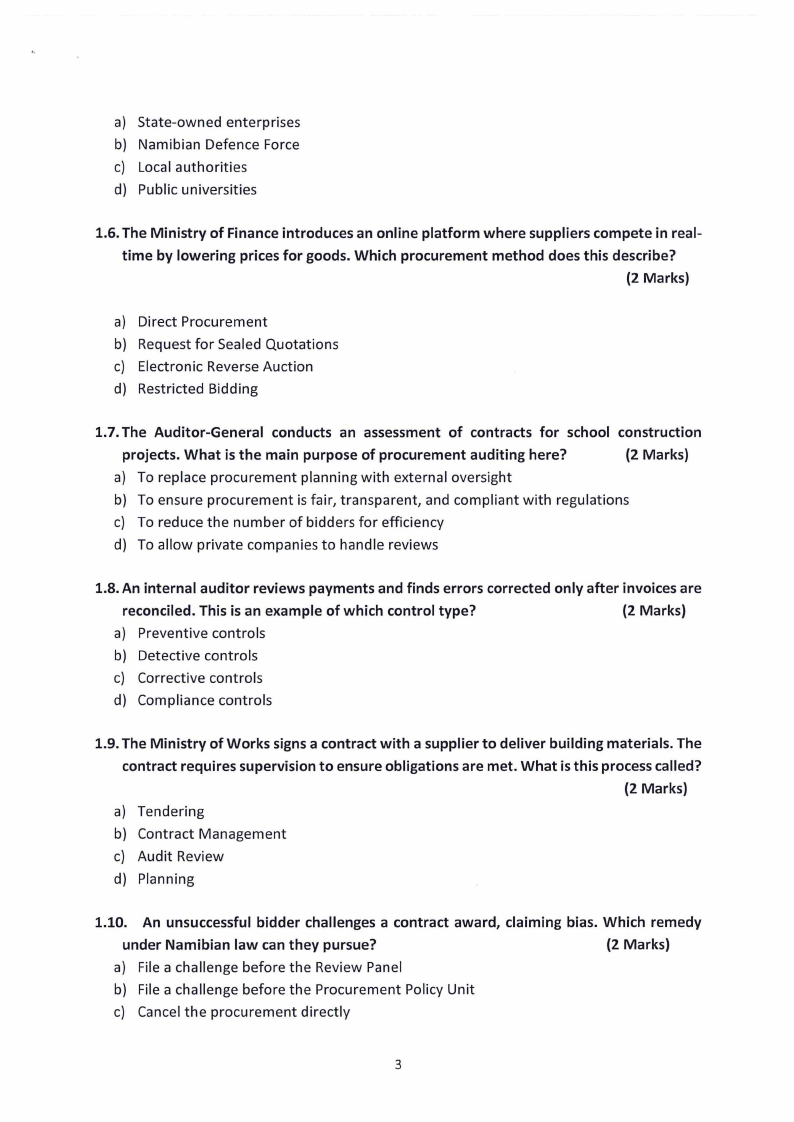
a} State-owned enterprises
b} Namibian Defence Force
c} Local authorities
d} Public universities
1.6. The Ministry of Finance introduces an online platform where suppliers compete in real-
time by lowering prices for goods. Which procurement method does this describe?
(2 Marks)
a} Direct Procurement
b} Request for Sealed Quotations
c} Electronic Reverse Auction
d} Restricted Bidding
1.7. The Auditor-General conducts an assessment of contracts for school construction
projects. What is the main purpose of procurement auditing here?
(2 Marks)
a} To replace procurement planning with external oversight
b} To ensure procurement is fair, transparent, and compliant with regulations
c} To reduce the number of bidders for efficiency
d} To allow private companies to handle reviews
1.8. An internal auditor reviews payments and finds errors corrected only after invoices are
reconciled. This is an example of which control type?
(2 Marks)
a} Preventive controls
b} Detective controls
c} Corrective controls
d} Compliance controls
1.9. The Ministry of Works signs a contract with a supplier to deliver building materials. The
contract requires supervision to ensure obligations are met. What is this process called?
(2 Marks)
a} Tendering
b} Contract Management
c} Audit Review
d} Planning
1.10. An unsuccessful bidder challenges a contract award, claiming bias. Which remedy
under Namibian law can they pursue?
(2 Marks)
a} File a challenge before the Review Panel
b} File a challenge before the Procurement Policy Unit
c} Cancel the procurement directly
3
|
|
4 Page 4 |
▲back to top |
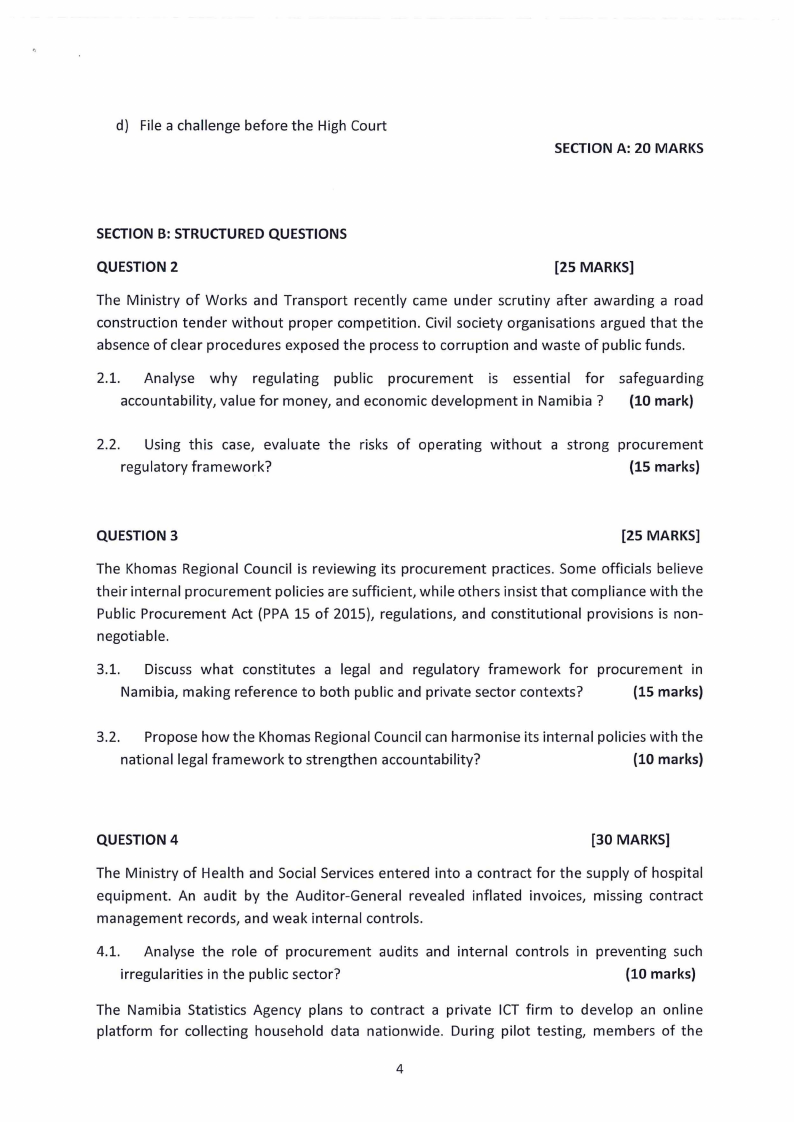
d) File a challenge before the High Court
SECTION A: 20 MARKS
SECTION B: STRUCTURED QUESTIONS
QUESTION 2
[25 MARKS]
The Ministry of Works and Transport recently came under scrutiny after awarding a road
construction tender w ithout proper competition. Civil society organisations argued that the
absence of clear procedures exposed the process to corruption and waste of public funds.
2.1. Analyse why regulating public procurement is essential for safeguarding
accountability, value for money, and economic development in Namibia ? (10 mark)
2.2. Using this case, evaluate the risks of operating without a strong procurement
regulatory framework?
(15 marks)
QUESTION 3
[25 MARKS]
The Khomas Regional Council is reviewing its procurement practices. Some officials believe
their internal procurement policies are sufficient, while others insist that compliance with the
Public Procurement Act (PPA 15 of 2015), regulations, and constitutional provisions is non-
negotiable.
3.1. Discuss what constitutes a legal and regulatory framework for procurement in
Namibia, making reference to both public and private sector contexts?
(15 marks)
3.2. Propose how the Khomas Regional Council can harmonise its internal policies with the
national legal framework to strengthen accountability?
(10 marks)
QUESTION 4
[30 MARKS]
The Ministry of Health and Social Services entered into a contract for the supply of hospital
equipment. An audit by the Auditor-General revealed inflated invoices, missing contract
management records, and weak internal controls.
4.1. Analyse the role of procurement audits and internal controls in preventing such
irregularities in the public sector?
(10 marks)
The Namibia Statistics Agency plans to contract a private ICT firm to develop an online
platform for collecting household data nationwide. During pilot testing, members of the
4
|
|
5 Page 5 |
▲back to top |
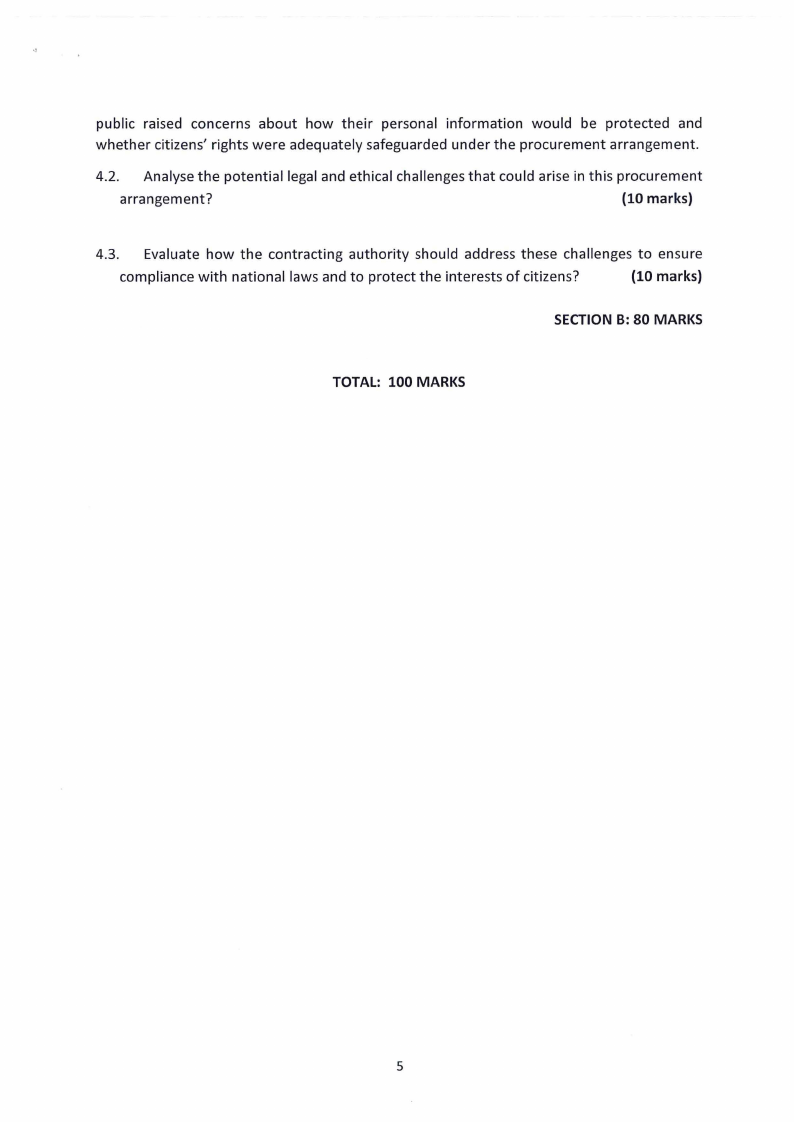
public raised concerns about how their personal information would be protected and
whether citizens' rights were adequately safeguarded under the procurement arrangement.
4.2. Analyse the potential legal and ethical challenges that could arise in this procurement
arrangement?
(10 marks)
4.3 . Evaluate how the contracting authority should address these challenges to ensure
compliance with national laws and to protect the interests of citizens?
(10 marks)
SECTION B: 80 MARKS
TOTAL: 100 MARKS
5