


 |
CIB810S-CONTEMPORARY ISSUES IN BANKING AND FINANCE-2ND OPP- JULY 2025 |
|
|
1 Page 1 |
▲back to top |
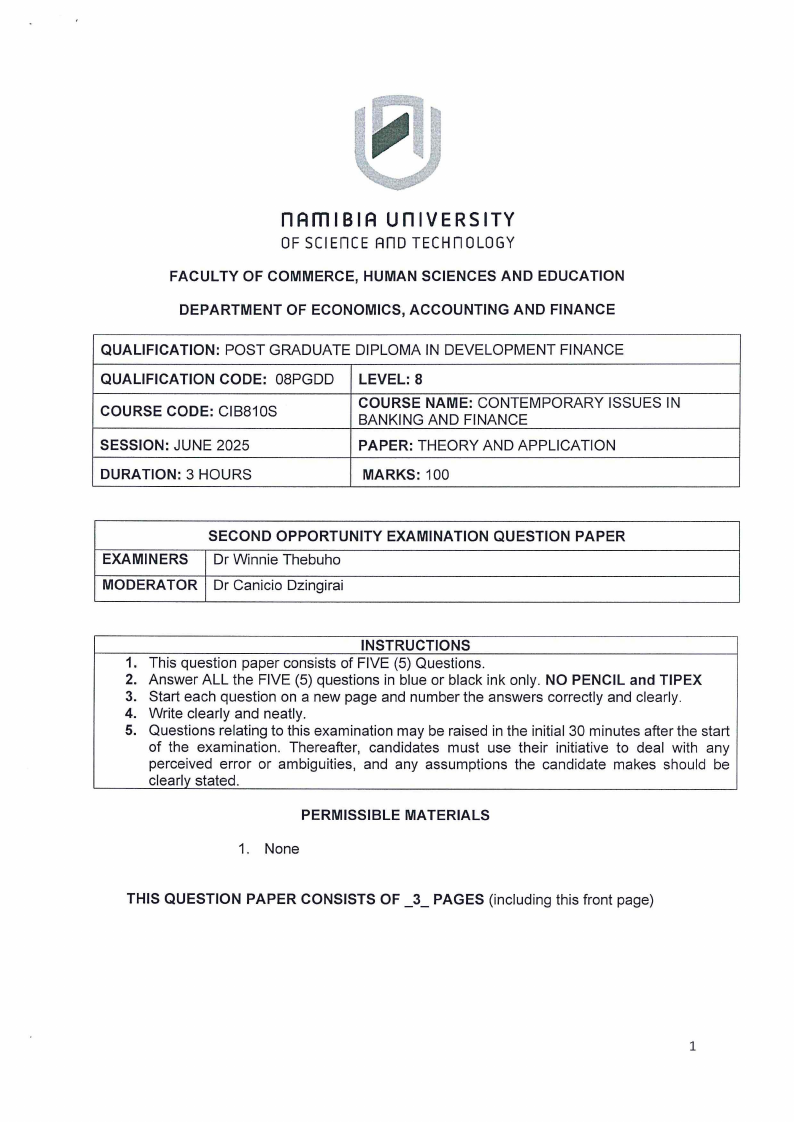
nAmlBIA unlVERSITY
OF SCIEnCE Ano TECHn OLOGY
FACULTY OF COMMERCE, HUMAN SCIENCES AND EDUCATION
DEPARTMENT OF ECONOMICS, ACCOUNTING AND FINANCE
QUALIFICATION: POST GRADUATE DIPLOMA IN DEVELOPMENT FINANCE
QUALi FiCA TION CODE: 08PGDD
COURSE CODE: CIB810S
SESSION: JUNE 2025
LEVEL:8
COURSENAME:CONTEMPORARYISSUESIN
BANKING AND FINANCE
PAPER: THEORY AND APPLICATION
DURATION: 3 HOURS
MARKS: 100
EXAMINERS
MODERATOR
SECOND OPPORTUNITY EXAMINATION QUESTION PAPER
Dr Winnie Thebuho
Dr Canicio Dzingirai
INSTRUCTIONS
1. This question paper consists of FIVE (5) Questions.
2. Answer ALL the FIVE (5) questions in blue or black ink only. NO PENCIL and TIPEX
3. Start each question on a new page and number the answers correctly and clearly.
4. Write clearly and neatly.
5. Questions relating to this examination may be raised in the initial 30 minutes after the start
of the examination. Thereafter, candidates must use their initiative to deal with any
perceived error or ambiguities, and any assumptions the candidate makes should be
clearly stated.
PERMISSIBLE MATERIALS
1. None
THIS QUESTION PAPER CONSISTS OF _3_ PAGES (including this front page)
1
|
|
2 Page 2 |
▲back to top |
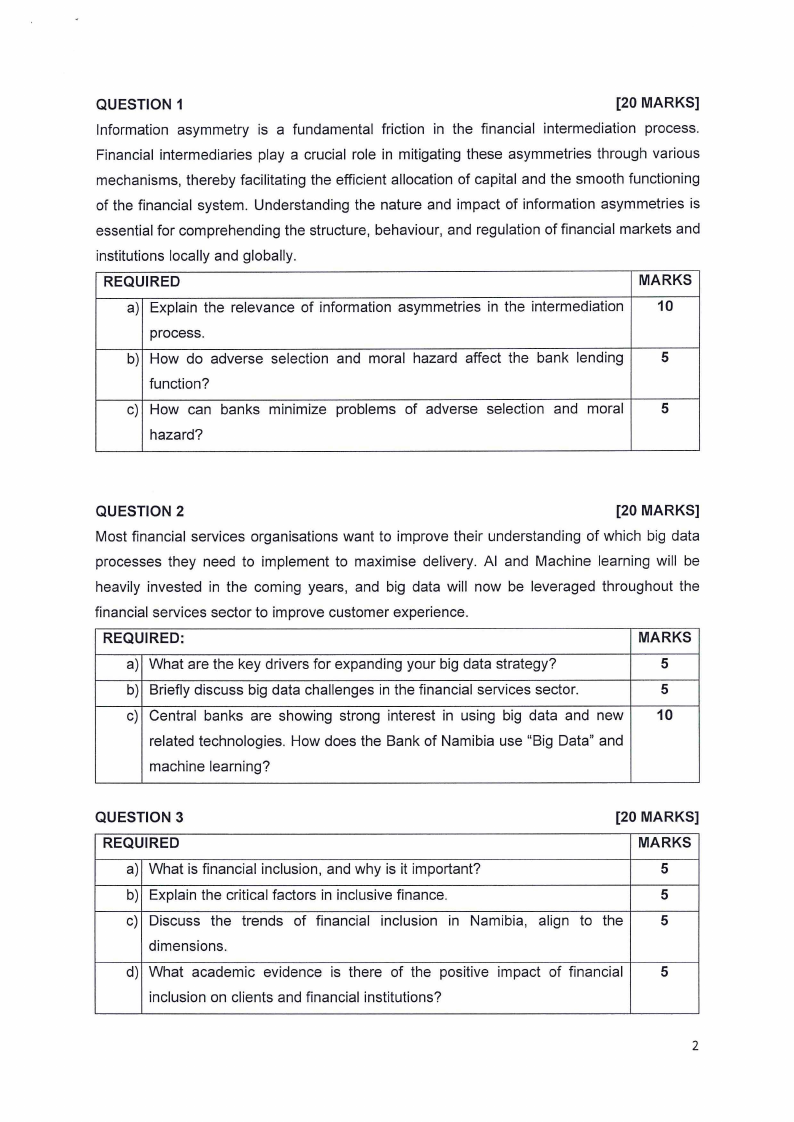
QUESTION 1
[20 MARKS]
Information asymmetry is a fundamental friction in the financial intermediation process.
Financial intermediaries play a crucial role in mitigating these asymmetries through various
mechanisms, thereby facilitating the efficient allocation of capital and the smooth functioning
of the financial system. Understanding the nature and impact of information asymmetries is
essential for comprehending the structure, behaviour, and regulation of financial markets and
institutions locally and globally.
REQUIRED
MARKS
a) Explain the relevance of information asymmetries in the intermediation
10
process.
b) How do adverse selection and moral hazard affect the bank lending
5
function?
c) How can banks minimize problems of adverse selection and moral
5
hazard?
QUESTION 2
[20 MARKS]
Most financial services organisations want to improve their understanding of which big data
processes they need to implement to maximise delivery. Al and Machine learning will be
heavily invested in the coming years, and big data will now be leveraged throughout the
financial services sector to improve customer experience.
REQUIRED:
MARKS
a) What are the key drivers for expanding your big data strategy?
5
b) Briefly discuss big data challenges in the financial services sector.
5
c) Central banks are showing strong interest in using big data and new 10
related technologies. How does the Bank of Namibia use "Big Data" and
machine learning?
QUESTION 3
[20 MARKS]
REQUIRED
MARKS
a) What is financial inclusion, and why is it important?
5
b) Explain the critical factors in inclusive finance.
5
c) Discuss the trends of financial inclusion in Namibia, align to the
5
dimensions.
d) What academic evidence is there of the positive impact of financial
5
inclusion on clients and financial institutions?
2
|
|
3 Page 3 |
▲back to top |
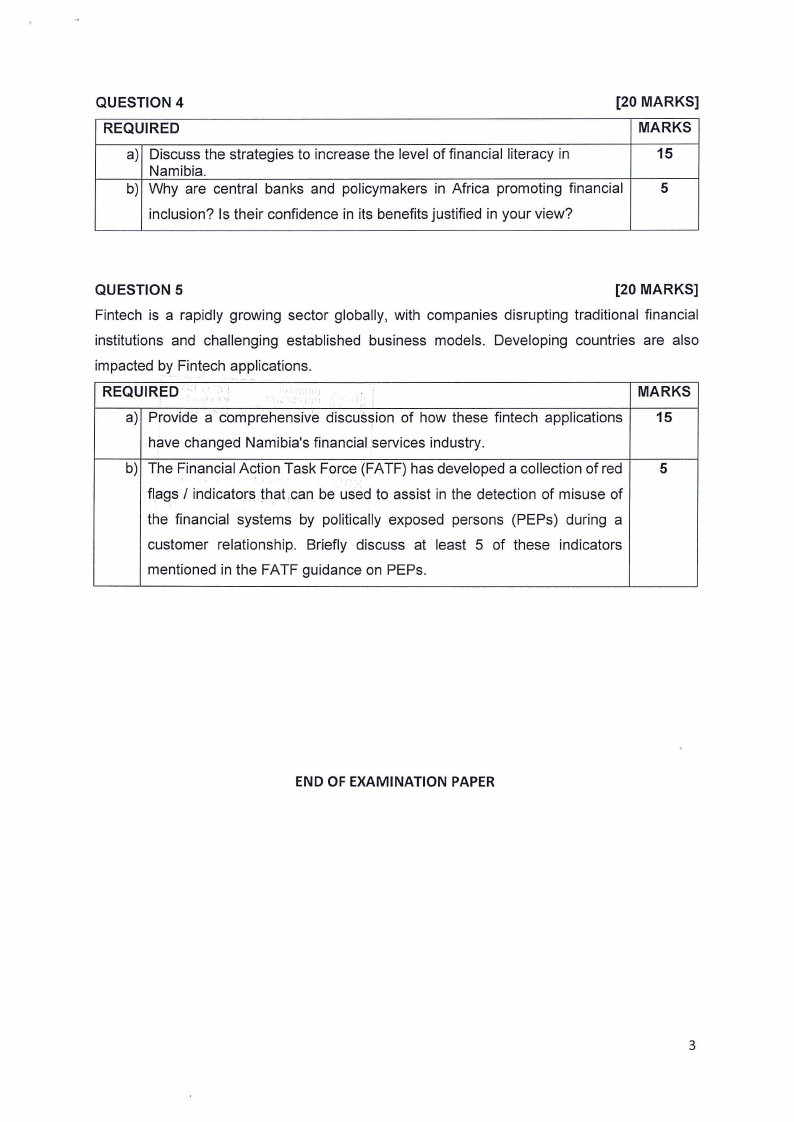
QUESTION 4
[20 MARKS]
REQUIRED
MARKS
a) Discuss the strategies to increase the level of financial literacy in
15
Namibia.
b) Why are central banks and policymakers in Africa promoting financial
5
inclusion? Is their confidence in its benefits justified in your view?
QUESTION 5
[20 MARKS]
Fintech is a rapidly growing sector globally, with companies disrupting traditional financial
institutions and challenging established business models. Developing countries are also
impacted by Fintech applications .
..
REQUIRED -· .. ,
a) Provide a· comprehensive discussion of how these fintech applications
MARKS
15
have changed Namibia's financial .services industry.
b) The Financial A~tion Task Force (FATF) has developed a collection of red
5
flags I indicator~ thatcan be used to assist in the detection of misuse of
the financial systems by politically exposed persons (PEPs) during a
customer relationship. Briefly discuss at least 5 of these indicators
mentioned in the FATF guidance on PEPs.
END OF EXAMINATION PAPER
3