


 |
ITT611S - INTELLIGENT TRANSPORTATION SYSTEMS - 1ST OPP - JUNE 2025 |
|
|
1 Page 1 |
▲back to top |
nAmlBIA UnlVERSITY
OF SCIEnCE Ano TECHnOLOGY
FACULTY OF COMMERCE, HUMAN SCIENCES AND EDUCATION
DEPARTMENT OF MARKETING, LOGISTICS AND SPORT MANAGEMENT
QUALIFICATION: BACHELOROF TRANSPORT MANAGEMENT
QUALIFICATION CODE: 07BTRA
LEVEL: 6
COURSE: INTELLIGENTTRANSPORTSYSTEMS COURSE CODE: ITT611S
SESSION: JUNE 2025
DURATION: 3 HOURS
PAPER: THEORY
MARKS: 100
EXAMINERS
FIRST OPPORTUNITY EXAMINATION QUESTION PAPER
PROF. SMART DUMBA (PM)
MS. MARTHA POLLA (FM)
MR. BONNY CHICKEN (DI)
MR. THOMAS MWAHENUKANGE (EF)
MODERATOR: DR HELVI PETRUS
INSTRUCTIONS
1. Answer ALL questions from Sections A and B, and any three (3) questions from Section C
2. Number_your answers clearly.
3. The number of marks per each question or part question is given in square brackets [ ].
These should guide you in the content of your answers.
4. This is a Closed Book Examination. No books or notes may be consulted during the exam.
THIS QUESTION PAPER CONSISTSOF Z PAGES(Including this front page)
1
|
|
2 Page 2 |
▲back to top |
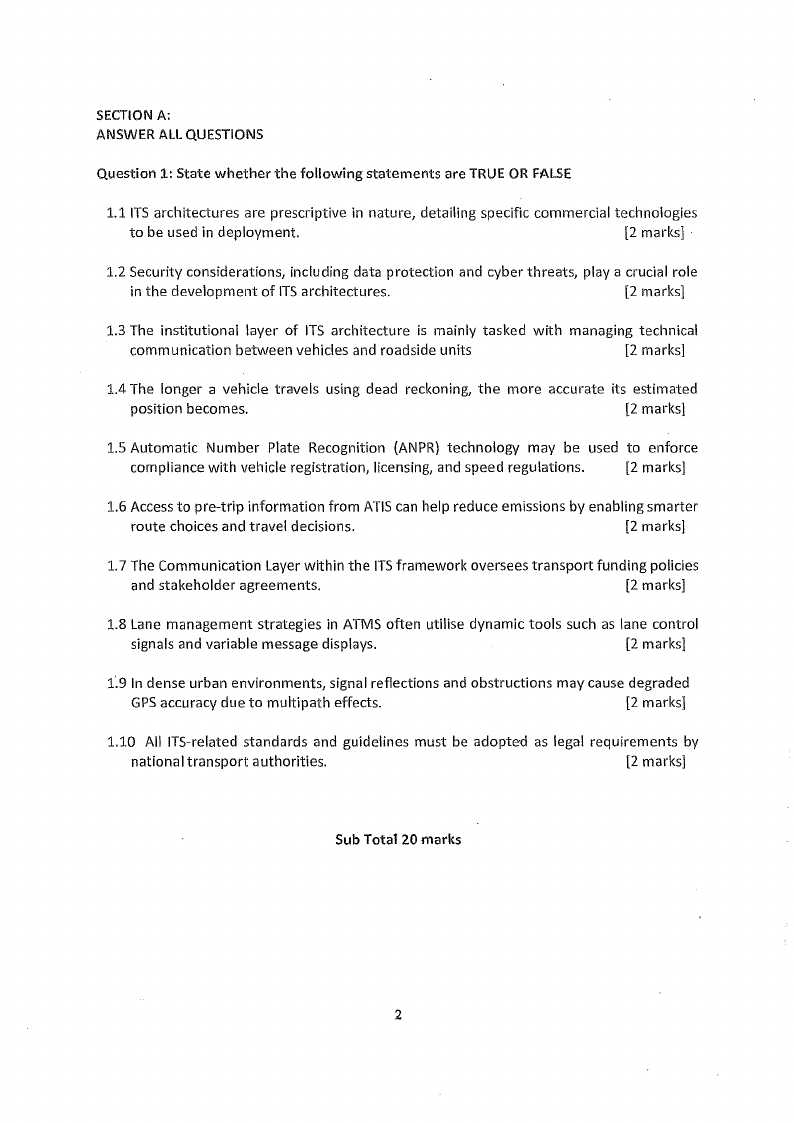
SECTIONA:
ANSWER ALI. QUESTIONS
Question 1: State whether the following statements are TRUE OR FALSE
1.1 ITS architectures are prescriptive in nature, detailing specific commercial technologies
to be used in deployment.
[2 marks] ·
1.2 Security considerations, including data protection and cyber threats, play a crucial role
in the development of ITS architectures.
[2 marks]
1.3 The institutional layer of ITS architecture is mainly tasked with managing technical
communication between vehicles and roadside units
[2 marks]
1.4 The longer a vehicle travels using dead reckoning, the more accurate its estimated
position becomes.
[2 marks]
1.5 Automatic Number Plate Recognition (ANPR} technology may be used to enforce
compliance with vehicle registration, licensing, and speed regulations.
[2 marks]
1.6 Access to pre-trip information from ATIS can help reduce emissions by enabling smarter
route choices and travel decisions.
[2 marks]
1.7 The Communication Layer within the ITSframework oversees transport funding policies
and stakeholder agreements.
[2 marks]
1.8 Lane management strategies in ATMS often utilise dynamic tools such as lane control
signals and variable message displays.
[2 marks]
i'.9 In dense urban environments, signal reflections and obstructions may cause degraded
GPSaccuracy due to multipath effects.
[2 marks]
1.10 All ITS-related standards and guidelines must be adopte-d as legal requirements by
national transport authorities.
[2 marks]
Sub Total 20 marks
2
|
|
3 Page 3 |
▲back to top |

SECTIONB:
ANSWERALLQUESTIONS
Question2: Selectthe correctanswer, each correctanswer carries2 marks
2.1 Which ITS architecture layer is responsible for defining governance structures,
stakeholder roles, and the coordination of organisational responsibilities across
agencies?
[2 marks]
A. Functional Layer
8. Governance Layer
C. Strategic Integration Layer
D. Institutional Layer
E. None of the above
2.2 Which sensor detects metallic objects by measuring changes in inductance? [2 marks]
A. PassiveInfrared
8. LiDAR
C. Inductive Loop Detector
D. Ultrasonic Sensor
E. All of the above
2.3 Which ITS enforcement tool deployed in Namibia calculates a vehicle's average speed
over a defined distance?
[2 marks]
A. ANPRintegrated with enforcement databases
8. Weigh-in-Motion stations with velocity overlays
C. ASODcamera system
D. Corridor-based radar enforcement
E. None of the above
2.4 What is the primary cross-border integration challenge facing international ITS
deployment?
[2 marks]
A. Lack of multilingual road signage
B. Inconsistent communication protocols and standards
C. GPSsignal degradation at borders
D. Vehicle size restrictions between regions
E. All of the above
3
|
|
4 Page 4 |
▲back to top |
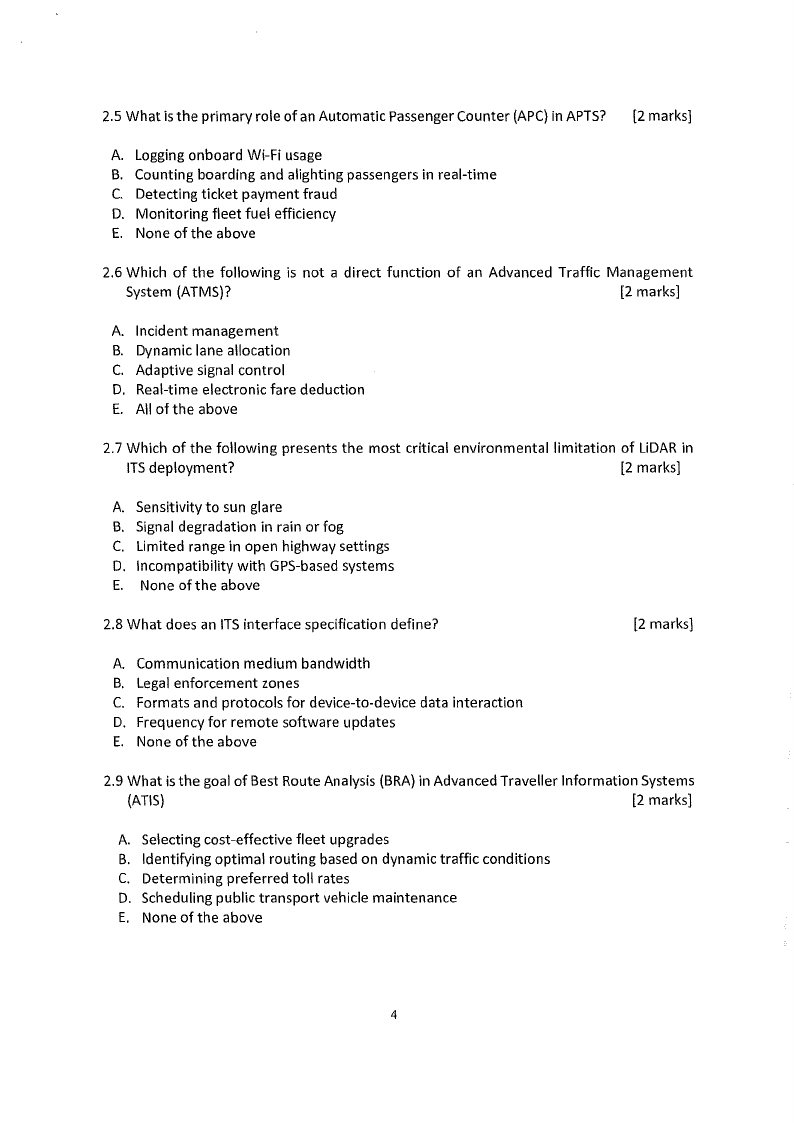
2.5 What is the primary role of an Automatic PassengerCounter (APC}in APTS? [2 marks]
A. Logging onboard Wi-Fi usage
B. Counting boarding and alighting passengers in real-time
C. Detecting ticket payment fraud
D. Monitoring fleet fuel efficiency
E. None of the above
2.6 Which of the following is not a direct function of an Advanced Traffic Management
System (ATMS)?
[2 marks]
A. Incident management
B. Dynamic lane allocation
C. Adaptive signal control
D. Real-time electronic fare deduction
E. All of the above
2.7 Which of the following presents the most critical environmental limitation of LiDAR in
ITSdeployment?
[2 marks]
A. Sensitivity to sun glare
B. Signal degradation in rain or fog
C. Limited range in open highway settings
D. Incompatibility with GPS-basedsystems
E. None of the above
2.8 What does an ITSinterface specification define?
[2 marks]
A. Communication medium bandwidth
B. Legal enforcement zones
C. Formats and protocols for device-to-device data interaction
D. Frequency for remote software updates
E. None of the above
2.9 What is the goal of Best Route Analysis (BRA)in Advanced Traveller Information Systems
(ATIS)
[2 marks]
A. Selecting cost-effective fleet upgrades
B. Identifying optimal routing based on dynamic traffic conditions
C. Determining preferred toll rates
D. Scheduling public transport vehicle maintenance
E. None of the above
4
|
|
5 Page 5 |
▲back to top |
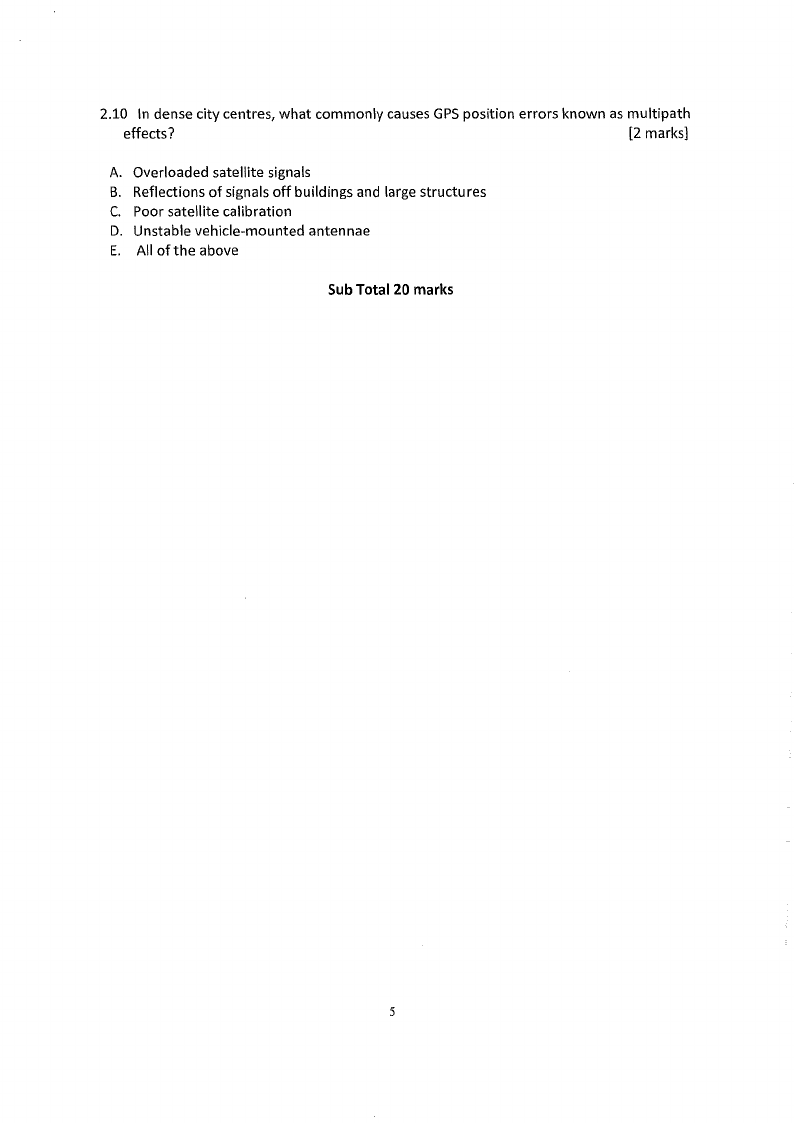
2.10 In dense city centres, what commonly causes GPS position errors known as multipath
effects?
[2 marks]
A. Overloaded satellite signals
B. Reflections of signals off buildings and large structures
C. Poor satellite calibration
D. Unstable vehicle-mounted antennae
E. All of the above
Sub Total 20 marks
5
|
|
6 Page 6 |
▲back to top |
SECTION C:
ANSWER ANY THREE (3) QUESTIONS, EACH QUESTION CARRIES20 MARKS
Question 3
In a serious weather-related incident, a bridge on the Windhoek-Rehoboth Bl highway,
located approximately 30 km south of the capital, suffered structural damage due to heavy
rainfall. The Roads Authority issued a public alert urging motorists to exercise extreme caution
while approaching the affected area. Images shared show a large crack across the bridge
surface, temporarily halting traffic and prompting an emergency response. Officials are
assessing the extent of the damage, while temporary diversions and safety measures have
been introduced. The event has highlighted the vulnerability of road infrastructure to climate-
related events and the urgent need for smart, real-time transport monitoring systems in
Namibia.
Using the above case study, discuss how Intelligent Transport Systems (ITS) can be applied
to prevent and manage similar incidents in the future.
[20 marks]
Question 4
Intelligent Transport Systems (ITS) rely on the integration of three core components to
enhance transport system efficiency and safety.
Discussthese components and explain how each contributes to the effective functioning of
m.
[20ma~
Question 5
In July 2024, the Road Fund Administration (RFA) of Namibia renewed its proposal to
implement targeted tolling system on selected national roads to ensure sustainable funding
for road infrastructure development and maintenance.
As part of the strategy, the RFA is exploring the integration of Intelligent Transport Systems
(ITS) such as Electronic Toll Collection (ETC},Automatic Number Plate Recognition (ANPR},
and GPS-based tolling, with the possibility of introducing dynamic congestion pricing based
on vehicle type, road section, and time-of-day demand.
This development has sparked national debate. While some view ITS-enabled tolling as a
progressive move toward road sustainability and traffic management, others express concern
about social equity, affordability, and digital readiness.
Critically evaluate the feasibility of introducing an ITS-based dynamic tolling system in
Namibia.
[20 marks]
6
|
|
7 Page 7 |
▲back to top |
Question 6
I. Define the concept of "data privacy" in the context of ITS.
[5 marks]
II. Briefly explain two ethical concerns associated with the collection and use of
transport-related data.
[5 marks]
Ill. Discuss the role of policy and regulation in addressing data privacy and ethical
challenges in transport technology systems.
[10 marks]
Question 7
i. Define Integrated Vehicle Health Monitoring System {IVHMS) and discuss its key
functions in supporting efficient fleet management.
[10 marks]
ii. Discuss the advantages and disadvantages of implementing Integrated Vehicle Health
Monitoring System {IVHMS)in commercial or public transport fleets.
[10 marks]
Sub Total 60 marks
TOTAL100 MARKS
END OF QUESTIONPAPER
7