


 |
NRS711S - NATURAL RESOURCES MANAGEMENT AND SUSTAINABLE DEVELOPMENT - 2ND OPP - JULY 2025 |
|
|
1 Page 1 |
▲back to top |
nAm I BIA UnlVE RSITY
OFSCIEnCEAno TECHnOLOGY
FACULTYOF ENGINEERINGAND THE BUILTENVIRONMENT
DEPARTMENT OF ARCHITECTUREP, LANNING AND CONSTRUCTION
QUALIFICATION:BACHELOROF REGIONALAND RURALDEVELOPMENT
QUALIFICATION CODE: 07BRAR
NQF LEVEL:7
COURSECODE:NRS711S
COURSENAME:
NATURAL RESOURCESMANAGEMENT AND
SUSTAINABLEDEVELOPMENT
DATE: JULY2025
PAPER: THEORY
DURATION: 3 HOURS
MARKS: 100
SECONDOPPORTUNITY/ SUPPLEMENTARYEXAMINATION PAPER
EXAMINER(S) Ms. Toini Angula
MODERATOR Mr. Reinhold Mangundu
INSTRUCTIONS
1. Read each question carefully and address all parts of the question.
2. Answer ALLthe questions.
3. Answers may be written in any order but must be legibly numbered.
4. Pleasewrite clearly and legibly.
5. Ensure your Student Number is on the EXAMINATIONBOOK(s).
6. The following materials are permissible during the examination: pen, pencil, ruler, eraser and
calculator
THIS EXAM QUESTION PAPERCONSISTSOF 7 PAGES(Including this front page)
|
|
2 Page 2 |
▲back to top |
Natural Resource Management and Sustainable Development
NRS711S
Question 1
Selects the single CORRECTanswer to each of the following questions. Just write down the
answer, e.g. (1) (i).
1) Select the incorrect statement. Earth system processes.........
(1)
(i) Often involve energy fluxes between sub-systems
(ii) Can take place at both very small and very large spatial scales
(iii) Are too vast and powerful to be influenced by human activities
(iv) Are responsible for maintaining natural equilibria
(v) Conjunctive use of various water sources
2) The roots of plants break up rocks to increase their weathering rate is an example of:
(1)
(i) The geosphere interacting with the atmosphere
(ii) The hydrosphere interacting with the atmosphere
(iii) The geosphere interacting with the biosphere
(iv) The biosphere interacting with the cryospehere
(v) The biosphere interacting with hydrosphere
3) Earth Overshoot day is:
(1)
(i) The number of days before the Earths System collapse
(ii) The date when the global population passes 8 billion
(iii) The number of days per year that mankind is in ecological deficit
(iv) The date in a year when mankind's demand for ecological resources and services surpasses
Earth's capacity to replace those resources and absorb those waste.
(v) Earth's biocapacity minus mankind's ecological footprint (in global hectares)
4) Which International conference in 1992 led to the adoption of Agenda 21 and raised awareness
about sustainable development
(1)
(i) Paris Agreement Summit
(ii) Rio Earth Summit
(iii) Montreal Conference on Protection of the Ozone Layer
(iv) Copenhagen Climate Conference
(v) Johannesburg Conference on Implementation of Sustainable Development
Second Opportunity Examination Question Paper
Page 2 of 7
July 2025
|
|
3 Page 3 |
▲back to top |
Natural Resource Management and Sustainable Development
NRS711S
5) Small Island Developing States receive special consideration in SDG 13 (Climate Action) because
they......
(1)
(i) Have excellent tourism potential
(ii) Are tax havens for ultrarich people in wealthy countries
(iii) Are particularly vulnerable to earthquakes
(iv) Offer great possibilities for carbon sequestration
(v) Are in imminent danger due to sea level rise
6) local horticultural production in Namibia is supported by ...
(1)
(i) Transport subsidies
(ii) Import restrictions on some fruits and vegetables at certain times of the year when there is
sufficient local supply
(iii) Export subsidies
(iv) Plans to dismantle the veterinary cordon fence ('Red Line')
(v) infant-industry protection for the chicken industry
7) Zoonoses are diseases that ...
(1)
(i) Develop in humans due to unhealthy lifestyles
(ii) Are only found in overcrowded zoos
(iii) Circulate within animal populations and can infect humans
(iv) Circulate within the human population and are transmitted from humans to animals
(v) Are plant diseases that can cause allergies in humans
8) Intergovernmental Panel on Climate Change....
(1)
(i) Is the governing body of the UN Framework Convention on Climate Change
(ii) Produces annual national communications on climate change
(iii) Prescribe to the UNFCCCConference of Parties how they must implement the articles of the
Convention
(iv) Produces regular assessment reports on the science of climate change, impacts, vulnerability and
adaptation, and mitigation
(v) Is a secretariat of the UNFCCCthat carries out its own research on climate change
9) The idea that a developing country can bypass outdated, inefficient or polluting technologies
and move directly to efficient, cost-effective and green technologies is known as......
(1)
(i)
Sustainability
(ii) The circular economy
(iii) The lifecycle approach
(iv) Leapfrogging
(v) The Fourth Industrial Revolution
10) Delimitation of territorial waters, exclusive economic zones, continental shelves, etc., is under
the authority of the.........
(1)
Second Opportunity Examination Question Paper
Page 3 of 7
July 2025
|
|
4 Page 4 |
▲back to top |
Natural Resource Management and Sustainable Development
(i) MARPOL
(ii) UN Deepsea Mining Authority
(iii) UN Convention of the Law of the Sea
(iv) International Seabed Authority
(vi) Namibian Ministry of Fisheries, Agriculture and Land Reform
NRS711S
[10)
Question 2
(a) Compile your own comprehensive definition of sustainable development, including clear
descriptions of its three pillars.
(4)
(b) Global Change is a collective term for planetary-wide changes in the Earth System and its
interconnected, interdependent subsystems, as well as related large-scale changes in human
society. These changes have become most noticeable since the start of the Industrial Era and
have been speeding up since the middle of the 20th Century.
Reflect on Global Change in terms of the types of observed changes and their drivers (direct
and root causes).
(6)
(c) Explain the following concepts:
(i) Biocapacity
(3)
(ii) Ecological footprint
(3)
(d) Discuss the impacts that infrastructure improvements, such as roads and electricity, have on
poverty reduction in rural areas.
(4)
[20)
Question 3
a) The United Nation Conference on Environment and Development (earth summit) took place
at Rio de Janeiro, Brazil in 1992. Agenda 21 framework was among the several outcomes of
the conference.
Based on lecture presentations and class discussions; In your own opinion, discuss what
Agenda 21 Framework is all about.
(10)
b) Discuss the co-benefits that green public open spaces in a city have for both the
environment and citizens. Be specific
(4)
c) What role do oceans play in regulating the Earth's climate?
(3)
d) Namibians are using solar energy in at least three (3) different ways as an energy source.
Elaborate on this statement.
(3)
Second Opportunity Examination Question Paper
Page 4 of7
July 2025
|
|
5 Page 5 |
▲back to top |
Natural Resource Management and Sustainable Development
NRS711S
[20)
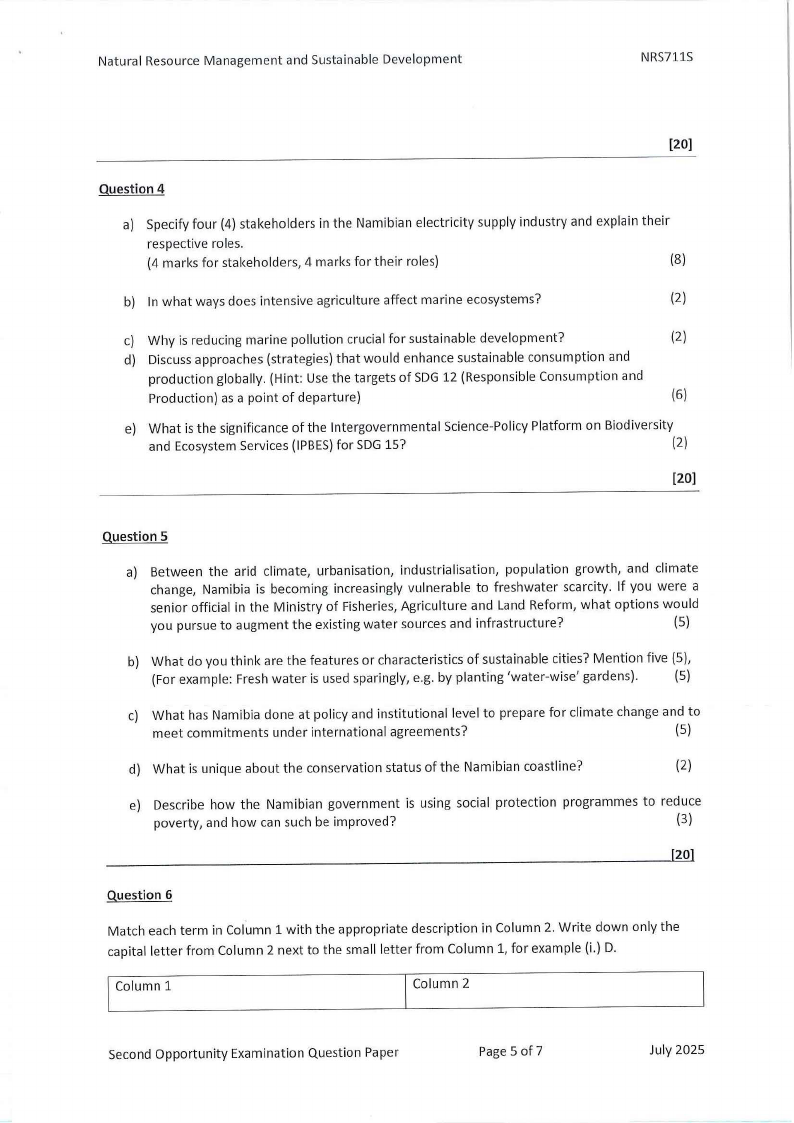
Question 4
a) Specify four (4) stakeholders in the Namibian electricity supply industry and explain their
respective roles.
(4 marks for stakeholders, 4 marks for their roles)
(8)
b) In what ways does intensive agriculture affect marine ecosystems?
{2)
c) Why is reducing marine pollution crucial for sustainable development?
(2)
d) Discuss approaches (strategies) that would enhance sustainable consumption and
production globally. (Hint: Use the targets of SDG 12 {Responsible Consumption and
Production) as a point of departure)
(6)
e) What is the significance of the Intergovernmental Science-Policy Platform on Biodiversity
and Ecosystem Services (IPBES)for SDG 15?
(2)
[20)
Question 5
a) Between the arid climate, urbanisation, industrialisation, population growth, and climate
change, Namibia is becoming increasingly vulnerable to freshwater scarcity. If you were a
senior official in the Ministry of Fisheries, Agriculture and Land Reform, what options would
you pursue to augment the existing water sources and infrastructure?
(5)
b) What do you think are the features or characteristics of sustainable cities? Mention five {5),
{For example: Fresh water is used sparingly, e.g. by planting 'water-wise' gardens).
(5)
c) What has Namibia done at policy and institutional level to prepare for climate change and to
meet commitments under international agreements?
(5)
d) What is unique about the conservation status of the Namibian coastline?
{2)
e) Describe how the Namibian government is using social protection programmes to reduce
poverty, and how can such be improved?
{3)
20
Question 6
Match each term in Column 1 with the appropriate description in Column 2. Write down only the
capital letter from Column 2 next to the small letter from Column 1, for example (i.) D.
IColumn 1
I Column 2
Second Opportunity Examination Question Paper
Page 5 of7
July 2025
|
|
6 Page 6 |
▲back to top |
Natural Resource Management and Sustainable Development
NRS711S
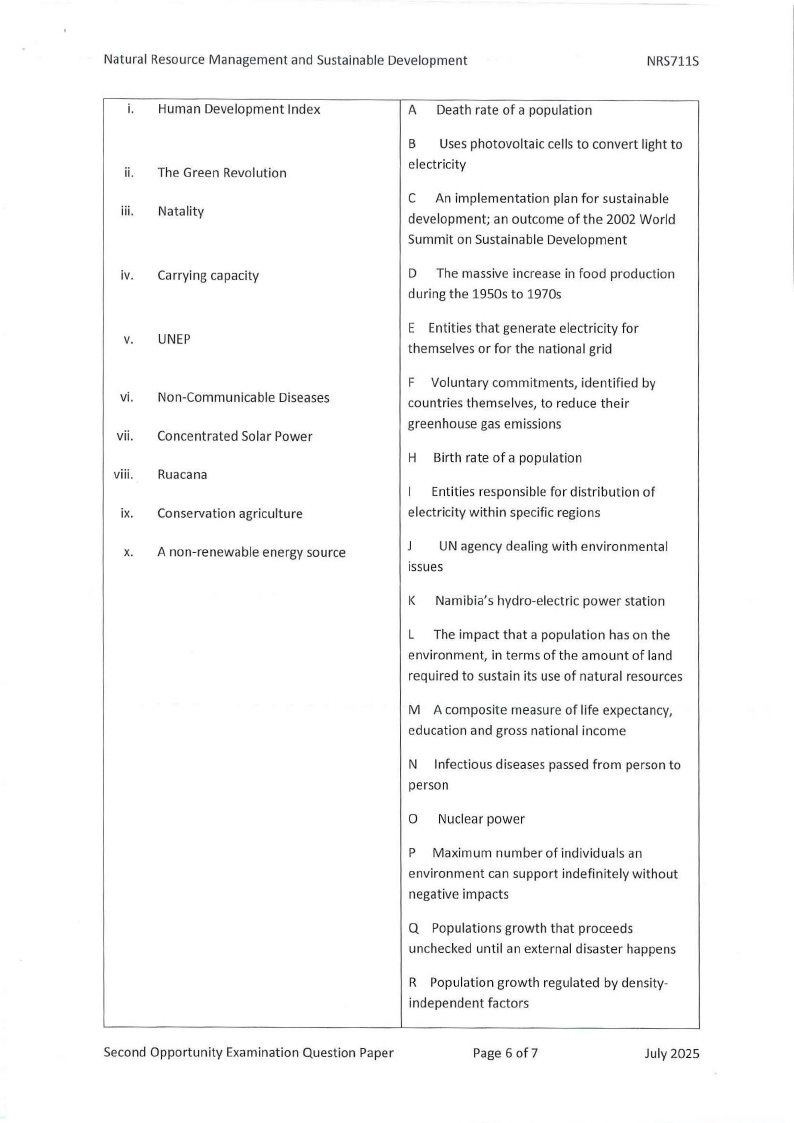
i. Human Development Index
ii. The Green Revolution
iii. Natality
iv. Carrying capacity
V. UNEP
vi. Non-Communicable Diseases
vii. Concentrated Solar Power
viii. Ruacana
ix. Conservation agriculture
X. A non-renewable energy source
A Death rate of a population
B Uses photovoltaic cells to convert light to
electricity
C An implementation plan for sustainable
development; an outcome of the 2002 World
Summit on Sustainable Development
D The massive increase in food production
during the 1950s to 1970s
E Entities that generate electricity for
themselves or for the national grid
F Voluntary commitments, identified by
countries themselves, to reduce their
greenhouse gas emissions
H Birth rate of a population
Entities responsible for distribution of
electricity within specific regions
UN agency dealing with environmental
issues
K Namibia's hydro-electric power station
L The impact that a population has on the
environment, in terms of the amount of land
required to sustain its use of natural resources
M A composite measure of life expectancy,
education and gross national income
N Infectious diseases passed from person to
person
0 Nuclear power
P Maximum number of individuals an
environment can support indefinitely without
negative impacts
Q Populations growth that proceeds
unchecked until an external disaster happens
R Population growth regulated by density-
independent factors
Second Opportunity Examination Question Paper
Page 6 of 7
July 2025
|
|
7 Page 7 |
▲back to top |
Natural Resource Management and Sustainable Development
NRS711S
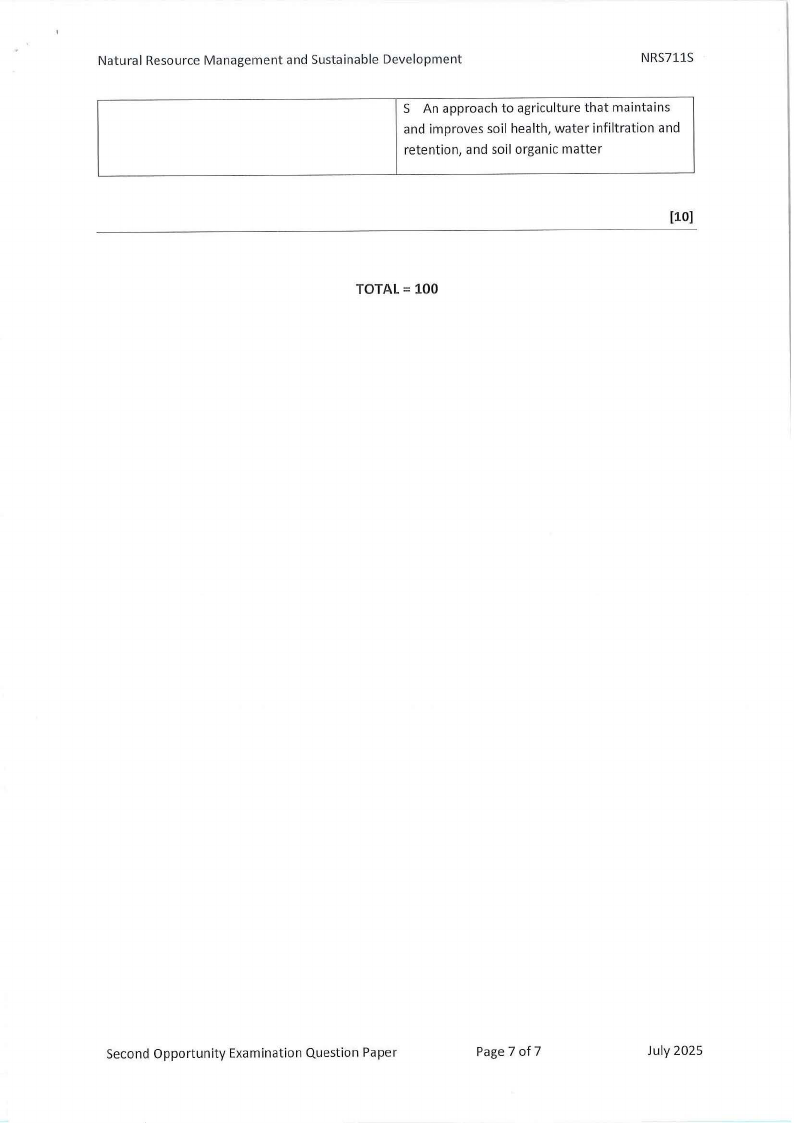
S An approach to agriculture that maintains
and improves soil health, water infiltration and
retention, and soil organic matter
[10)
TOTAL= 100
Second Opportunity Examination Question Paper
Page 7 of 7
July 2025