


 |
DFM811S - DIGITAL FORENSICS MANAGEMENT - 1ST OPP - JUNE 2025 |
|
|
1 Page 1 |
▲back to top |
n Am I BIA u n IVER s ITY
OF SCIEnCEAno TECHnOLOGY
FACULTY OF COMPUTING AND INFORMATICS
DEPARTMENTOF CYBERSECURITY
QUALIFICATION: BACHELOROF COMPUTERSCIENCEHONOURS(DIGITALFORENSICS)
QUALIFICATION CODE: 08BHDF
LEVEL: 8
COURSE: DIGITALFORENSICSMANAGEMENT COURSE CODE: DFM811S
DATE: JUNE 2025
PAPER: THEORY
DURATION: 3 HRS
MARKS: 100
EXAMINERS
MODERATOR
FIRST OPPORTUNITY EXAMINATION QUESTION PAPER.
MS. SEPISOCHIKURUWO
MR. JULIASSILAA
PROF.AMELIA PHILLIPS
THIS PAPER CONSISTS OF 3 PAGES
(Excluding this front page)
INSTRUCTIONS
1. Answer ALLthe questions on the answer scripts.
2. Write clearly and neatly.
3. Number the answers clearly.
PERMISSIBLE MATERIALS
1. Pen, Pencil & Eraser
|
|
2 Page 2 |
▲back to top |
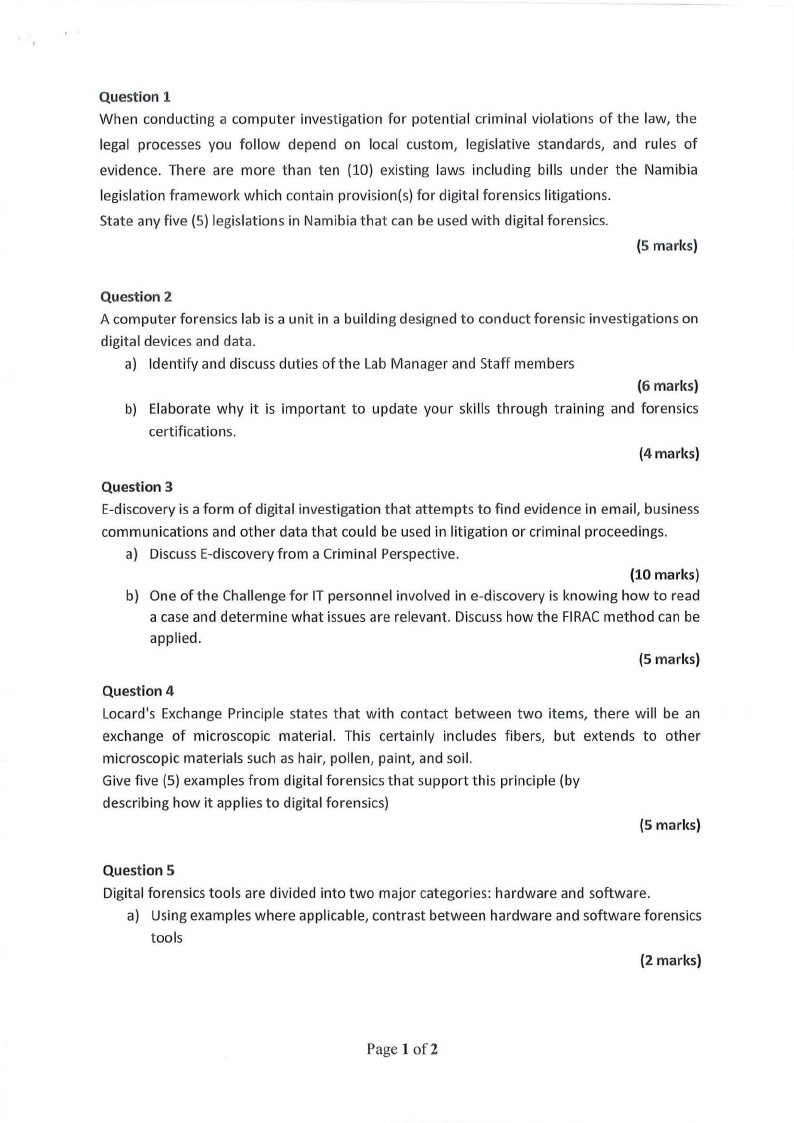
Question 1
When conducting a computer investigation for potential criminal violations of the law, the
legal processes you follow depend on local custom, legislative standards, and rules of
evidence. There are more than ten (10) existing laws including bills under the Namibia
legislation framework which contain provision(s) for digital forensics litigations.
State any five (5) legislations in Namibia that can be used with digital forensics.
(5 marks)
Question 2
A computer forensics lab is a unit in a building designed to conduct forensic investigations on
digital devices and data.
a) Identify and discuss duties of the Lab Manager and Staff members
(6 marks)
b) Elaborate why it is important to update your skills through training and forensics
certifications.
(4 marks)
Question 3
E-discovery is a form of digital investigation that attempts to find evidence in email, business
communications and other data that could be used in litigation or criminal proceedings.
a) Discuss E-discovery from a Criminal Perspective.
(10 marks)
b) One of the Challenge for IT personnel involved in e-discovery is knowing how to read
a case and determine what issues are relevant. Discuss how the FIRACmethod can be
applied.
(5 marks)
Question 4
Locard's Exchange Principle states that with contact between two items, there will be an
exchange of microscopic material. This certainly includes fibers, but extends to other
microscopic materials such as hair, pollen, paint, and soil.
Give five (5) examples from digital forensics that support this principle (by
describing how it applies to digital forensics)
(5 marks)
Question 5
Digital forensics tools are divided into two major categories: hardware and software.
a) Using examples where applicable, contrast between hardware and software forensics
tools
(2 marks)
Page 1 of2
|
|
3 Page 3 |
▲back to top |
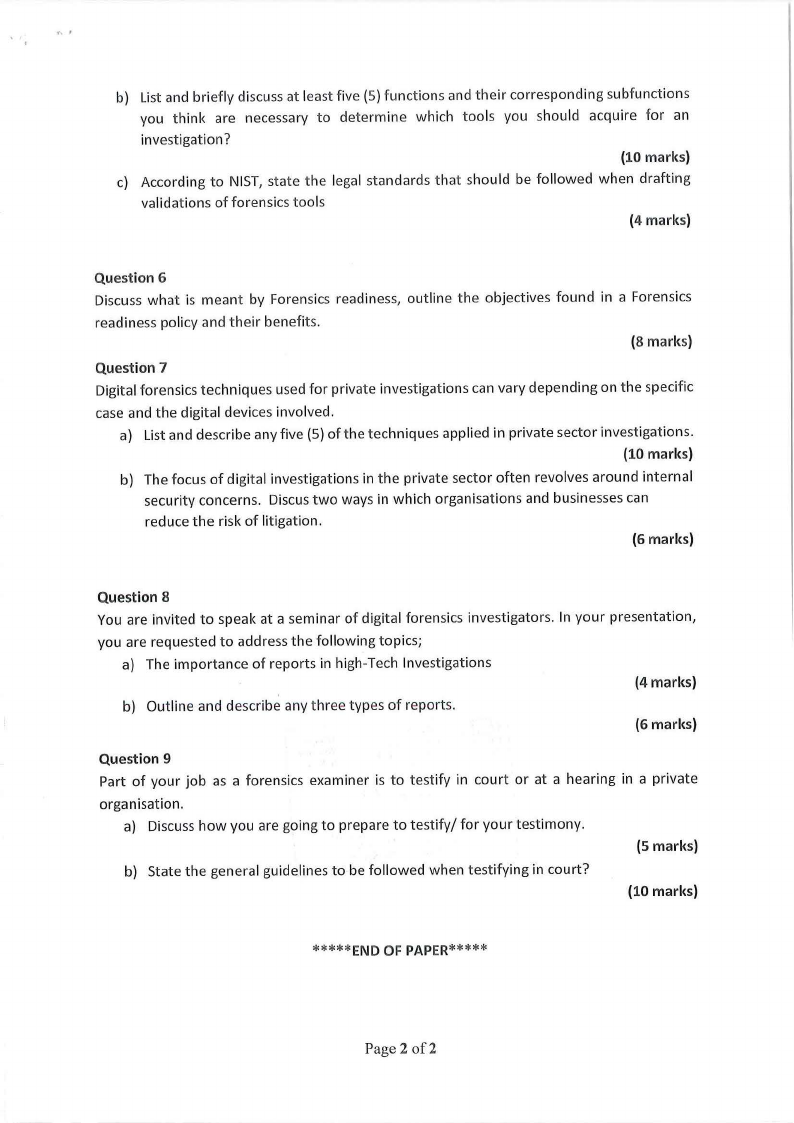
b) List and briefly discuss at least five (5) functions and their corresponding subfunctions
you think are necessary to determine which tools you should acquire for an
investigation?
(10 marks)
c) According to NIST, state the legal standards that should be followed when drafting
validations of forensics tools
(4 marks)
Question 6
Discuss what is meant by Forensics readiness, outline the objectives found in a Forensics
readiness policy and their benefits.
(8 marks)
Question 7
Digital forensics techniques used for private investigations can vary depending on the specific
case and the digital devices involved.
a) List and describe any five (5) ofthe techniques applied in private sector investigations.
(10 marks)
b) The focus of digital investigations in the private sector often revolves around internal
security concerns. Discus two ways in which organisations and businesses can
reduce the risk of litigation.
(6 marks)
Question 8
You are invited to speak at a seminar of digital forensics investigators. In your presentation,
you are requested to address the following topics;
a) The importance of reports in high-Tech Investigations
(4 marks)
b) Outline and describe any three types of reports.
(6 marks)
Question 9
Part of your job as a forensics examiner is to testify in court or at a hearing in a private
organisation.
a) Discuss how you are going to prepare to testify/ for your testimony.
(5 marks)
b) State the general guidelines to be followed when testifying in court?
(10 marks)
*****END OF PAPER*****
Page 2 of 2