IFN712S-INTERNATIONAL FINANCE-2ND OPP-DEC 2025


IFN712S-INTERNATIONAL FINANCE-2ND OPP-DEC 2025


1 Page 1

▲back to top


nAm I BIA u n IVERSITY
OF SCIEnCE Ano TECHnOLOGY
FACULTY OF COMMERCE, HUMAN SCIENCES AND EDUCATION
DEPARTMENT OF ECONOMICS, ACCOUNTING AND FINANCE
QUALIFICATION: BACHELOR OF ECONOMICS
QUALIFICATION CODE: O7BEC0
LEVEL: 7
COURSE CODE: IFN712S
COURSE NAME: INTERNATIONAL FINANCE
SESSION: DECEMBER 2025
DURATION: 3 HOURS
PAPER:THEORY
MARKS: 100
SECOND OPPORTUNITY EXAMINATION QUESTION PAPER
EXAMINER(S) Ms K. Kavezeri
MODERATOR: Mr I. Nashivela
INSTRUCTIONS
1. Answer ALL the questions.
2. Write clearly and neatly.
3. Number the answers clearly.
PERMISSIBLE MATERIALS
1. Pens/pencils/erasers
2. Calculator
3. Ruler
THIS QUESTION PAPER CONSISTS OF 9 PAGES (Including this front page)

2 Page 2

▲back to top


QUESTION 1
(25 Marks]
Select the letter that best represents your choice.
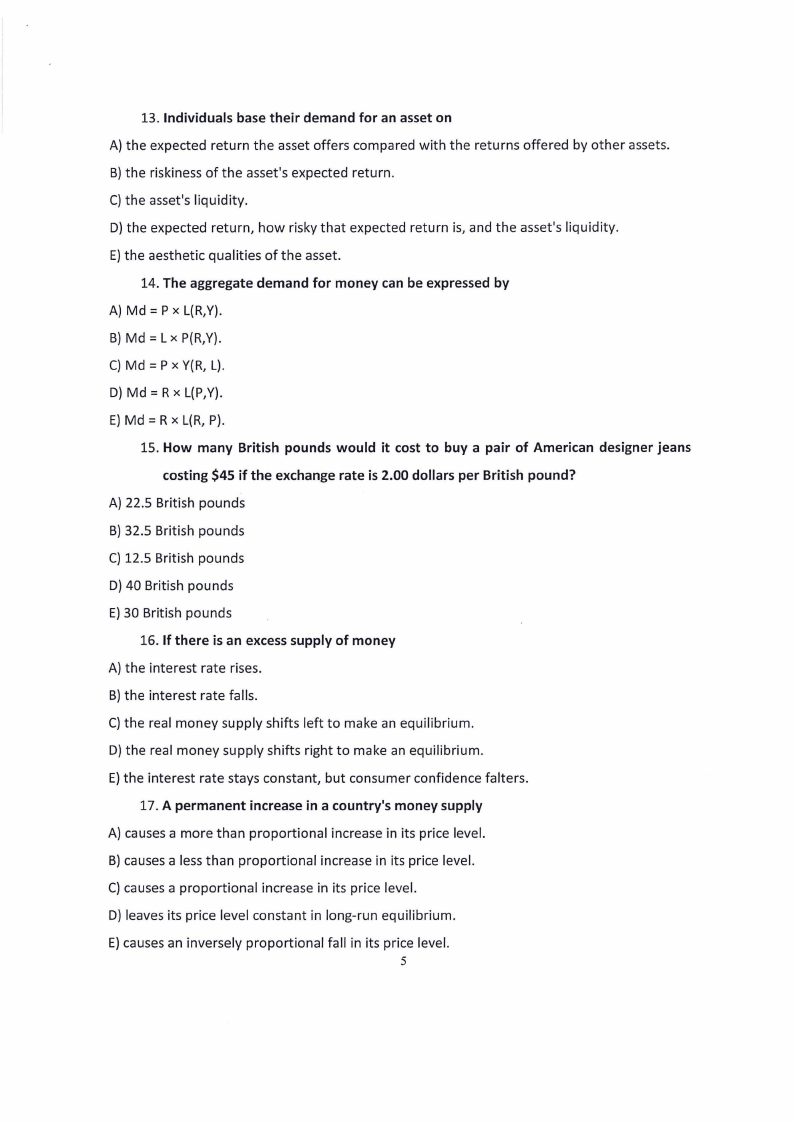
1. International capital markets experience a kind of risk not faced in domestic capital
markets, namely
A) "economic meltdown" risk.
B) Flood and hurricane crisis risk.
C) the risk of unexpected downgrading of assets by Standard and Poor.
D) the risk of exchange rate fluctuations.
E) the risk of political upheaval
2. A country's gross national product (GNP) is
A) the value of all final goods and services produced by its factors of production and sold on
the market in a given time period.
B) the value of all intermediate goods and services produced by its factors of production and
sold on the market in a given time period.
C) the value of all final goods produced by its factors of production and sold on the market in a
given time period.
D) the value of all final goods and services produced by its factors of production and sold on
the market.
E) the value of all final goods and services produced by its factors of production, excluding land,
and sold on the market in a given time period.
3. GDP is supposed to measure
A) the volume of production within a country's borders.
B) the volume of services generated within a country's borders.
C) the volume of production of a country's output.
D) GNP plus depreciation.
E) net unilateral transfers from foreigners.
2

3 Page 3

▲back to top


4. hich one of the following expressions is the MOST accurate?
A)CA=IM-EX
B) CA= EX- IM
C) CA= EX= IM
D) CA= EX+ IM
E) CA- IM= EX
5. Government savings, 5g, is equal to
A)T-G.
B)T+G.
C) T = G.
D) T + G -1.
E) T - G = I.
6. The sale of
A) a used textbook does enter GNP.
B) a used textbook does not enter GNP, but the sale of a used house does.
C) both a used textbook and a used house do not enter GNP.
D) a used house does not enter GNP, but the sale of a used book does.
E) the GNP does not include sale of used items priced below $1000.
7. Every international transaction automatically enters the balance of payments
A) once either as a credit or as a debit.
B) twice, once as a credit and once as a debit.
C) once as a credit.
D) twice, both times as debit.
E) three times, once as a credit, once as a debit, and once as an exchange.
8. An open economy
A) can save only by building up its capital stock.
B) can save only by acquiring foreign wealth.
C) cannot save either by building up its capital stock or by acquiring foreign wealth.
D) can save either by building up its capital stock or by acquiring foreign wealth.
E) can save by avoiding excessive imports.
3

4 Page 4

▲back to top


9. Which one of the following statements is the MOST accurate?
A) A depreciation of a country's currency makes its goods cheaper for foreigners.
B) A depreciation of a country's currency makes its goods more expensive for foreigners.
C) A depreciation of a country's currency makes its goods cheaper for its own residents.
D) A depreciation of a country's currency makes its goods cheaper.
E) An appreciation of a country's currency makes its goods more expensive .
10. Forward and spot exchange rates
A) are necessarily equal.
B) do not move closely together.
C) are always such that the forward exchange rate is higher.
D) move closely together and are equal on the value date.
E) are unrelated to the value date.
11. Futures contracts differ from forward contracts in that
A) future contracts ensures you will receive a certain amount of foreign currency at a specified
future date.
B) future contracts bind you into your end of the deal.
C) future contracts allow you to sell your contract on an organized futures exchange .
D) future contracts are a disadvantage if your views about the future spot exchange rate are to
change.
E) futures contracts don't allow you to realize a profit of a loss right away.
12. The earnings of a Spanish factory with British owners are
A) counted in Spain's GDP.
B) part of Britain's GNP.
C) only counted in Britain's GDP.
D) only part of Spain 's GNP.
E) counted in Britain's GDP and are a part of Spain's GNP.
4

5 Page 5

▲back to top


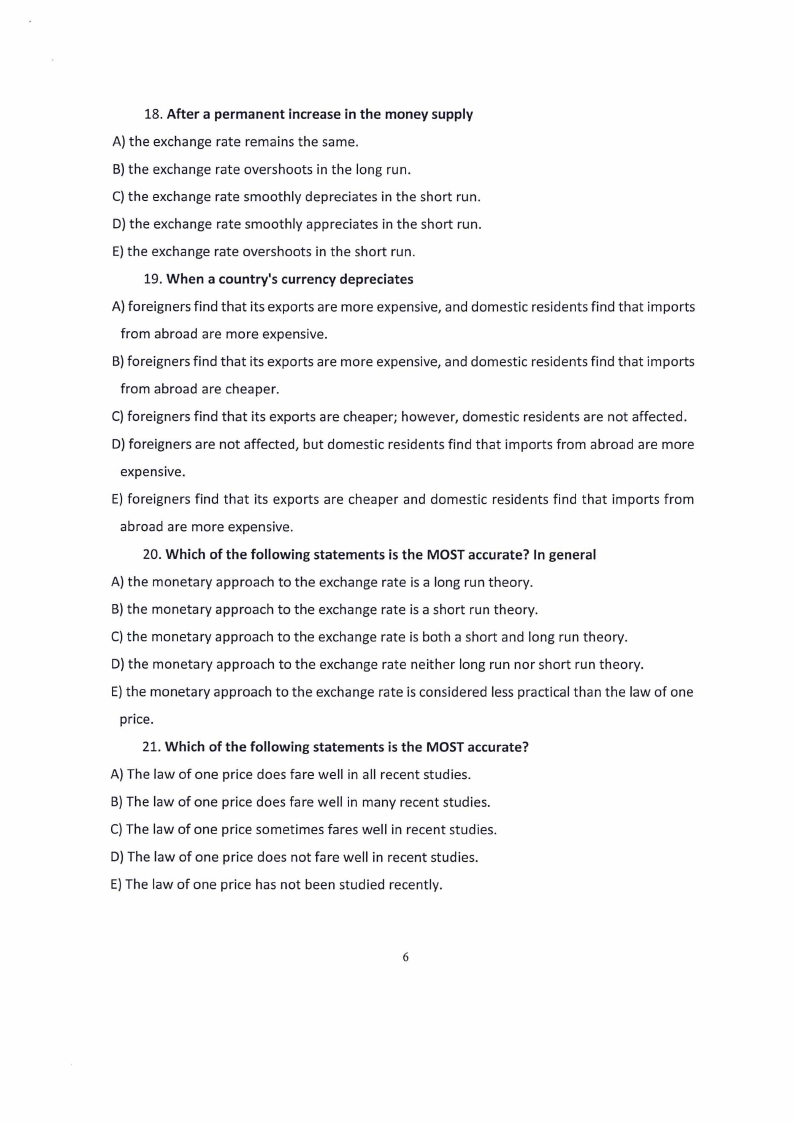
13. Individuals base their demand for an asset on
A) the expected return the asset offers compared with the returns offered by other assets.
B) the riskiness of the asset's expected return.
C) the asset's liquidity.
D) the expected return, how risky that expected return is, and the asset's liquidity.
E) the aesthetic qualities of the asset.
14. The aggregate demand for money can be expressed by
A) Md= p X L(R,V).
B) Md = L x P(R,V).
C) Md = p X V(R, L).
D) Md= Rx L(P,V).
E) Md = Rx L(R, P).
15. How many British pounds would it cost to buy a pair of American designer jeans
costing $45 if the exchange rate is 2.00 dollars per British pound?
A) 22.5 British pounds
B) 32.5 British pounds
C) 12.5 British pounds
D) 40 British pounds
E) 30 British pounds
16. If there is an excess supply of money
A) the interest rate rises.
B) the interest rate falls.
C) the real money supply shifts left to make an equilibrium.
D) the real money supply shifts right to make an equilibrium .
E) the interest rate stays constant, but consumer confidence falters.
17. A permanent increase in a country's money supply
A) causes a more than proportional increase in its price level.
B) causes a less than proportional increase in its price level.
C) causes a proportional increase in its price level.
D) leaves its price level constant in long-run equilibrium.
E) causes an inversely proportional fall in its price level.
5

6 Page 6

▲back to top


18. After a permanent increase in the money supply
A) the exchange rate remains the same.
B) the exchange rate overshoots in the long run.
C) the exchange rate smoothly depreciates in the short run .
D) the exchange rate smoothly appreciates in the short run.
E) the exchange rate overshoots in the short run .
19. When a country's currency depreciates
A) foreigners find that its exports are more expensive, and domestic residents find that imports
from abroad are more expensive.
B) foreigners find that its exports are more expensive, and domestic residents find that imports
from abroad are cheaper.
C) foreigners find that its exports are cheaper; however, domestic residents are not affected.
D) foreigners are not affected, but domestic residents find that imports from abroad are more
expensive.
E) foreigners find that its exports are cheaper and domestic residents find that imports from
abroad are more expensive.
20. Which of the following statements is the MOST accurate? In general
A) the monetary approach to the exchange rate is a long run theory.
B) the monetary approach to the exchange rate is a short run theory.
C) the monetary approach to the exchange rate is both a short and long run theory.
D) the monetary approach to the exchange rate neither long run nor short run theory.
E) the monetary approach to the exchange rate is considered less practical than the law of one
price.
21. Which of the following statements is the MOST accurate?
A) The law of one price does fare well in all recent studies.
B) The law of one price does fare well in many recent studies.
C) The law of one price sometimes fares well in recent studies.
D) The law of one price does not fare well in recent studies.
E) The law of one price has not been studied recently.
6

7 Page 7

▲back to top


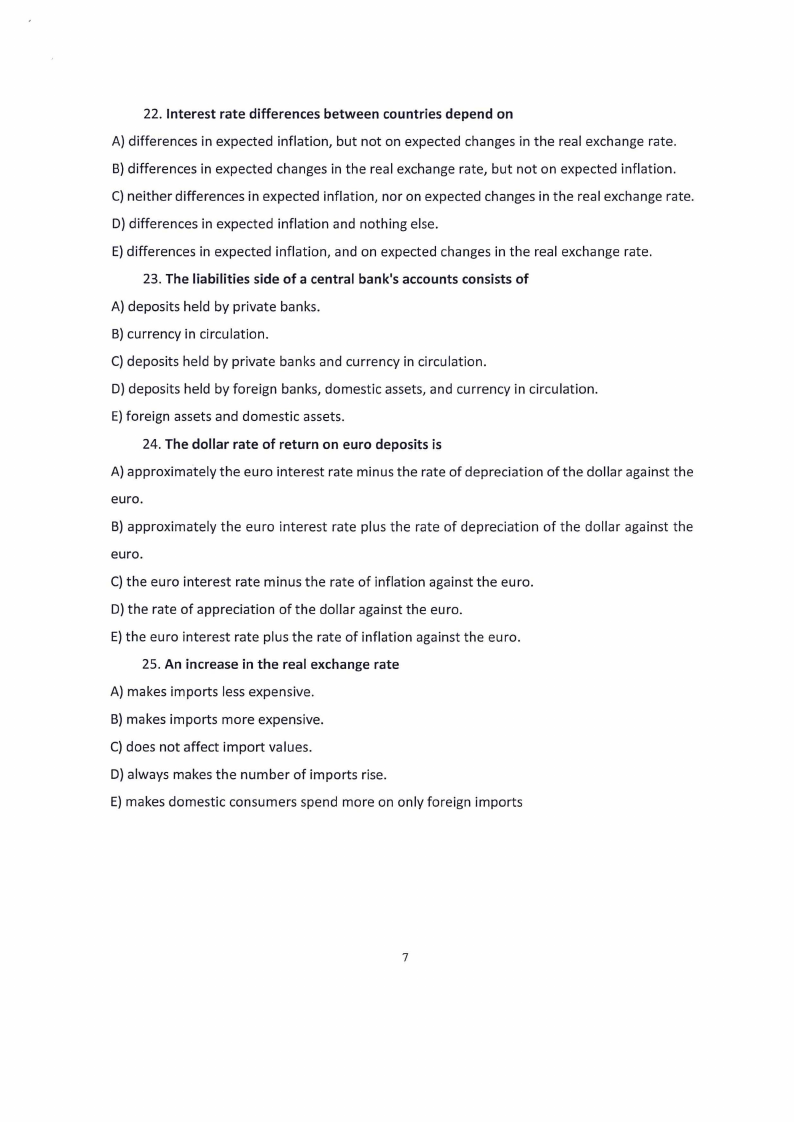
22. Interest rate differences between countries depend on
A) differences in expected inflation, but not on expected changes in the real exchange rate.
B) differences in expected changes in the real exchange rate, but not on expected inflation.
C) neither differences in expected inflation, nor on expected changes in the real exchange rate.
D) differences in expected inflation and nothing else .
E) differences in expected inflation, and on expected changes in the real exchange rate.
23. The liabilities side of a central bank's accounts consists of
A) deposits held by private banks.
B) currency in circulation .
C) deposits held by private banks and currency in circulation .
D) deposits held by foreign banks, domestic assets, and currency in circulation.
E) foreign assets and domestic assets.
24. The dollar rate of return on euro deposits is
A) approximately the euro interest rate minus the rate of depreciation of the dollar against the
euro.
B) approximately the euro interest rate plus the rate of depreciation of the dollar against the
euro.
C) the euro interest rate minus the rate of inflation against the euro .
D) the rate of appreciation of the dollar against the euro.
E) the euro interest rate plus the rate of inflation against the euro.
25. An increase in the real exchange rate
A) makes imports less expensive.
B) makes imports more expensive.
C) does not affect import values.
D) always makes the number of imports rise.
E) makes domestic consumers spend more on only foreign imports
7

8 Page 8

▲back to top


QUESTION 2
[25 Marks]
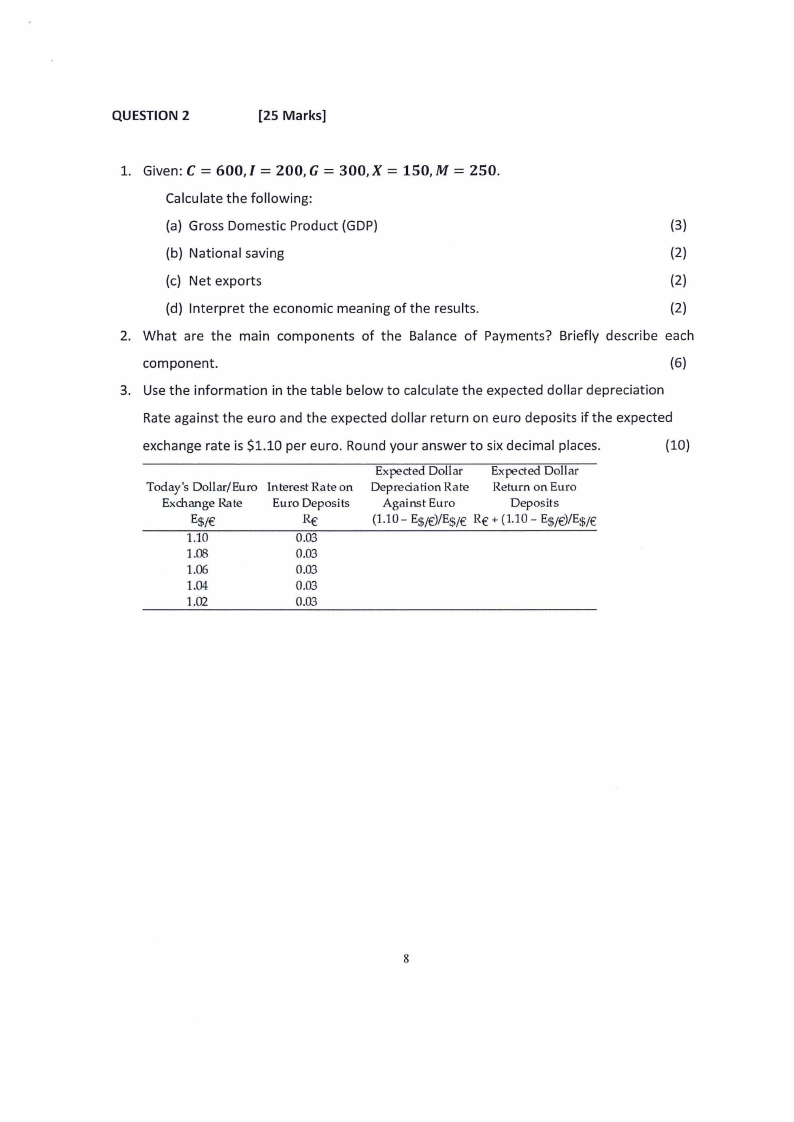
1. Given: C = 600,1 = 200,G = 300,X = 150,M = 250.
Calculate the following:
(a) Gross Domestic Product (GDP)
(3)
(b) National saving
(2)
(c) Net exports
(2)
(d) Interpret the economic meaning of the results.
(2)
2. What are the main components of the Balance of Payments? Briefly describe each
component.
(6)
3. Use the information in the table below to calculate the expected dollar depreciation
Rate against the euro and the expected dollar return on euro deposits if the expected
exchange rate is $1.10 per euro. Round your answer to six decimal places.
(10)
Today's Dollar/Euro Interest Rate on
Exchange Rate Euro Deposits
E$/€
R€
1.10
0.03
1.08
0.03
1.06
0.03
1.04
0.03
1.02
0.03
Expected Dollar Expected Dollar
Depredation Rate Return on Euro
Against Euro
Deposits
(1.10 - E$/€)/E$/€ Rf + ( 1.10 - E$/€)/E$/€
8

9 Page 9

▲back to top


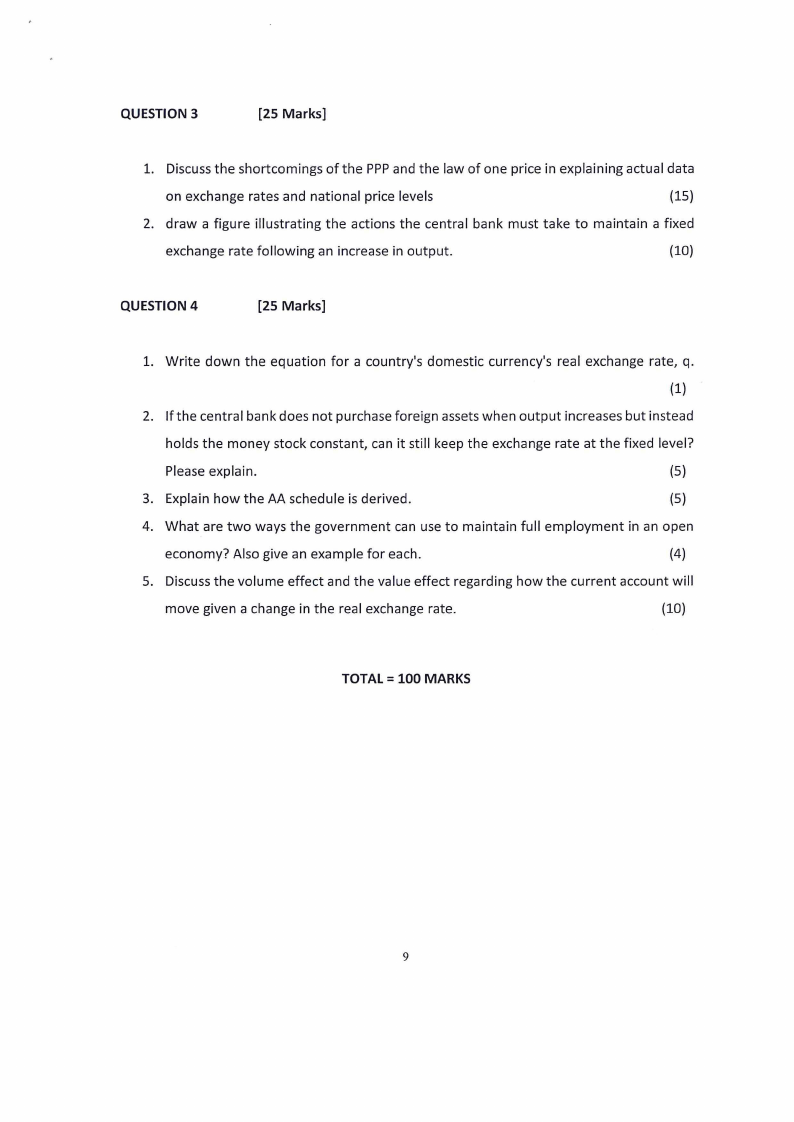
QUESTION 3
[25 Marks]
1. Discuss the shortcomings of the PPP and the law of one price in explaining actual data
on exchange rates and national price levels
(15)
2. draw a figure illustrating the actions the central bank must take to maintain a fixed
exchange rate following an increase in output.
(10)
QUESTION 4
[25 Marks]
1. Write down the equation for a country's domestic currency's real exchange rate, q.
(1)
2. If the central bank does not purchase foreign assets when output increases but instead
holds the money stock constant, can it still keep the exchange rate at the fixed level?
Please explain.
(5)
3. Explain how the AA schedule is derived.
(5)
4. What are two ways the government can use to maintain full employment in an open
economy? Also give an example for each.
(4)
5. Discuss the volume effect and the value effect regarding how the current account will
move given a change in the real exchange rate.
(10)
TOTAL = 100 MARKS
9