


 |
PRS821S - PROGRAMMING FOR SECURITY PERSONNEL - 1ST OPP - NOV 2025 |
|
|
1 Page 1 |
▲back to top |
nAmlBIA UnlVERSITY
OF SC IEnCE Ano TECHnO LO GY
FACULTY OF COM PUTING AND INFORMATICS
DEPARTMENT OF SOFTWARE ENGINEERING
QUALIFICATION: BACHELOR OF COMPUTER SCIENCE HONOURS (SOFTWARE
DEVELOPMENT)
QUALIFICATION CODE: 08BCHS
LEVEL: 8
COURSE: PROGRAMMING FOR SECURITY
PERSONNEL
DATE: NOVEMBER 2025
COURSE CODE: PRS821S
PAPER: THEORY
DURATION: 2 HOURS
MARKS: 100
FIRST OPPORTUNITY EXAMINATION QUESTION PAPER
EXAMINER
PROF AMBROSE AZETA
MODERATOR:
DR OMOBAVO ESAN
INSTRUCTIONS
1. Answer ALL the questions.
2. Read all the questions carefully before answering.
3. Number the answers clearly.
THIS QUESTION PAPER CONSISTS OF 8 PAGES
(Including this front page)
1
|
|
2 Page 2 |
▲back to top |
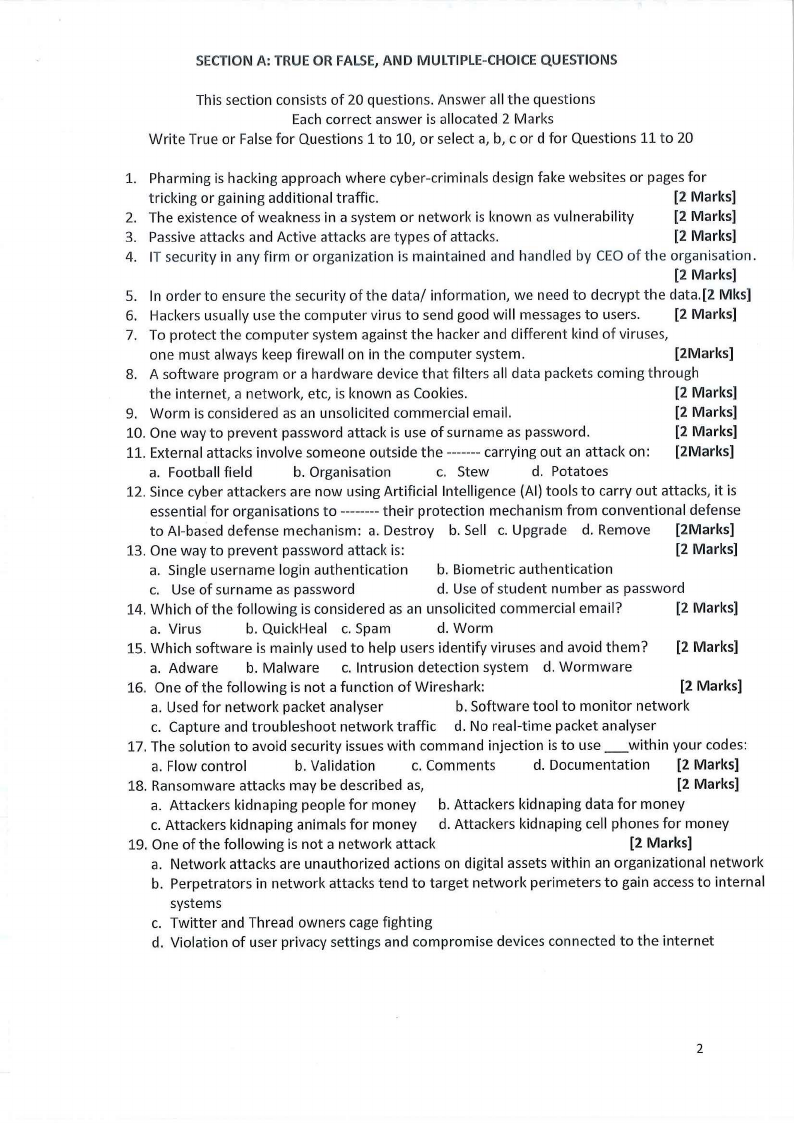
SECTION A: TRU EOR FALSE, AN D MULTIPLE-CHOICE QUESTIONS
This section consists of 20 questions. Answer all the questions
Each correct answer is allocated 2 Marks
Write True or False for Questions 1 to 10, or select a, b, cord for Questions 11 to 20
1. Pharming is hacking approach where cyber-criminals design fake websites or pages for
tricking or gaining additional traffic.
[2 Marks]
2. The existence of weakness in a system or network is known as vulnerability
[2 Marks]
3. Passive attacks and Active attacks are types of attacks.
[2 Marks]
4. IT security in any firm or organization is maintained and handled by CEO of th e organisation.
[2 Marks]
5. In order to ensure the security of the data/ information, we need to decrypt the data.[2 Mks]
6. Hackers usually use the computer virus to send good will messages to users. [2 Marks]
7. To protect the computer system against the hacker and different kind of viruses,
one must always keep firewall on in the computer system.
[2Marks]
8. A software program or a hardware device that filters al l data packets coming through
the internet, a network, etc, is known as Cookies.
[2 Marks]
9. Worm is considered as an unsolicited commercial email.
[2 Marks]
10. One way to prevent password attack is use of surname as password.
[2 Marks]
11. External attacks involve someone outside the------- carrying out an attack on: [2Marks]
a. Football field
b. Organisation
c. Stew
d. Potatoes
12. Since cyber attackers are now using Artificial Intelligence (Al) tools to carry out attacks, it is
essential for organisations to-------- their protection mechanism from conventional defense
to Al-based defense mechanism: a. Destroy b. Sell c. Upgrade d. Remove [2Marks]
13. One way to prevent password attack is:
[2 Marks]
a. Single username login authentication b. Biometric authentication
c. Use of surname as password
d. Use of student number as password
14. Which of the following is considered as an unsolicited commercial email?
[2 Marks]
a. Virus
b. QuickHeal c. Spam
d. Worm
15. Which software is mainly used to help users identify viruses and avoid them? [2 Marks]
a. Adware b. Malware c. Intrusion detection system d. Wormware
16. One of the following is not a function of Wireshark:
[2 Marks]
a. Used for network packet analyser
b. Software tool to monitor network
c. Capture and troubleshoot network traffic d. No real-time packet analyser
17. The solution to avoid security issues with command injection is to use _within your codes:
a. Flow control
b. Validation
c. Comments
d. Documentation [2 Marks]
18. Ransomware attacks may be described as,
[2 Marks]
a. Attackers kidnaping people for money b. Attackers kidnaping data for money
c. Attackers kidnaping animals for money d. Attackers kidnaping cell phones for money
19. One of the following is not a network attack
[2 Marks]
a. Network attacks are unauthorized actions on digital assets within an organizational network
b. Perpetrators in network attacks tend to target network perimeters to gain access to internal
systems
c. Twitter and Thread owners cage fighting
d. Violation of user privacy settings and compromise devices connected to the internet
2
|
|
3 Page 3 |
▲back to top |
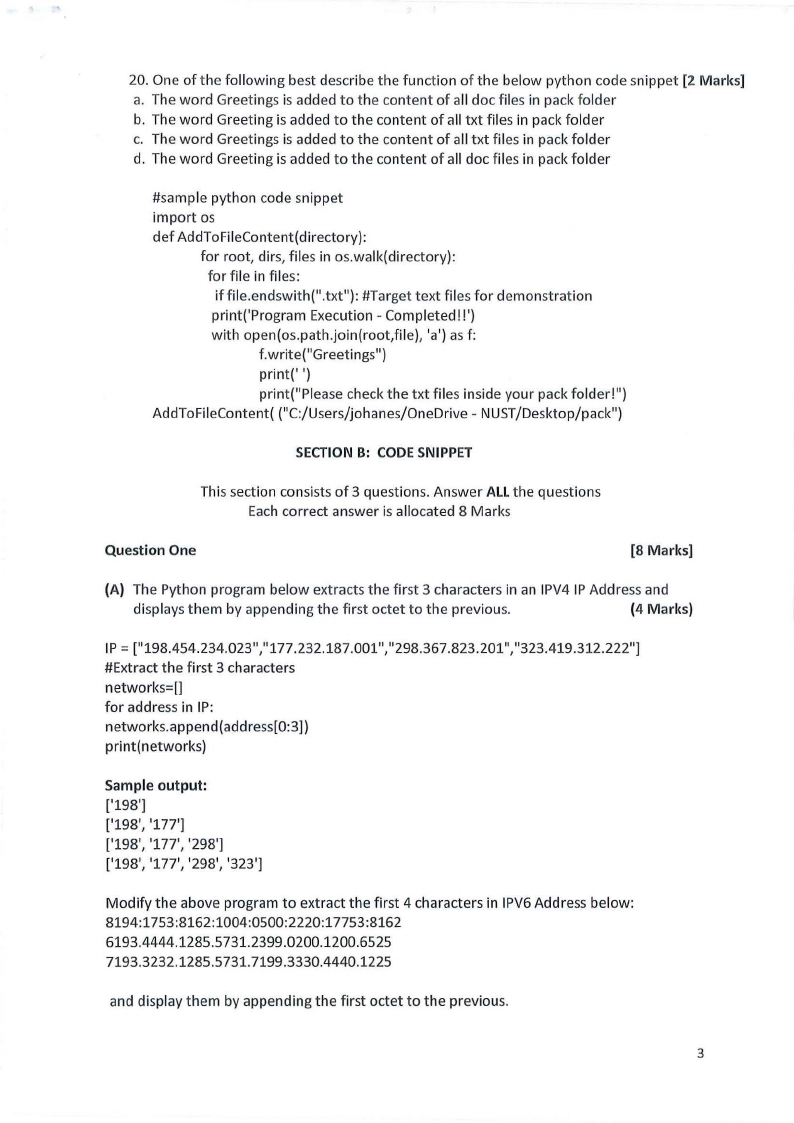
20. One of the following best describe t he function of the below python code snippet [2 Marks]
a. The word Greetings is added to the content of all doc files in pack folder
b. Th e word Greeting is ad ded to the content of all txt fil es in pack folder
c. The word Greetings is added to the content of all txt fil es in pack folder
d. The word Greeting is ad ded to the content of all doc files in pack folder
#sample python code snippet
import os
def AddToFileContent(directory):
for root, dirs, files in os.wa lk(directory):
for file in fi les:
if file.endswith(".txt"): #Target text files for demonstration
print('Program Execution - Completed !!')
with open(os.path.join(root,file), 'a') as f:
f .write("Greetings")
print(' ')
print("Please check the t xt files inside your pack folder!")
AddToFileContent( ("C:/Users/johan es/OneDrive - NUST/Desktop/pack")
SECTION B: CODE SNIPPET
This section consists of 3 question s. Answer ALL the question s
Each correct answer is allocated 8 Marks
Question One
[8 Marks]
(A) The Python program below extracts the first 3 charact ers in an IPV4 IP Address and
displays them by appending the first octet to the previous.
(4 Marks)
IP = ["198.454.234.023","177.232.187.001","298.367.823.201","323.419.312.222"]
#Extract the first 3 characters
networks=[]
for address in IP:
networks.ap pen d(address[0:3]}
print(networks)
Sample output:
['198']
['198', '177']
['198', '177', '298']
['198', '177', '298', '323']
Modify the above program to extract the first 4 characters in IPV6 Address below:
8194:1753 :8162:1004:0500:2220:17753:8162
6193.4444.1285.5731.2399.0200.1200.6525
7193.3232.1285.5731. 7199.3330.4440.1225
and display them by appending the first octet to the previous.
3
|
|
4 Page 4 |
▲back to top |
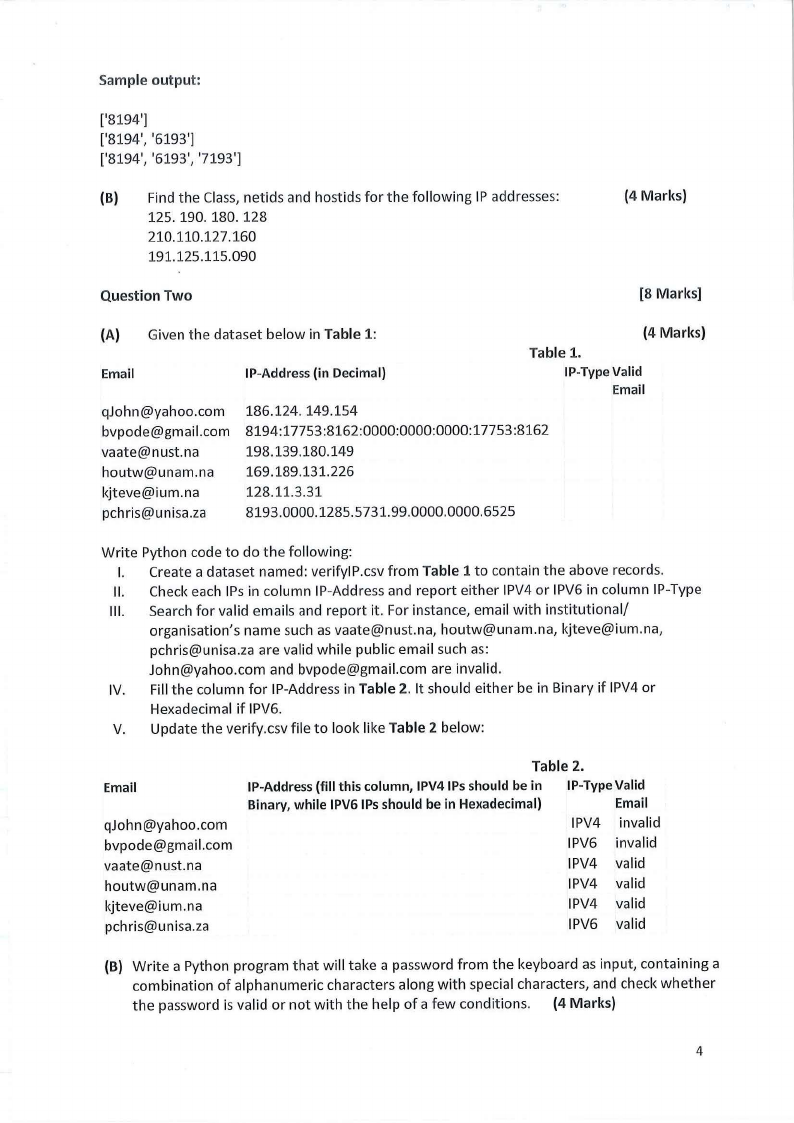
Sample output:
['8194']
['8194', '6193']
['8194', '6193', '7193']
(B) Find the Class, netids and hostids for the following IP addresses:
125. 190. 180. 128
210.110.127.160
191.125.115.090
(4 Marks)
Question Two
(8 Marks]
(A) Given the dataset below in Table 1:
(4 Marks)
Table 1.
Email
IP-Address (in Decimal)
IP-Type Valid
Email
qJohn@yahoo.com 186.124. 149.154
bvpode@gmail.com 8194:17753:8162:0000:0000:0000:17753:8162
vaate@nust.na
198.139.180.149
houtw@unam.na 169.189.131.226
kjteve@ium.na
128.11.3.31
pchris@unisa.za
8193.0000.1285.5731.99.0000.0000.6525
Write Python code to do the following:
I. Create a dataset named: verifylP .csv from Table 1 to contain the above records.
II. Check each IPs in column IP-Address and report either IPV4 or IPV6 in column IP-Type
Ill. Search for valid emails and report it. For instance, email with institutional/
organisation's name such as vaate@nust.na, houtw@unam.na, kjteve@ium.na,
pchris@unisa.za are valid while public email such as:
John@yahoo.com and bvpode@gmail.com are invalid.
IV. Fill the column for IP-Address in Table 2. It should either be in Binary if IPV4 or
Hexadecimal if IPV6.
V. Update the verify.csv file to look like Table 2 below:
Email
qJohn@yahoo.com
bvpode@gmail.com
vaate@nust.na
houtw@unam.na
kjteve@ium.na
pchris@unisa.za
Table 2.
IP-Address (fill this column, IPV4 IPs should be in IP-Type Valid
Binary, while IPV6 IPs should be in Hexadecimal)
Email
IPV4 invalid
IPV6 invalid
IPV4 valid
IPV4 valid
IPV4 valid
IPV6 valid
(B) Write a Python program that will take a password from the keyboard as input, containing a
combination of alphanumeric characters along with special characters, and check whether
the password is valid or not with the help of a few conditions. (4 Marks)
4
|
|
5 Page 5 |
▲back to top |
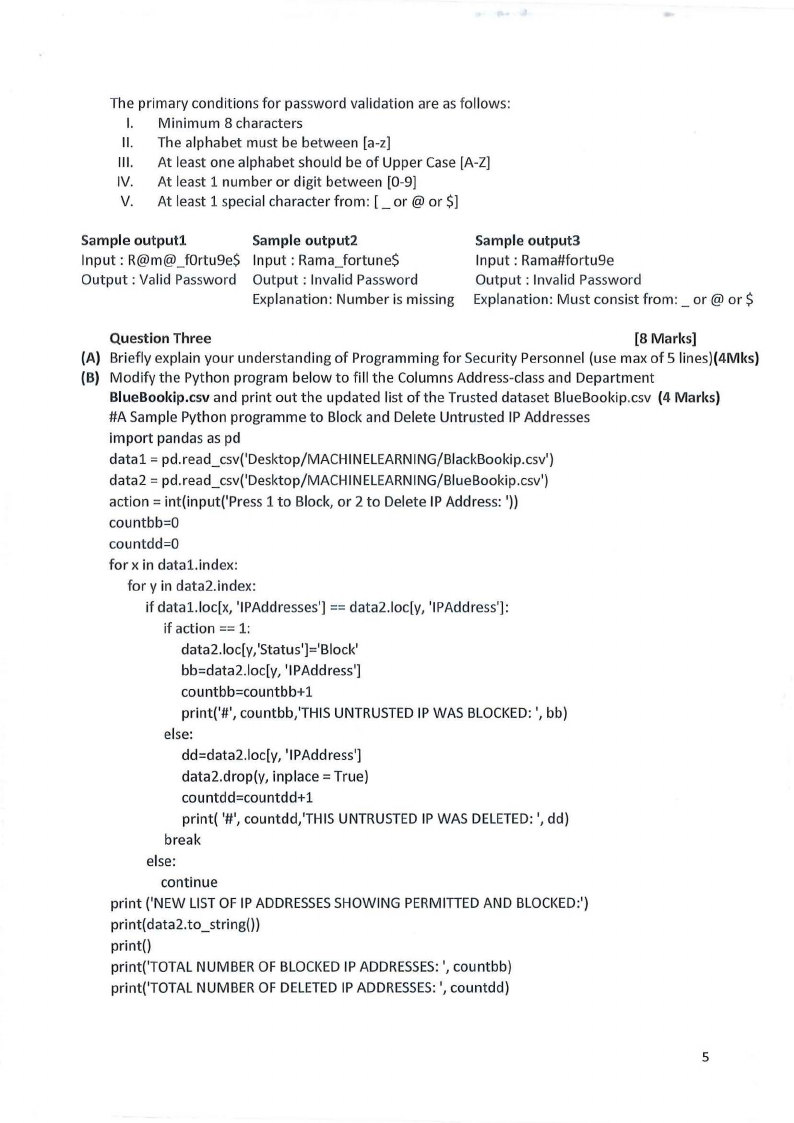
The primary conditions for password validation are as follows:
I. Minimum 8 characters
II. The alphabet must be between [a-z]
Ill. At least one alphabet should be of Upper Case [A-Z]
IV. At least 1 number or digit between [0-9]
V. At least 1 special character from: [ _or@ or$]
Sample outputl
Input : R@m@_f0rtu9e$
Output : Valid Password
Sample output2
Input : Rama_fortune$
Output : Invalid Password
Explanation: Number is missing
Sample output3
Input : Rama#fortu9e
Output : Invalid Password
Explanation: Must consist from: _ or@ or$
Question Three
[8 Marks]
(A) Briefly explain your understanding of Programming for Security Personnel (use max of 5 lines)(4Mks)
(B) Modify the Python program below to fill the Columns Address-class and Department
BlueBookip.csv and print out the updated list of the Trusted dataset BlueBookip.csv (4 Marks)
#A Sample Python programme to Block and Delete Untrusted IP Addresses
import pandas as pd
datal = pd.read_csv{'Desktop/MACHINELEARNING/BlackBookip.csv')
data2 = pd.read_csv('Desktop/MACHINELEARNING/BlueBookip.csv')
action = int(input('Press 1 to Block, or 2 to Delete IP Address: '))
countbb=0
countdd=0
for x in datal.index:
for yin data2.index:
if datal.loc[x, 'IPAddresses'] == data2.loc[y, 'IPAddress']:
if action == 1:
data2.loc[y,'Status']='Block'
bb=data2.loc[y, 'IPAddress']
countbb=countbb+l
print('#', countbb,'THIS UNTRUSTED IP WAS BLOCKED:', bb)
else:
dd=data2.loc[y, 'IPAddress']
data2.drop{y, inplace = True)
countdd=countdd+l
print('#', countdd,'THIS UNTRUSTED IP WAS DELETED:', dd)
break
else:
continue
print ('NEW LIST OF IP ADDRESSES SHOWING PERMITTED AND BLOCKED:')
print(data2.to_string())
print()
print('TOTAL NUMBER OF BLOCKED IP ADDRESSES:', countbb)
print('TOTAL NUMBER OF DELETED IP ADDRESSES:', countdd)
5
|
|
6 Page 6 |
▲back to top |
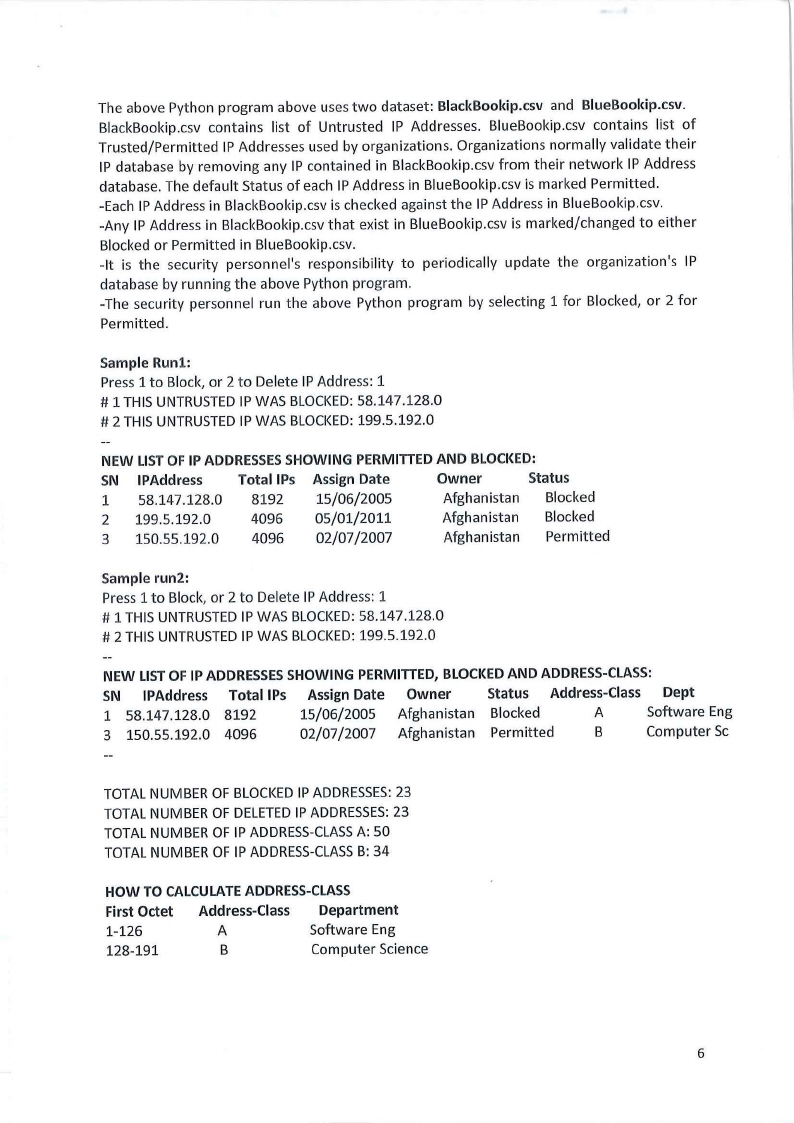
The above Python program above uses two dataset: BlackBookip.csv and BlueBookip.csv.
BlackBookip.csv contains list of Untrusted IP Addresses. BlueBookip.csv contains list of
Trusted/Permitted IP Addresses used by organizations. Organizations normally validate their
IP database by removing any IP conta ined in BlackBookip.csv from their network IP Address
database. The default Status of each IP Address in BlueBookip.csv is marked Permitted.
-Each IP Address in BlackBookip.csv is checked against the IP Address in BlueBookip.csv.
-Any IP Address in BlackBookip.csv that exist in BlueBookip.csv is marked/changed to either
Blocked or Permitted in BlueBookip.csv.
- It is the security personnel's responsibility to periodically update the organization 's IP
database by running the above Python program.
-The security personnel run the above Python program by selecting 1 for Blocked, or 2 for
Permitted.
Sample Run1:
Press 1 to Block, or 2 to Delete IP Address: 1
# 1 THIS UNTRUSTED IP WAS BLOCKED: 58.147.128.0
# 2 THIS UNTRUSTED IP WAS BLOCKED: 199.5.192.0
NEW LIST OF IP ADDRESSES SHOWING PERMITTED AND BLOCKED:
SN IPAddress
Total IPs Assign Date
1 58.147.128.0 8192 15/06/2005
Owner
Status
Afghanistan Blocked
2 199.5.192.0
4096 05/01/2011
Afghanistan Blocked
3 150.55.192.0 4096 02/07/2007
Afghanistan Permitted
Sample run2:
Press 1 to Block, or 2 to Delete IP Address: 1
# 1 THIS UNTRUSTED IP WAS BLOCKED: 58.147.128.0
# 2 THIS UNTRUSTED IP WAS BLOCKED: 199.5.192.0
NEW LIST OF IP ADDRESSES SHOWING PERMITTED, BLOCKED AND ADDRESS-CLASS:
SN IPAddress Total IPs Assign Date Owner
Status Address-Class Dept
1 58.147.128.0 8192
15/06/2005 Afghanistan Blocked
A
Software Eng
3 150.55.192.0 4096
02/07/2007 Afghanistan Permitted
B
Computer Sc
TOTAL NUMBER OF BLOCKED IP ADDRESSES: 23
TOTAL NUMBER OF DELETED IP ADDRESSES: 23
TOTAL NUMBER OF IP ADDRESS-CLASS A: 50
TOTAL NUMBER OF IP ADDRESS-CLASS B: 34
HOW TO CALCULATE ADDRESS-CLASS
First Octet Address-Class Department
1-126
A
Software Eng
128-191
B
Computer Science
6
|
|
7 Page 7 |
▲back to top |
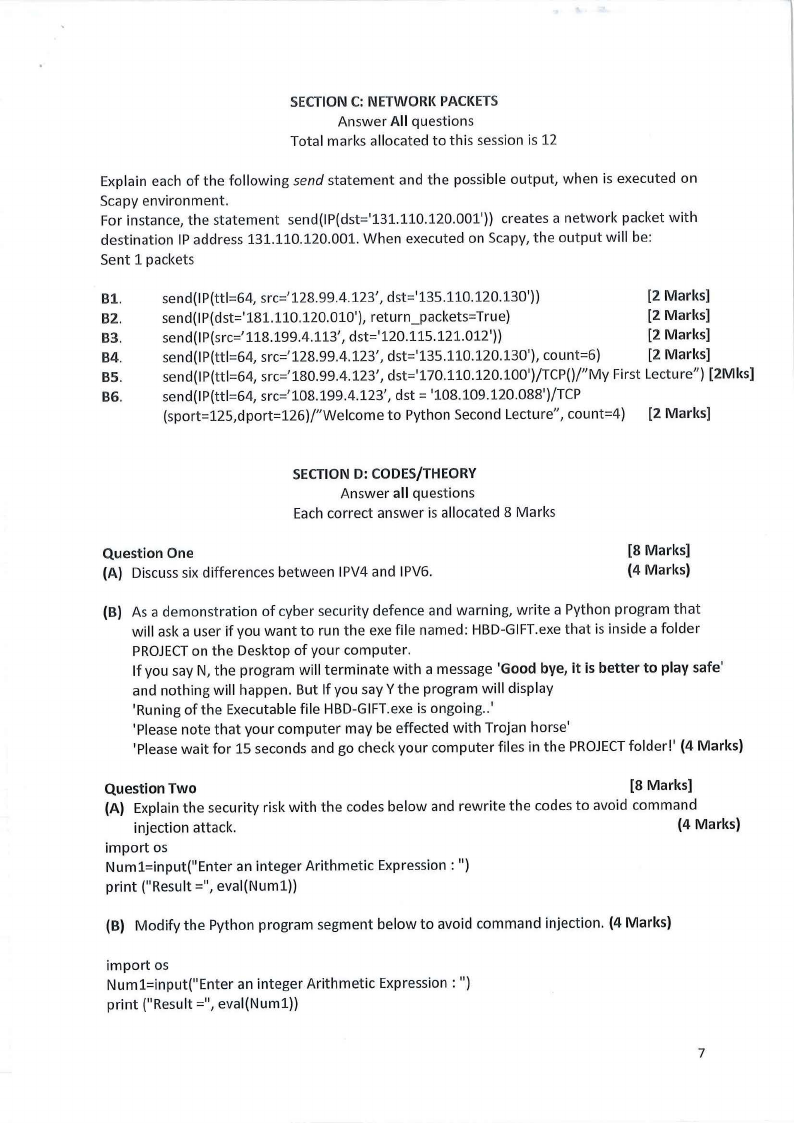
SECTION C: NETWORK PACKETS
Answer All questions
Total marks allocated to this session is 12
Explain each of the following send statement and the possible output, when is executed on
Scapy environment.
For instance, the statement send(IP(dst='131.110.120.001')) creates a network packet with
destination IP address 131.110.120.001. When executed on Scapy, the output will be:
Sent 1 packets
Bl.
send(IP(ttl=64, src='128.99.4.123', dst='135.110.120.130'))
[2 Marks]
B2.
send(IP(dst='181.110.120.010'), return_packets=True)
[2 Marks]
B3.
send(IP(src='118.199.4.113', dst='120.115.121.012'))
[2 Marks]
B4.
send(IP(ttl=64, src='128.99.4.123', dst='135.110.120.130'), count=6)
[2 Marks]
BS.
send(IP(ttl=64, src='180.99.4.123' , dst='170.110.120.100')/TCP()/"My First Lecture") [2Mks]
BG.
send(IP(ttl=64, src='108.199.4.123', dst = '108.109.120.088')/TCP
(sport=125,dport=126)/"Welcome to Python Second Lecture", count=4) [2 Marks]
SECTION D: CODES/THEORY
Answer all questions
Each correct answer is allocated 8 Marks
Question One
(A) Discuss six differences between IPV4 and IPV6.
[8 Marks]
(4 Marks)
(B) As a demonstration of cyber security defence and warning, write a Python program that
will ask a user if you want to run the exe file named: HBD-GIFT.exe that is inside a folder
PROJECT on the Desktop of your computer.
If you say N, the program will terminate with a message 'Good bye, it is better to play safe'
and nothing will happen. But If you say Y the program will display
'Runing of the Executable file HBD-GIFT.exe is ongoing..'
'Please note that your computer may be effected with Trojan horse'
'Please wait for 15 seconds and go check your computer files in the PROJECT folder!' (4 Marks)
Question Two
[8 Marks]
(A) Explain the security risk with the codes below and rewrite the codes to avoid command
injection attack.
(4 Marks)
import os
Numl=input("Enter an integer Arithmetic Expression : ")
print ("Result=", eval(Numl))
(B) Modify the Python program segment below to avoid command injection. (4 Marks)
import os
Numl=input("Enter an integer Arithmetic Expression : ")
print ("Result=", eval(Numl))
7
|
|
8 Page 8 |
▲back to top |
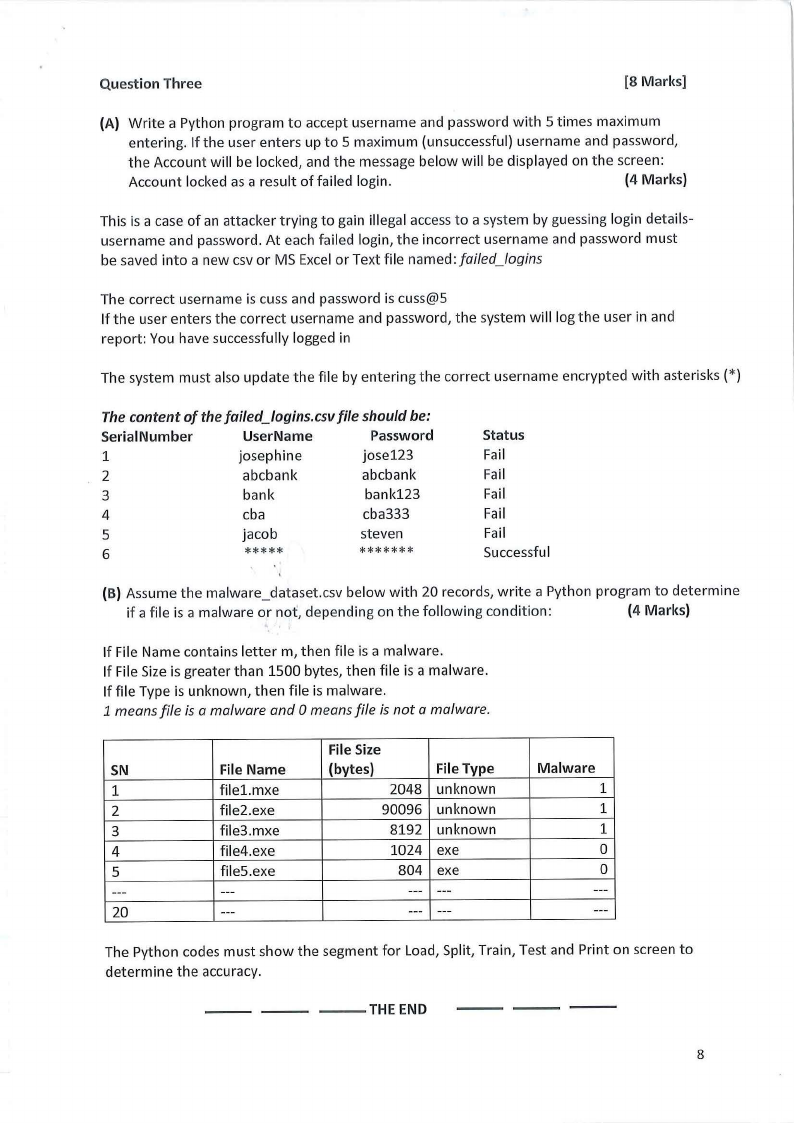
Question Three
[8 Marks]
(A) Write a Python program to accept username and password with 5 times maximum
entering. If the user enters up to 5 maximum (unsuccessful) username and password,
the Account will be locked, and the message below will be displayed on the screen:
Account locked as a result of failed login.
(4 Marks)
This is a case of an attacker trying to gain illegal access to a system by guessing login details-
username and password. At each failed login, the incorrect username and password must
be saved into a new csv or MS Excel or Text file named: failed_logins
The correct username is cuss and password is cuss@S
If the user enters the correct username and password, the system will log the user in and
report: You have successfully logged in
The system must also update the file by entering the correct username encrypted with asterisks(*)
The content of the failed_ logins.csv file should be:
Serial Number
UserName
Password
1
josephine
jose123
2
abcbank
abcbank
3
bank
bank123
4
cba
cba333
5
jacob
steven
6
*****
*******
Status
Fail
Fail
Fail
Fail
Fail
Successful
(B) Assume the malware_dataset.csv below with 20 records, write a Python program to determine
if a file is a malware or not, depending on the following condition:
(4 Marks)
If File Name contains letter m, then file is a malware.
If File Size is greater than 1500 bytes, then file is a malware.
If file Type is unknown, then file is malware.
1 means file is a ma/ware and Omeans file is not a ma/ware.
File Size
SN
File Name
(bytes)
File Type
Malware
1
filel.mxe
2048 unknown
1
2
file2.exe
90096 unknown
1
3
file3.mxe
8192 unknown
1
4
file4.exe
1024 exe
0
5
fileS.exe
804 exe
0
---
---
--- ---
---
20
---
--- ---
---
The Python codes must show the segment for Load, Split, Train, Test and Print on screen to
determine the accuracy.
- - THE END
8