


 |
RTP610S - REFLECTIVE TEACHING AND PRACTICE - 1ST OPP - JUNE 2025 |
|
|
1 Page 1 |
▲back to top |
nAmlBIA unlVERSITY
OF SCIEnCE Ano TECHn OLOGY
FACULTYOF COMMERCE, HUMAN SCIENCEAND EDUCATION
DEPARTMENT OF TECHNICAL AND VOCATIONAL EDUCATION AND TRAINING
QUALIFICATION: DIPLOMA IN TECHNICAL AND VOCATIONAL EDUCATION AND TRAINING:
TRAINER
QUALIFICATION CODE: 0GDTVT
COURSE CODE: RTP610S
SESSION: JUNE 2025
LEVEL: 6
COURSE NAME: REFLECTIVETEACHING AND
PRACTICE
PAPER: 1
DURATION: 3 HOURS
MARKS: 100
FIRST OPPORTUNITY EXAMINATION QUESTION PAPER
EXAMINER(S) DR OKSANA KACHEPA
MODERATOR: DR MICHAEL TJIVIKUA
INSTRUCTIONS
1. Answer ALLthe questions.
2. Read all the questions carefully before answering.
3. Number the answers clearly
THIS QUESTION PAPER CONSISTS OF _6_ PAGES (Including this front page)
|
|
2 Page 2 |
▲back to top |
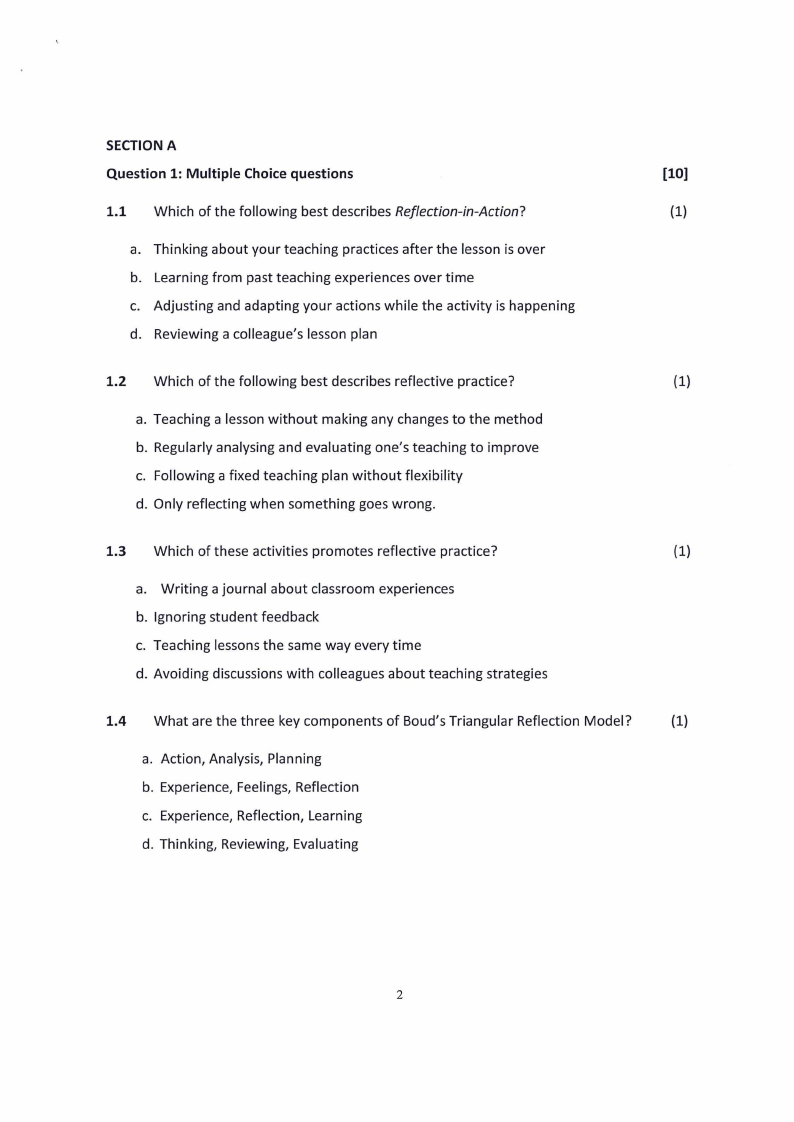
SECTION A
Question 1: Multiple Choice questions
1.1 Which of the following best describes Reflection-in-Action?
a. Thinking about your teaching practices after the lesson is over
b. Learning from past teaching experiences over time
c. Adjusting and adapting your actions while the activity is happening
d. Reviewing a colleague's lesson plan
[10]
(1)
1.2 Which of the following best describes reflective practice?
(1)
a. Teaching a lesson without making any changes to the method
b. Regularly analysing and evaluating one's teaching to improve
c. Following a fixed teaching plan without flexibility
d. Only reflecting when something goes wrong.
1.3 Which of these activities promotes reflective practice?
(1)
a. Writing a journal about classroom experiences
b. Ignoring student feedback
c. Teaching lessons the same way every time
d. Avoiding discussions with colleagues about teaching strategies
1.4 What are the three key components of Boud's Triangular Reflection Model?
(1)
a. Action, Analysis, Planning
b. Experience, Feelings, Reflection
c. Experience, Reflection, Learning
d. Thinking, Reviewing, Evaluating
2
|
|
3 Page 3 |
▲back to top |
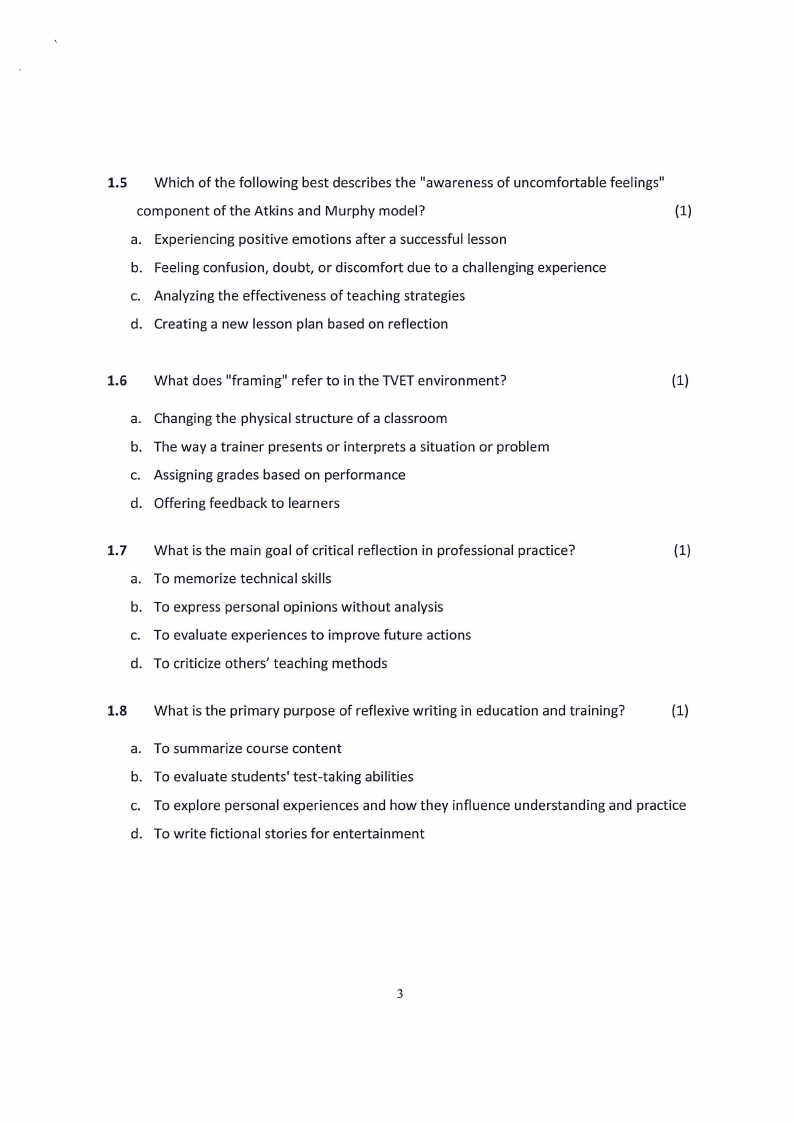
1.5 Which of the following best describes the "awareness of uncomfortable feelings"
component of the Atkins and Murphy model?
(1)
a. Experiencing positive emotions after a successful lesson
b. Feeling confusion, doubt, or discomfort due to a challenging experience
c. Analyzing the effectiveness of teaching strategies
d. Creating a new lesson plan based on reflection
1.6 What does "framing" refer to in the TVET environment?
(1)
a. Changing the physical structure of a classroom
b. The way a trainer presents or interprets a situation or problem
C. Assigning grades based on performance
d. Offering feedback to learners
1.7 What is the main goal of critical reflection in professional practice?
(1)
a. To memorize technical skills
b. To express personal opinions without analysis
C. To evaluate experiences to improve future actions
d. To criticize others' teaching methods
1.8 What is the primary purpose of reflexive writing in education and training?
(1)
a. To summarize course content
b. To evaluate students' test-taking abilities
c. To explore personal experiences and how they influence understanding and practice
d. To write fictional stories for entertainment
3
|
|
4 Page 4 |
▲back to top |
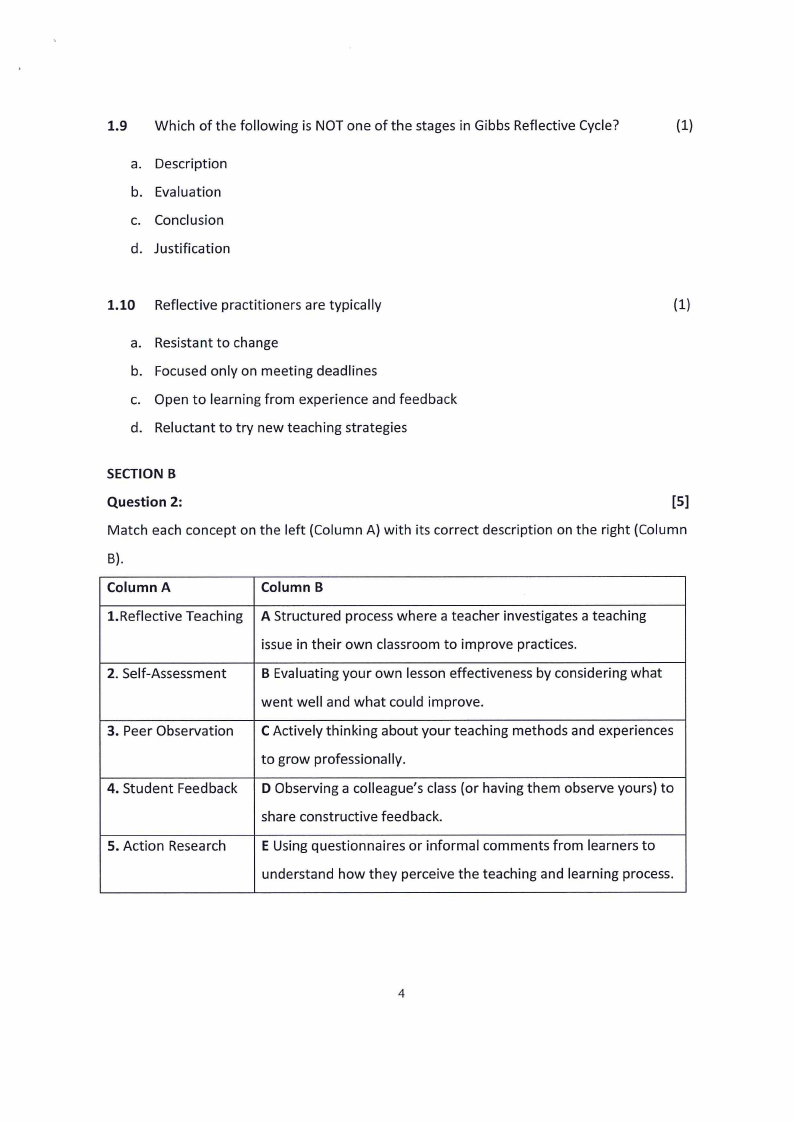
1.9 Which of the following is NOT one of the stages in Gibbs Reflective Cycle?
(1)
a. Description
b. Evaluation
c. Conclusion
d. Justification
1.10 Reflective practitioners are typically
(1)
a. Resistant to change
b. Focused only on meeting deadlines
c. Open to learning from experience and feedback
d. Reluctant to try new teaching strategies
SECTION B
Question 2:
[5]
Match each concept on the left (Column A) with its correct description on the right (Column
B).
Column A
Column B
1.Reflective Teaching A Structured process where a teacher investigates a teaching
issue in their own classroom to improve practices.
2. Self-Assessment
B Evaluating your own lesson effectiveness by considering what
went well and what could improve.
3. Peer Observation C Actively thinking about your teaching methods and experiences
to grow professionally.
4.StudentFeedback
D Observing a colleague's class (or having them observe yours) to
share constructive feedback.
5. Action Research
E Using questionnaires or informal comments from learners to
understand how they perceive the teaching and learning process.
4
|
|
5 Page 5 |
▲back to top |
Question 3
[5]
Identify the True and False statements. Include the reason for the statement being true or
false.
3.1 Reflection-on-Action occurs during a lesson, allowing the trainer to make real-time
adjustments.
(1)
3.2 Reflective practice helps trainers identify areas for improvement in their teaching
methods.
(1)
3.3 Reflection in Boud's model includes processing both positive and negative emotions. (1)
3.4 Reframing in the TVET environment helps trainers view challenges from different
perspectives, leading to creative solutions and improved student outcomes.
(1)
3.5 Critical reflection involves simply describing what happened during an experience. (1)
SECTION C
Question 4
[15]
4.1 Define Reflection-in-Action and Reflection-on-Action and explain the difference
between the two.
(5)
4.2 Provide one example of each type of reflection in a TVET classroom setting.
(4)
4.3 Discuss how applying both types of reflection can improve a trainer's professional
practice. Provide a detailed discussion of any three (3) relevant points.
(6)
Question 5
[15]
5.1 Provide a definition of reflective practice and explain its importance in the context of
TVETtraining. Support your answer with three (3) relevant points.
(5)
5.2 Describe three (3) key characteristics of an effective reflective practitioner.
(6)
5.3 Explain how reflective practice contributes to improved student learning outcomes.
Provide a detailed discussion of any two (2) relevant points.
(4)
5
|
|
6 Page 6 |
▲back to top |
Question 6
[14]
6.1 State and describe the components of Baud's Triangular Reflection Model.
Include one (1) reflective question for each component.
(9)
6.2 Explain how a TVET trainer can use this model to improve their professional practice.
Provide an explanation of any three (3) relevant points.
(6)
Question 7
[18]
7.1 Define Framing and Reframing in the context of the TVET environment.
(4)
7.2 Explain why Framing and Reframing matter in Reflective Practice. Provide an explanation
of any four (4) relevant points.
(8)
7.3 Provide an example of solving a problem encountered during your teaching practice by
applying Framing and Reframing.
(6)
Question 8
[18]
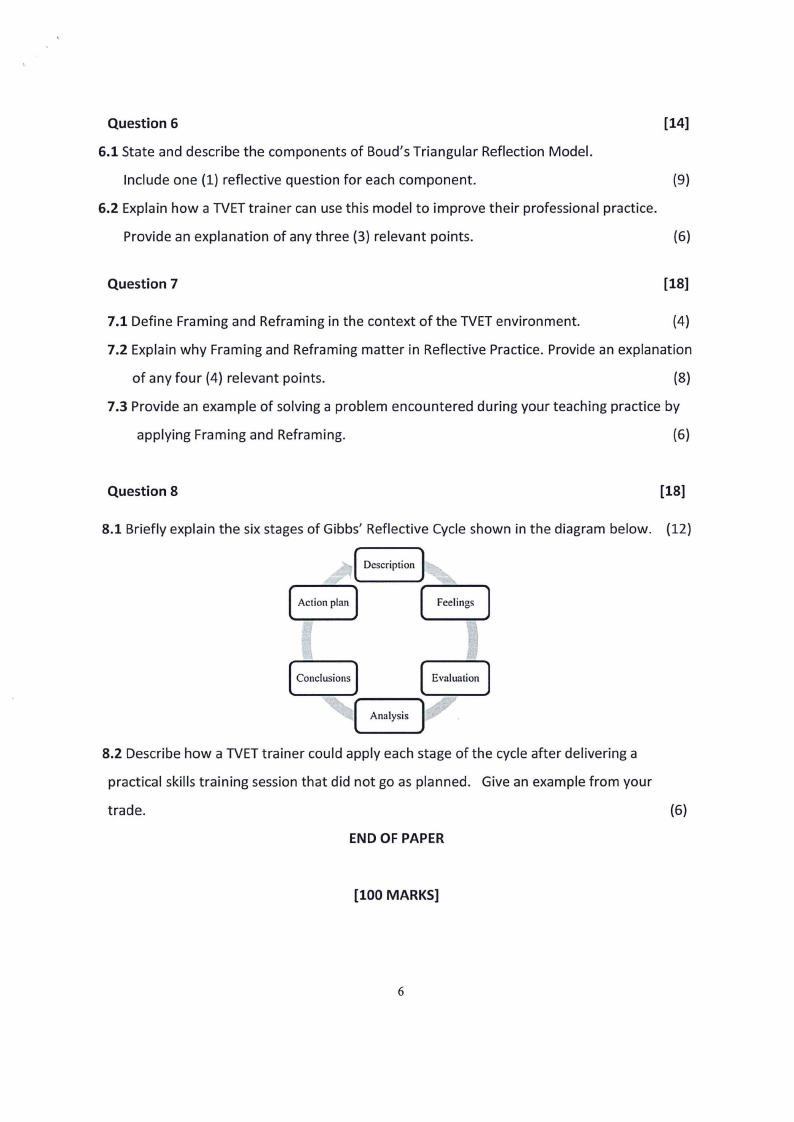
8.1 Briefly explain the six stages of Gibbs' Reflective Cycle shown in the diagram below. (12)
Description
Conclusions
Evaluation
8.2 Describe how a TVET trainer could apply each stage of the cycle after delivering a
practical skills training session that did not go as planned. Give an example from your
trade.
(6)
END OF PAPER
[100 MARKS]
6